
How to Find Mentors in a New Industry Quickly

Discover how to find mentors in a new industry quickly with targeted strategies and key connections that lead to success.
Get a relevant mentor within weeks by clarifying one specific goal, activating your five strongest bridge contacts, and booking free sessions on fast-match platforms before you ever cold-email a stranger. That sequence, done in order, beats scattershot networking every time.
Here's the checklist to run this week:
- Write one sentence describing exactly what you need (not "a mentor" but "someone who's hired for this role in the last year").
- List your five strongest bridge contacts: former managers, colleagues, alumni.
- Book one free session on ADPList, which lets you browse vetted mentors and lock in a session in under two minutes.
- Turn your best informational interview into a recurring, short mentoring check-in.
Most people who follow this system land their first real mentor within 1 to 3 months. That's not a guarantee, but it's a realistic bar. It's fast enough to matter and slow enough to be honest.
Key Takeaways
Career changers who clarify one specific goal, activate strong bridge contacts first, and use fast-match platforms typically secure a working mentor relationship within one to three months.
| Point | Details |
|---|---|
| Define one clear ask | Convert vague mentorship desires into a goal, outcome, and time commitment before reaching out. |
| Work bridges before strangers | Contact former managers, colleagues, and alumni first; they convert faster than cold outreach. |
| Use ADPList for speed | Book a free session in under two minutes to test mentor fit quickly and cheaply. |
| Keep asks time-boxed | Request one focused conversation instead of an open-ended mentorship to raise your acceptance rate. |
| Start with a clarity tool | Nuecareer's 7-Minute Career Quiz helps you define your target role before you contact any mentor. |
Where to start looking right now
- ADPList: free, fast matching with thousands of volunteer mentors.
- SCORE and alumni programs: slower intake, more reliable structured matching.
- Professional associations in your target field: often free with membership.
Table of Contents
- How Do You Find Mentors in a New Industry Quickly?
- Who Should You Contact First to Build Mentors Fast?
- What Platforms Help You Connect With Mentors Fast?
- What Should You Say When Reaching Out to a Mentor?
- How Do You Keep a Mentor Engaged After the First Call?
- What's a Realistic Timeline for Finding a Mentor?
- What Mistakes Slow Down Your Mentor Search?
- Find Your Direction Before You Find Your Mentor
- Sources
- FAQ
How Do You Find Mentors in a New Industry Quickly?
Speed comes from clarity, not charisma. The mentees who get fast "yes" replies aren't the most impressive on paper. They're the ones who make it painfully easy for a busy stranger to say yes in ten seconds.
Before you reach out to anyone, convert your vague desire for "guidance" into a request specific enough that a mentor can picture saying yes. Use this template:
- Goal: What outcome are you chasing (a job offer, a portfolio that lands interviews, clarity on which sub-field fits you)?
- Outcome: What does success look like in 30, 60, or 90 days?
- Success signal: How will you know the conversation worked?
- Time commitment: One 20-minute call? Three calls over six weeks?
Also decide the scope. Do you need transition advice (how did you break in), interview prep (what do hiring panels actually ask), portfolio feedback (is this good enough), or industry navigation (which companies, which titles, which certifications matter)? Trying to get all four from one person in one call is how you get generic advice and no second meeting.
Pro Tip: Pick one issue-based, time-boxed objective, like reviewing a single hiring rubric or mapping a three-call transition plan, instead of asking someone to "be your mentor" in general. Specific requests get accepted far more often than open-ended ones.
Who Should You Contact First to Build Mentors Fast?
Not every contact is equal, and treating them that way is the single biggest reason career changers waste weeks. Sort your network into three tiers before you send a single message.

Strong bridges know your work directly and have real access to your target industry: former managers, close colleagues, people who recently made the exact pivot you're attempting. Medium bridges know you but not your target field, or know the field but not you well, think alumni or old vendors. Weak bridges are LinkedIn connections you've never actually spoken with. Strong bridges convert fastest because they can vouch for you specifically, not just generically.
Work the list in this order:
- Former managers and close colleagues who've seen your work firsthand.
- Alumni from your school or past employer now working in your target field.
- Vendors, clients, or partners you worked alongside in your old role.
- Peers who made a similar industry switch in the last one to three years.
For each strong bridge, run a quick activation: reintroduce yourself, share your pivot story in two sentences, then ask for one or two specific introductions or a 20-minute call. Extension research on mentor searches consistently finds that warm contacts inside your existing network produce better response rates than outreach to strangers, because context does most of the persuading for you.
What Platforms Help You Connect With Mentors Fast?
The right platform depends on how much time and money you have, but a handful of options consistently beat generic networking for speed.
ADPList is the fastest free option. It lists thousands of volunteer mentors across fields, and you can read a profile and book a session in under two minutes. Because sessions are free and short, you can test fit with three or four mentors in the time it takes to schedule one traditional coffee chat.
Structured programs trade speed for reliability. SCORE, alumni mentoring programs, and professional association mentorships handle matching for you, which tends to produce more consistent quality and, often, better equity of access than informal cold outreach. The tradeoff is a slower intake process, sometimes weeks instead of days.
Paid coaching is worth considering only when you need guaranteed, ongoing access rather than occasional advice, as explained in the differences between career coaching and mentoring. It's a different tool than mentorship, closer to structured career coaching than a volunteer relationship.
Pro Tip: Book two ADPList sessions with different mentors in your first week. Comparing their advice quickly reveals which one actually understands your target field versus which one is just being nice.
- Fast and free: ADPList (best for testing fit quickly).
- Reliable but slower: SCORE, alumni networks, professional associations.
- Paid and ongoing: coaching platforms, best once you know exactly what you need.
What Should You Say When Reaching Out to a Mentor?
The ask matters more than the platform. Career-services guidance frames the informational interview as a fact-finding conversation, not a job request, and that framing is what gets replies.
Try these openers:
- Bridge contact: "I'm making the switch to [industry] and would love 20 minutes to hear how you navigated it. Any chance you're free next week?"
- Warm introduction: "[Name] suggested I reach out. I'm exploring [specific goal] and would value your take. Could we grab 20 minutes?"
- Cold outreach: "I saw your work on [specific project]. I'm pivoting into [field] and have one focused question about [topic]. Open to a quick call?"
Structure the call itself tightly: open by thanking them and restating your one goal, ask five targeted questions (how they broke in, what surprised them, what skills mattered most, who else they'd suggest talking to, what they'd do differently), then close by asking if a short follow-up in a few weeks would be reasonable.
Follow up three to four weeks later with a short note on what you did with their advice. That update, more than any reminder, is what keeps someone willing to help again.
How Do You Keep a Mentor Engaged After the First Call?
Mentors say yes to a second meeting for the same reason they said yes to the first: you make it easy and worth their time.
Set expectations early. Propose a time-boxed cadence (three calls over six weeks, not "let's stay in touch") with a light agenda for each one. Do your homework before every conversation: research what the mentor has published or worked on recently, and bring one specific update or question rather than a blank "so, any advice?"
Create mutual value where you can. Offer a relevant article, a warm introduction of your own, or simply visible proof you acted on their last suggestion. A workable rhythm looks like this:
- Before: Send a two-line agenda and one specific question.
- During: Take notes, ask for one referral or resource at the end.
- After: Send a thank-you within 48 hours summarizing what you'll do next.
- Never show up without an agenda.
- Never let more than four weeks pass without an update.
- Always end a call by asking, "Who else should I talk to?"
What's a Realistic Timeline for Finding a Mentor?
Expect roughly one to three months from first outreach to a working mentoring relationship, if you run a consistent system rather than sporadic messages.
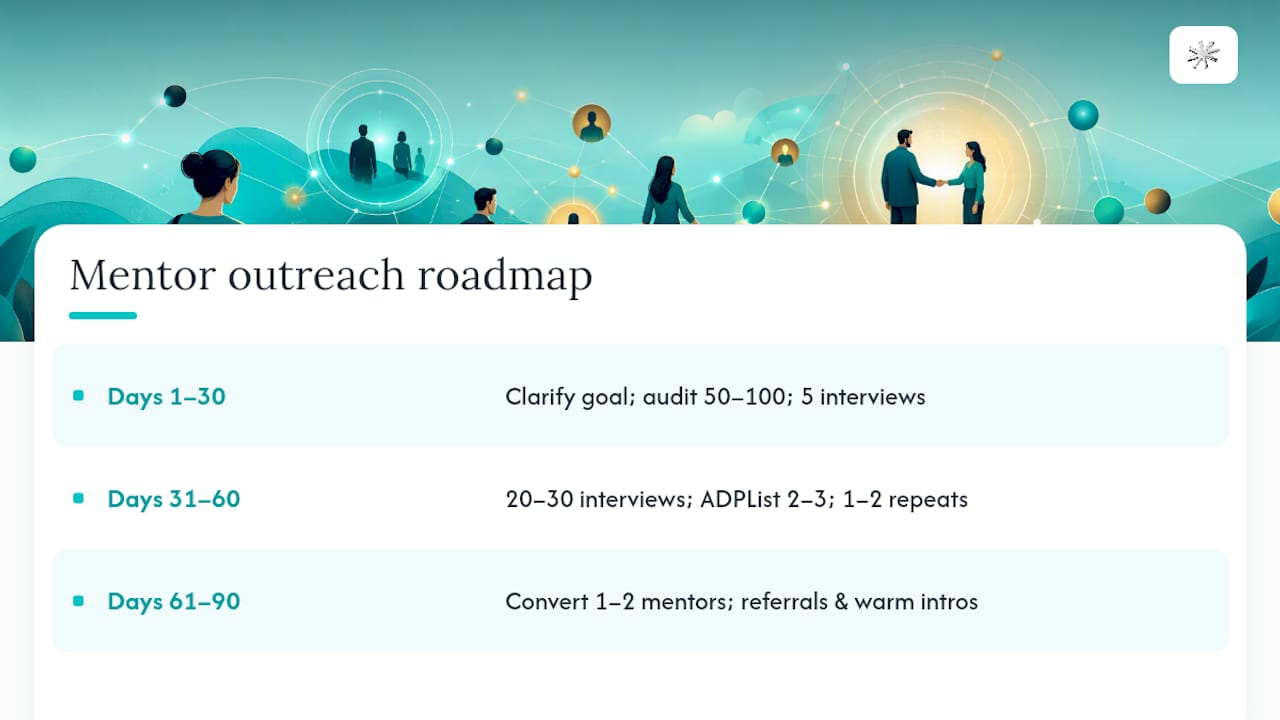
Days 1 to 30: Clarify your one goal, audit 50 to 100 contacts across LinkedIn and your existing network, reactivate your five strongest bridges, and schedule five informational interviews.
Days 31 to 60: Expand to 20 to 30 total interviews, book two or three sessions on ADPList, and aim to secure one or two repeat conversations with people who gave especially useful advice.
Days 61 to 90: Convert your best one or two contacts into a short mentoring cycle, collect referrals from everyone you've spoken with, and start applying to roles where you have a warm introduction rather than a cold application.
This pacing tracks with broader networking research showing that roughly 85% of jobs come through networking. A mentor who introduces you to two hiring managers is worth more than a stack of cold applications, and that's exactly what a working 90-day network produces. For a fuller roadmap that pairs with this timeline, see this career change roadmap.
What Mistakes Slow Down Your Mentor Search?
The fastest way to stall your search is asking someone to "be your mentor" in the first message. It's vague, it's a big ask from a stranger, and it invites a polite no. Other common mistakes: skipping research before a call, going silent after getting advice, and treating every contact as equally valuable.
Watch for red flags in return: mentors who repeatedly no-show, who give the same generic advice regardless of your question, or who always ask for something before offering help. If a match isn't working, say so directly, thank them, and ask if they can point you toward someone better suited. That's a graceful exit, not a failure.
Why short, issue-based mentorship beats open-ended arrangements
Busy professionals say yes to a specific, time-boxed ask far more often than an open-ended one, because it's a request they can actually estimate and fulfill. Framing your ask around one problem, one hiring rubric, one portfolio review, rather than an indefinite relationship, respects a mentor's time and tends to produce faster, more concrete feedback than vague ongoing check-ins ever do.
Find Your Direction Before You Find Your Mentor
Outreach only works when you know what you're asking for, and that's the piece most career changers skip. Nuecareer's 7-Minute Career Quiz identifies your strengths and matches you to career paths, including ones you haven't considered, so you walk into every mentor conversation with a specific goal instead of a vague "I'm exploring options."
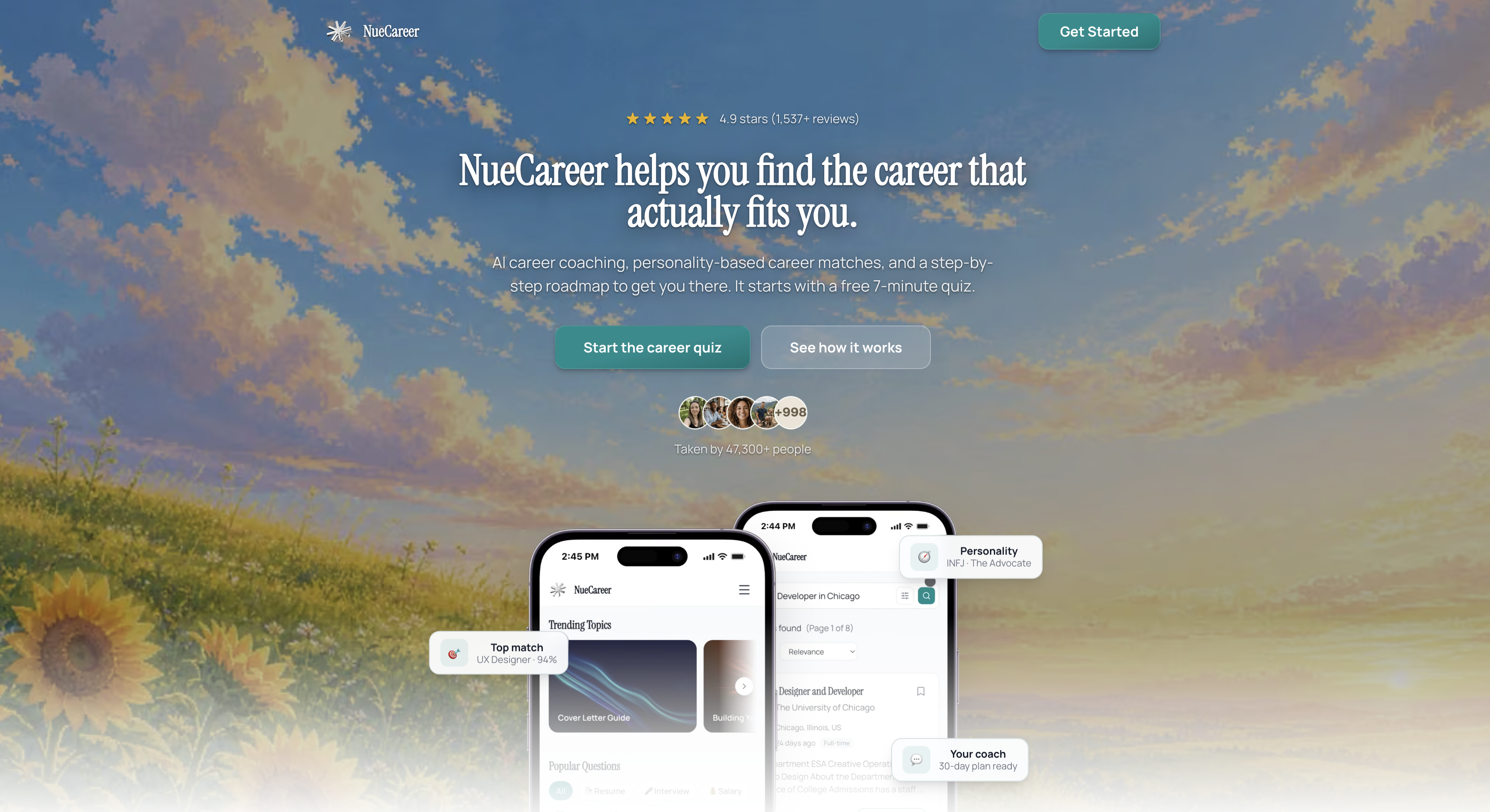
From there, Nuecareer builds a personalized roadmap for your target roles, with 24/7 coaching chat for the questions that come up between mentor calls and a job board tailored to where you're headed. Pair that clarity with the bridge-first outreach strategy above, and your mentor conversations stop sounding generic. Take the quiz today and walk into your next informational interview with a specific goal already in hand.
Sources
- ADPList — Find a mentor
- Important networking statistics everyone should know (Career Design Studio, UB)
- How to find a mentor: 8 tips (UW–Madison Division of Extension)
- Informational interview guide (Texas State University Career Services)
FAQ
How do I find an industry mentor quickly?
Clarify one specific goal, contact your five strongest bridge connections first, and book a free session on ADPList to test mentor fit within days rather than weeks.
What is the "law of 33%" in mentorship?
Can I use ChatGPT as a mentor?
AI tools can help you draft outreach messages, prepare interview questions, or clarify your goals before a conversation, but they can't replace a real person's firsthand industry experience or make warm introductions on your behalf.
How long does it typically take to find a mentor?
Most people who run a consistent outreach system land a working mentor relationship within one to three months, starting with bridge contacts and expanding to platforms and interviews.
Should I ask a stranger to "be my mentor" right away?
No. Requesting a specific, time-boxed conversation about a problem the person has already solved gets accepted far more often than an open-ended ask for ongoing mentorship.