

Yes, you can move into product management from another career, and you do not need a prior PM title to do it. What gets you hired is proof that you already think and work like a product manager: you understand customers, make trade-offs, and ship things with other people. This guide shows which routes into the role are most common, how to build that proof while you still hold your current job, and how to turn it into a plan you can follow.
TL;DR
- There is no single required degree or path. More than half of product managers come from non-product backgrounds, so your current field is an asset, not a disqualifier.
- The most common route is an internal transfer, followed by a move to a new company in an adjacent role or an associate-level PM job.
- Do product work before you have the title: write a PRD, run customer interviews, support a launch, or own a small feature decision.
- Start with a clear picture of your strengths and target role, then build a roadmap, a portfolio and application materials around it.
Table of Contents
- Is a career change into product management realistic?
- What product managers actually do (and whether you will like it)
- The main routes into product management
- Which backgrounds transfer best
- Build product experience before you have the title
- Credentials: what you need and what you can skip
- A step-by-step plan for a U.S. job seeker
- Common mistakes career changers make
- Our perspective
- Make your plan with NueCareer
- FAQ
- Sources
Is a career change into product management realistic?
It is, and the data on who holds the job explains why. Harvard's Division of Continuing Education notes that there is no one specific path or specialized degree required, and that more than 50% of product managers have a background in non-product roles. A Product School survey of 5,000 product professionals reached the same figure.
Some employers say it outright. Shopify's Associate Product Manager program states in its FAQ that no previous product experience is required and that it welcomes career switchers from engineering, research, design and other disciplines, with no specific academic background required.
Realism also means knowing the other side. Product management is usually not an entry-level job. Capella's guide to the path says people commonly enter from adjacent roles after they have shown product thinking. So the question is not "Am I allowed in?" but "What evidence can I show that I already do pieces of this work?"
That is good news if you feel stuck. It means the first move is rarely a leap. It is a series of smaller steps that you can start this month, from where you are.

What product managers actually do (and whether you will like it)
Before you commit months to a switch, make sure the daily work fits you. Product managers decide what gets built and why. In practice that means talking with customers, defining the problem, weighing business value against effort, writing down requirements, and keeping engineers, designers and stakeholders pointed in the same direction. Much of it is persuasion and prioritization, not authority.
Mind the Product's guidance for first-timers implies a smart test: before you commit, try discovery and validation yourself. Talk to potential customers about a real problem, sketch the business case, and see whether the work energizes you. If you enjoy the ambiguity and the conversations, that is a strong signal. If you only like the idea of the title, you will find out cheaply.
A few honest questions to ask yourself:
- Do I like turning vague problems into clear choices?
- Am I comfortable influencing people without managing them?
- Do I get energy from talking to customers, not just analyzing data about them?
- Can I live with decisions made on incomplete information?
If most answers are yes, keep going.
The main routes into product management
There are four routes worth knowing, and they are not equal in difficulty. Lenny Rachitsky, a widely read product writer, lists these ways in: an internal transition, a junior PM role, joining a startup that has a product need, and starting a company.
| Route | What it looks like | Why it works or where it gets hard |
|---|---|---|
| Internal transfer | You move into a PM role at your current employer | Your credibility, relationships and product knowledge already exist |
| Adjacent role first | You join a company in analyst, coordinator, marketing or project roles, then move across | Builds domain knowledge and internal allies before you apply |
| Associate or junior PM | You apply to an entry-level PM program or title | Fewer of these roles exist, so competition for them is real |
| Early-stage startup | You join a small company that needs product help | Titles are flexible, but the work is broad and fast |
Internal transfer: usually the fastest
Jackie Bavaro, a longtime product leader, calls internal transfer the most common transition route, because you can lean on the credibility, relationships and product knowledge you already have. Rachitsky agrees that it is generally the easiest and quickest path, when three conditions line up: a transfer process exists, you have a chance to show PM skills, and a PM inside the company is willing to champion you.
Bavaro's practical advice is specific. Take on PM-like tasks where you are, talk with the PM hiring manager, learn how your company's internal transfer process works, and ask colleagues who made the move what they did.
Moving to a new company
If your employer has no product team, or the door is closed, look outward. Mind the Product advises career changers to target industries where they already have domain expertise, such as healthcare or finance, and possibly join a relevant company in a non-product role before moving across internally. A nurse who understands clinical workflows or a bank operations lead who knows compliance holds knowledge that a generic candidate cannot fake.
When you search job boards, track titles such as associate product manager, product analyst and product coordinator. Capella lists these as entry-level titles to watch when you begin.
Which backgrounds transfer best
Capella points to business analysts, program managers, engineers and product marketers as common feeders into product management, because each brings something the role needs: data skills, coordination, technical fluency or customer insight. Here is how that maps to other careers readers often come from:
- Project or program managers already run scope, schedules and stakeholders. The shift is from delivering a defined plan to deciding what the plan should be. If you are weighing that adjacent move, our guide on changing careers to project management covers the planning side.
- Engineers and analysts bring technical credibility and comfort with data. The gap is usually customer contact and business framing.
- Marketers, sales and customer success professionals know what customers say and why deals close. The gap is often technical fluency and writing requirements.
- Designers and researchers understand users deeply. The gap tends to be business trade-offs and prioritization.
- Teachers, clinicians and operations leaders bring domain expertise and experience managing complexity. The gap is the product vocabulary and a visible track record.
Notice that every background has a gap and every one has an angle. Your job is to name both. If you are not sure what your strengths are in the first place, our walkthrough on identifying transferable skills helps you list them in the language hiring managers use.
Build product experience before you have the title
This is the step that separates people who talk about switching from people who switch. Capella's advice is to do the work before you receive the title: write product requirement documents, conduct user interviews, support a launch, or own a small feature or workflow decision. If your job offers no such opening, build side projects or product teardowns and publish them.
Inside your current job
- Find a problem your customers or colleagues complain about. Frustrations in your own workflow are the easiest ones to study.
- Interview five people who feel it. Ask what they do today and what goes wrong. Do not pitch a solution yet.
- Write a one-page brief. State the problem, who has it, what success looks like, and what you would try first.
- Propose a small change and measure it. Even a revised process or a new template counts if you track the outcome.
- Ask to sit in on planning or launch meetings with the product or engineering team.
Outside your current job
Mind the Product says career changers can create credible experience by validating a product idea: speak with potential customers, define the vision and business case, assess product-market fit, and build a prototype. The same source recommends practicing customer interviews, since PMs spend so much time talking with and listening to customers.
Its practitioner view is also encouraging: authentic product work of this kind can outweigh a formal PM employment record for an early candidate. A teardown of an app you use, a validated idea with real interview notes, or a clickable prototype gives an interviewer something to discuss. Our article on product management portfolio projects that get interviews goes deeper on what to include, and the guide to building proof with projects shows how to frame work when you lack the title.

Credentials: what you need and what you can skip
You do not need a specific degree. Rachitsky writes that an MBA is not necessary for entering product management, although MBA graduates increasingly use junior PM routes. Harvard's guidance is likewise that no specialized degree is required.
What should you learn? Entry-level PM postings tend to repeat the same practical skills: basic SQL, analytics, spreadsheets and wireframing. Spend your study time there, and apply what you learn to your portfolio project so each skill leaves a visible artifact. A certificate on its own is a weaker signal than something you made.
A step-by-step plan for a U.S. job seeker
Here is a sequence you can adapt. Timing varies with your starting point, so treat the stages as a map, not a deadline. Our career transition timeline guide helps you set realistic expectations.
Step 1: Confirm the fit
Run the small discovery test described above and check your answers against your strengths and what energizes you. This is also the stage to compare product management with neighboring roles, such as business analyst or program manager, that may suit you better or serve as a stepping stone. The 7-minute NueCareer quiz is built to identify your strengths and match you to career paths, including ones you may not have considered, so you can see where product management ranks for you.
Step 2: Pick a target entry point
Choose one of the routes above. If your company has a product team, start there. If not, pick an industry where your domain knowledge is an advantage, and list ten employers in it.
Step 3: Close the two or three biggest gaps
Compare your background with five real job descriptions. Highlight repeated requirements you cannot yet prove. Those are your gaps, and each one should map to a project or a task.
Step 4: Build two or three pieces of evidence
Choose projects that show different skills: one customer discovery piece, one prioritization or requirements document, and one measurable result. Our guide to interview portfolios for career changers explains how to pick two or three that prove your case.
Step 5: Network toward the people who hire
Bavaro's advice for internal moves applies outside too: talk to people who made the same jump and ask what convinced their hiring manager. Ask for twenty minutes, come with specific questions, and share your project.
Step 6: Rewrite your story
Your resume should read as a product story: problems you found, decisions you influenced, outcomes you measured. Lead with a summary that names the target role. Our resume summary examples can help you phrase it for a career change.
Step 7: Prepare to explain the switch
Interviewers will ask why you are changing and what proof you have. A confident answer connects your past to the role in two or three sentences. See our guide to career changer interview answers and how to convince an employer to hire you as a career changer.
Common mistakes career changers make
- Collecting certificates instead of evidence. Credentials are fine, but a project with customer notes and a result is more persuasive in an interview.
- Applying only to "Product Manager" titles. Adjacent and associate roles are often the real doorway.
- Hiding your old career. Your domain expertise is your edge. Lead with it.
- Skipping customers. A PM who has never spoken to a user is easy to spot. Do the interviews.
- Waiting until you feel ready. Readiness comes from doing the work and getting feedback on it.
Our perspective
Most people who write to us about product management are not short on ambition. They are short on a clear picture of what they already have. They look at a job description, see ten requirements and a title they have never held, and decide the door is closed.
We think the better first question is about alignment: which of your strengths does this role actually use, and which parts of the work will wear you down? Product management rewards curiosity, communication and comfort with ambiguity. If those describe you, a career change is a matter of building proof and sequencing the steps, not starting over.
That is why we built NueCareer around a 7-minute quiz that identifies your strengths and matches you to career paths, then follows through with a personalized roadmap, 24/7 coaching chat, job boards tailored to your target roles, and resume and cover letter tools. A change like this feels lighter when the next step is always visible.
You do not have to have everything figured out today. You have to take the next small step, and then another.
Shane
Make your plan with NueCareer
If you want a clearer starting point, take the 7-minute NueCareer quiz. It identifies your strengths and matches you to career paths built around who you are, including ones you may never have considered. From there, the platform offers a personalized roadmap, a 24/7 coaching chat, job boards tailored to your target roles, and a suite of resume and cover letter tools for applying with confidence.
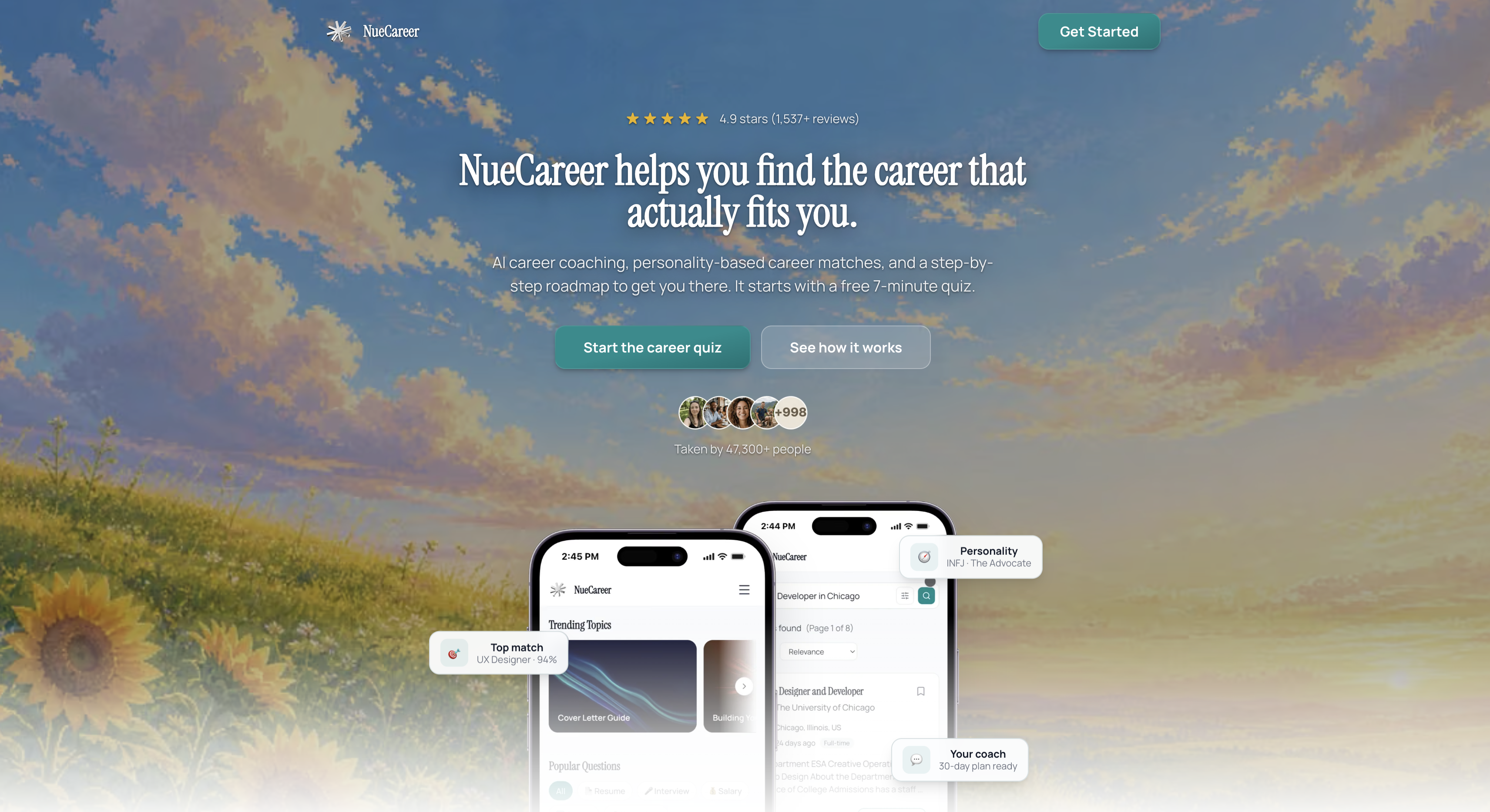
When your materials are ready, the NueCareer tools include an ATS resume checker, a cover letter generator and mock interview practice, so you can rehearse the product-management story you have built.
FAQ
Can I become a product manager with no experience?
Yes, though "no experience" usually means no PM title. Shopify's associate program states that no previous product experience is required, and most hires come from other backgrounds. Build proof through projects, customer interviews and small product decisions in your current role.
Do I need an MBA or a technical degree?
No. Harvard's guidance says no specialized degree is required, and Rachitsky writes that an MBA is not necessary. Focus on practical skills such as spreadsheets, basic SQL, analytics and wireframing, and on a portfolio that shows how you think.
What is the fastest way in?
For most people it is an internal transfer, since you already have credibility and relationships. Learn your company's transfer process, take on PM-like tasks and find a PM who will back you. If that is not possible, move to a company in an adjacent role and transfer later.
How long does the switch take?
It depends on your starting point, your target route and how much proof you build. Someone already working beside a product team can move faster than someone changing industries. Set stage-by-stage goals using a realistic timeline rather than a fixed deadline.
Which job titles should I search for?
Start with associate product manager, product analyst and product coordinator, which Capella lists as entry-level titles. Also look at roles that sit next to product in your industry, since they often lead to an internal move.
Sources
- How to Become a Product Manager and Bring Value to Your Customers, Harvard Division of Continuing Education
- Frequently Asked Questions, Shopify APM program
- How to become a product manager: skills, education and career path, Capella University
- Product School 2022 product management report
- How to get into product management, Lenny Rachitsky
- How to become a product manager, Jackie Bavaro
- How to kickstart your career in product management, Mind the Product