

A career change resume summary is a short block at the top of your resume, usually three to four lines, that tells a hiring manager who you are now, what you bring from your past work, and which role you are aiming for next. Its job is to connect the dots for the reader so they do not have to. If you have felt that your experience points in the wrong direction, this is where you turn it around. Below you will find a simple formula, before-and-after examples, guidance for people without a degree, and ways to carry the same message into your LinkedIn headline and About section.
TL;DR
- Lead with the role you want, not the job you are leaving. Your first line should name your target and your strongest proof.
- Keep the summary to three or four lines. Use transferable skills, one or two concrete results, and a clear statement of direction.
- No degree? Put skills, projects, and results first, and list education honestly and briefly.
- Use the same story on LinkedIn: a headline that names where you are going, and an About section that explains why your background fits.
- Match your summary to each job posting. Reuse its language where it is true for you.
Table of Contents
- Why the summary matters more when you change careers
- Summary, profile, headline, or objective: what is the difference?
- The four-part formula for a career change resume summary
- Before and after: three examples
- How to find the transferable skills worth featuring
- How long should it be, and what should you leave out?
- A resume headline for a career change
- Writing a resume summary when you do not have a degree
- Carry the same story to LinkedIn
- Tailor it to each job
- Our perspective: clarity beats cleverness
- Get the direction right, then the words
- A quick checklist before you send
- FAQ
- Sources
Why the summary matters more when you change careers
When your job titles match the role you are applying for, a reader can skim your resume and see the fit in seconds. When they do not, the reader has to guess. Most will not.
The top of your resume is the one place where you get to frame everything below it. A good summary tells the reader how to interpret your history: not as a detour, but as preparation. Your title as a retail manager becomes evidence of scheduling, coaching, and budgeting. Your years in teaching become evidence of training design, communication, and managing competing priorities.

This is also why layout matters. The University of Michigan Alumni Career resume guide notes that a functional or skills-focused layout can be useful for a drastic career change, because it puts transferable skills and strengths in front. The summary is the first step in that direction, even if you keep a traditional reverse-chronological format. If you want a fuller walkthrough of layout choices, our guide to career change resume tips covers them in more detail.
Summary, profile, headline, or objective: what is the difference?
The terms get used loosely, so here is how we use them.
| Term | What it is | Typical length | Best for |
|---|---|---|---|
| Professional summary (or profile) | A short paragraph of your strengths, proof, and direction | 3 to 4 lines | Most career changers |
| Resume headline | A single line above or inside the summary naming your target role | One line | Making your direction obvious at a glance |
| Objective | A statement of what you want from the next job | 1 to 2 lines | Rarely, mostly when you have very little experience to summarize |
| LinkedIn headline | The line under your name on LinkedIn | One line | Search and first impressions online |
For most career changers, we recommend a headline plus a short summary, and skipping the objective. An objective talks about what you want. A summary talks about what the employer gets. Employers read the second one more closely.
The four-part formula for a career change resume summary
You do not need a clever opening. You need a clear structure. Here is the one we suggest:
- Your target identity. Name the role or field you are moving into, in the words used in job postings.
- Your strongest transferable skills. Pick two or three that the new role clearly values.
- One or two pieces of proof. A result, a number, a project, a certification, or a scope of responsibility.
- Your direction. One short phrase on what you want to do next and for whom.
Put together, it reads like this:
Operations professional moving into project management, with eight years of experience coordinating teams, budgets, and deadlines in healthcare administration. Led a scheduling overhaul that cut patient wait times by 20%. Completed a project management certification and now seeking a project coordinator role where process improvement drives results.
Notice what it does not say. It does not apologize for a lack of experience, and it does not open with "Hard-working professional seeking new opportunities." Every phrase is doing a job.
One note on numbers: use only figures you can stand behind in an interview. The 20% above is an illustration of the format. Replace it with your own real result, even if it is small. A modest true number beats a large vague claim.
Before and after: three examples
The examples below are illustrations of structure. Adapt the details to your own history and keep them truthful.
From teaching to corporate training
Before: "Dedicated teacher looking for a new challenge in the corporate world. Passionate about learning and helping others grow."
After: "Educator transitioning to learning and development, with ten years of designing curriculum, running workshops, and measuring learning outcomes for groups of 25 to 150. Built a peer-mentoring program adopted across a school district. Looking to apply instructional design and facilitation skills to employee training."
Why it works: it uses the vocabulary of the target field (learning and development, instructional design, facilitation) and gives scope.
From retail management to customer success
Before: "Retail manager with many years of experience seeking a role in tech."
After: "Customer-focused team leader moving into customer success, with seven years of experience resolving escalations, coaching teams of 12, and building loyalty with repeat customers. Recognized for raising satisfaction scores on my team year over year. Currently completing a CRM fundamentals course."
Why it works: it names the destination in the first line, and it shows learning in progress without pretending to a title you have not held.
From hospitality to data analysis
Before: "Hotel supervisor interested in data and analytics."
After: "Detail-oriented analyst-in-transition with six years of experience tracking occupancy, revenue, and guest feedback to guide staffing and pricing decisions. Built spreadsheet dashboards used in weekly management meetings. Skilled in Excel and SQL through self-directed projects, targeting junior data analyst roles."
Why it works: it presents past work as analysis, which it was, and it points to portfolio-style proof.
How to find the transferable skills worth featuring
Many people undersell themselves here because they list duties, not skills. Try this quick exercise:
- Pull up three job postings for the role you want.
- Highlight the phrases that repeat: skills, tools, responsibilities.
- Next to each, write a moment from your past work where you did something similar, even under a different name.
- Choose the two or three strongest matches. Those become the skills in your summary.
For example, "stakeholder communication" in a posting may match the time you handled difficult clients. "Process improvement" may match the time you rewrote a messy handoff checklist. If you need prompts, our lists of transferable skills examples and a step-by-step guide to identifying transferable skills can help you name what you have already done.
If you are not sure which direction fits you in the first place, it is worth settling that before polishing your wording. A summary aimed at three different roles reads as aimed at none.
How long should it be, and what should you leave out?
Aim for three to four lines on the page, or roughly 40 to 70 words. That is enough for the four parts above without turning into a paragraph nobody reads.
Leave out:
- Clichés such as "results-driven," "team player," and "go-getter." They could describe anyone.
- First-person pronouns. Resume summaries conventionally drop "I" and "my." Start with a noun phrase or an adjective and a title.
- Apologies and hedges like "although I lack experience in..." Let the proof speak.
- Your whole career story. The cover letter is the place for the longer "why I am changing" narrative. Our guide to a career change cover letter shows how to write it.
- Skills that are irrelevant to the target role, however proud you are of them.
A resume headline for a career change
A resume headline is a single line placed just under your name, above the summary. For a career changer, it replaces the question "what is this person?" with an answer.
Good headlines name the target and add one differentiator:
- Project Coordinator | Healthcare Operations Background | PMP Candidate
- Customer Success Professional | 7 Years Leading Customer-Facing Teams
- Junior Data Analyst | SQL, Excel, and Dashboard Reporting
Only claim a credential or title you actually hold or are actively pursuing. "Candidate" or "in progress" is accurate and reads well.
Writing a resume summary when you do not have a degree
A missing or incomplete degree worries a lot of career changers, but it changes your strategy rather than ending it. The approach is to move evidence ahead of credentials.
1. Lead with skills and results. Your summary should talk about what you can do and have done. Do not mention education in the summary at all unless it helps.
2. Consider a skills-forward layout. As the Michigan alumni guide notes, skills-focused formats can suit big career shifts. Place a skills section with real examples above your work history, and put education lower down.
3. Add proof outside of work. Certifications, short courses, volunteer work, freelance projects, and a portfolio all count. Our guide to changing careers without experience explains how to build that proof with small projects.
4. List education honestly and briefly. If you completed some college, you can list the school, the field of study, and the years you attended, without implying you graduated. Something like "Coursework toward a B.S. in Business Administration, State University" is accurate. If you have no college, you can simply leave the education section for certifications and training.

5. Do not hide it with misleading wording. Never imply a degree you did not finish. Background checks and interviews bring it up, and it is far better to be clear and let your results carry the page.
An example summary for someone without a degree:
Self-taught web developer moving from restaurant management, with five years of experience leading teams of 15 and managing a six-figure budget. Built and launched three client websites using HTML, CSS, and JavaScript. Seeking a junior front-end role where reliability, communication, and a fast learning curve add value.
No education is mentioned, and it does not need to be. The proof is in the first three lines. For a deeper look at this layout, see our skills-based resume template.
Carry the same story to LinkedIn
Your resume is one version of your story. Your LinkedIn profile is the other, and recruiters often check both. If they disagree, you create doubt. If they match, you create confidence.
Your LinkedIn headline
By default, LinkedIn fills the headline with your current job title. For a career changer, that is the worst message to send. Replace it with one that points forward.
A simple pattern: Target role | Core skills | Proof or background
- Aspiring UX Designer | Research, Prototyping | Former Teacher Who Designs for Learners
- Operations Leader Moving into Project Management | Budgets, Timelines, Team Coordination
- Customer Success Manager | Relationship Building | 7 Years in Retail Leadership
Use the words recruiters would type into a search for the role you want. Your headline is one of the places that shapes how you appear in those searches, so name the target role plainly rather than something clever.
Your LinkedIn About section
This is where you have more room than on a resume. Write it in first person, in a warm and direct voice, and follow this order:
- The pivot, in one sentence. What you did and what you are moving toward.
- The connection. Two or three ways your past work prepared you.
- The proof. One or two accomplishments and any new training.
- The invitation. What kind of roles or conversations you would welcome.
A short example:
After nine years in hospitality management, I am moving into data analysis. Running a 120-room property taught me to read numbers under pressure and turn them into decisions about staffing and pricing. Over the past year I have built dashboards for my team and completed coursework in SQL. I am looking for a junior analyst role where I can keep turning information into clear action. If that sounds like your team, I would love to connect.
Make the rest of the profile agree
- Set your profile to show you are open to the roles you want, using LinkedIn's own settings.
- Reorder your skills so the ones relevant to your target role come first.
- Rewrite the top bullets in each past job to emphasize transferable work, as you did on your resume.
- Add projects, courses, and volunteer work to the profile sections made for them.
Tailor it to each job
Your core summary can stay the same, but swap one or two details for each application. Read the posting, pick its top two requirements, and make sure your summary speaks to them in the posting's own words, wherever that is honest. This also helps with applicant tracking systems, which often scan for matching keywords. Use our ATS Resume Checker if you want a quick read on how a resume lines up with a posting.
A five-minute tailoring habit looks like this:
- Copy the job title exactly into your headline if it fits you.
- Match two required skills in your summary.
- Move the most relevant bullet in your latest role to the top.
- Read the summary aloud. If it sounds like a stranger, simplify it.
Our perspective: clarity beats cleverness
We talk with a lot of working adults who feel stuck, and the same pattern shows up again and again. They have real strengths, but they describe themselves in the vocabulary of the job they want to leave. The summary comes out sounding like an apology or a vague wish.
We believe the fix starts before the writing. When you know which roles fit who you are, the summary becomes much easier, because you stop trying to appeal to everyone. That is why we built our platform around a 7-minute quiz that matches you to career paths based on your strengths, including paths you may never have considered. Once the direction is clear, the language follows.
Our advice is simple. Pick one target. Name two or three skills that matter there. Show one honest piece of proof. Then say plainly where you are headed. Employers do not need a perfect career story. They need to believe you can do the work, and a clear, confident summary helps them see it.
You are not starting from zero. You are starting from experience that deserves a better introduction.
— Shane
Get the direction right, then the words
If you are still weighing which role to aim for, the summary will feel hard to write, and that is normal. At NueCareer, the 7-minute career quiz identifies your strengths and matches you to career paths, and the platform then builds a personalized transition roadmap, with 24/7 coaching chat and resume and cover letter tools to help you apply with confidence.
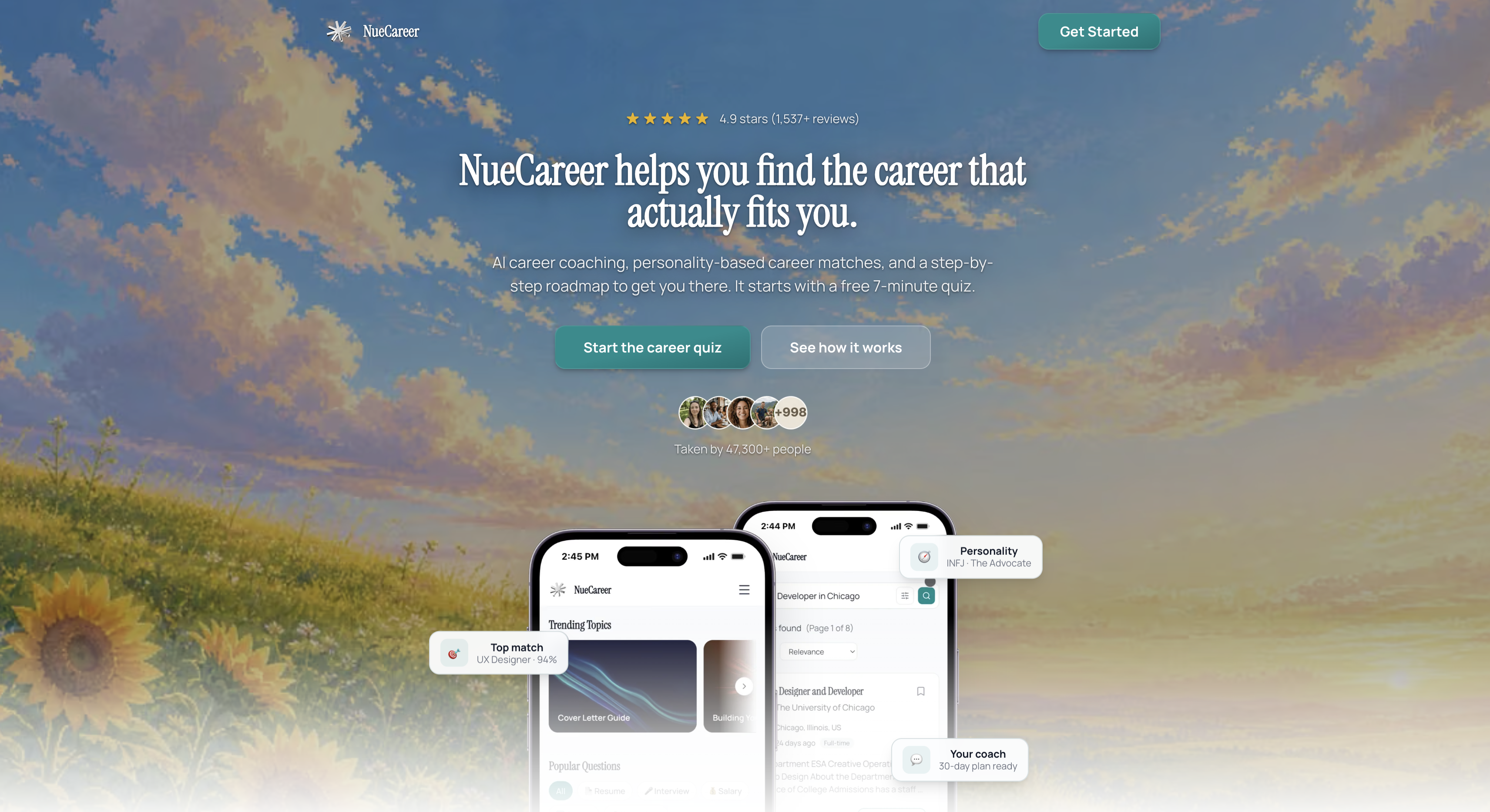
When you have a target in mind, our resume and cover letter tools can help you turn your summary into a full application. You can also explore the rest of the platform on the NueCareer home page.
A quick checklist before you send
- Does the first line name the role you want?
- Are there two or three skills that appear in the job posting?
- Is there at least one specific, true result?
- Is it three or four lines, with no clichés?
- Does your LinkedIn headline point to the same target?
- Could you explain every sentence in an interview?
If you can answer yes to each, your summary is doing its job. For the interview that comes next, our guide to career changer interview answers helps you tell the same story out loud, and our walkthrough on how to switch careers lays out the wider plan.
FAQ
How do I write a resume profile when changing careers?
Start with the role you are targeting, then name two or three transferable skills from your past work, add one honest result, and close with the direction you want to take. Keep it to three or four lines and use the language of the job posting where it is true for you.
Should I use an objective or a summary on a career change resume?
A summary is usually stronger, because it tells the employer what you offer, not just what you want. An objective can work if you have very little experience to summarize, but even then, one sentence naming your target and strengths is enough.
Can I get a good resume together without a degree?
Yes. Lead with skills, results, projects, and certifications, and place education lower on the page. If you attended college without finishing, list the school and field honestly without implying a completed degree.
What should my LinkedIn headline say if I am changing careers?
Name the role you are moving toward, add two or three relevant skills, and include a short proof point or background phrase. Avoid leaving your old job title as the whole headline, since it sends readers in the wrong direction.