

A career change elevator pitch is a 30- to 60-second answer to "What do you do, and what are you looking for?" It names where you are now, the strengths you are carrying over, and the direction you are heading. The part that matters most for career changers is the direction. If you lead with your old job title, people file you under it. If you lead with what you are moving toward and back it with proof from your past, they can picture you in the new role.
This guide shows you the structure that university career centers and employers recommend. It gives you fill-in-the-blank examples, explains how to adapt the pitch for networking, interviews and job fairs, and lists what to cut. If you want to start from your strengths rather than a blank page, our elevator pitch generator gives you a first draft to edit.
TL;DR
- Keep it to roughly 30 seconds for networking and 60 to 90 seconds for "Tell me about yourself" in an interview.
- Use three parts: present, past, future. Put the transferable strengths in the middle and the new direction at the end.
- Name one or two specific accomplishments with a result. Skip generic adjectives and industry jargon.
- Close with a question or a clear ask, such as who you should talk to next.
- Draft it, say it out loud, and adjust it for each audience until it sounds like you.
Table of Contents
- Why a career change pitch is different
- The three-part structure that works
- A fill-in-the-blank template
- Three career change examples
- A different order: lead with where you're going
- Adapting the pitch to the situation
- Answering "Tell me about yourself" as a career changer
- What to leave out
- How to practice until it sounds natural
- Make the pitch show up everywhere else
- Where NueCareer fits in
- Perspective
- FAQ
- Sources
Why a career change pitch is different
Most pitch advice assumes a straight line: your degree, your field, the job you want. You have a bend in your path, and listeners will notice it. If you do not explain it, they will fill the gap themselves, and the explanation they invent is rarely flattering.
A good career change pitch answers three silent questions:
- Why are you leaving? Briefly, and positively. The pitch is about what pulls you forward.
- What do you bring? The skills that carry over, shown through results.
- Where are you going? A specific target, not "I'm open to anything."
That last point is where many people stall. If you are not yet sure which roles fit you, a pitch is hard to write because there is nothing to point it at. That is a normal place to be, and it is solvable. Our 7-minute career quiz identifies your strengths and matches you to career paths, including ones you may not have considered. Once you have a target, the pitch gets much easier.
The three-part structure that works
Several university career offices teach nearly the same skeleton. Vassar's career center describes an elevator pitch as a 30- to 60-second summary of who you are, what skills you bring and where you want to go. It recommends the order present, past, future: introduce your current focus, highlight one or two accomplishments that show transferable skills, then connect it all to why you are excited about the role or organization.
Tufts frames the same idea as three questions: who you are, what you do, and what you want to do. It adds that your background should be explained in layperson's terms, and it gives a career-change style example of someone moving their skills into user experience work.
Deloitte's recruiting tips use different labels but the same logic: an introduction, a background snapshot, and an objective that ends with a statement or question inviting further conversation.
For a career changer, here is how the three parts translate.
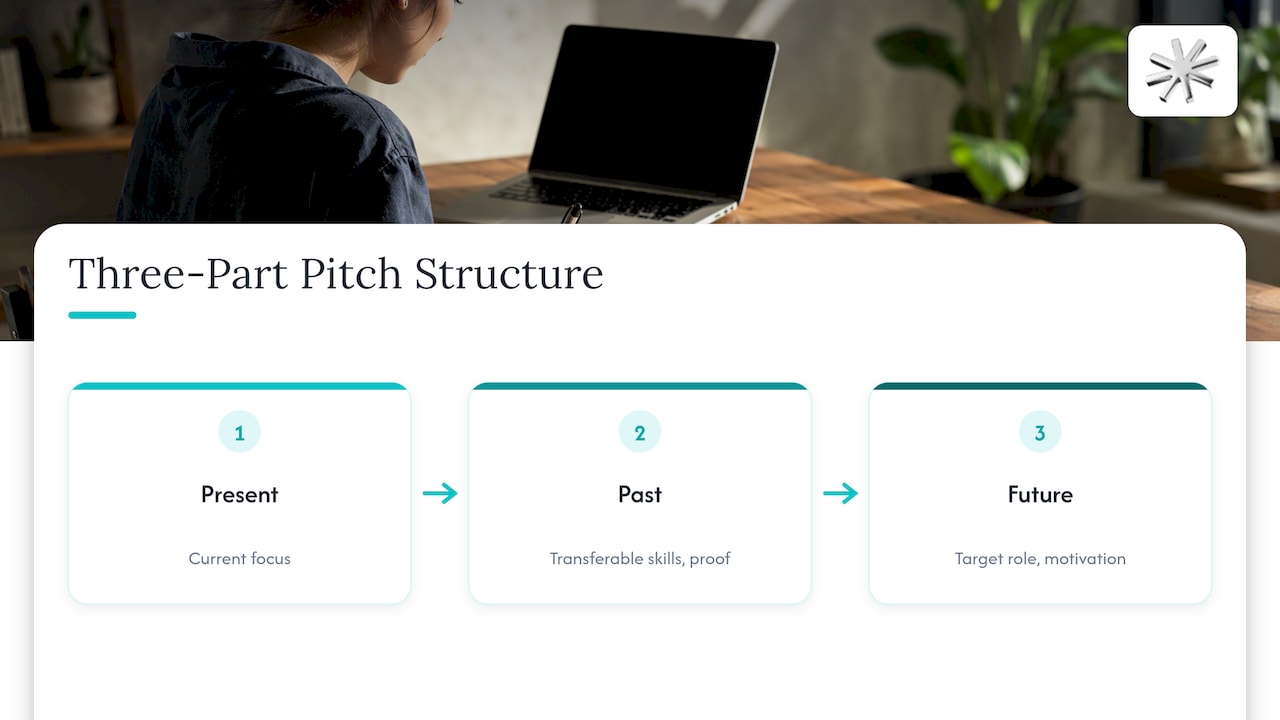
Part 1: Present (one sentence)
Start with what you are doing now or what you have been focused on. If you are still employed, say so plainly. If you have been exploring, say that.
"I've spent nine years in operations at a regional logistics company, and I'm now moving into project management."
Notice that the sentence has both your past field and your destination. You are not hiding the bend. You are naming it first, on your terms.
Part 2: Past (two sentences, the proof)
This is the core of the pitch. Pick one or two accomplishments, and pick them for the new job, not the old one. A result with a number carries more weight than a description of duties.
"I coordinated vendors, schedules and a team of twelve across three warehouses, and I led a process change that cut order errors by about a third. That's the work I enjoyed most: getting a complicated project from messy to done."
The second sentence matters because it bridges. It tells the listener which part of your history you want more of. Montana State's career-change template suggests naming your favorite parts of the previous job and connecting them to the change.
If your accomplishments feel too ordinary or too far from the new field, widen the lens. Volunteer work, side projects and community roles count. Skills-based volunteering is one way people build and show relevant experience outside a paycheck. Our guide to transferable skills examples can help you name what you did in terms the new field recognizes.
Part 3: Future (one or two sentences, the direction and the ask)
Say what you want next and why this role or organization makes sense. Then give the other person something easy to respond to.
"I'm looking for a project coordinator or associate project manager role in healthcare operations. Do you know anyone on a team like that I should talk to?"
The closing question turns a speech into a conversation. Montana State's template ends with exactly this kind of ask: whether the listener knows anyone hiring for the target job.
A fill-in-the-blank template
Use this as scaffolding, then rewrite it in your own words until you would say it to a friend.
"I'm [name]. For [number] years I've worked in [current or past field], where I [one concrete accomplishment with a result]. What I enjoyed most was [the part that connects to the new field], so I'm now moving into [specific target role or industry]. I'm especially interested in [company, team or problem]. [Closing question or ask.]"
That is roughly 60 to 75 words, which is about 30 seconds at a natural pace. If you are running long, cut the second accomplishment first.
Three career change examples
The examples below are illustrations of the structure, not scripts to memorize. Swap in your real numbers and details.
Teacher moving to corporate training
"I'm a middle school teacher of eight years, and I'm moving into corporate learning and development. I designed a new curriculum for 140 students and trained six colleagues to use it, and what I loved most was seeing adults and kids alike get a hard concept. I'm looking for instructional design roles. Are there people on your learning team I could talk to?"
Retail manager moving to customer success
"I've managed a team of 15 at a retail store for six years, handling everything from scheduling to customer escalations. My team's satisfaction scores were the highest in our district last year, and I realized the part I enjoy is keeping customers happy long term. I'm now looking for customer success roles at software companies. Does your company have that team?"
Administrative professional moving to data analysis
"I've spent ten years as an executive assistant, and I've become the person who builds the spreadsheets and reports everyone depends on. I taught myself SQL and built a dashboard that saved my department several hours a week. I'm moving into data analyst roles. What would you recommend I learn next?"
Each one states the shift in the first sentence, backs it with a specific result, and ends by asking for something the listener can answer.
A different order: lead with where you're going
The present-past-future order is the safest. There is an alternative worth knowing. A Forbes and Next Avenue piece suggests career switchers first write a one-page description in three paragraphs covering context, relationships and impact. You then shrink it into three sentences in reverse order: impact first (where you're going), relationships next (your values and how you work with others), and context last (the skills and experience that make you ready). The logic is that a pitch opening with your destination is more memorable than one opening with your history.
Try both with the same material and say them aloud. One will feel more natural to you.
Adapting the pitch to the situation
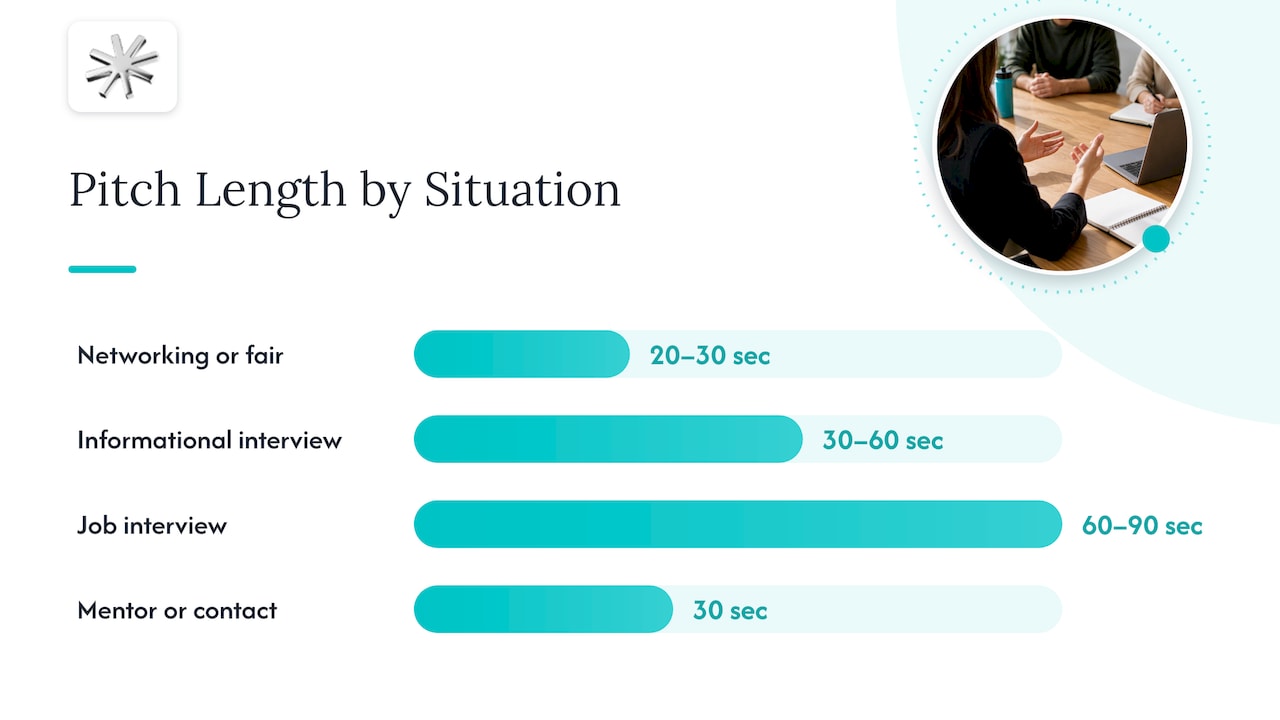
One pitch does not fit every setting. Binghamton University's career center lists four common situations: career fairs and networking events, conferences or informational interviews, answering "Tell me about yourself" in an interview, and introducing yourself to mentors, alumni or professional contacts. Here is how to adjust for each.
| Situation | Length | What to emphasize | Close with |
|---|---|---|---|
| Networking event or career fair | 20 to 30 seconds | Your target role and one proof point | A question about their team or openings |
| Informational interview | 30 to 60 seconds | Why you are curious about their path | A request for advice or an introduction |
| Job interview ("Tell me about yourself") | 60 to 90 seconds | Transferable strengths tied to this job | The reason this role is the next step |
| Mentor, alumni or contact | 30 seconds | The change and what help you want | A specific, easy ask |
MIT's career office draws a similar line: a longer one- to two-minute answer for interviews and senior contacts, and a shorter 20- to 30-second version for career fairs and impromptu introductions.
For job fairs, the U.S. Department of Labor advises tailoring your self-introduction to the position the employer is trying to fill, including the education, experience, specialties and strengths that fit the job, in its job fair networking guide. Its marketing guide for transitioning job seekers makes the same point about customizing for different audiences and highlighting transferable strengths.
Answering "Tell me about yourself" as a career changer
This is the same pitch, stretched a little. Interviewers asking it want a short story that explains why you are in the room.
Colorado State's career center treats the answer as a 90-second elevator pitch in three parts: past, present and future. MIT's guide suggests opening with a one-sentence professional identity, then two or three strengths tied to the target function, then your motivation for the transition, then tailoring it to the audience.
A workable interview version:
- Identity (one sentence): "I'm an operations manager with nine years in logistics, now moving into project management."
- Strengths (two or three sentences): Pick the two or three skills in the job posting that you can prove, each with a short example.
- Motivation (one sentence): What drew you to this change, framed as a pull toward the work.
- Fit (one sentence): Why this company and this role.
Before the interview, read the posting and choose the strengths it names. If the posting asks for stakeholder communication and you have run client meetings for years, that is your lead. For more on handling these questions, see our career changer interview answers guide. If you want to rehearse out loud with feedback, mock interview practice is part of our toolkit.
What to leave out
A short pitch is mostly a matter of cutting. These are the usual culprits:
- Clichés. One university career advisor recommends skipping words like "hardworking" and "personable," because everyone uses them and they tell the listener nothing. A result says more than an adjective.
- Jargon. The University of Iowa's career office lists acronyms and jargon among the things to avoid, and it matters double for you. Your listener probably does not know your old field's vocabulary. Translate it.
- Too much detail. The same Iowa guide warns against being verbose. One or two strong details beat six.
- Too many personal details. The SNHU advisor suggests leaving hobbies and personal interests out of a professional pitch.
- A long apology for your background. Say the change once, matter-of-factly, then move to what you offer.
- A vague destination. "I'm exploring options" gives people nothing to act on. Name a role or an industry, even if it may shift later.
- Bad-mouthing your old employer or field. Keep the reason for leaving about what you are moving toward.
A quick test is the three C's. Asana describes a good pitch as clear, concise and compelling: easy to follow without jargon, short with every word purposeful, and focused on the value you offer the listener.
How to practice until it sounds natural
A pitch that reads well on paper can sound stiff out loud. Plan for a few rounds.
- Write it long first. Dump everything: the accomplishments, the reasons, the target.
- Cut to three parts. Trim to present, past, future.
- Say it out loud, with a timer. Aim for 30 seconds, then a 60-second version.
- Practice on people. Tufts recommends practicing on friends and family until it feels natural without sounding rehearsed.
- Repeat in short sessions. The Forbes and Next Avenue piece notes that building a pitch can take up to a few weeks and suggests 5 to 30 minutes of daily practice, including rehearsing in front of a mirror.
- Adjust for each audience. Keep a master version and swap the proof point and the ask.
The goal is not to memorize a script. It is to know your three parts so well that you can say them in whatever words the moment needs.
Make the pitch show up everywhere else
Your pitch is the spoken version of your career-change story, and the same story should run through your written materials. The opening of your resume, your cover letter and your LinkedIn summary should all make the same case: the strengths you carry over and the direction you are headed. Our guides on career change resume tips and the career change cover letter show how to carry the story onto the page. If you are short on direct experience, building proof with projects gives you something concrete to point to when you say "here's what I've done."
Where NueCareer fits in
A pitch is only as strong as the direction behind it. NueCareer is built for working adults who feel stuck or unsure of the next step. The 7-minute quiz identifies your strengths and matches you to career paths built around who you are, including careers you may never have considered. From there the platform gives you a personalized roadmap, 24/7 AI coaching chat, a job board tailored to your target roles, and AI-powered resume and cover letter tools, plus mock interview practice.
If you already know your target, start with the free tools. If you are still deciding, take the career quiz and build your pitch around the result.
Perspective
Most career changers we hear from think their problem is the pitch. Usually it is the target. When you cannot say where you are going, no amount of polishing makes the first sentence land, because the listener has nothing to hold on to.
That is why we built NueCareer around a short quiz first. In about seven minutes it points you toward career paths that fit your strengths, including ones you would not have thought to search for. Once you have a direction, the pitch nearly writes itself: your strengths become the middle, the target role becomes the ending, and the roadmap, coaching chat and application tools help you act on it.
Say your pitch out loud, and let it change as you learn. A career change is a process, and you do not need to have it all figured out to speak about it with confidence.
Shane
FAQ
What is a good elevator pitch for a career change?
A good pitch is short, specific and forward-looking. It names your current or past field, gives one or two results that apply to the new role, and states the role you want next. It ends with a question that invites the listener to respond. The examples above show the structure.
How long should a career change elevator pitch be?
About 30 seconds, or 60 to 75 words, for networking and career fairs. Interview answers to "Tell me about yourself" can run 60 to 90 seconds. University career offices such as Vassar, MIT and Colorado State give ranges within those bounds.
How do I answer "Tell me about yourself" when I'm changing careers?
Open with one sentence that names who you are professionally and where you are heading. Add two or three strengths from the job posting, each with a quick example, then say why you are making the move and why this role fits. Keep the story about what you are moving toward.
What should I not say in a career change pitch?
Avoid clichés like "hardworking," jargon from your old field, long lists of details, hobbies, and criticism of past employers. Do not end with "I'm open to anything," because a vague goal gives people nothing to act on.
Do I need a different pitch for each situation?
You need one core version and a few adjustments. Change the length, the proof point and the closing ask for each setting: a job fair, an informational interview, a job interview or a conversation with a mentor.
Sources
- Vassar College Center for Career Education: telling your story
- Tufts Graduate Student Career Guide
- Deloitte US: creating an elevator pitch
- Montana State HRM: 30-second commercial guidelines
- Forbes and Next Avenue: for a career switch, create an elevator pitch
- Binghamton University: 30-second commercial
- MIT Career Development Office: drafting your tell-me-about-yourself
- Colorado State University: nail the "Tell me about yourself" question
- U.S. Department of Labor: job fair networking and strategies
- U.S. Department of Labor: marketing yourself and other job search tactics
- SNHU: elevator pitch examples
- University of Iowa Pomerantz Career Center: elevator pitches
- Asana: elevator pitch examples
- Skills-based volunteering