
Why a Career Change at 50 Is Possible: Practical Steps

Discover why a career change at 50 is possible. Learn practical steps and unlock new opportunities for job satisfaction and success.
Changing careers at 50 is not just possible — many people who made the switch after 45 reported a successful transition, and many said they found higher job satisfaction on the other side. You likely have 15 or more working years ahead of you, a network built over decades, and a level of self-knowledge that most 25-year-olds simply don't have yet. The labor market is also shifting in your favor: as AI handles more routine tasks, employers are paying more for the human judgment, cross-functional leadership, and institutional pattern recognition that experienced professionals carry naturally.
Here is what the evidence points to right away:
- Success rates are high. 82% of people who changed careers after 45 reported a successful transition.
- Market demand favors your strengths. Employers increasingly value judgment and leadership over technical speed alone.
- You have runway. Most 50-year-olds have 15+ years of working life remaining — enough time to build a second career from scratch, let alone pivot to an adjacent one.
Your immediate next step: spend 7 minutes on the Nuecareer quiz to identify your transferable strengths and see which career paths align with who you are now, not who you were at 30.
Table of Contents
- Why a career change at 50 can actually work in your favor
- What gets in the way — and how to move past it
- A step-by-step roadmap for making the switch
- Career ideas that tend to work well for people over 50
- How long does retraining take, and what does it cost?
- How to present your experience so it lands
- How a guided platform can shorten your path
- Key Takeaways
- The part most career-change guides get wrong
- Nuecareer helps you move from stuck to applied
- Useful sources
- FAQ
Why a career change at 50 can actually work in your favor
The case for switching careers at 50 is stronger than most people realize, and it rests on three distinct pillars: what you bring, what the market wants, and what your life stage makes possible.
What you bring to the table
Decades of work don't just produce a long resume. They produce judgment. You've seen projects fail, organizations restructure, and markets shift. That pattern recognition is genuinely hard to teach, and employers are increasingly recognizing it as AI automates the routine tasks that used to differentiate junior from senior workers. Cross-functional knowledge, the ability to manage stakeholders, and institutional credibility are assets that compound over time. They don't expire at 50.

Your professional network is another underrated advantage. A well-maintained network built over 20 or 25 years gives you access to hiring managers, referrals, and industry intelligence that no job board can replicate. Most career changers at 50 already know someone in the field they want to enter.
What the market is offering
Flexible work arrangements — fractional roles, consulting contracts, remote positions, and part-time advisory work — have expanded significantly. These structures often favor experienced professionals who can deliver results without needing extensive onboarding. Labor shortages in fields like healthcare, education, skilled trades, and financial planning mean that motivated, credentialed candidates are in genuine demand regardless of age.
Statistic to know: 82% of people who changed careers after age 45 reported a successful transition. That figure holds even when the pivot involved retraining.
What your life stage makes possible
At 50, many people have financial runway that younger changers don't: mortgages closer to paid off, savings accumulated, and children who are financially independent or nearly so. That stability makes it realistic to take a lower-paying role temporarily, invest in a short credential program, or spend a few months consulting while you build toward a target role. You can afford to be strategic in a way that a 28-year-old with student debt simply cannot.
Clearer priorities matter too. Most people at 50 know what drains them and what energizes them. That self-knowledge shortens the exploration phase considerably and makes it far less likely you'll land in another role that doesn't fit.
What gets in the way — and how to move past it
Three obstacles come up consistently for people making a career change at 50: ageism, confidence, and skill gaps. Each one is real. None of them is insurmountable.
Ageism: what it looks like and what you can do
Age discrimination in hiring is illegal under the Age Discrimination in Employment Act, but it still shows up in practice. Automated applicant-tracking systems can filter resumes before a human ever reads them, and some interviewers carry unconscious assumptions about adaptability or tech fluency in older candidates.
The practical response is to remove age signals from your application materials before they trigger those filters:
- Omit graduation dates from your resume and LinkedIn profile.
- Cut roles older than 15 years unless they are directly relevant to the target position.
- Drop obsolete technologies (software or platforms no longer in active use) from your skills section.
- Lead with a skills-first summary rather than a chronological job list.
Remote work is worth pursuing deliberately. Several career experts note that remote roles reduce the visual and social cues that can activate age bias, letting your performance speak more directly.
Confidence and self-imposed limits
Career experts consistently flag that negative self-talk and internalized ageism often do more damage than external bias. The inner voice that says "I'm too old for this" or "they won't take me seriously" can prevent you from applying at all. Reframing is not just motivational language — it is a practical tactic. Your experience is not a liability to apologize for; it is a focused value proposition that most candidates your target employer interviews cannot match.

Pro Tip: When you catch yourself thinking "I'm overqualified," reframe it as "I bring pattern recognition that will shorten their learning curve." That shift changes how you write your cover letter, how you answer interview questions, and how you carry yourself in the room.
Skill gaps: targeted, not total
Most career changers at 50 don't need a new degree. Short, targeted upskilling — a microcredential, a community college certificate, or a focused bootcamp — usually delivers enough credibility for an adjacent pivot without the time or cost of a full program. The fastest way to validate new skills is to use them: take a freelance project, volunteer in the target field, or complete a visible portfolio piece before you apply.
Checklist to neutralize each barrier:
- Remove age signals from resume and LinkedIn (graduation year, early roles, outdated tools)
- Complete one targeted credential in your target field within 90 days
- Reframe your summary as a value proposition, not a career history
- Take one freelance or volunteer project to build recent, relevant proof
- Prepare two interview talking points that explain your pivot as a strategic choice
A step-by-step roadmap for making the switch
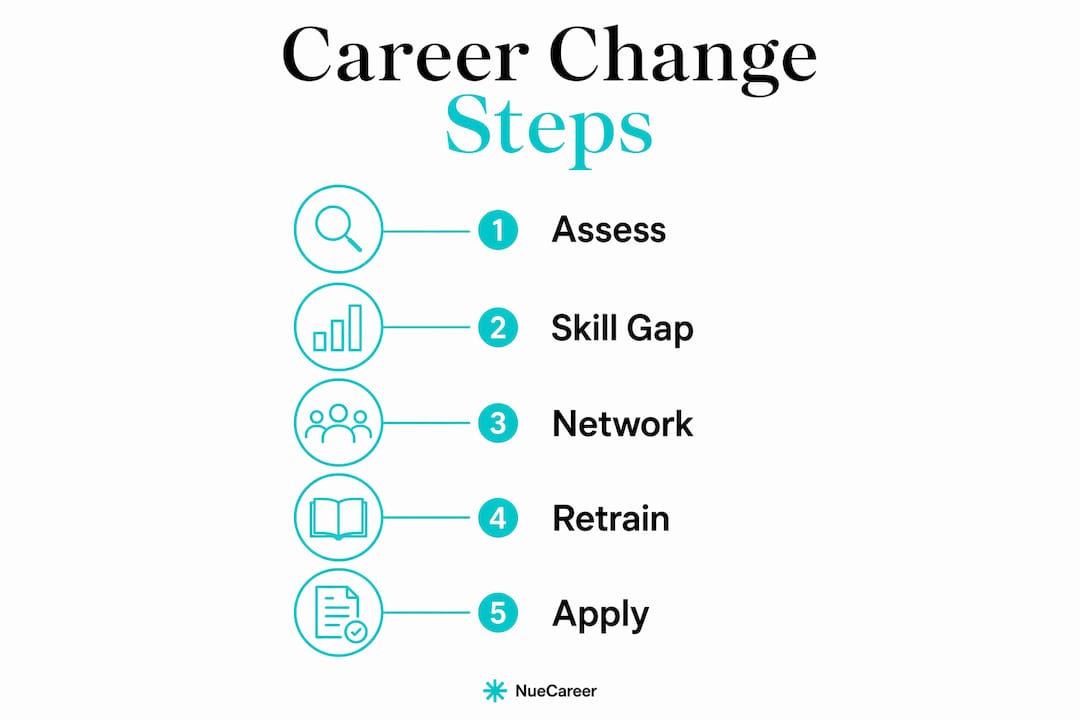
A career change roadmap works best when it moves in a specific order. Skipping steps — especially the assessment and small-experiment phases — is the most common reason transitions stall.
Assess your strengths and values (Weeks 1–2). Take a structured assessment to identify transferable skills, energy peaks, and non-negotiables. The Nuecareer quiz takes 7 minutes and surfaces career paths you may not have considered. Write down what you want more of, what you want less of, and what you need financially.
Clarify your target role (Weeks 2–4). Research two or three specific roles, not just industries. Read 20 job postings in each role to understand what employers actually require. Note the skills you already have and the gaps you'd need to close.
Map your career capital (Weeks 3–5). Adjacent pivots preserve most of your accumulated career capital; full resets often sacrifice 20–30% of it. Identify roles with strong skill overlap to your current field before considering a complete restart.
Fill the gaps with targeted upskilling (Months 2–4). Choose the shortest credible path to close your skill gaps: a microcredential, a community college certificate, or a bootcamp. Avoid over-investing in credentials before you've tested the market.
Run a small experiment (Months 3–5). Freelance, consult, or volunteer in the target field before committing fully. This validates your interest, builds recent experience, and generates references. A value-giver networking approach — reaching out to help or learn rather than to ask for jobs — can rebuild a relevant network in under 20 months.
Update your positioning materials (Month 4–5). Rewrite your resume with a skills-first summary, refresh your LinkedIn headline to name your target role, and prepare two or three interview talking points. Use Nuecareer's job application skills tool to identify the right language for your target roles.
Apply with a targeted strategy (Month 5 onward). Apply to roles where you have 70–80% of the listed requirements. Prioritize companies where you have a referral. Track applications, follow up, and treat each interview as data — adjust your positioning based on what resonates.
For concrete career change timeline examples by pathway, including faster and slower routes, Nuecareer's timeline guide breaks down realistic milestones.
Career ideas that tend to work well for people over 50
The strongest options for career changers at 50 share a common trait: they reward experience, judgment, and relationships over raw speed or technical novelty. Here are eight worth considering, with the fastest entry path for each.
Consulting or fractional work in your current field. This is the lowest-risk pivot available. You take your existing expertise and sell it directly to companies that need it part-time. Entry path: identify three companies in your sector that could use your specific knowledge, reach out with a defined offer, and start with a short-term project. No new credentials required.
Corporate training and learning and development. Organizations pay well for professionals who can translate real-world experience into training programs. If you've managed teams, led projects, or built processes, you already have the raw material. Entry path: a certificate in instructional design (available through Coursera or community colleges in 3–6 months) plus one portfolio training module you've built yourself. Adult learning strategies are a distinct skill set worth studying before you pitch your first client.
Healthcare support roles. Medical coding, health coaching, patient advocacy, and care coordination are in high demand and don't require clinical degrees. Entry path: community college certificate programs typically run 6–12 months and cost a fraction of a four-year degree.
Real estate. Licensing requirements vary by state but generally involve 60–150 hours of coursework and a state exam — achievable in 3–6 months. Your existing network is a direct business asset from day one.
Education and tutoring. Teaching, corporate instruction, or private tutoring draws directly on your subject-matter expertise. Many school districts have alternative certification pathways for career changers. Entry path: research your state's alternative certification program; some can be completed while you're already in the classroom.
Financial planning and coaching. The CFP (Certified Financial Planner) credential is the gold standard and takes roughly 18–24 months to complete. Financial coaching, a lighter credential, can be earned in 3–6 months and serves a different but real market.
Entrepreneurship and small business. Michelle Lyman, a medical engineer, shifted to entrepreneurship after 50 and built a business around her domain expertise. The pattern is common: deep industry knowledge plus a specific problem you've seen go unsolved is a viable business premise. Entry path: validate the idea with three paying customers before investing in infrastructure.
Remote and contract work in your specialty. Project management, writing, UX research, data analysis, and operations consulting all have active remote contract markets. Platforms like Upwork and Toptal let you test the market before committing. For a broader look at second career options over 40, Nuecareer's guide covers additional paths with entry steps.
How long does retraining take, and what does it cost?
Most career changers at 50 can complete a meaningful credential in 1–12 months, depending on the pathway. The table below reflects typical U.S. ranges; actual costs vary by institution and location.
| Pathway | Typical Duration | Typical U.S. Cost | Low-Cost Alternative |
|---|---|---|---|
| Microcredential / online certificate | 1–3 months | — | Free MOOCs (Coursera audit, edX audit) |
| Community college certificate | 6–12 months | — | Financial aid, employer tuition assistance |
| Coding or tech bootcamp | 3–6 months | — | Free/low-cost options via freeCodeCamp |
| Professional certification (e.g., CFP, PMP) | 6–24 months | — | Study groups, employer sponsorship |
| Bachelor's degree completion | 2–4 years | — | Community college transfer pathway |
For most adjacent pivots, the microcredential or community college certificate row is the right starting point. A full degree is rarely necessary and often counterproductive when time and budget are limited.
Financial planning for the transition period matters as much as the credential cost. AARP's guidance recommends planning for a 6–12 month transition window with reduced income. Practically, that means:
- Building 6 months of living expenses in a liquid account before you leave your current role.
- Pricing healthcare coverage carefully — COBRA, ACA marketplace plans, or a spouse's plan each carry different costs and coverage levels.
- Avoiding early retirement account withdrawals, which trigger taxes and penalties that can significantly reduce your transition budget.
- Considering part-time or contract work in your current field during the transition to maintain cash flow.
How to present your experience so it lands
The goal on a resume, LinkedIn, and in interviews is not to hide your experience. It's to reframe it as a focused value proposition for the role you want now.
Resume tactics
- Open with a skills-first summary (3–4 sentences) that names your target role, your top two or three transferable strengths, and one measurable outcome from your career. Example: "Operations leader with 20 years of cross-functional project management seeking a corporate training role. Reduced onboarding time by 40% at [Company] by redesigning the new-hire curriculum. Skilled in adult learning design, stakeholder communication, and process documentation."
- Limit your work history to the last 15 years. Earlier roles can be listed in a brief "Additional Experience" line without dates if they're relevant.
- Lead each bullet with a measurable outcome, not a task description. "Managed a team" becomes "Led a 12-person team that delivered a $2M product launch on time and 8% under budget."
- Remove graduation dates, early certifications with outdated years, and any technology that's no longer in active use.
For a deeper look at career change resume tactics that clear applicant-tracking filters, Nuecareer's resume guide covers the full structure.
LinkedIn positioning
Your headline should name your target role and your top transferable skill, not your current title. Instead of "VP of Operations at [Company]," try "Operations Leader | Corporate Training & Process Design | Open to New Opportunities." Your summary should tell the pivot story in three short paragraphs: where you've been, what you've learned, and where you're headed — and why that direction makes sense given your experience.
Interview talking points
Two soundbites worth preparing and adapting:
On the pivot itself: "After 20 years in operations, I've spent the last year deliberately moving toward training and development. The skills overlap more than people expect — I've been designing processes and teaching teams my entire career. I'm now formalizing that with a certificate in instructional design and actively building a portfolio."
On experience and salary: "I'm looking for a role where I can contribute at a high level from day one. I'm flexible on compensation because I'm more focused on fit and growth trajectory than on matching my previous salary exactly."
For more career changer interview answers and scripts, Nuecareer's interview guide has full examples you can adapt.
How a guided platform can shorten your path
The hardest part of a career change at 50 isn't motivation — it's knowing where to start and what to prioritize. A guided platform compresses the early stages of the roadmap significantly.
Here's where a tool like Nuecareer makes a concrete difference:
- Skills assessment: The 7-minute quiz identifies your transferable strengths and matches them to career paths you may not have considered, cutting weeks off the self-assessment phase.
- Career matching: Instead of browsing hundreds of job titles, you get a shortlist of roles built around your actual profile.
- Resume and cover letter tools: Nuecareer's built-in suite helps you translate your experience into role-specific language quickly, without starting from a blank page.
- Job board and coaching chat: A 24/7 coaching chat and targeted job board mean you're not navigating the search alone. Personalized coaching at this stage can meaningfully accelerate both clarity and confidence.
- Roadmap alignment: Every feature maps directly to the roadmap steps above — assess, reskill, apply — so you're always moving forward rather than circling back.
The free job description analyzer is a practical starting point: paste in a job posting and get a clear read on what the employer actually wants, so you can tailor your resume and cover letter with precision.
Key Takeaways
A career change at 50 is realistic, evidence-backed, and most achievable when you lead with transferable strengths, remove age signals from your materials, and take one small experiment before committing fully.
| Point | Details |
|---|---|
| Success rates are high | 82% of people who changed careers after 45 reported a successful transition. |
| Adjacent pivots protect your career capital | Lateral moves preserve most of what you've built; full resets can sacrifice 20–30% of accumulated career capital. |
| Retraining is faster than you think | Microcredentials take 1–3 months; community college certificates typically run 6–12 months at modest cost. |
| Remove age signals first | Omit graduation dates, cut roles older than 15 years, and lead with a skills-first resume summary to clear automated filters. |
| Nuecareer accelerates the process | The 7-minute quiz, personalized roadmaps, and resume tools help you move from assessment to application faster. |
The part most career-change guides get wrong
Most articles about switching careers at 50 spend the majority of their space on the obstacles — ageism, skill gaps, employer skepticism — and only a paragraph or two on why the timing is actually good. That framing does real harm. It primes people to approach the process defensively, which shows up in how they write their resumes, how they answer interview questions, and how quickly they give up after a few rejections.
The evidence points in a different direction. The 82% success rate for midlife changers isn't a fluke. It reflects something structural: people who change careers at 50 tend to do it deliberately, with a clearer sense of what they want and more resources to pursue it. They're not making impulsive moves. They're making considered ones.
What I'd push back on is the idea that the goal is to "overcome" your age. The more useful frame is to stop competing on the dimensions where younger candidates have an edge — speed, novelty, willingness to work for less — and start competing on the dimensions where you genuinely win: judgment, reliability, cross-functional credibility, and the ability to see around corners that someone with five years of experience simply can't see yet.
The people who struggle most in midlife transitions are usually the ones trying to present themselves as younger than they are. The ones who succeed tend to lead with exactly what they've built.
Nuecareer helps you move from stuck to applied
If you've been sitting with the idea of a career change for months without a clear next step, the problem usually isn't motivation. It's structure. Nuecareer is built for exactly this moment: working adults who know they want something different but aren't sure where to start or how to present what they already have.
The 7-minute quiz identifies your strengths and matches you to career paths you may not have considered. From there, you get a personalized roadmap, a 24/7 coaching chat, and a full suite of resume and cover letter tools — all tailored to your target roles. No generic advice, no starting from scratch.
The free career tools are a low-friction way to begin. You'll walk away with a clearer picture of your strengths, the right language for your applications, and a concrete next step — in less time than it takes to update your LinkedIn profile manually.
Useful sources
- AARP: Ready for a Career Change at 50? — Practical U.S.-focused guidance on labor-market trends, financial planning for transitions, and step-by-step advice for older workers.
- Revarta: Career Change at 50 — Complete Guide — Covers transferable skills, mindset reframing, and market-side tailwinds for midlife changers.
- MyKelly: Changing Careers at 50 — Source for the 82% success-rate figure and practical resume and adjacent-pivot tactics.
- The Daily Pitch: Career Reinvention After 50 — Real-world case study on network rebuilding and entrepreneurship as a second-act path.
- Forward From 50: Michelle Lyman — Illustrative example of a midlife pivot from engineering to entrepreneurship.
- EEOC: Age Discrimination — Primary source on federal protections under the Age Discrimination in Employment Act.
FAQ
Why is it so hard to get a job after 50?
Automated applicant-tracking systems can filter out resumes with age signals before a human reviews them, and some interviewers carry unconscious bias about adaptability. Removing graduation dates, cutting roles older than 15 years, and leading with a skills-first summary significantly reduces these barriers.
What is the best career change at 50?
Adjacent pivots — roles with strong skill overlap to your current field — tend to work best because they preserve most of your accumulated career capital. Consulting, corporate training, healthcare support, and real estate are among the most practical options for people over 50.
Is it too late to change careers at 50?
No. 82% of people who changed careers after 45 reported a successful transition, and most people at 50 have 15 or more working years ahead. The Nuecareer quiz can help you identify where your strengths align with roles you haven't yet considered.
What career can a 50-year-old start?
Consulting in your current field, corporate training, healthcare support roles, real estate, and financial coaching are all realistic starting points that reward experience and typically require 1–12 months of targeted preparation rather than a full new degree.