
Pivot Careers: A Practical Plan That Protects Your Income

Ready to pivot careers? Discover practical steps to leverage your skills and secure a stable income in a new role that fits you better.
A career pivot is a directional shift in your work life that carries forward your experience and seniority instead of resetting them to zero. It's not quitting your field to start over. It's moving your existing skills sideways or diagonally into work that fits you better.
The Bureau of Labor Statistics tracks career changes as a routine part of American working life, not an exception. Your first move should be small: run a transferable-skills audit this week and pick one adjacent target role to test before you commit to anything bigger. Most advisors recommend building a financial runway before making the leap, scaled to how far you're jumping.
Here's what to do first:
- Write down your last three projects and the outcomes you drove, not just your job title.
- Pick one adjacent role (same industry, new function, or same function, new industry) and read 10 real job postings for it.
- Try a tool like NueCareer's quiz to surface strengths and matching paths you may not have considered.
Key Takeaways
A successful career pivot preserves your income and seniority by prioritizing adjacent roles, proof-based skill bridging, and parallel job searching over quitting first and figuring it out later.
| Point | Details |
|---|---|
| Start with an audit | Compare your real accomplishments against 10 to 20 target job descriptions before applying anywhere. |
| Choose adjacency first | Same-industry or same-function moves carry lower risk and shorter timelines than a full retrain. |
| Build proof, not credentials | One portfolio piece or freelance project beats a lengthy program for most transitions. |
| Network before you apply | Referrals outperform cold applications as the primary path into a new field. |
| Use Nuecareer to speed the process | Its quiz, job description analyzer, and resume tools turn each step of this plan into a concrete task. |
Table of Contents
- Why People Pivot Careers and What Type Fits You
- How to Pivot Your Career in Five Steps
- How Do You Reframe Transferable Skills for a New Field?
- Three Real Pivot Stories and the Patterns Behind Them
- What Obstacles Should You Expect and How Do You Manage Them?
- How Long Does a Career Pivot Take and What Does It Cost?
- How Do You Tell Your Pivot Story on a Resume and in Interviews?
- How Nuecareer Makes Your Pivot Faster to Execute
- Useful Resources for Planning Your Pivot
- Sources
- FAQ
Why People Pivot Careers and What Type Fits You
Most pivots start with common triggers such as burnout, a pay ceiling, a growth stall, life changes like becoming a parent, or a shift toward remote work. None of these require blowing up your career. They require redirecting it.
There are three basic pivot types, and each carries a different risk and timeline:
- Adjacent role, same industry. A financial analyst moving into FP&A at the same company. Lowest risk, often 3 to 6 months.
- Same function, new industry. A marketing manager in retail moving to marketing in healthcare. Moderate risk, usually 6 to 12 months.
- Full retrain into a new field. A teacher moving into UX design. Highest risk, typically 9 to 18 months or more.
At later career stages, seniority itself becomes an asset. Instead of assuming a full restart, experienced workers can translate judgment and their network into a specialized niche, which is exactly why adjacency beats reinvention for most people over 40.
How to Pivot Your Career in Five Steps
- Choose one adjacent target role. Define success narrowly: a specific title, three required skills you're missing, and a role that sits at the intersection of what you know and what you want.
- Bridge the gaps with proof, not promises. For each missing skill, build one proof asset: a portfolio piece, a freelance project, or a short certificate. You don't need a new degree. Most career changers build proof through short courses, freelance gigs, or portfolio projects rather than retraining for years.
- Reframe your resume and LinkedIn. Lead with your pivot story, not an apology for it. Draft a 90-day plan you can walk an interviewer through: what you'd learn, ship, and prove in your first quarter.
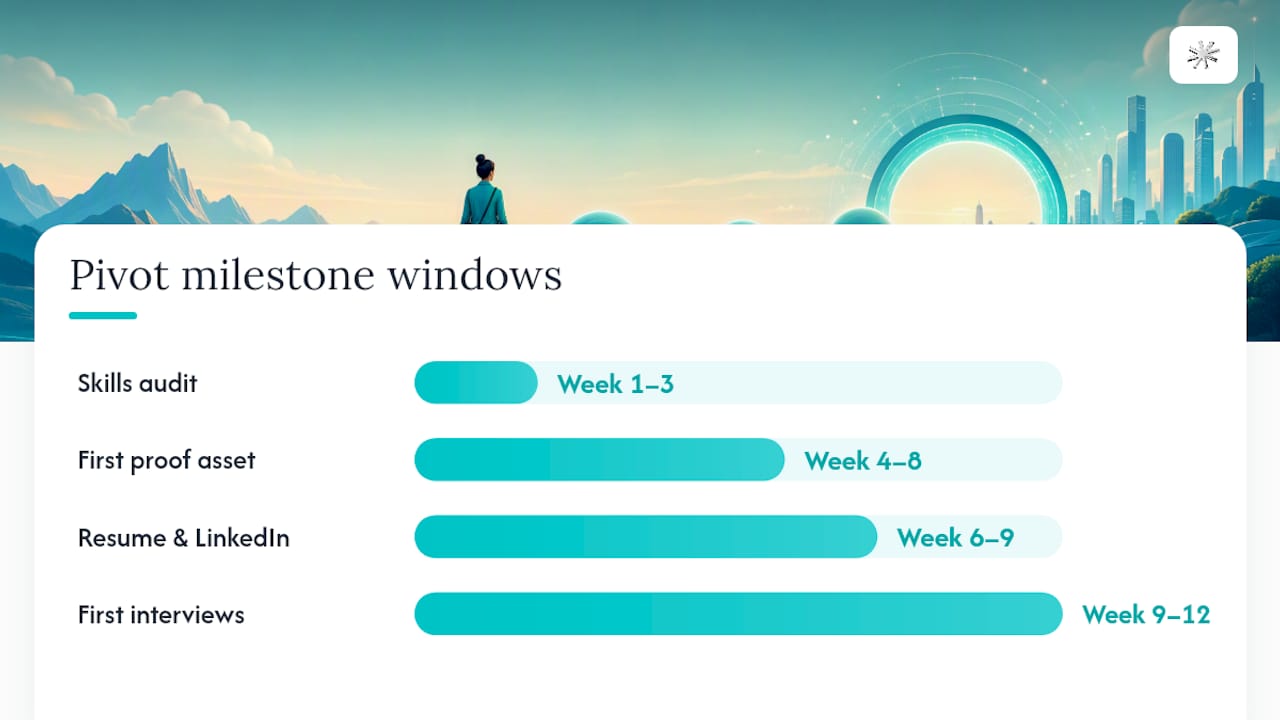
A rough week-by-week arc: weeks 1 to 3 for the skills audit and target selection, weeks 4 to 8 for building your proof asset and rewriting materials, weeks 9 to 12 for networking outreach and your first real interviews. Our step-by-step roadmap breaks this down further if you want a week-by-week version.
Pro Tip: Keep your current job while you build proof. A pivot done in parallel protects your income and your seniority, and it gives you leverage to negotiate rather than desperation to accept the first offer.
How Do You Reframe Transferable Skills for a New Field?
Hiring managers and applicant tracking systems both need to see your old experience in their language, not yours. The fix is a three-part audit: list what you actually did, map it to outcomes and numbers, then translate that into the vocabulary of your target role.
Before: "Managed weekly team meetings and tracked project status." After: "Led cross-functional stand-ups for a 6-person team, reducing project delays by coordinating dependencies across three departments."
The second version reads like project management experience because it is project management experience, just described honestly. Four skill categories transfer almost everywhere:
- Project management (deadlines, resourcing, prioritization)
- Stakeholder communication (managing up, translating technical to non-technical)
- Data interpretation (using numbers to make a decision, not just report one)
- Product or customer orientation (understanding what the end user actually needs)
Three Real Pivot Stories and the Patterns Behind Them
The adjacent mover: A hospital administrator shifted into healthcare compliance analytics, using existing regulatory knowledge as the bridge. Timeline: five months, no pay cut.

The portfolio-first pivot: A retail store manager spent evenings building a small UX portfolio from freelance projects before applying anywhere. Timeline: eleven months, one grade level down at first, recovered within a year.
The slow, parallel pivot: A teacher moved into instructional design by consulting part-time for an ed-tech company while still teaching, then went full-time once the offer matched her salary. Timeline: fourteen months.
First-hand accounts from career changers consistently show friction and short-term risk, but also that preparation and networks sharply improve outcomes. The pattern that shows up again and again is gradual movement, not sudden jumps.
The moves that best protect both income and seniority share one trait: they happen in parallel with a paycheck, not instead of one. Adjacency and proof, not drama, do the heavy lifting.
What Obstacles Should You Expect and How Do You Manage Them?
Ageism, income dips, skill gaps, and burnout trip up more pivots than lack of talent does. Ageism often shows up as unspoken hesitation rather than a stated rejection, which is why leading with judgment and network value matters more than chasing junior-level credentials. Income dips hurt most when there's no runway; a two-track income strategy (freelance or consulting alongside a search) softens the blow. Overtraining is a quieter trap: a targeted micro-credential usually beats a lengthy program nobody asked for.

Pro Tip: Negotiate from your transferable value, not your years in the new field. Anchor the conversation on the outcomes you've driven, not the title you're leaving behind.
| Obstacle | Risk Level | Primary Mitigation |
|---|---|---|
| Ageism / seniority doubt | Medium | Lead with judgment and network, not junior credentials |
| Income dip | High | Two-track income; 3–12 month runway |
| Skill gaps | Medium | One proof asset per missing skill, not a full retrain |
| Burnout mid-search | Low | Parallel pacing; keep current job during transition |
How Long Does a Career Pivot Take and What Does It Cost?
An adjacent-role pivot typically takes 3 to 6 months. A same-function, new-industry move runs 6 to 12 months. A full retrain into an unrelated field often takes 9 to 18 months or longer. Financial planning should scale with that risk: a common rule of thumb is a 3 to 12 month income runway depending on how far you're jumping.
| Milestone | Target Window |
|---|---|
| Skills audit complete | Week 1–3 |
| First proof asset built | Week 4–8 |
| Resume and LinkedIn rewritten | Week 6–9 |
| First interviews | Week 9–12 |
Budget for micro-credentials, portfolio materials, and the occasional networking event rather than a full second degree. Our realistic timeline guide walks through variations by pivot type.
How Do You Tell Your Pivot Story on a Resume and in Interviews?
Restructure your resume around a skills-first summary, followed by relevant experience reframed for the target role, then a short transition-evidence section that names your proof asset directly. This structure exists specifically to overcome ATS filters and hiring-manager skepticism about candidates without a linear path.
- LinkedIn headline: name the destination, not just the origin ("Operations Leader Moving Into Supply Chain Analytics" beats "Former Store Manager").
- About section: open with what you're building toward, then show the evidence, not a chronology.
- STAR interview answer template: explain why now (the trigger), what you bring (three transferable strengths with numbers), and your 90-day plan (what you'd learn and ship first).
For structured phrasing, our resume tips for career changers and interview answer guide both walk through full examples.
A Coach's Honest Take on Pivoting
The biggest mistake I see isn't lack of skill. It's people assuming they need permission, or a full retrain, before they're allowed to move. You don't. Start with the audit, pick one adjacent role, and build a single piece of proof. Tools like NueCareer's 7-minute quiz exist because most people undersell what they already know how to do. [Professional background and credentials to be added.]
How Nuecareer Makes Your Pivot Faster to Execute
Every step in this plan gets easier with the right tools, and that's exactly what Nuecareer builds. Instead of guessing which skills to highlight, the job description analyzer reads a real posting and shows you the language to mirror in your own application, cutting the guesswork out of Step 1 above.
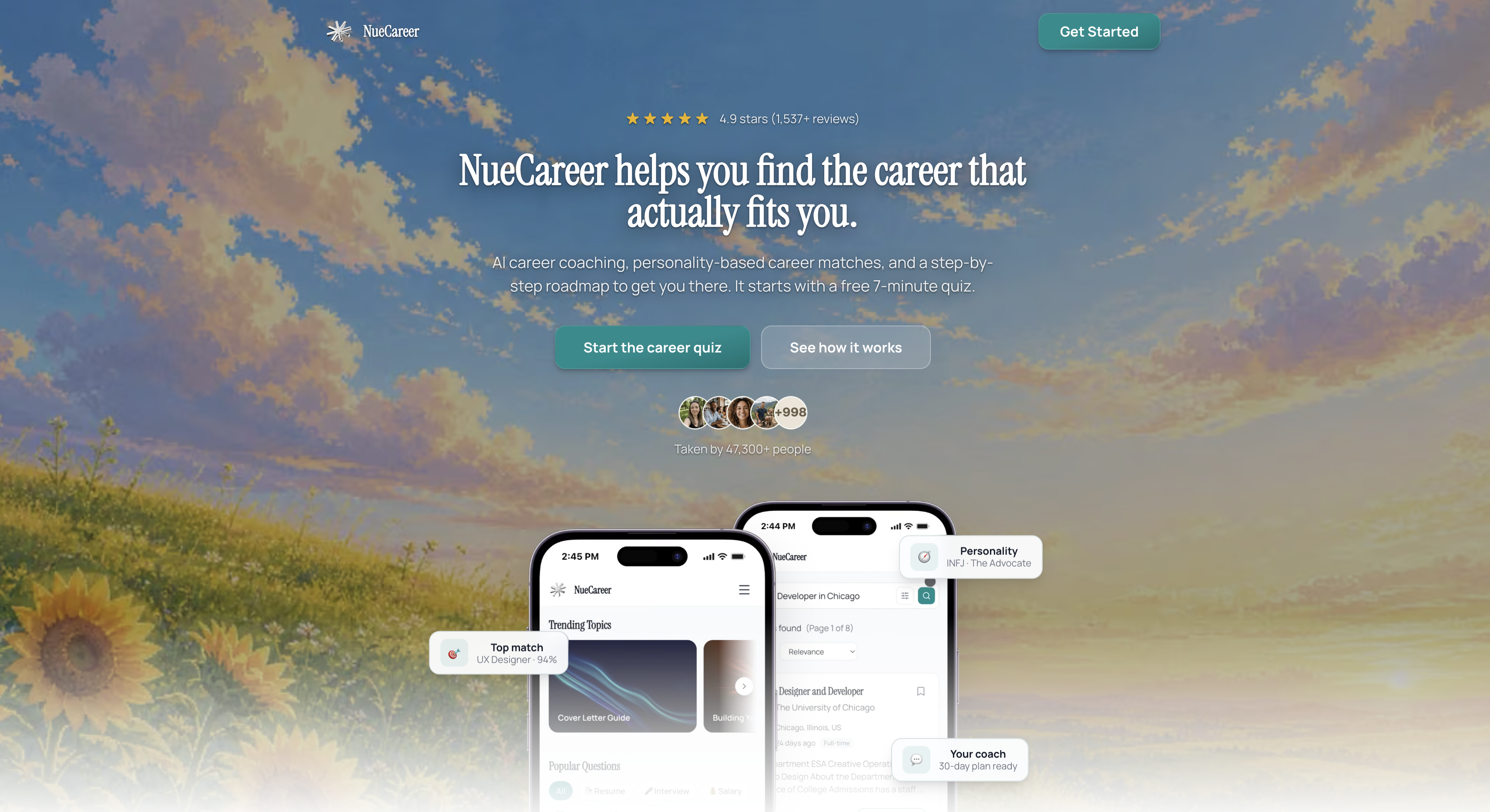
Pair that with the resume objective writer to draft a pivot-focused summary in seconds, and you've closed the gap between "I have transferable skills" and "here's proof of them, in your language." Nuecareer's full platform layers on a strengths assessment quiz, personalized roadmaps, and 24/7 coaching chat, so you're not piecing this plan together alone at 11 PM. Start with the free career tools to see where your strengths point next.
Useful Resources for Planning Your Pivot
- Five Strategies for Making a Career Pivot: a framework for clarifying what you want before you move.
- Career change guide with financial planning advice: budgeting and runway guidance.
- Career advice for later-stage pivots: practical guidance for age-related concerns.
- Personal action plan templates: a week-by-week planning tool.
- Nuecareer's full career change guide: the broader roadmap version of this plan.
Sources
- How to Change Careers in 2026: A Step-by-Step Guide to a Successful Career Pivot (From a Recruiter Who Mentored 500+ Career Changers) 2026 | StylingC
- Five Strategies for Making a Career Pivot | Stanford Graduate School of Business
- Resume
- How To Change Careers, According To 50 People Who Made A Pivot | MIT CAPD
FAQ
What does it mean to pivot careers?
It means redirecting your existing experience toward a new role, function, or industry while keeping the skills and seniority you've already built, rather than starting over.
Is 30 too late to pivot careers?
No. Thirty is early by most measures. Even later-career pivots work well when you lead with judgment and your professional network instead of competing on entry-level credentials.
What is a pivot job?
A pivot job, sometimes called a bridge role, sits at the intersection of your old skills and your new target field, letting you gain relevant experience without abandoning your existing expertise.
How do I start a career pivot without going back to school?
Most successful pivots skip formal retraining entirely. Build proof through a short course, a freelance project, or a portfolio piece, then let that evidence carry your application instead of a degree.
Can Nuecareer help me figure out what to pivot into?
Yes. Its 7-minute quiz matches your strengths to career paths you may not have considered, then provides a roadmap and coaching to help you act on the result.