
What Is a Career Pivot? Your Complete 2026 Guide

Discover what a career pivot is and how it can transform your professional path. Learn to leverage your skills effectively in 2026.
TL;DR:
- A career pivot involves redirecting existing skills into a new role or industry without starting over. Most professionals can achieve a successful pivot within months by planning carefully and testing the new role early. The key to a successful pivot is developing a clear narrative and applying skills in roles with high overlap to protect income and seniority.
A career pivot is defined as a strategic redirection of your professional path that applies your existing skills in a new context rather than starting from scratch. It sits between a minor job change and a full career overhaul, and 69% of American workers have changed careers or seriously considered it within the last year. That number tells you this is not a fringe decision. It is one of the most common professional crossroads working adults face. Understanding exactly what a career pivot means, and how it differs from simply switching jobs, is the first step toward making a confident move.
What is a career pivot, exactly?
A career pivot is a deliberate shift in direction that leverages your accumulated career capital in a fundamentally different context. Career capital includes your skills, relationships, reputation, and domain knowledge. You are not discarding it. You are redirecting it.

The formal term used in career development literature is career transition, but "career pivot" has become the widely recognized shorthand for a specific type of transition: one where you change your problem domain while keeping your core competencies intact. 73% of career changers successfully leverage their existing skills during this process. That figure matters because it dismantles the fear that you need to start over.
A pivot is not a crisis response. It is a planned move. Professionals who treat it as a deliberate strategy, rather than an escape from a bad situation, consistently report better outcomes in terms of role fit, income, and satisfaction.
How do career pivots differ from job changes and career changes?
The clearest way to separate these three concepts is by measuring discontinuity. A job change is a lateral or upward move within the same field. A career change is a near-complete restart in a new field, often requiring new credentials and accepting a junior title. A career pivot sits in the middle.
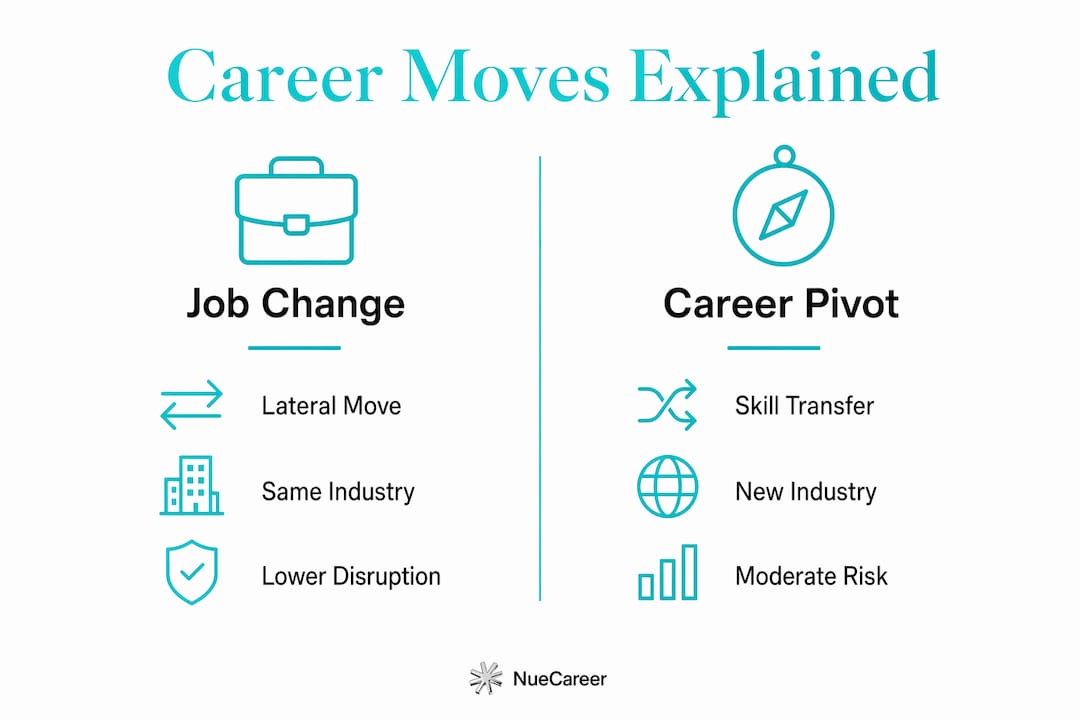
Discontinuity is the defining factor that separates a pivot from a job change. In a pivot, you redirect toward a different problem domain while applying your accumulated career capital. A software engineer who moves to a product management role is pivoting. A software engineer who joins a different tech company as a senior developer is making a job change.
Key distinctions at a glance:
- Job change: Same role, same industry, different employer. No discontinuity.
- Career pivot: Different role or industry, but strong skill overlap. Moderate discontinuity.
- Career change: New field, new credentials, often a step back in seniority. High discontinuity.
The practical implication is significant. Career pivots preserve seniority and income far more often than full career changes do. You are not trading your experience away. You are reframing it.
Pro Tip: Before you label your situation a "career change," check whether it is actually a pivot. If more than half your current skills transfer directly to the target role, you are pivoting, not starting over.
What are the common types of career pivots?
Career pivots vary widely in scope and risk. Understanding the main types helps you identify which path fits your situation.
Same skills, new industry. You apply your existing expertise in a different sector. A corporate trainer who moves into instructional design for a healthcare company is a clear example. The skills transfer directly. The industry context changes.
Same industry, new function. You stay in your sector but shift your role. A marketing analyst who moves into a brand strategy role within the same industry is doing this. The domain knowledge stays relevant. The day-to-day work shifts.
New role within the same company. Internal mobility is often the lowest-risk pivot option because you already have organizational trust and established relationships. Many companies actively support this through internal job boards and lateral transfer programs.
Adjacent role in a new industry. This is the broadest type of pivot and carries the most risk. A finance professional who moves into operations consulting at a tech startup is making this kind of move. The skill overlap exists, but both the role and the industry are new.
The table below summarizes each type by skill transfer and risk level.
| Pivot type | Skill transfer | Risk level |
|---|---|---|
| Same skills, new industry | High | Low |
| Same industry, new function | Medium to high | Low to medium |
| Internal role change | High | Very low |
| Adjacent role, new industry | Medium | Medium to high |
Choosing the right type depends on how much stability you need during the transition. Lower-risk pivots protect your income and seniority. Higher-risk pivots offer more change but require more preparation.
How can you successfully execute a career pivot?
Successful pivots follow a clear sequence. Skipping steps, especially the pilot phase, is the most common reason professionals end up needing a second pivot within two years.
Perform a values and skills audit. List every task in your current role, then mark which ones energize you versus which ones drain you. Separating energizing skills from daily tasks prevents you from pivoting into a role that looks different on paper but feels identical in practice. Use a structured tool like Nuecareer's free skills assessment to make this process faster and more objective.
Apply the adjacency rule. Identify roles where at least 60–70% of your current skills apply directly. The adjacency rule helps you target positions that protect your seniority and income while still offering genuine change. Roles with strong skill overlap require less retraining and shorten your transition timeline.
Develop your pivot narrative. Most people underestimate how much of the gap is a framing problem, not a capability problem. Gap closure during a pivot usually involves reframing achievements and building proof rather than acquiring entirely new skills. Write a clear story that connects your past experience to your target role. Practice it until it sounds natural.
Pilot before you commit. Take on a side project, volunteer for a cross-functional team, or conduct informational interviews with people already in your target role. Piloting via side projects is critical to avoid costly mistakes. Successful pivots follow a Plant, Scan, Pilot, Launch pattern. The pilot phase is where you confirm the fit before making it official.
Make the formal transition. Once you have tested the role and built proof assets, such as a portfolio piece, a completed project, or a relevant credential, you are ready to apply. Update your resume to reflect the new narrative. A resource like Nuecareer's career change resume tips can help you reframe your experience for a new audience.
Pro Tip: Informational interviews are one of the most underused tools in a pivot. Talking to three people already doing your target job will tell you more about fit than six months of online research.
Successful career pivots typically take several months rather than years, precisely because they build on existing skills. That timeline is realistic and achievable with a clear plan.
What are common pitfalls in career pivots and how to avoid them?
Most pivot failures trace back to a small set of predictable mistakes. Recognizing them early saves you significant time and stress.
The full reset mindset. Treating your pivot as a complete restart leads to unnecessary risk. The full reset mindset causes professionals to accept junior titles and pay cuts they do not need to accept. Your experience has value in the new context. Reframe it rather than abandon it.
Skipping the pilot phase. Committing to a new role without testing it first is the single most common reason pivots fail. Skipping piloting forces a second pivot within a short period, which is costly in both time and confidence.
Ignoring internal mobility. Many professionals look outward immediately when an internal move would be faster, safer, and just as fulfilling. Check whether your current employer has roles that match your pivot target before searching externally.
Accepting a downlevel role without alignment. Taking a junior position in a new field is sometimes necessary, but only when the role genuinely builds toward your goal. Accepting a step down simply because you feel you have no leverage is a mistake. Your transferable skills are worth more than you think.
Failing to build proof assets. Hiring managers in a new field cannot evaluate your potential from a resume alone. A portfolio piece, a completed freelance project, or a relevant certification gives them concrete evidence. Without proof, even a strong pivot narrative falls flat.
Key takeaways
A career pivot is a strategic redirection that applies your existing skills in a new context, and most professionals can execute one in months rather than years with the right preparation.
| Point | Details |
|---|---|
| Pivot vs. career change | A pivot preserves skill overlap and seniority; a full career change does not. |
| Skills audit first | Identify which skills energize you before targeting any new role. |
| Pilot before committing | Test the target role through side projects or informational interviews first. |
| Adjacency protects income | Target roles with 60–70% skill overlap to maintain your level and pay. |
| Framing closes most gaps | Most pivot gaps are a proof and narrative problem, not a capability problem. |
The part most career advice skips
Here is what I have noticed after watching hundreds of professionals attempt a pivot: the biggest obstacle is almost never a skills gap. It is a story gap. People spend months acquiring new certifications when what they actually need is a clearer way to explain what they already know.
The professionals who pivot most successfully are the ones who treat their existing experience as an asset to be repositioned, not a liability to be apologized for. A project manager who wants to move into operations consulting does not need to start over. She needs to show, specifically, how her work managing cross-functional teams translates to the problems an operations consultant solves. That is a narrative exercise, not a training exercise.
The other thing I would push back on is the idea that there is a perfect time to pivot. There is not. Professionals in their 30s worry they are too late. Professionals in their 50s worry even more. The data does not support that fear. What matters is the quality of your preparation, not the number on your birthday cake.
If you are feeling stuck, the most useful thing you can do right now is a honest career path evaluation that separates what you are good at from what you actually want to do more of. Those two things are not always the same. Getting clear on that distinction is where every good pivot begins.
— Shane
Nuecareer tools that support your career pivot
Planning a pivot is easier when you have the right tools at each stage.
Nuecareer's free career tools cover the full pivot process, from identifying your strengths to applying with confidence. The 7-minute Nuecareer quiz matches you to career paths built around your actual skills, including roles you may never have considered. Once you know your direction, the job application skills tool helps you identify and articulate exactly what you bring to a new role. Nuecareer also includes a built-in cover letter generator and 24/7 coaching chat, so you have support at every step of your transition.
FAQ
What is the difference between a career pivot and a career change?
A career pivot applies existing skills in a new context while preserving seniority and income. A career change typically involves starting over in a new field, often at a lower level.
How long does a career pivot take?
Most career pivots take several months rather than years because they build on existing skills rather than requiring new ones from scratch.
Can I pivot careers without taking a pay cut?
Yes. Pivots that follow the adjacency rule, targeting roles with strong skill overlap, protect income and seniority far more often than full career changes do.
What is the first step in a career pivot?
The first step is a values and skills audit that separates tasks you perform from skills that genuinely energize you. That distinction shapes every decision that follows.
Is a career pivot possible at any age?
A career pivot is viable at any career stage. The quality of your preparation and the clarity of your pivot narrative matter far more than your age or years of experience.