
Decoding Job Requirements: A Decision-First Guide

Learn how to decode job description requirements realistically to boost your application success. Apply confidently with expert insights!
Yes, apply, if you meet the hard requirements listed under "required" or "must." If you're missing one or two "preferred" items but hit everything else, apply anyway. The job posting is a wish list written by someone trying to solve a business problem, not a literal contract, and career coaches note that most postings reflect aspiration more than reality.
Your next move: pull the three or four must-have qualifications and match each one to a specific resume bullet before you touch the "submit" button.
Before you apply, scan for these deal-breaker signals:
- A required certification, clearance, or citizenship status you don't have
- A years-of-experience minimum stated as "must have," not "ideally"
- Contact information missing or an application process that feels deliberately vague
Job descriptions are wish lists. Hiring managers write them to attract a solution to a problem, not to filter out anyone who lacks a single bullet point.
Key Takeaways
Realistic decoding means treating "required" as a filter, "preferred" as a differentiator, and every posting as a business problem in disguise.
| Point | Details |
|---|---|
| Read requirements as filters | Treat "required" and "must" language as deal-breakers; treat "preferred" as a way to stand out among qualified candidates. |
| Prioritize by hiring impact | Rank compliance and licensing needs above day-one skills, and day-one skills above growth-oriented extras. |
| Mirror verbs and scale | Match ownership-level verbs like "own" or "define" and quantify your scale to fit what the posting implies about seniority. |
| Scan for red-flag phrasing | Watch for "wears many hats," "fast-paced environment," and missing contact details as signals to probe or reconsider. |
| Let a tool do the first pass | NueCareer's free Job Description Analyzer extracts must-haves and keywords, so you can apply the prioritization framework faster. |
Table of Contents
- How to Decode Job Description Requirements Realistically
- Required Vs. Preferred: What's Actually Negotiable
- A Framework for Prioritizing Job Requirements
- Red Flags Hiding in Plain Sight
- Tailoring Your Resume: A Before-and-After Example
- Sources
- FAQ
How to Decode Job Description Requirements Realistically
Every section of a job posting sends a signal, and reading it as a document instead of a checklist changes how you apply. This is what "analyzing a job description" actually means in practice: separating the parts that describe a real constraint from the parts that describe an ideal candidate nobody expects to find.
Start with the title and opening summary. A "Senior" or "Lead" prefix, or an opening line about "owning" a function, signals scope and seniority before you read a single qualification. The responsibilities list usually appears in priority order. What's listed first is what the hiring manager cares about most on day one, not what sounds impressive in a bullet list.
- Job title and summary: reveals seniority level and how much autonomy the role carries
- Responsibilities, in order: shows real daily priorities, not just a wish list of duties
- Qualifications section: separates hard requirements from aspirational extras
- Fine print and application instructions: often hides genuine eligibility conditions
- Company overview and values: signals the culture and pace you'd be walking into
The USAJOBS guidance on writing requirements makes an important point: the requirements section can include conditions like citizenship status, security clearances, or specific application steps. Miss one, and you're disqualified regardless of how strong your resume looks otherwise.
Required Vs. Preferred: What's Actually Negotiable
Language does most of the work here. "Required," "must have," and "will" mean the employer will filter out applications missing that item, often before a human reads them. "Preferred," "nice to have," and "bonus" mean the opposite: these are differentiators among otherwise-qualified candidates, not gatekeepers.
Three rules help you decide when a "preferred" item should be treated as required instead:
- It appears in both the qualifications section and the responsibilities list (repetition signals real priority)
- It's the first item listed under "preferred," rather than buried at the bottom
- It's a licensing or compliance requirement dressed in soft language, like "certification preferred" for a regulated role
Pro Tip: Read the posting twice. The first pass tells you what the job is. The second pass, where you highlight every repeated term, tells you what the employer actually needs to see in your application. This two-pass method is standard advice from CareerOneStop's guide to analyzing postings, and it works because repetition rarely happens by accident in a document someone edited under deadline pressure.
A Framework for Prioritizing Job Requirements
You don't need to overthink this. A three-step process gets you from a wall of bullet points to a decision and a tailored application.
- Extract the must-haves. Pull anything tied to compliance, licensing, specific tools, or an explicit years-of-experience threshold. These are non-negotiable filters, not suggestions.
- Rank by hiring impact. Safety and compliance requirements outrank day-one skill requirements, which outrank "nice to have" growth signals like a second language or an unrelated certification.
- Map one bullet per requirement. For each top requirement, find one line from your work history that proves you've done it, or something close enough to argue convincingly.
Match your resume verbs to the seniority the posting implies. Verbs like "own" and "define" in the responsibilities section signal full accountability. If your resume still says "assisted with" or "supported," you're undercutting yourself for a role that expects ownership language. Notch Resume's breakdown of job-posting verb patterns makes this connection directly: verb choice in the posting predicts what verb choice the employer expects to see back.
- Match scale words ("managed a $2M budget" vs. "managed a small budget") to what the posting implies about team or company size
- Use the same tool names and platform names the posting uses, not your own internal shorthand
- Skip generic soft-skill claims like "team player" unless the posting explicitly calls out a specific collaboration structure
Red Flags Hiding in Plain Sight
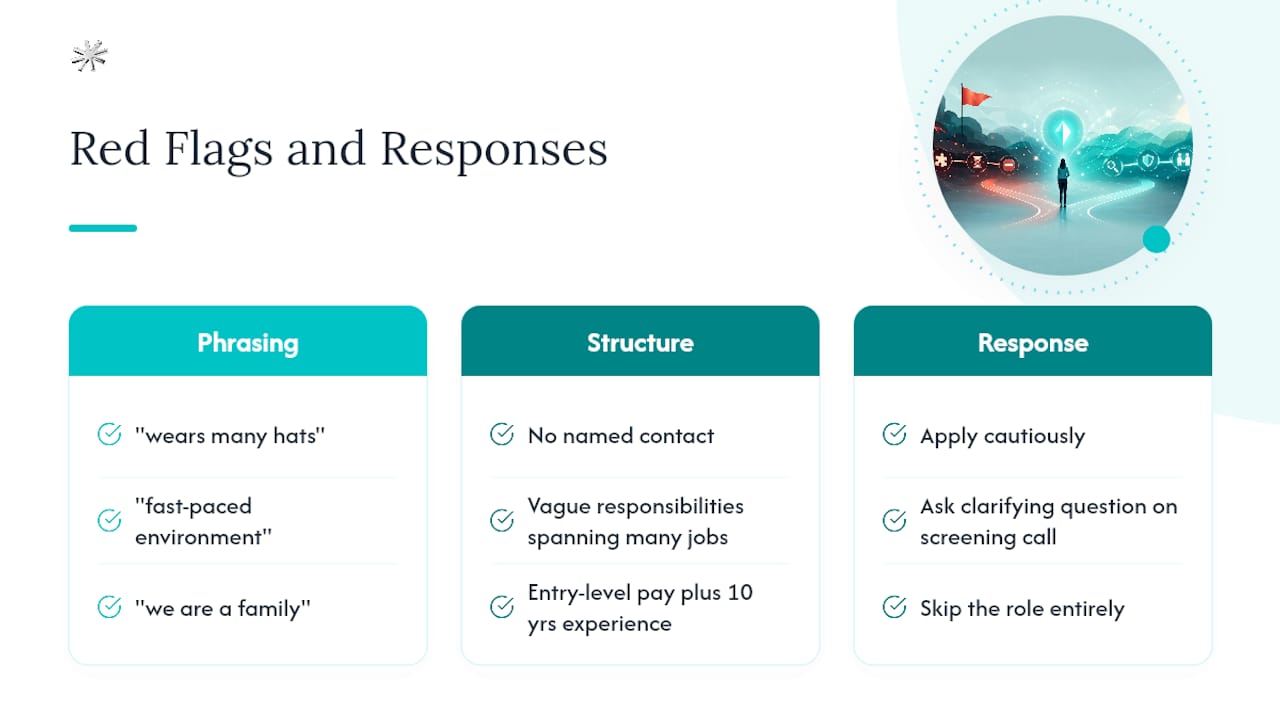
Some phrasing is common enough that job seekers stop noticing it, and that's exactly the problem. Watch for "wears many hats," "fast-paced environment," and "we are a family." Career coaches flag these as common signals of understaffing, weak boundaries, or burnout risk, even when the rest of the posting reads professionally.
Structural red flags matter just as much as phrasing. A posting with no named contact, vague responsibilities that could describe five different jobs, or a qualifications list that combines entry-level pay with ten years of experience is telling you something about how the role was scoped, or whether it was scoped at all. Use these signals to decide whether to apply cautiously, ask a clarifying question during the first screening call, or skip the role entirely.
Tailoring Your Resume: A Before-and-After Example
Once you've prioritized requirements, tailoring becomes mechanical instead of overwhelming. Mirror the posting's exact language in your title, summary, and the first bullet under each job, since that's where applicant tracking systems and human reviewers weight keywords most heavily.
Keyword placement priority:
- Resume title or headline (mirror their job title if it fits your background)
- Summary section (work in two or three exact-match terms from the posting)
- First bullet under your most recent role (front-load your strongest match)
- Skills section (list tools and certifications exactly as the posting names them)
Here's a raw bullet before decoding the posting, and after:
Before: "Responsible for helping manage customer accounts and supporting the sales team."
The second version mirrors an "own" verb from the posting's responsibilities section, adds scale (40+ accounts), and shows a measurable outcome instead of a vague duty. That's the difference between a bullet that survives an ATS scan and one that gets read by a human and remembered.
For your cover letter, skip the summary of your resume and instead name the specific business problem the role exists to solve, then show one example of solving something similar. If you're shifting industries or roles, the career change resume guide walks through how to translate transferable experience into language a hiring manager recognizes, and the free cover letter generator can help you structure that argument quickly.
How a Job Description Analyzer Speeds Up Decoding
Doing this manually for every posting is slow. NueCareer's free Job Description Analyzer does the first pass for you.
- Extracts must-have qualifications and separates them from preferred ones automatically
- Flags repeated keywords and phrases that signal ATS priorities
- Highlights ownership-level verbs so you know what seniority the employer expects
Paste in your target posting, then feed the output straight into the three-step prioritization framework above.
What Realistic Decoding Actually Requires
Most job seekers either take every requirement literally and talk themselves out of applying, or ignore requirements entirely and apply everywhere with the same resume. Neither works. The posting is a negotiation opener written under time pressure by someone who wants a specific problem solved, and your job is to read past the wish-list language to that problem.
The one place I won't compromise: never fabricate a qualification to match a posting's language. Mirror the verbs, mirror the scale, mirror the tools, but only where it's true. A clear read on where you actually stand against a role's requirements is worth more than a resume that oversells and gets exposed in the first interview question.
Try the Free Tools Before You Apply
Reading ten job postings a day and manually separating must-haves from wish-list items eats hours you don't have. NueCareer's Job Description Analyzer does that work in seconds, pulling out required qualifications, flagging the ATS keywords worth mirroring, and showing you exactly which verbs signal the seniority level the employer expects.

Once you've got that breakdown, the skills-to-application tool helps you match your own background against what the posting prioritizes, so you can decide in minutes whether a role is a real fit or a stretch worth attempting anyway. Pair it with the full tools hub for resume and cover letter generation once you know what to emphasize. If you're rethinking your direction entirely rather than just tailoring one application, this guide on switching careers without starting over is worth a look too. Start with the analyzer on your next open posting and see what it flags.
Sources
- Red flags to look out for in job postings — coaches' expert insights (Forbes)
- How to write job announcement requirements (USAJOBS Help)
- Analyzing job postings (CareerOneStop)
FAQ
What Is the 70/30 Rule in Hiring?
The 70/30 rule suggests candidates should apply if they meet a substantial majority of a posting's requirements, treating the remaining 30% as growth areas rather than disqualifiers. It's a rule of thumb, not a formal standard, so weigh it against which specific requirements you're missing.
What Are the Levels of the Job Title Hierarchy?
Job titles typically escalate through entry-level, associate, mid-level, senior, lead or principal, manager, director, and executive tiers, though exact naming varies by company and industry. The title and opening summary of a posting usually signal which tier you're being evaluated against.
What Are Common Mistakes in Job Descriptions?
Common mistakes include vague or duplicated responsibilities, unrealistic combinations of entry-level pay with senior-level requirements, and burying true eligibility conditions like clearances or certifications in fine print instead of the main qualifications list, a pattern flagged in job-posting red-flag research.
Should I Apply If I'm Missing a "Preferred" Qualification?
Yes, in most cases. "Preferred" qualifications are differentiators, not filters, unless the item is repeated in both the qualifications and responsibilities sections, which signals it functions as a real requirement.
How Can I Quickly Check Which Requirements Actually Matter?
Run the posting through NueCareer's Job Description Analyzer to separate required from preferred qualifications and surface the keywords worth mirroring in your resume.