
Older Jobseekers: Ageism in Hiring Cuts Callbacks 11–50%: What to Do

Research backed guide for older jobseekers: learn why ageism cuts callbacks 11–50%, which resume and interview fixes help, and how the 180 day EEOC clock...
Yes, ageism in hiring is real, measurable, and starts earlier in the process than most job seekers assume. A 2023 meta-analysis found older applicants face 11–50% lower odds of being considered, and the ADEA gives you real legal recourse if it crosses into discrimination. Your first moves: strip obvious date signals from your resume, vet employers before you apply, and start a simple log of every rejection that feels off.
TL;DR:
- Removing graduation dates older than 15 years and cutting phrases like "20+ years of experience" can significantly reduce age signals on resumes.
- Job ads requesting "digital natives" or "high energy" or asking for birth dates are subtle indicators that bias may be present in the hiring process.
- The legal window to file an age discrimination claim is 180 days from the incident, extendable to 300 days in some states, with proper documentation needed.
- Correspondence studies show older applicants face an 11% to 50% lower chance of callback, with bias strongest during resume screening.
- Employers actively valuing age diversity typically emphasize skills and outcomes over buzzwords and feature diverse teams, making research on company culture valuable.
Table of Contents
- What Does Ageism in Hiring Actually Look Like?
- What Are Your Legal Protections and EEOC Deadlines?
- What Does the Research Show About Age Bias in Hiring?
- Which Resume Edits Cut Age Signals Without Cutting Experience?
- How Do You Handle Age Bias in the Interview Room?
- How Do You Find Employers That Actually Value Age Diversity?
- How Do You Document and Prove Age Discrimination?
- How Can NueCareer Help You Act on This Right Now?
- What Should You Actually Expect From This Fight?
- Start With the Quiz, Then Fix What's Holding You Back
- Where to Read More
- Sources
- FAQ
What Does Ageism in Hiring Actually Look Like?
Age discrimination in employment means treating someone worse in hiring, promotion, or firing because they're 40 or older, according to the Equal Employment Opportunity Commission's guidance. It rarely announces itself. It shows up as small, deniable signals scattered across a job posting or an interview.
Watch for these patterns:
- Job ads that ask for a "digital native" or someone with "high energy" instead of specific skills
- Application forms that request your graduation year or date of birth before an offer is made
- Recruiter language that hints at "culture fit" tied to youth rather than ability
- Interviewers who fixate on decades of tenure instead of recent, relevant results
- Postings loaded with buzzwords like "ninja" or "guru" that skew toward younger applicant pools
None of these guarantee illegal age discrimination in employment on their own. Together, they're worth noticing.
What Are Your Legal Protections and EEOC Deadlines?
The Age Discrimination in Employment Act (ADEA) protects workers 40 and older at companies with 20 or more employees. It's one of the oldest federal shields against workplace bias, but it only works if you act inside its clock.

The window is tighter than most people think: 180 days. You generally have 180 days from the discriminatory act to file an EEOC charge, extended to 300 days if your state or city has its own age discrimination law. Once you file, you can bring a lawsuit 60 days later. Miss the deadline, and even a strong case can be thrown out on timing alone.
Before you file, gather:
- The original job posting, saved or screenshotted
- Every email or message exchanged with the employer
- Notes on interview questions, especially anything touching age
- A timeline of your application, interviews, and rejection
- Names of who you interacted with and their titles
What Does the Research Show About Age Bias in Hiring?
The strongest evidence comes from correspondence studies, which send matched fictitious resumes that differ only in signaled age. The 2023 systematic review and meta-analysis pooling these studies found older applicants receive 11% to 50% lower odds of a callback, with the penalty growing more severe as candidates age. That's not a hunch. That's dozens of controlled experiments pointing the same direction.
| Study type | What it measures | Key finding |
|---|---|---|
| Correspondence experiments | Resume screening stage | Strongest, most consistent age penalty; masking age narrows the gap |
| Vignette studies | Hypothetical hiring decisions | Weaker signal; less predictive of real callback behavior |
| BLS labor data | Long-term unemployment | 23.6% of unemployed people were jobless 27 weeks or longer as of September 2025 |
The screening stage is where bias hits hardest. Age-blind formatting, meaning resumes without graduation years or decades-old job titles, measurably narrows that gap in field tests. That's also why the long-term unemployed numbered in the millions that same month, a group where older workers are consistently overrepresented.
Which Resume Edits Cut Age Signals Without Cutting Experience?
Your resume doesn't need to hide your career. It needs to stop announcing your birth decade before a hiring manager reads your qualifications.
Start here:
- Drop graduation years and any dates older than 15 years
- Cut phrases like "20+ years of experience" unless the job explicitly wants tenure
- Rewrite bullets around outcomes, not job duration ("Cut onboarding time 30%" beats "Managed team for 12 years")
- Swap outdated tools for the platforms the job posting actually names
- Add a line for recent certifications, courses, or training completed in the past two years
Pro Tip: Write a short, role-specific summary at the top of your resume, three lines max, that mirrors the exact language in the job posting. It helps you clear applicant tracking systems and gives a human reader your strongest, most current qualification before anything else.
An ATS resume checker can flag outdated formatting or missing keywords before a recruiter ever sees the file, and career-change resume guidance walks through reframing long tenure as a strength rather than a liability.
How Do You Handle Age Bias in the Interview Room?
Interviews are where subtler bias lives. You can't control every interviewer's assumptions, but you can control how much current, adaptable competence you put on display.
- Open behavioral answers with a recent, measurable win, not your oldest career highlight.
- Use the STAR method (Situation, Task, Action, Result) to keep answers tight and outcome focused.
- Offer a brief demo or walk-through of a current tool or process when it's relevant to the role.
- If asked an unlawful age-related question ("When did you graduate?"), redirect calmly: "I focus on staying current. I recently completed X, and here's how it applies here."
- Note the exact wording of any inappropriate question right after the interview, while it's fresh.
Interviewers who ask about your development, mentoring style, or recent projects, rather than your retirement timeline, tend to signal genuinely age-inclusive teams. A short interview portfolio of two or three recent projects can carry that same "I'm current" message without a word of justification.
How Do You Find Employers That Actually Value Age Diversity?
Some employers filter out older applicants without ever saying so. Others actively recruit for age diversity in recruitment because they've seen what mixed-experience teams deliver. Learning to tell them apart before you apply saves you months.
- Green flag: job ads that list skills and outcomes instead of vague culture buzzwords
- Red flag: leadership pages or team photos that show only one generation
- Green flag: employee reviews on Glassdoor mentioning mentorship or "experienced hires welcome"
- Red flag: rapid-fire interview loops with no mention of onboarding support
- Green flag: explicit diversity statements that name age alongside other categories
Healthcare, education, government, and skilled trades tend to have stronger track records of hiring across age brackets. Checking a company's LinkedIn employee tenure spread takes five minutes and tells you more than most job ads ever will.
How Do You Document and Prove Age Discrimination?
A gut feeling isn't evidence. A pattern, documented consistently, is. If you suspect discrimination, treat every application like a case file from day one.
- Screenshot the job posting the moment you apply, including the date.
- Save every email, rejection notice, and scheduling message in one folder per employer.
- Write down interview questions verbatim within an hour of the interview, while memory is sharp.
- Track outcomes across multiple applications. A single rejection is not a pattern; five rejections followed by visibly younger new hires at the same company might be.
- If a pattern emerges, consult the EEOC or an employment attorney before your 180 day window closes.
Organized, timestamped records are what turn a suspicion into a credible charge. Vague memories rarely hold up.
How Can NueCareer Help You Act on This Right Now?
Knowing the tactics is one thing. Executing them under deadline pressure is another. NueCareer's 7-Minute Career Quiz identifies your strengths and matches you to roles you might not have considered, which matters when age bias has narrowed your usual search. From there, the ATS Resume Checker and Cover Letter Generator catch outdated formatting, and Mock Interview Practice lets you rehearse STAR answers before they count. Pair those with 24/7 coaching chat when you hit a wall mid-search.

What Should You Actually Expect From This Fight?
Ageism in hiring is a system-level problem, not a personal failing, and no resume trick erases that entirely. What you control is smaller but real: how current your application looks, how sharp your interview answers are, and whether you're keeping a record if something feels wrong. Start with one resume edit this week, target three employers with genuine age-diverse signals, and log anything questionable as it happens. If a pattern shows up, don't sit on it. Tactics and legal protections work best together, not as a choice between them.
— Shane
Start With the Quiz, Then Fix What's Holding You Back
NueCareer gives you a faster way to find roles that actually fit your strengths, instead of guessing which openings might overlook your age. The 7-Minute Career Quiz matches you to career paths built around your real strengths, often ones you hadn't considered, and hands you a personalized roadmap for getting there.
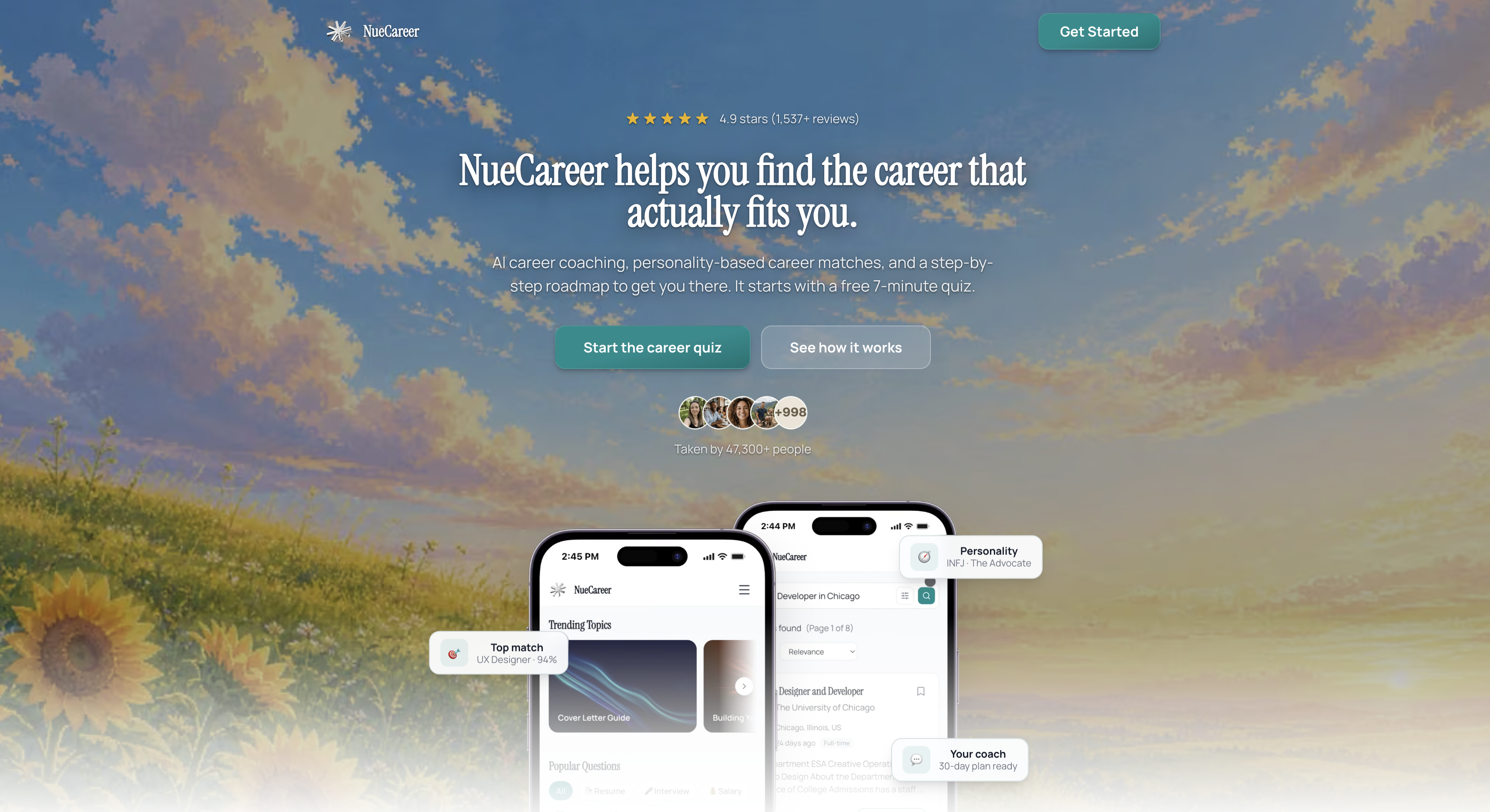
From that starting point, you can run your resume through the ATS Resume Checker, rewrite your professional summary with resume summary templates, and rehearse your STAR answers with Mock Interview Practice before you ever walk into a room. If you want a second opinion on whether an offer or a termination situation involves broader legal issues, resources like TerminationHelp cover employment discrimination questions worth understanding. Take the quiz, get matched, and start applying with a plan instead of a guess.
Where to Read More
- EEOC Facts About Age Discrimination: official rules on lawful and unlawful employer practices
- EEOC Filing Time Limits: exact deadlines for charges and lawsuits
- Collabra Meta-Analysis on Hiring Ageism: the pooled research behind the callback statistics
- BLS Long-Term Unemployment Report: labor-market context for older job seekers
Sources
- Ageism in Hiring: A Systematic Review and Meta-analysis
- Time limits for filing a charge of discrimination | U.S. Equal Employment Opportunity Commission
- Long-term unemployed accounted for 23.6 percent of all unemployed people in September 2025 | U.S. Bureau of Labor Statistics
FAQ
What Is the 70/30 Rule in Hiring?
There's no single, universally recognized rule tied to age discrimination in hiring. If you've seen one referenced, it likely refers to a specific company's internal hiring guideline rather than a legal standard, so treat it as anecdotal rather than an ADEA rule.
What Are Signs That Age Discrimination Is Happening at Work?
Common signs include being passed over for promotions despite strong performance, exclusion from training or new projects, comments about retirement plans, and being replaced by a younger, less-qualified hire. Coded job language and requests for graduation dates on applications are early warning signs during the hiring stage itself.
How Do You Prove Age Discrimination in the Hiring Process?
You build a case with saved job postings, email records, interview notes, and a documented pattern across multiple applications, since a single rejection rarely qualifies as proof. The EEOC generally requires a charge filed within 180 days of the discriminatory act, or 300 days in states with additional age discrimination protections.
How Do You Beat Ageism and Get Hired?
Start by removing date signals from your resume, framing experience around recent, measurable outcomes, and rehearsing STAR-based interview answers that highlight current skills. Tools like NueCareer's 7-Minute Career Quiz and ATS Resume Checker help you apply these tactics quickly instead of guessing what to fix first.