

Passion is not a career plan. That is the uncomfortable truth behind why so many people who "follow their heart" end up burned out, underpaid, or stuck in roles that no longer feel meaningful. Relying on passion as your primary guide when choosing a career is a high-risk strategy, and the research backs that up clearly.
Here is why passion alone falls short as a foundation for career choice:
- Passion fluctuates. What excites you at 22 may feel hollow at 32. Emotional states are not stable enough to anchor a decade-long career decision.
- Most jobs contain unglamorous work. Even careers built around genuine interests involve tedious tasks, administrative overhead, and difficult days that passion cannot carry you through.
- Passion ignores market demand. A career that nobody is hiring for, or that pays below a living wage, creates financial stress that erodes the passion itself.
- Passion precedes competence in the wrong order. Research from MIT's career development center shows that passion typically follows mastery, not the other way around.
- Burnout risk is real. When you tie your identity entirely to work you love, a bad quarter or a difficult manager can feel like a personal failure, accelerating emotional exhaustion.
- Skills and market fit predict success more reliably than enthusiasm alone, especially over a 10- to 20-year career horizon.
The good news: passion does not have to be abandoned. It just cannot be the only factor. The sections below explain what goes wrong when it is, and what a more grounded approach looks like.
Why passion alone fails as a reliable career guide
Passion is an emotional state, and emotional states shift. Career psychologists have long noted that what people describe as "passion" is often novelty, curiosity, or early excitement rather than a durable motivational force. Once the novelty fades and the real work begins, that initial spark rarely sustains performance on its own.
The practical reality of any job compounds this problem. A graphic designer still spends hours on client revisions they did not ask for. A chef still manages inventory and handles staff conflicts. No career is purely the part you love. Expecting constant passion is, as Forbes contributor Dr. Diane Hamilton writes, a myth that sets people up for disappointment by ignoring the necessary, unglamorous work every career requires.

Financial stability is another dimension passion-first thinking tends to skip. A career that aligns with your interests but has weak market demand puts you in a difficult position: you may love the work but struggle to pay rent, which creates a different kind of misery. Passion vs. practicality is not a binary choice, but ignoring the practical side entirely is a genuine financial risk. Startups built purely on founder passion, with no attention to market fit, face a high risk of closure: less than half survive, and 63% face closure according to recent research.
There is also a psychological cost to passion-only career choices that does not get enough attention. When your identity is fused with your work, criticism of your output feels like criticism of who you are. That dynamic accelerates burnout and makes it harder to adapt when the market or your interests shift.
Pro Tip: Before committing to a passion-driven career path, spend 30 days tracking which specific tasks within that field energize you versus drain you. The ratio tells you more than the label "I love this" ever will.
Key limitations to keep in mind:
- Passion is not a reliable predictor of long-term job satisfaction: fewer than half of tech startups survive, and 63% face closure when passion drives decisions without market fit.
- Work always includes tasks outside your area of enthusiasm.
- Market demand and compensation are non-negotiable practical constraints.
- Emotional investment in work without competence leads to fragile confidence.
- Career tests built on interest matching often fail to account for market realities and social roles, producing unreliable guidance.
What works better than "follow your passion"
The alternative to passion-first thinking is not passion-free thinking. The goal is integration: combining what interests you with what you are good at, what the market needs, and what your life actually requires. That combination produces careers that are both fulfilling and sustainable.
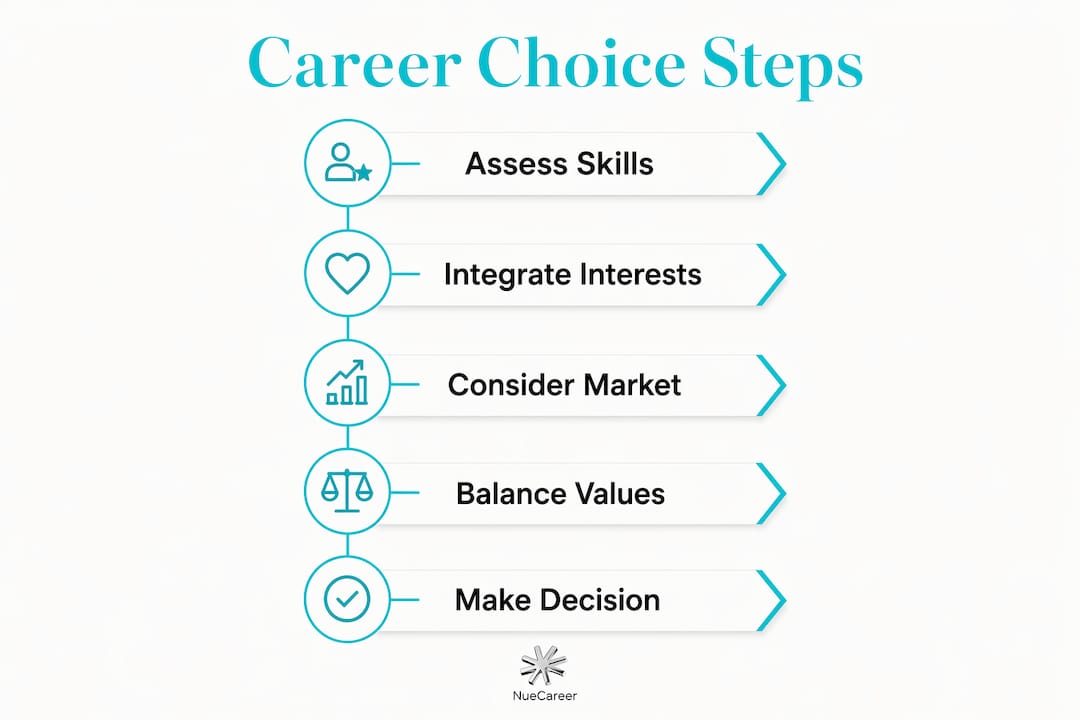
Start with skills. Building genuine competence in a field creates the conditions for deeper interest to develop. This reverses the conventional wisdom. Rather than waiting to feel passionate before investing effort, you invest effort first, and the passion often follows as you get better. Career capital built through deliberate skill acquisition leads to autonomy, impact, and eventually the kind of intrinsic motivation people mistake for pre-existing passion.
A hybrid career path offers another practical model. You keep a stable job that covers your financial needs while developing passion projects on the side. This "5-to-9" structure, where your evenings and weekends fund your growth, lets you test whether a passion can become a viable career without betting your rent on it. Many people discover their side project either grows into a full career or stays a fulfilling hobby, and both outcomes are valid.
Personal values and lifestyle goals belong in this equation too. A career that pays well but requires 70-hour weeks may conflict with your need for family time or creative freedom. Choosing a career wisely means asking not just "what do I love?" but "what kind of life do I want, and which careers make that life possible?"
Pro Tip: Test a career direction before committing to it fully. Volunteer, freelance, shadow a professional, or take a short course. Low-cost experiments give you real data that introspection alone cannot.
Better approaches in practice:
- Build skills first; let passion develop from competence.
- Use a hybrid model to manage financial risk during transitions.
- Align career choices with personal values and lifestyle needs, not just interests.
- Treat market demand as a filter, not an afterthought.
- Develop analytical skills for career change that transfer across roles and industries.
What career experts say about the passion myth
The "follow your passion" advice has been repeated so often it feels like common sense. Career researchers and psychologists have spent years unpacking why it is not.
"The 'follow your passion' myth creates unrealistic expectations that all work should feel effortless and exciting. Every career, no matter how well-matched to your interests, includes difficult, unglamorous, and sometimes deeply frustrating work. Expecting otherwise does not just set you up for disappointment — it makes you less resilient when the hard parts arrive."
— Dr. Diane Hamilton, Forbes
Research from 80,000 Hours, a career research organization, reinforces this. Their analysis found that career tests built on interest or personality matching consistently fail to predict long-term job performance or satisfaction, partly because they ignore how much context, team dynamics, and skill development shape outcomes. The best predictors of fit are not personality profiles but actual experience in the field.
Passion also tends to obscure the social function of work. A job is not just a vehicle for self-expression. It connects you to colleagues, serves a community, and provides structure. When passion fades, as it often does, those social and structural dimensions of work can carry you through periods of lower motivation. Passion-first thinkers who have not considered these dimensions often feel lost when the excitement wears off.
Common myths worth examining:
- "If I'm passionate, success will follow." Passion without skill, market fit, and persistence rarely produces sustainable success.
- "I'll know my calling when I feel it." Research consistently shows that passion emerges from mastery, not from a moment of revelation.
- "Doing what I love means I'll never feel like I'm working." Every career has hard days. The goal is meaningful work, not effortless work.
- "Career tests will tell me what I'm passionate about." Interest-based tests have weak predictive validity for long-term fit and often ignore market realities entirely.
- "Practicality means giving up on what matters to me." A stable income can fund the space and time to pursue what you care about most.
A practical framework for choosing a fulfilling career
Structured decision-making consistently outperforms gut instinct for complex, long-horizon choices like career selection. The framework below, grounded in research from MIT's career development center and 80,000 Hours, gives you a process that accounts for both personal fit and practical realities.
Generate more options than you think you need. The biggest mistake in career decisions is narrow framing: considering too few possibilities. Before evaluating anything, broaden your list of options deliberately. Include careers you have never seriously considered. The cost of ruling out a great option too early is much higher than the cost of investigating one more path.
Rate each option against 3–7 key factors. Avoid vague pros and cons lists. Instead, score each career option against factors that genuinely matter: career capital (skills and connections you will build), personal fit, market demand, supportive conditions, and alignment with your values and lifestyle. This structure keeps you focused on what actually drives long-term satisfaction rather than what feels exciting in the moment.
Investigate your top options with low-risk experiments. Do not rely on introspection. Effective career testing uses sequential, low-commitment experiments: read deeply about the field, speak to people doing the work, shadow a professional, take a short course, or freelance on a small project. Each step gives you real data about fit before you make a major commitment.
Check your gut, but do not defer to it entirely. After structured analysis, your instincts still carry useful information. If something feels wrong despite a strong rational case, take that seriously and investigate the source of the unease. A helpful reflection: imagine you made the decision. How would you feel 10 minutes from now, 10 months from now, and 10 years from now? That time-layered check often surfaces concerns that a spreadsheet misses.
Pro Tip: After completing your structured analysis, sleep on the decision for at least two days before acting. Your gut needs time to process what your rational mind has laid out. Decisions made immediately after analysis often miss what the slower, reflective part of your thinking would catch.
A balanced perspective on passion and career success
Passion is worth caring about. The goal here is not to dismiss it but to place it accurately in a larger picture. Passion alone cannot guarantee career satisfaction or financial stability, and treating it as the primary guide for career choice sets up unrealistic expectations that most careers cannot meet.
The research points toward a more grounded model:
- Competence comes before passion. Skill-building creates the conditions for genuine, durable interest to develop. Waiting to feel passionate before investing effort reverses the sequence that actually works.
- Market demand is a filter, not a ceiling. A career that nobody is hiring for, or that pays below your needs, creates stress that undermines the passion itself. Aligning interests with real opportunities is not selling out; it is being realistic.
- Values and lifestyle matter as much as interests. A career that conflicts with how you want to live will erode satisfaction regardless of how much you love the work itself.
- Hybrid approaches reduce risk. Keeping a stable job while developing passion projects on the side lets you test, grow, and transition without financial pressure forcing your hand.
- Structured decision-making beats gut instinct for long-horizon choices. Generate options, rate them against real factors, run low-risk experiments, and then check your gut with the benefit of that groundwork.
The most fulfilling careers tend to sit at the intersection of what you are genuinely good at, what the world needs, and what you can be paid for. Passion often shows up there, but it usually arrives after the work, not before it.
Not sure where your strengths actually point?
That is exactly the problem Nuecareer was built to solve. The 7-minute career quiz identifies your strengths and matches you to career paths built around who you are, including paths you have never considered. From there, you get personalized roadmaps, 24/7 coaching chat, and a full suite of resume and cover letter tools, all tailored to your target roles. If you feel stuck or lost, start with the quiz. It takes less time than a coffee break and gives you a clearer direction than months of second-guessing.
Key Takeaways
Passion alone is an unreliable foundation for career choice; combining it with skills, market demand, and structured decision-making produces far more sustainable and satisfying outcomes.
| Point | Details |
|---|---|
| Passion follows mastery | Competence built through deliberate practice tends to generate passion, not the other way around. |
| Market demand is non-negotiable | Careers with weak market fit create financial stress that erodes even genuine enthusiasm over time. |
| Hybrid careers reduce risk | A stable job funding passion projects lets you test and grow without betting your livelihood on early excitement. |
| Structured decisions beat gut instinct | Rating options against 3–7 real factors outperforms pros and cons lists for complex, long-horizon career choices. |
| Low-risk experiments reveal true fit | Shadowing, freelancing, and short courses give you real data that introspection and career tests cannot match. |
FAQ
Should passion determine your career choice?
Passion should inform your career choice, not determine it. Sustainable careers require skills, market demand, and alignment with your values alongside genuine interest.
How does passion affect your career over time?
Passion tends to fluctuate. Research shows it often develops from mastery rather than preceding it, so careers built on early excitement alone frequently lead to burnout when the novelty fades.
Is it better to pursue passion or a stable career?
A hybrid approach works best for most people: a stable job that covers financial needs while passion projects develop on the side, reducing risk and allowing real-world testing before a full transition.
What should you do if you have lost all passion for your career?
Audit which specific tasks within your current role still engage you, then use that data to identify adjacent roles or skills worth building. Passion often returns when competence grows in a new direction, so low-risk experiments matter more than a dramatic career overhaul.
Why do career tests fail to predict the right path?
Most career tests rely on interest or personality matching without accounting for market realities, team dynamics, or how much performance depends on context. Low-commitment field experiments consistently outperform test results as predictors of long-term fit.