
What Is a Hybrid Career Path? Your 2026 Guide

Discover what is a hybrid career path in 2026. Learn how integrating diverse skills can boost your income and career opportunities.
TL;DR:
- A hybrid career combines multiple roles or income streams into a cohesive professional identity, offering higher earnings and resilience. Building a successful hybrid requires establishing credibility in one lane first and managing roles with strong systems, not simultaneously. This approach aligns with market trends, as companies increasingly adopt hybrid employment, and professionals use it to diversify income and grow skills.
A hybrid career path is a professional trajectory that integrates multiple skill sets, roles, or income streams into one cohesive career portfolio. Rather than climbing a single ladder in one industry, you build across lanes. McKinsey's 2023 analysis found that hybrid workers earn on average 12% more than their single-employer peers. That premium reflects the real market value of professionals who bring depth from more than one domain. Kudzi Chikumbu, a well-known multi-hyphenate executive, puts it plainly: "security is not in one paycheck; it is in building more than one lane."
What is a hybrid career path, exactly?
A hybrid career path is formally described in career development literature as a "portfolio career" or "multi-hyphenate career." Both terms describe the same core idea: you hold more than one professional identity at once, or you build them in deliberate sequence. The informal phrase "hybrid career path" is the version most people search for, but portfolio career is the recognized industry term you will encounter in academic research and HR policy.
The model is not about doing random jobs. It is about combining roles that share an underlying logic. A data analyst who also teaches statistics workshops and consults for nonprofits is not scattered. That person is building contextual intelligence across three environments that reinforce each other. The skill transfer is the point.

Hybrid career paths represent a fundamental realignment of institutional power toward individual workers who assemble their own portfolio capital. That shift is visible in labor market data, corporate hiring experiments, and the growing number of professionals who no longer see a single employer as their primary source of security.
What are the common types of hybrid career structures?
The portfolio career model takes several distinct forms. Understanding each one helps you choose the structure that fits your life, not just your ambitions.
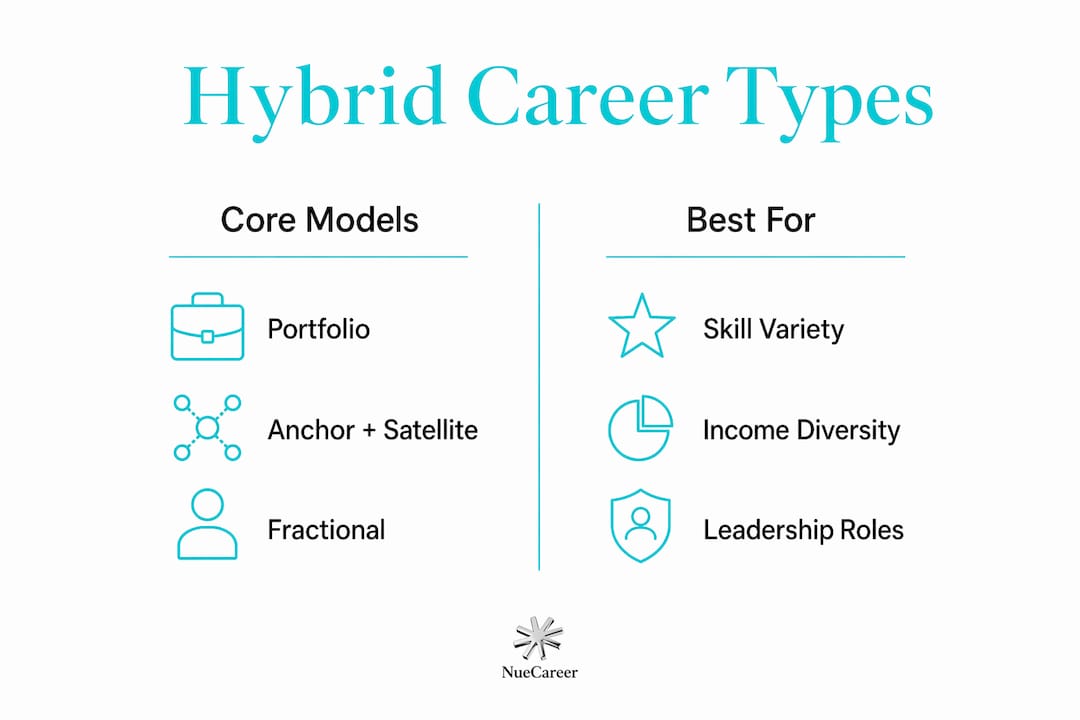
| Type | Description | Best For |
|---|---|---|
| Portfolio (multi-hyphenate) | Multiple complementary roles held simultaneously | Creatives, consultants, educators |
| Anchor plus satellite | One stable role supported by freelance or gig projects | Early-career professionals, parents |
| Fractional employee | Part-time executive or specialist across multiple companies | Senior professionals with niche expertise |
| Sequential hybrid | Roles built one after another, each expanding on the last | Those managing risk or energy carefully |
| Entrepreneurial combo | Salaried job plus active side business | Professionals testing a business idea |
The anchor plus satellite model
The anchor plus satellite structure combines a stable part-time or full-time role with smaller freelance or gig projects on the side. The anchor provides income stability and professional credibility. The satellite projects provide experimentation, extra income, and skill growth. This model works especially well for college graduates who want to test new directions without abandoning financial security.
Fractional employment
Fractional employment places a senior professional inside multiple companies on a part-time basis. IBM's 2022 pilot of fractional employment contracts across divisions reported a 15% reduction in total talent acquisition costs. That number matters because it signals that companies are actively building infrastructure for this model. Fractional roles are no longer a workaround. They are becoming a standard hiring option.
Pro Tip: If you are considering simultaneous roles, start with just two lanes. Trying to manage three or more at once dramatically increases burnout risk before you have built the systems to support them.
What benefits do hybrid career paths offer professionals?
The financial case for a hybrid career is clear. The 12% earnings premium documented by McKinsey comes primarily from premium rates on freelance and consulting contracts. Professionals who bring cross-domain expertise command higher fees because they solve problems that specialists cannot.
Beyond income, the career resilience argument is compelling. A professional with one employer is fully exposed if that employer downsizes, pivots, or disappears. A professional with three active lanes loses one-third of their income in the worst case. That is a manageable setback, not a crisis.
Professionals with contextual intelligence, who apply knowledge from multiple domains, solve complex problems better and lead more effectively. Employers increasingly recognize this. A marketing manager who also codes is more valuable than one who does not, even if the coding is never used directly in the marketing role.
Key benefits of building a portfolio career include:
- Multiple income streams: Reduces financial exposure to any single employer or client
- Continuous skill growth: Each role teaches something the others do not
- Greater marketability: Cross-domain experience stands out in competitive job markets
- Career satisfaction: Variety reduces the monotony that drives burnout in single-track careers
- Entrepreneurial testing: You can test a business idea alongside salaried work before committing fully
The number of nascent entrepreneurs among hybrid workers rose by 6 points from 2021 to 2024, driven by professionals testing new business ideas alongside salaried work. That growth reflects a broader shift: people are using hybrid structures not just to earn more, but to build toward something they own.
How to create a hybrid career path that actually works
Building a portfolio career requires structure. Without it, you end up overcommitted, underperforming, and exhausted. Most successful hybrid careers are built sequentially, by first establishing credibility in one lane before adding complementary roles. That sequence is not timidity. It is leverage.
Follow these steps to build your hybrid career path with intention:
- Identify your anchor lane. Choose the role or skill set where you already have credibility or can build it fastest. This becomes your foundation.
- Map adjacent opportunities. Look for roles, projects, or freelance work that draw on your anchor skills in a different context. Adjacency reduces the learning curve.
- Start small on the satellite. Take one freelance project or part-time role before treating it as a full lane. Validate the fit before investing heavily.
- Build your systems. Set up a shared calendar, create simple contracts for freelance work, and define your personal brand as the connective tissue across all roles.
- Audit your energy quarterly. Review which lanes are growing, which are draining you, and whether the combination still serves your goals.
- Update your resume and LinkedIn profile. Group your experience by skills and projects rather than by employer. An integrated resume summary creates a clearer value proposition than a list of disconnected jobs.
Hybrid careers fail most often due to poor structural management, specifically the absence of systems like calendars, contracts, and a consistent personal brand. That failure mode is entirely preventable. The professionals who thrive in portfolio careers treat the management of their career like a business operation.
A common resume mistake for hybrid roles is disjointed presentation. Grouping skills and projects into an integrated summary tells a coherent story. A list of unrelated job titles does not.
Pro Tip: Your personal brand is the thread that connects your lanes. Define one clear professional identity that encompasses all your roles, then make sure your LinkedIn headline, resume summary, and portfolio all reflect that same identity.
What trends and examples show hybrid careers going mainstream?
Kudzi Chikumbu's career is one of the clearest illustrations of the multi-hyphenate model in practice. He has operated simultaneously as a corporate executive, community builder, and creative director. His approach treats each role as reinforcing the others rather than competing with them. That integration is the defining feature of a well-built portfolio career.
"Security is not in one paycheck; it is in building more than one lane." — Kudzi Chikumbu
Corporate experimentation with hybrid employment is accelerating. IBM's fractional employment pilot is one data point. Broader labor market data shows the same direction. The rise of hybrid careers reflects a shift from specialization as the primary career value to contextual intelligence as the new premium skill.
| Trend | Data Point | Implication |
|---|---|---|
| Earnings premium | 12% higher pay for hybrid workers (McKinsey 2023) | Financial incentive is real and documented |
| Entrepreneurial growth | Nascent entrepreneurs up 6 points, 2021–2024 (GEM 2024) | Hybrid workers are building, not just earning |
| Corporate adoption | IBM pilot cut talent costs by 15% (2022) | Companies are structuring roles for hybrid professionals |
| Skill premium | Contextual intelligence increasingly valued by employers | Multi-domain experience is a competitive advantage |
The highest-performing professionals in 2026 will be those with hybrid skills and contextual intelligence to navigate complex, changing environments. That is not a prediction. It is a description of what employers are already paying for.
For professionals exploring nontraditional career trajectories, the hybrid model offers a structured way to move between industries without starting over each time.
Key takeaways
A hybrid career path succeeds when it is built sequentially, managed with clear systems, and anchored in one strong lane before expanding into others.
| Point | Details |
|---|---|
| Definition matters | A hybrid career path is a portfolio career: multiple complementary roles or income streams built into one cohesive professional identity. |
| Earnings are higher | McKinsey data shows hybrid workers earn 12% more on average than single-employer peers. |
| Structure prevents failure | Calendars, contracts, and a consistent personal brand are the systems that keep hybrid careers from collapsing. |
| Sequential beats simultaneous | Building one lane at a time reduces burnout and creates leverage for the next role. |
| Resume presentation is critical | Grouping skills and projects in an integrated summary communicates hybrid value far better than a list of unrelated titles. |
Why I think most people approach hybrid careers backwards
Most of the professionals I see struggling with a hybrid career made the same mistake: they tried to build three lanes at once before any single lane was solid. They spread their time, their energy, and their professional reputation across too many directions too fast. The result was not a portfolio. It was a pile.
The professionals who get this right treat their first lane like a foundation, not a limitation. They build credibility, earn trust, and develop a clear professional identity before they add anything else. That patience is not a lack of ambition. It is the reason their second and third lanes actually work.
The other thing I have noticed is that the brand coherence question matters far more than people expect. You can hold three completely different roles and still present as one clear professional if the thread connecting them is visible. A nurse who also teaches health communication and consults for healthcare startups is not confusing. That person is a healthcare professional who works across clinical, educational, and commercial contexts. The framing is everything.
Hybrid careers are not a destination you arrive at. They are a design practice you return to every few months. The professionals who thrive are the ones who keep asking: does this lane still serve the whole? If the answer is no, they cut it. That kind of intentional pruning is what separates a real portfolio career from just being busy.
— Shane
Build your hybrid career with Nuecareer
Knowing you want a hybrid career is one thing. Knowing which skills to lead with, how to present them, and which roles to target is another challenge entirely.
Nuecareer's free career skills assessment identifies your strongest transferable skills and shows you where gaps exist across your target roles. From there, the job application skills tool helps you highlight the right skills for each specific role you apply to. And the free job description analyzer breaks down exactly what employers are looking for so your application speaks their language. If you are ready to put your hybrid career on paper, Nuecareer's resume and cover letter tools are built for professionals with complex, multi-lane experience.
FAQ
What is the difference between a hybrid career and a portfolio career?
A portfolio career is the formal industry term for what most people call a hybrid career path. Both describe a professional who holds multiple complementary roles or income streams rather than a single full-time position.
Is a hybrid career right for me?
A hybrid career fits professionals who want income diversification, skill variety, and greater control over their work. It requires strong self-management and the ability to build systems across multiple commitments.
How do I start building a hybrid career path?
Start by establishing credibility in one anchor role before adding satellite projects. Sequential development reduces burnout and creates the professional leverage needed to expand into additional lanes.
How should I present a hybrid career on my resume?
Group your experience by skills and projects rather than by employer. An integrated summary that connects your roles into one clear value proposition communicates your hybrid background far more effectively than a list of unrelated titles.
Do companies actually hire for hybrid roles?
Yes. IBM's 2022 fractional employment pilot cut talent acquisition costs by 15%, and fractional and part-time specialist roles are now a standard hiring option across many industries.