

TL;DR:
- Career fulfillment provides genuine meaning and satisfaction through aligned work, boosting overall well-being. Meeting core psychological needs like autonomy, competence, and relatedness sustains motivation and prevents burnout. Deliberate job crafting and organizational support enhance engagement, performance, and life satisfaction without job changes.
Career fulfillment is defined as the deep sense of meaning and satisfaction that comes from work aligned with your values, autonomy, and desire for growth. Why career fulfillment matters becomes clear when you look at the data: workers who enjoy their daily work rate their overall life satisfaction 0.28 points higher on global evaluation scales. That gap is not trivial. It means the quality of your work experience shapes how you feel about your entire life. Career fulfillment, known in organizational psychology as work meaningfulness, is not a luxury. It is a measurable driver of wellbeing, motivation, and sustained performance.
Why career fulfillment matters for your psychological health
The psychological case for career fulfillment rests on Self-Determination Theory, one of the most replicated frameworks in work psychology. The theory identifies three core needs that every person brings to work: autonomy (control over how you work), competence (the ability to grow and succeed), and relatedness (genuine connection with others). When your job satisfies all three, you stay motivated. When it blocks them, you burn out.
Autonomy, competence, and relatedness are not abstract ideals. They are the psychological fuel that sustains performance across roughly 90,000 working hours in a lifetime. That is a long time to run on empty. Burnout does not arrive suddenly. It builds slowly when your needs go unmet, week after week, until motivation collapses entirely.
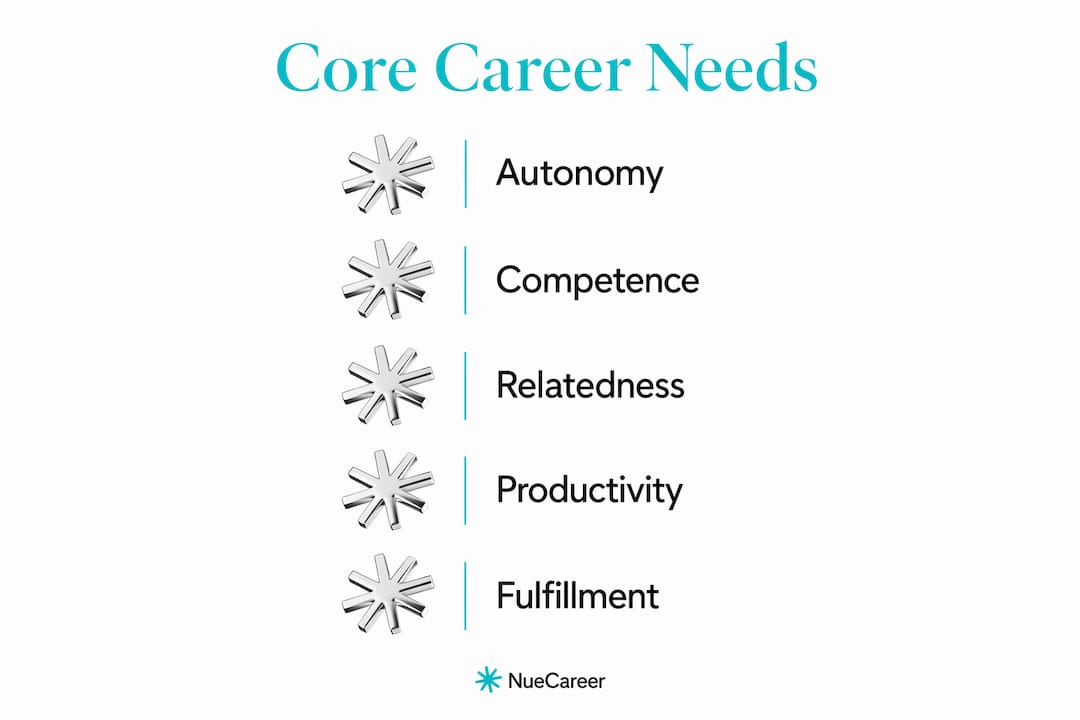
Work engagement, characterized by vigor, dedication, and absorption, is the direct result of meeting these needs. Engagement buffers burnout and builds the resilience that carries you through difficult periods. Without it, even high performers plateau and disengage.
The three psychological needs that career fulfillment satisfies:
- Autonomy: Having real input over your tasks, schedule, and methods. This is the single strongest predictor of job satisfaction.
- Competence: Facing challenges that stretch your skills without overwhelming you. Stagnation kills motivation as surely as overload does.
- Relatedness: Building trust and genuine connection with colleagues. Isolation at work is a direct path to disengagement.
Pro Tip: If you feel stuck or unmotivated, audit which of these three needs your current role is blocking. That diagnosis tells you exactly where to focus your energy.
How does career fulfillment influence productivity and performance?
The productivity benefits of career fulfillment are not theoretical. They show up in measurable organizational outcomes. Research from the LSE Business Review examined what happens when organizations run structured "Discover Your Purpose" workshops. The results were striking.
- Low performance dropped sharply. Workers performing below expectations fell from 10.4% to 5.3% after purpose-driven interventions. That is nearly a 50% reduction in underperformance.
- Gender performance gaps narrowed. Women showed disproportionately strong gains, suggesting that meaning-based work design addresses systemic engagement barriers that pay raises alone do not.
- Turnover increased, but productively. Some workers who found clarity about their purpose chose to leave roles that were a poor fit. The remaining workforce performed at a higher level.
- Financial incentives fell short. Meaning-based interventions outperform monetary rewards for sustained productivity gains. Pay gets people in the door. Purpose keeps them performing.
The key insight: Purpose interventions do not just make people feel better. They change behavior in ways that show up on performance metrics.
The productivity argument for career fulfillment is now one of the strongest in organizational research. When people find meaning in their work, they bring more energy, focus, and creativity to every task. That is a competitive advantage no salary package can replicate.
Is passion enough to find career joy?

The short answer is no. Passion is a starting point, not a destination. The "passion trap" is the belief that finding the right field or dream industry will automatically produce satisfaction. Research from the Fung Institute at UC Berkeley shows that job satisfaction depends far more on job characteristics than on field alignment. A nurse who loves medicine but has zero autonomy and no feedback will be miserable. A data analyst who never imagined working in tech but has strong relationships and meaningful tasks will thrive.
The Job Characteristics Model, developed by organizational psychologists Hackman and Oldham, identifies five job features that predict satisfaction more reliably than industry choice:
| Job characteristic | Why it matters |
|---|---|
| Skill variety | Using multiple abilities prevents boredom and builds confidence |
| Task significance | Seeing the real impact of your work creates meaning |
| Autonomy | Control over how you work is the strongest satisfaction driver |
| Feedback | Knowing how you are doing sustains motivation and growth |
| Task identity | Completing a whole piece of work gives a sense of ownership |
Autonomy has the strongest effect on satisfaction, followed by feedback and task significance. This means you can redesign your experience of almost any job by targeting these five levers. You do not need to quit and start over. You need to understand what actually drives your satisfaction.
Social relationships at work matter just as much. Job satisfaction comes more from meaningful social experiences and autonomy than from working in a dream industry. A supportive team, a manager who listens, and a culture of trust are not soft perks. They are core ingredients of a fulfilling career.
Pro Tip: Before switching industries, assess your current role against the five Job Characteristics Model factors. You may find that targeted changes to your existing role deliver more satisfaction than a full career change.
What practical steps can you take to build career fulfillment now?
Job crafting is the most evidence-backed method for increasing fulfillment without changing jobs. It is the practice of making self-initiated changes to your work to better align it with your strengths, values, and relationships. Job crafting positively correlates with increased job satisfaction and engagement across industries and roles.
There are three types of job crafting, and each targets a different dimension of your work experience:
- Task crafting: Change the scope, type, or number of tasks you take on. Volunteer for projects that use your strengths. Delegate or minimize tasks that drain you without adding value.
- Relational crafting: Reshape who you interact with at work. Seek out colleagues who energize you. Build mentoring relationships. Reduce time with people who consistently undermine your motivation.
- Cognitive crafting: Change how you think about your work. Reframe a repetitive task as a contribution to a larger mission. A hospital administrator who sees their role as "keeping patients safe" rather than "processing paperwork" experiences the same job very differently.
Start small. Pick one task this week that you could shift, one relationship you could invest in, or one reframe you could apply to a draining responsibility. Measure how your energy and engagement shift over two to four weeks. The benefits of career path clarity compound when you make consistent, deliberate adjustments rather than waiting for a perfect opportunity.
Avoiding burnout is part of this process too. Freelancers and remote workers face particular risks, and the strategies for avoiding burnout overlap directly with job crafting principles: protect your autonomy, build social connection intentionally, and create feedback loops for your own performance.
Pro Tip: Keep a two-week "energy log." Note which tasks, interactions, and moments leave you feeling energized versus depleted. Your log will reveal your natural strengths and the specific changes most likely to increase your fulfillment.
How can organizations build a culture that supports career fulfillment?
Organizations that treat fulfillment as a cultural priority outperform those that rely on compensation alone. Career satisfaction is a dynamic evaluation shaped by psychological capital, organizational support, and work-life balance. That means it is not fixed. Managers and leaders can actively move it in the right direction.
The most effective organizational practices for building fulfilling work environments:
- Design jobs with autonomy built in. Give people real control over their methods and schedules, not just the illusion of choice.
- Create regular, meaningful feedback loops. Annual reviews are not enough. Weekly check-ins that focus on growth and contribution sustain engagement.
- Communicate organizational purpose clearly. People need to see how their individual work connects to a mission that matters. Purpose workshops, like those studied by the LSE, are a proven starting point.
- Build psychological safety. People share ideas, admit mistakes, and grow faster when they trust that honesty will not be punished.
- Support career development actively. Coaching, mentoring, and career coaching for adults all signal that the organization is invested in the person, not just the role.
Leadership behavior is the single most powerful lever. A manager who models curiosity, acknowledges uncertainty, and connects daily work to larger goals creates the conditions where fulfillment can grow.
Key Takeaways
Career fulfillment is the most reliable predictor of sustained motivation, performance, and life satisfaction. It is built through autonomy, meaningful work design, and deliberate job crafting, not through passion or pay alone.
| Point | Details |
|---|---|
| Fulfillment drives life satisfaction | Workers who enjoy their work rate their overall life satisfaction measurably higher on global scales. |
| Three psychological needs are non-negotiable | Autonomy, competence, and relatedness must be met to prevent burnout across a working lifetime. |
| Purpose beats pay for performance | Meaning-based interventions cut low performance rates nearly in half, outperforming financial incentives. |
| Passion is not enough | Job characteristics like autonomy, feedback, and task significance predict satisfaction more than industry choice. |
| Job crafting works without switching jobs | Task, relational, and cognitive crafting increase engagement and satisfaction in your current role. |
What I have learned after years of watching people chase the wrong thing
The most common mistake I see is people treating career fulfillment as a destination. They believe that once they find the right job title, the right company, or the right industry, satisfaction will follow automatically. It almost never works that way.
What actually moves the needle is ownership. The people I have seen build genuinely fulfilling careers are not the ones who waited for the perfect role. They are the ones who actively shaped their current role, built relationships with intention, and got honest about what they actually needed from work. They used tools like the career identity framework to understand who they are before deciding where to go.
The research backs this up. Career satisfaction is a psychological mechanism that links daily work to long-term success through personal ownership, not organizational luck. The uncomfortable truth is that no employer can give you fulfillment. They can create conditions for it. You have to do the rest.
My advice: stop waiting for the right circumstances and start making deliberate, small changes to how you experience your current work. The compound effect of those changes is more powerful than most people expect.
— Shane
Nuecareer can help you find your path faster
Knowing that career fulfillment matters is one thing. Knowing where to start is another. Nuecareer is built for working adults who feel stuck or unsure about their direction. The platform gives you the tools to understand your strengths, identify roles that align with your values, and apply with real confidence.
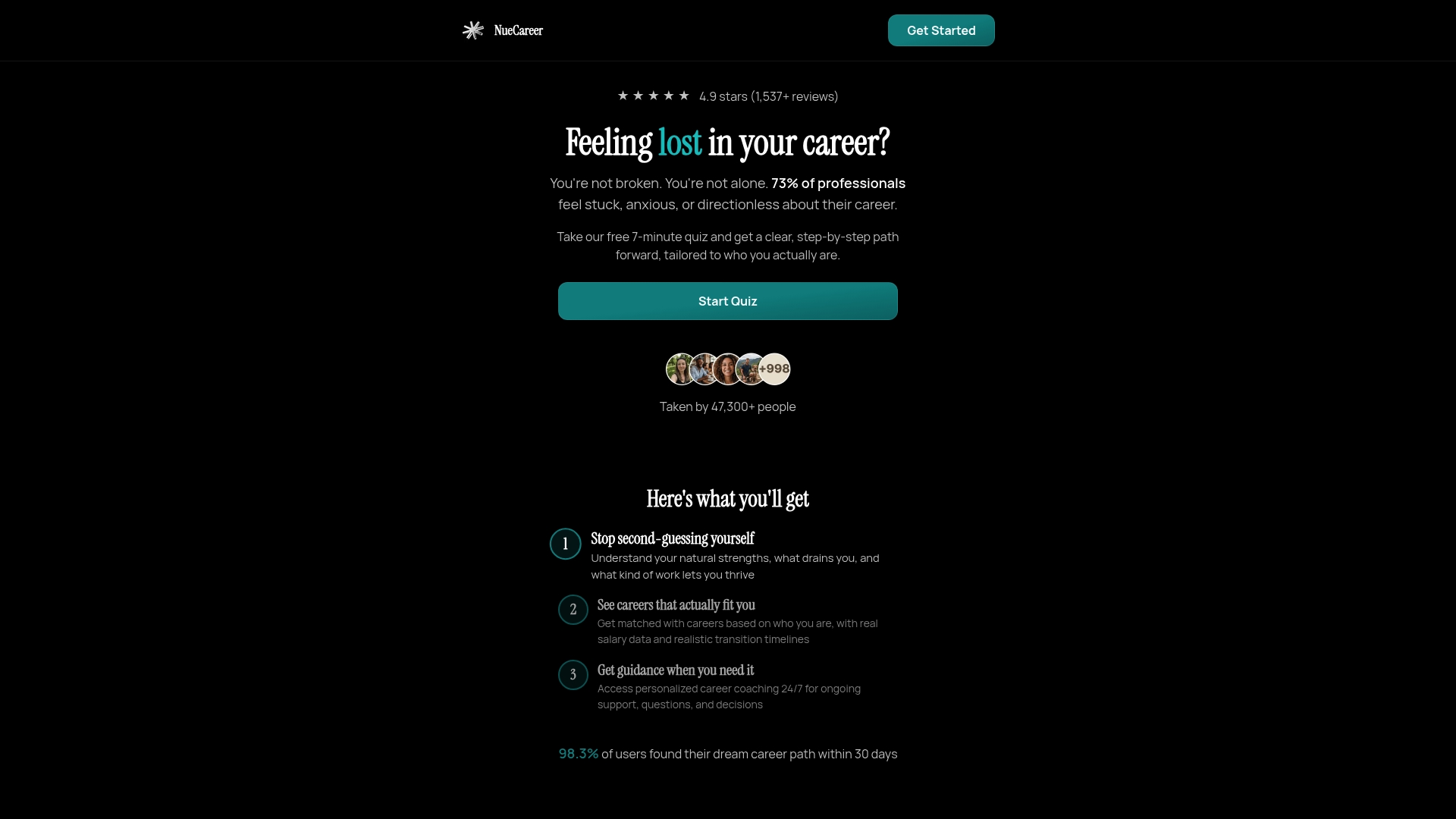
The 7-Minute Career Quiz is the fastest way to get clarity. It matches you to career paths built around who you are, including options you may never have considered. From there, Nuecareer's free career tools give you personalized roadmaps, 24/7 coaching chat, and a full suite of resume and cover letter resources. You do not need to figure this out alone. Nuecareer puts the right support in your corner from day one.
FAQ
What is career fulfillment, exactly?
Career fulfillment is the sense of meaning and satisfaction that comes from work aligned with your values, autonomy, and personal growth. It is distinct from job satisfaction, which measures moment-to-moment contentment, and reflects a deeper, more sustained connection to your work.
Does a higher salary lead to greater career fulfillment?
Financial incentives are less effective than meaning-based approaches for long-term motivation and performance. Research shows that purpose-driven interventions produce stronger, more sustained productivity gains than pay increases alone.
Can you increase career fulfillment without changing jobs?
Yes. Job crafting, which includes task, relational, and cognitive changes, positively correlates with higher job satisfaction and engagement. Most people can meaningfully improve their work experience through deliberate, self-initiated adjustments to their current role.
How do I know if my career needs are being met?
Audit your work against three core needs: autonomy, competence, and relatedness. If one or more of these is consistently blocked, you are likely experiencing the early stages of disengagement or burnout, and targeted job crafting or coaching can help.
How does career fulfillment affect life outside of work?
Workers who enjoy their daily work rate their overall life satisfaction measurably higher than those who do not. The impact of job fulfillment extends well beyond the office, shaping energy levels, relationships, and overall sense of purpose.