
3 O*NET Aligned Skills Matrix Examples for Career Changers

Three evidence backed skills matrix examples for career changers, mapped to O*NET and BLS vocabulary. Take the 7-Minute Career Quiz to get a starter plan.
A personal skills matrix is a simple grid that lines up your strongest skills, how well you actually perform them, and the roles they point toward. Below, you'll find three annotated examples you can copy today, a step-by-step build method rooted in real evidence, and a fast option for mapping your strengths if you'd rather skip the spreadsheet: The 7-Minute Career Quiz.
TL;DR:
- A skills matrix should include specific skills, proficiency ratings, concrete evidence of past tasks, and targeted roles, ideally focusing on your top three strengths.
- When building the matrix, start from actual tasks performed, translate them into recognized skills, and rate proficiency on a 0-4 scale, identifying skills that need further development.
- Use your completed matrix to craft tailored resume bullets, cover letter lines, and interview stories that accurately reflect your strengths and close key skill gaps.
- Prioritize closing gaps that unlock the most roles with the least effort, such as short courses or small projects, and verify role requirements through reputable sources like O*NET and BLS.
- A quick assessment quiz can speed up mapping your strengths but should be combined with detailed evidence to sharpen your application materials.
Table of Contents
- 1. Annotated skills matrix examples you can copy
- 2. How to build your skills matrix step by step
- 3. Using the matrix to close gaps and tailor applications
- Common mistakes career changers make with a skills matrix
- Try The 7-Minute Career Quiz to speed up your skills mapping
- Where to check your target-role requirements
- Sources
- FAQ
1. Annotated skills matrix examples you can copy
The fastest way to build your matrix is to start from one that already fits your situation. Here are three formats, each suited to a different kind of career change.
Project coordination pivot. If you're moving from an operations, admin, or support role into project management, your matrix should separate what you've done from what a hiring manager needs to see.
| Skill | Proficiency (0-4) | Evidence (task) | Match to target role |
|---|---|---|---|
| Scheduling and timeline management | 3 | Coordinated vendor deliveries across 3 concurrent events | Project scheduling for client engagements |
| Cross-team communication | 4 | Ran weekly status updates for 5 department heads | Stakeholder reporting |
| Budget tracking | 2 | Monitored a departmental supply budget | Project cost control |
| Risk flagging | 1 | Occasionally caught vendor delays before they escalated | Risk management planning |
Data-adjacent pivot. For readers moving toward analyst or reporting roles, split technical and transferable skills so a recruiter can see both at a glance.
- Technical: spreadsheet modeling (proficiency 3, evidence: built a shared inventory tracker used by four teams).
- Technical: SQL basics (proficiency 1, learning action: complete a short SQL course before applying).
- Transferable: attention to detail (proficiency 4, evidence: caught recurring billing errors before they reached clients).
- Transferable: presenting findings to non-technical audiences (proficiency 3, evidence: summarized quarterly reports for leadership).
Compact one-page matrix. When you're tailoring a resume or cover letter fast, trim the grid to five or six rows and drop straight into your application language: skill, proficiency, one evidence line, and the exact phrase from the job posting it answers.
Portfolio matrix. If your target role rewards work samples over titles, list two or three achievement bullets tied to specific skills instead of a full grid: "Redesigned onboarding checklist, cutting new-hire questions by half" ties directly to process improvement and documentation skills, and reads better in a portfolio than a bare rating.

2. How to build your skills matrix step by step
Building the matrix works best when you start from what you've actually done, not from a list of skills you think sound impressive. BLS guidance on changing occupations recommends assessing your existing qualifications first and tailoring your résumé and cover letter to the target job's real tasks, rather than simply stating that you're switching fields.
- Inventory your tasks. List ten to fifteen things you actually did in recent roles, then pull out the action verbs: coordinated, drafted, negotiated, audited, trained.
- Translate verbs into standardized skills. Use O*NET's transferable-skills vocabulary to convert "coordinated vendor schedules" into a recognized skill label like scheduling and logistics coordination, which keeps your language consistent with how employers and applicant tracking systems actually search.
- Rate your proficiency. Use a plain 0 to 4 scale (0 = no experience, 4 = expert) and mark each gap as either closeable with a short course or project, or a true entry barrier that requires a license or degree.
- Map skills to your target roles. Pick one to three roles and note any education or certification expectations tied to each.
- Prioritize. CareerOneStop's assessment guidance recommends narrowing down to your three strongest skills and up to eight career matches, which keeps the matrix usable instead of overwhelming.
Pro Tip: Write your evidence line before you write the skill label. It's easier to spot the right skill once you've described what you actually did.
3. Using the matrix to close gaps and tailor applications
Once your matrix exists, its job is to feed directly into your applications, not sit in a folder. Every evidence line you wrote in step one can become a resume bullet: turn "coordinated vendor schedules" into "coordinated delivery schedules across three vendors, cutting delays by tracking weekly check-ins," adding a number wherever you have one.
- Pick two to four short projects or microcredentials that close your highest-priority gaps, such as a weekend SQL course or a volunteer project that gives you a real deliverable to point to.
- Build STAR-based interview stories (situation, task, action, result) directly from your matrix evidence, so your answers match what's on your resume.
- Rewrite your strongest matrix rows into two or three cover letter lines that speak directly to the target role's listed tasks.
- Sort your gap list by impact versus effort, and close the ones that unlock the most roles for the least time invested first.
More than half of workers, 60.8% according to the BLS Occupational Requirements Survey, need more than basic people skills to do their jobs, which is a strong argument for giving interpersonal skills their own rows in your matrix rather than folding them into a generic "communication" line. A partner guide on aligning your resume to current hiring trends offers practical steps for turning this kind of evidence into resume language that actually gets read.
Common mistakes career changers make with a skills matrix

Most matrices fail for the same reason: the skills are too vague to prove anything. "Good communicator" tells a hiring manager nothing; "trained four new hires on client intake procedures" does. Another common mistake is treating every gap the same way. A missing certification is an entry barrier you plan around, not a skill you can casually pick up in a weekend.
Refresh your matrix as you learn more about your target occupations, and keep checking your entries against real O*NET and BLS data rather than assumptions. When the mapping feels overwhelming or you're not sure which roles fit your strengths at all, a guided assessment like The 7-Minute Career Quiz can shortcut the first draft.
— Shane
Try The 7-Minute Career Quiz to speed up your skills mapping
Building a matrix from scratch takes real time, and if you'd rather start with a draft than a blank page, The 7-Minute Career Quiz gives you a starting map of your strengths and matches them to career paths, including some you may never have considered. From there, NueCareer turns that output into a personalized transition roadmap so you're not left guessing what to do with your results.
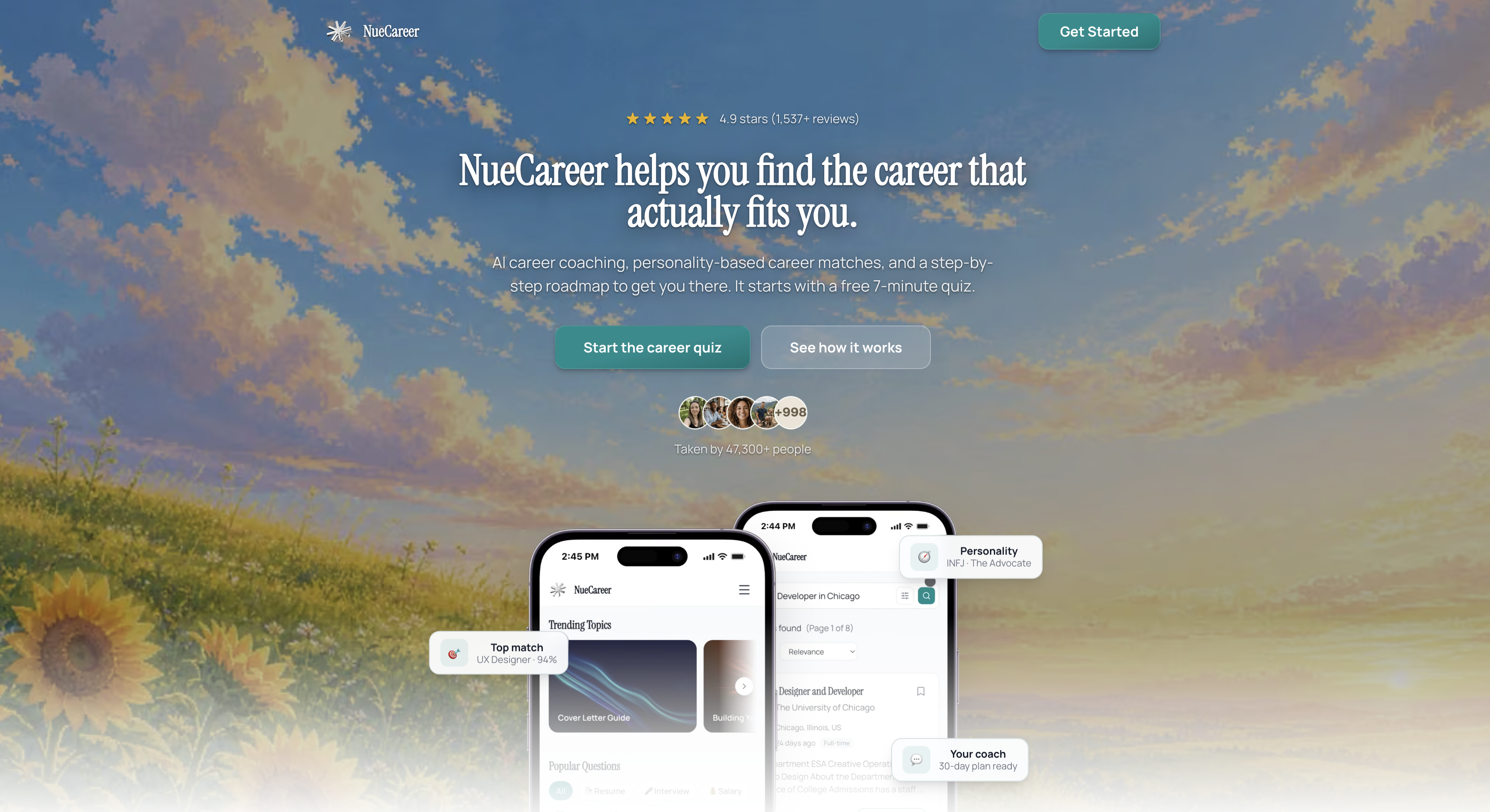
Once you have your matches, the rest of the toolkit picks up where the matrix leaves off:
- A personalized roadmap that sequences your gap-closing steps by priority.
- Around-the-clock AI coaching chat to discuss which roles may fit your evidence best.
- Resume, cover letter, and interview prep tools that turn your matrix rows straight into application language.
Take the quiz, review your matches, and let the roadmap tell you exactly what to build next.
Where to check your target-role requirements
Before you commit to a target role, verify your matrix against the people who track this professionally: O*NET for skill vocabulary, CareerOneStop's Skills Matcher for practical rating tools, and BLS for occupational outlook data.
Sources
- CareerOneStop — What is an assessment?
- BLS — New year, new career: 5 tips for changing occupations
- BLS — Occupational Requirements Survey, 2025 summary
- ONET — transferable skills and occupational data (via DOL/ONET)
- CareerOneStop — Skills Matcher
FAQ
What should a personal skills matrix include?
A personal skills matrix should list your skills, a proficiency rating (commonly 0 to 4), a piece of evidence from a past task, and the target role each skill supports. CareerOneStop recommends narrowing your list to your three strongest skills and up to eight career matches.
How many skills should I put on my matrix?
Keep your matrix focused rather than exhaustive. CareerOneStop's Skills Matcher rates 40 skills but suggests exporting only your top results for resumes and job searches, since a shorter list is easier to act on.
What's the difference between a technical skill and a transferable skill?
A technical skill is tied to a specific tool or method, like SQL or bookkeeping software, while a transferable skill, such as communication or problem solving, applies across many roles. O*NET's transferable-skills data provides standardized vocabulary for labeling both types consistently.
How do I know if a skill gap is closeable or a real barrier?
A closeable gap is one you can address with a short course, certification, or practice project within a few months. A true barrier usually involves a required license or degree, and BLS career-change guidance recommends treating the two differently in your planning.
Can a quiz replace building my own skills matrix?
A quiz like The 7-Minute Career Quiz can give you a fast starting map of your strengths and likely career matches, but pairing it with a detailed matrix of task-level evidence gives you stronger material for resumes and interviews.