

A skills inventory is a written list of what you can do, where you did it, and how well, with proof next to each line. The template below has five columns: the skill, where you used it, a 1 to 4 rating, the evidence, and whether you want to keep using it. Fill it in once and you have the raw material for a resume, an interview answer, or a career change plan. It works best when it is honest, specific, and finished in a single sitting.
If you feel stuck, an inventory is a calm place to start. It turns a vague worry ("I don't know what I'm good at") into a page you can read, edit, and act on. Below you will find the template, a worked example, a checklist of skills to prompt your memory, and a way to turn the result into target jobs.
TL;DR
- A skills inventory lists your skills, where you used them, a rating, and proof. The proof is what makes it useful to employers.
- Rate each skill on a 1 to 4 scale and back every 3 or 4 with a short STAR story (Situation, Task, Action, Result).
- Add a column for enjoyment. A skill you are good at but dislike should not drive your next job search.
- Compare the finished list to three real job postings to see your matches and gaps.
- Our 7-minute career quiz can show you careers built around your strengths, including ones you may not have considered.
Table of Contents
- What a skills inventory is, and how it differs from a skills audit
- The skills inventory template
- How to fill it in, step by step
- A filled-in skills inventory example
- A skills inventory checklist to jog your memory
- Making your ratings trustworthy
- From inventory to career change: mapping your skills to jobs
- Turning your inventory into resume and interview material
- Where NueCareer fits
- Our perspective
- FAQ
- Sources
What a skills inventory is, and how it differs from a skills audit
People use "skills inventory," "skills audit," and "skills assessment" almost interchangeably, and for a job seeker the overlap is fine. There are small differences worth knowing.
The Open University's career course defines a skills audit as a review and assessment of your existing skills that gives you a profile to compare with what you need now and later. Its activity has you work through a categorized questionnaire, list the skills you score highest and enjoy most, and note the ones you want to develop.
San Jose State University's School of Information draws a finer line. It describes an assessment as a current measurement of growth, while an inventory is an exercise in identity: you recall every role you have held, group them into categories, and name the skills, metrics, and actions they share.
In plain terms:
- Inventory: what you have done and can do, written down with proof.
- Audit: the inventory plus a review of strengths, enjoyment, and gaps.
- Assessment: a measured score, often from a quiz or a manager.
The template in this article covers the first two. For the third, our free career skills assessment gives you a view of strengths and gaps.
The skills inventory template
Copy this table into a document or spreadsheet. Add as many rows as you need. Most people end up with 15 to 30.
| Skill | Where I used it | Ability (1-4) | Evidence (STAR) | Enjoyment (1-4) |
|---|---|---|---|---|
Here is what each column does.
Skill. One skill per row, named as a verb phrase or a clear noun: "training new staff," "building budget reports," "resolving customer complaints." Specific beats broad.
Where I used it. A job, a volunteer role, a class, a side project, even a family responsibility. Central Michigan University's skills exercise uses a similar structure, with columns for skills you have, where you used them, and how you can show mastery to an employer.
Ability (1 to 4). The U.S. Department of Labor's employment workshop guide has participants rank each skill from 1 (not competent) to 4 (very competent) and add any skills missing from the list. We suggest the same four steps: 1 not competent, 2 somewhat competent, 3 moderately competent, 4 very competent.
Evidence. One or two lines in STAR form. If you cannot write the evidence, rate the skill lower or mark it as a skill to develop.
Enjoyment (1 to 4). This is our addition, and it matters for career change. More on that below.
How to fill it in, step by step
1. Start with your history, not a list of buzzwords
Write down every role you have held, paid or unpaid. SJSU encourages you to list roles without limits, from jobs and school to hobbies and volunteering, then look for the patterns across categories. A parent who runs the PTA bake sale and a retail supervisor may both have scheduling, budgeting, and conflict resolution on their lists.
Where it goes wrong: starting from job titles. Titles hide skills. Start from what you actually did on an ordinary Tuesday.
2. Pull out the verbs
For each role, write five to ten things you did, beginning each with a verb: scheduled, trained, negotiated, analyzed, drafted, repaired. Each verb is a candidate skill. Johns Hopkins University's career center takes a similar approach: it has you list professional and personal accomplishments, mark transferable skills from a provided list, and add two or three skills that were critical to each success that the list left out.
3. Use a checklist to jog your memory
Most people forget skills because they feel ordinary to them. Run through the checklist in the next section and add anything that applies.
4. Rate ability, then add evidence
Give each skill a 1 to 4 for ability. Then write the evidence for every 3 and 4. The DOL guide teaches STAR statements, which turn a duty like "train team members" into a short story with a visible result. If you want more practice, our guides to STAR method examples and turning daily behaviors into STAR stories show how.
Keep evidence to behaviors, not adjectives. "Detail-oriented" says nothing. "Checked a 40-page report for consistency before it went to the client" proves it.
5. Rate enjoyment separately
This is where an inventory becomes a career change tool. Sort each skill into one of four groups:
- Good at it and enjoy it: your core. Lead with these on your resume and in your job search.
- Enjoy it but not yet strong: your growth list. These are worth building through courses or projects.
- Good at it but don't enjoy it: the trap. You can do the work, but a job made of these skills will wear you down.
- Neither: let it go.
People changing careers often discover that the skill they use most is the one they most want to leave behind.
6. Don't undersell yourself
The Open University warns that modesty or low confidence during an audit might close off work options you are interested in and leave you underselling yourself to employers. If you are unsure between a 2 and a 3, ask a former coworker or manager what they would say. Ask for their examples, not just a number.
A filled-in skills inventory example
Here is an illustrative inventory for a fictional office manager, Dana, who is considering a move into operations or training. The details are made up to show the format.
| Skill | Where I used it | Ability | Evidence | Enjoyment |
|---|---|---|---|---|
| Scheduling | Office manager, 14 staff | 4 | Built a shared calendar system that ended double-booked meeting rooms | 2 |
| Training others | Office manager | 3 | Taught three new hires the billing system; all were working independently within a month | 4 |
| Writing procedures | Office manager | 3 | Rewrote the staff handbook and cut onboarding questions | 4 |
| Public speaking | None yet | 1 | Avoids it | 3 |
| Budget tracking | Church fundraiser volunteer | 3 | Tracked a small event budget and reported to the board | 3 |
Read it the way a career coach would. Dana's core skills are training others and writing procedures: strong and enjoyable. Scheduling is the trap, since Dana is very good at it and does not enjoy it. Public speaking is a growth item that matters for training roles. A target job like corporate trainer or operations coordinator suddenly looks plausible, and Dana has two real stories to bring to an interview.
A skills inventory checklist to jog your memory
Use these prompts to find skills you have stopped noticing. The Department of Labor guide separates two kinds, and it helps to cover both.
Hard skills are technical knowledge you can teach and test:
- Software you use (spreadsheets, CRMs, design tools, scheduling systems)
- Typing, data entry, record keeping
- Mechanical or equipment skills
- A second language
- Licenses, certifications, and safety procedures
Soft skills describe how you work with people and problems. The DOL guide lists communication, critical thinking, relationship building, and teamwork among them. The same guide cites a RAND study of transferable skills that service members share, including project planning, decision making, and attention to detail. Those apply to civilians too.
To go further, try these prompts:
- What do coworkers ask you for help with?
- What did you do in your last role that no one asked you to do?
- What tasks make time disappear?
- What have you taught someone else?
- What problems have you fixed that saved time or money?
For ready-made wording, our list of transferable skills examples gives more than 30 you can adapt for a resume.
Making your ratings trustworthy
A 1 to 4 scale is simple, but different people read the numbers differently. Two habits fix that.
First, define each level by what you can do, not by a label. For project management, a 2 might mean you keep a plan up to date with guidance, and a 3 might mean you run a cross-functional project on your own and handle the risks that come up. Write one sentence like that for your most important skills.
Second, date your ratings. A skill you used daily three years ago is not the same as one you used last month. Put a year next to the evidence, and re-rate anything you have not touched recently.
If you want an outside view, an online self-assessment can prompt reflection in areas your work history does not cover, and you can bring what you learn back to your inventory.
From inventory to career change: mapping your skills to jobs
A finished inventory is only useful if it points somewhere. Here is a four-step way to map skills to jobs.
- Circle your core skills. These are the rows with high ability and high enjoyment.
- Find roles built from them. Browse job titles whose duties are mostly your core skills. The CareerOneStop transferable skills page, from the U.S. Department of Labor, suggests reflecting on tasks from volunteer, educational, and job experience, then comparing your list with the skills for a target job to see what training or experience you may need.
- Test against three real postings. Highlight every required skill in each posting. Match it to a row in your inventory. Skills you have nowhere on the page are hard gaps. Skills in your growth group are soft gaps you can close while working.
- Label each duty. Mark each posting duty as core (you are good at it and enjoy it), growth (you want to build it), or trap (you can do it but would rather not). A role with mostly core and growth duties is worth pursuing.
The Labor Department's guide also tells transitioning service members not to downplay their experience, noting that employers are often looking for potential, and that a supply officer's scheduling and budgeting skills carry over to project management. The same logic applies to a teacher, a retail manager, or a restaurant lead. Your skills are portable even when your job title is not. Our guide to identifying transferable skills for a career change walks through the translation in more detail.
Turning your inventory into resume and interview material
Once your evidence column is filled in, you have most of your application written.
- Resume bullets: Take each STAR story and compress it into one line with a number if you have one: "Trained three new hires on the billing system; all independent within a month."
- Skills section: Use the exact skill names that appear in the postings you tested, as long as your inventory backs them up. Our skills for a job application tool can help you choose which ones to feature.
- Interview answers: Each 3 or 4 in your inventory is a ready-made answer to "Tell me about a time when..."
Keep the inventory as a master document and tailor a short version for each application.
Where NueCareer fits

A spreadsheet shows what you have done. The harder question for a career changer is which careers fit it. We built NueCareer for working adults who feel lost or stuck. Our 7-minute quiz helps you identify your strengths and matches you to career paths built around who you are, including careers you may never have considered. From there, the platform gives you a personalized roadmap, 24/7 coaching chat, job boards tailored to your target roles, and resume and cover letter tools.
You can take the 7-minute career quiz and then compare the matches to your own inventory. Where they overlap, you have your strongest direction.
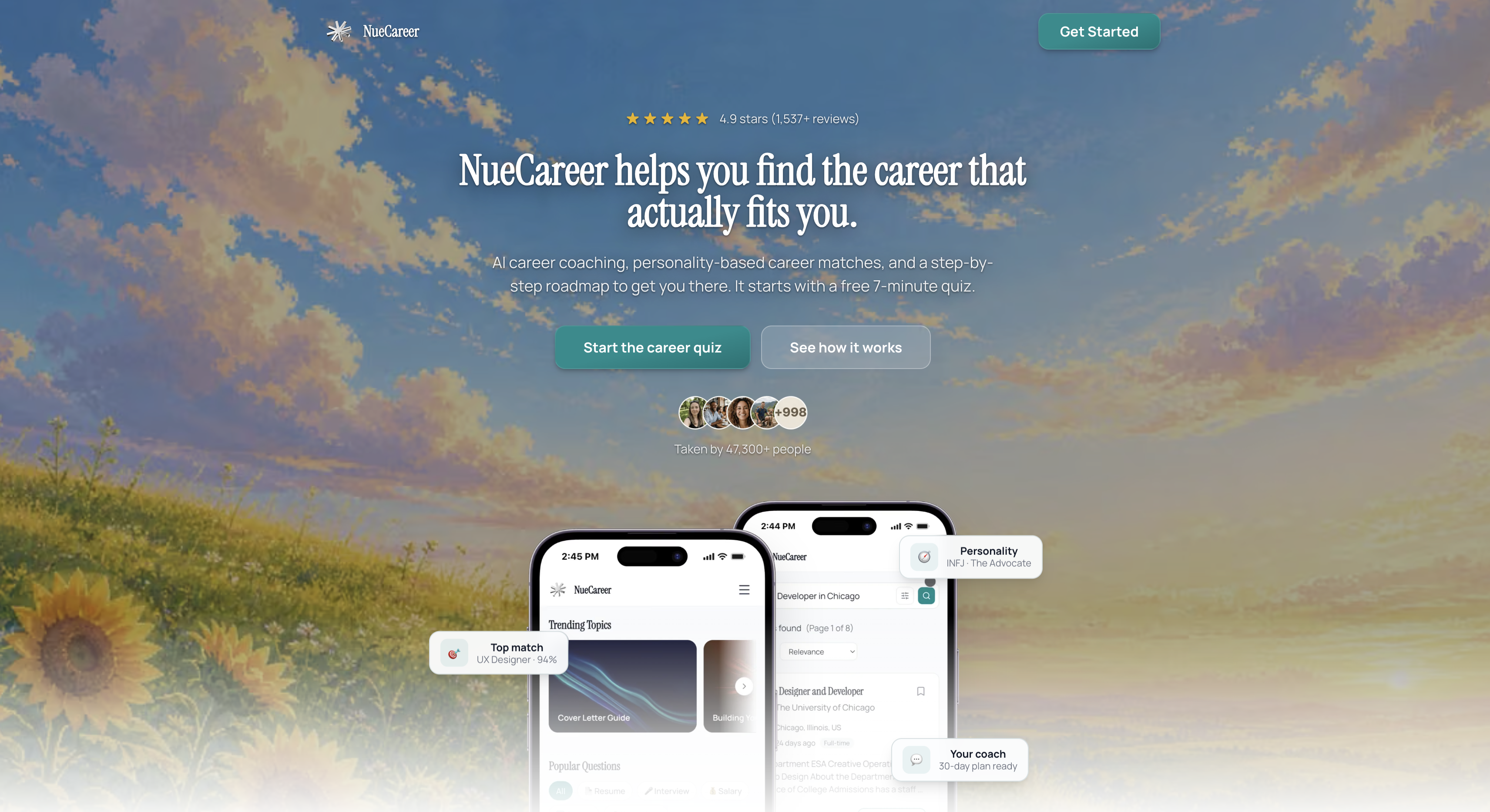
If you would like to see the tools that help after the match, from the ATS resume checker to mock interview practice, they are collected on our tools page.
Our perspective
Most people we talk to who feel stuck are not short on skills. They are short on a clear picture of them. They have spent years doing the work and never stopped to name it, so when a form asks "What are your strengths?" they freeze.
That is why we like the inventory habit: write it down, prove it with a story, and rate how much you enjoy it. The enjoyment column is the one most templates leave out, and it is the one that tells you which direction to go.
We also believe your inventory should not stay on a page. The point is to find roles that fit who you are, including ones outside your current field, and then to build a plan to get there. That is what our quiz, roadmaps, and coaching chat are designed to do: take what you already know about yourself and turn it into next steps you can feel confident about.
Shane
FAQ
How long should a personal skills inventory take?
Plan for 60 to 90 minutes for a first pass. Spend the first 20 minutes listing roles and verbs, the next 30 rating skills, and the rest writing evidence for your strongest ones. You can refine it over a week, but a rough first draft done in one sitting beats a perfect one you never finish.
How many skills should I list?
Aim for 15 to 30 skills. Fewer than that and you are probably missing things. More than that and the list gets hard to use. Group related skills, such as "scheduling" and "calendar management," into one row.
What is the difference between a skills inventory and a skills audit template?
The two are close enough that the same table works for both. An inventory focuses on recalling and documenting what you have done. An audit adds a review step: comparing your skills to what a target job needs and noting gaps. The template above does both once you add the posting comparison.
Can I use a skills inventory if I am changing careers?
Yes, and it is one of the best uses. Because it records skills rather than job titles, it shows what carries over to a new field. Pair it with three real job postings for the role you want, and mark what is a match and what is a gap.
Sources
- Open University, OpenLearn: Understanding your skills and abilities
- San Jose State University School of Information: Take Stock of Yourself with a Skill Inventory
- Central Michigan University: Skills Assessment Exercise
- U.S. Department of Labor: Employment Workshop Participant Guide
- Johns Hopkins University Imagine: Skills Inventory
- CareerOneStop: Transferable skills