

Do a structured skills self-assessment now, using a simple worksheet or The 7-Minute Career Quiz, to surface your top strengths, your transferable skills, and the few skills worth building next. A clear rating scale plus concrete evidence makes your ratings far more reliable, and BLS and O*NET data can anchor them to real occupations. Below you will find the worksheet layout, a mapping method, and a short development plan.
TL;DR:
- Use a consistent scale for technical and soft skills, attach dated evidence to each rating, and ask a trusted colleague to review your strongest claims.
- CareerOneStop compares up to 40 skill ratings with more than 900 O*NET occupations and filters as many as 150 matches by education, pay, and outlook.
- BLS lists adaptability, attention to detail, and interpersonal skills among the workforce’s top skills, while occupational rankings vary, so prioritize your target role’s needs.
- Choose a few skills that match target roles, set measurable goals, then produce proof, such as a report or presentation, in weeks 6–7.
Table of Contents
- How do you run a skills self-assessment in one sitting?
- How do you spot the transferable skills hiding in your work?
- How do you turn your skills into realistic career options?
- How do you build a short plan from your results?
- Why does this method hold up against real labor-market data?
- What I have learned about keeping a self-assessment honest
- Why take the quiz next, and what comes after?
- FAQ
- Sources
How do you run a skills self-assessment in one sitting?
You need some uninterrupted time, a blank document or spreadsheet, and your recent work history. The goal is a single page that shows what you can do, how well, and what you want to grow. Guidance from SFIA says self-assessment works best with a structured framework and documented evidence, and that recording that evidence improves accuracy and credibility.
Start by gathering proof before you rate anything:
- Recent roles, with dates and your main responsibilities
- Projects you led or contributed to, and what changed because of your work
- Achievements, feedback, awards, or numbers you can point to
Then work through these steps:
- List your technical skills, such as spreadsheet modeling, scheduling software, or content editing.
- List your soft skills, such as communication, problem solving, or coaching others.
- Rate each one using a scale such as Beginning, Developing, Accomplished, or Exemplary.
- Write the evidence next to every rating, including dates and metrics where you have them.
- Mark whether you enjoy using the skill, and flag the ones you want to develop first.
Set up your worksheet with columns for Skill, Evidence (project or activity), Rating, Enjoy (yes or no), and Develop (priority). If you want a ready-made starting point, explore our career tools. For a wider look at why this step matters during a job change, see our piece on the role of self-assessment in career change.
For accuracy, ask a trusted colleague to look over your strongest ratings. A second view catches both modesty and overconfidence.
How do you spot the transferable skills hiding in your work?
Transferable skills are abilities that are not tied to one job title. Communication, problem solving, data handling, leadership, project management, and customer focus all travel well across roles and industries. The trick is translating what you did day to day into the skill underneath it.
Here are some activity-to-skill pairs to model your own list on:
- Managed vendor onboarding: project coordination and stakeholder communication
- Handled escalated customer complaints: problem solving and customer focus
- Built a weekly sales report: data handling and attention to detail
- Trained new hires: coaching and clear explanation
- Covered a teammate's workload during a busy quarter: adaptability and prioritization
- Ran the monthly budget review: numerical reasoning and accountability
- Organized a team move to a new tool: change management and planning
- Led a small cross-team initiative: leadership and negotiation
On a resume or in an interview, name the skill, then back it up with an outcome. "Coordinated vendor onboarding and made the setup process more efficient" lands far better than "good at organization." If you have a metric, use it. If you do not, describe the result in plain terms: what got faster, cheaper, safer, or easier.
Pro Tip: Write each skill as "verb + what you did + result." You will reuse these lines in your resume, your cover letters, and your interview answers.
Our guide to identifying transferable skills for a career change has more examples. Communication shows up on almost every employer's wish list, and this communication skills assessment overview shows how recruiters think about evaluating it.
How do you turn your skills into realistic career options?
Your self-ratings get stronger when you check them against labor-market data. Two free resources do most of the work. CareerOneStop's Skills Assessment lets you rate up to 40 areas, build a list of your strongest skills, and see which careers match, using ONET mapping. The BLS skills data page explains that ONET underpins its tables of top skills by occupation and occupational group.

The Skills Matcher compares your 40 ratings with the knowledge, skills, and abilities for more than 900 O*NET occupations, and the help page says it returns up to 150 matches with filters for education, pay, and outlook.
Use it like this:
- Take your top-rated skills from your worksheet and enter your ratings in the Skills Matcher.
- Apply filters for education level, wage, and job outlook so the results fit your real constraints.
- Open a few matched occupations in O*NET OnLine and compare their listed skills with your worksheet.
- Note the skills a target role asks for that you rated Beginning or Developing. Those are your gaps.
BLS skills data lists Adaptability, Detail-oriented, and Interpersonal as the top three skills for the total U.S. workforce. That gives you a useful baseline when you decide which of your own skills to highlight first, as shown in the BLS skills analysis.
These tools are free, and using them takes much of the guesswork out of choosing a target role.
How do you build a short plan from your results?
An assessment only pays off when it changes what you do next. Pick a few skills, set small goals, and decide what proof you will collect along the way. Favor skills that overlap with your target roles, can be learned relatively quickly, and match your interests.
Write each goal in SMART form. For example: "Complete an intermediate spreadsheet course and build a dashboard from real data by a chosen deadline." Measurable evidence could be a portfolio piece, a course certificate, or a before-and-after metric from a volunteer project.
Here is a sample skills-development sprint:
- Start by finishing your worksheet, getting peer feedback, and choosing target skills.
- Next, take a focused course or tutorial for each skill, practicing on a small real task.
- Weeks 6–7: Produce one visible piece of evidence, such as a report, a project write-up, or a presentation.
- Finally, update your resume bullets and re-rate those skills honestly.
For a longer-term view, repeat the cycle, adding a larger project or a stretch assignment and a conversation with someone working in your target role. Our skills assessment career guide pairs well with this stage.
Pro Tip: Keep a running "proof folder" with screenshots, feedback emails, and numbers. Application season gets much easier when the evidence is already in one place.
Why does this method hold up against real labor-market data?
The approach works because it combines your own reflection with standardized, outside reference points. The BLS table of top skills by detailed occupation ranks skills occupation by occupation, and the table of top skills by major occupational group shows how they vary. Computer and mathematical occupations, for example, list computers and information technology, adaptability, and critical and analytical thinking. That variation is why a target role should shape your priorities.
BLS reports that management occupations list Adaptability, Leadership, and Problem solving/decision making as top-tier requirements. If you are aiming for a leadership path, those are the skills to document first.
BLS advises treating skills data as a dynamic planning tool and matching skills by occupational group to connect past experience to growing industries.
That guidance comes from the BLS methodology and user guide. Pair it with a clear rating scale and written evidence, and a hiring manager can see how you reached your conclusions rather than taking your word for it.
What I have learned about keeping a self-assessment honest
Three mistakes show up again and again: overrating yourself, listing vague skills like "hard worker," and skipping the evidence. A quick corrective checklist helps. Is each skill specific enough that someone could test it? Is there a date, a number, or a named project beside it? Did someone else look at your top ratings?
Quick peer feedback can help counter solo second-guessing. Keep an evidence log as you go, and re-run the exercise periodically, since your skills and your target roles will both move. A fast tool like The 7-Minute Career Quiz can speed up the discovery side while you collect proof on the other side. Treat the results as a starting hypothesis, then let evidence confirm or correct it.
— Shane
Why take the quiz next, and what comes after?
The 7-Minute Career Quiz is the quickest way we know to turn a pile of half-formed ideas into a clear starting point. It maps your strengths and shows career paths built around who you are, including some you may never have considered. It is free to take.
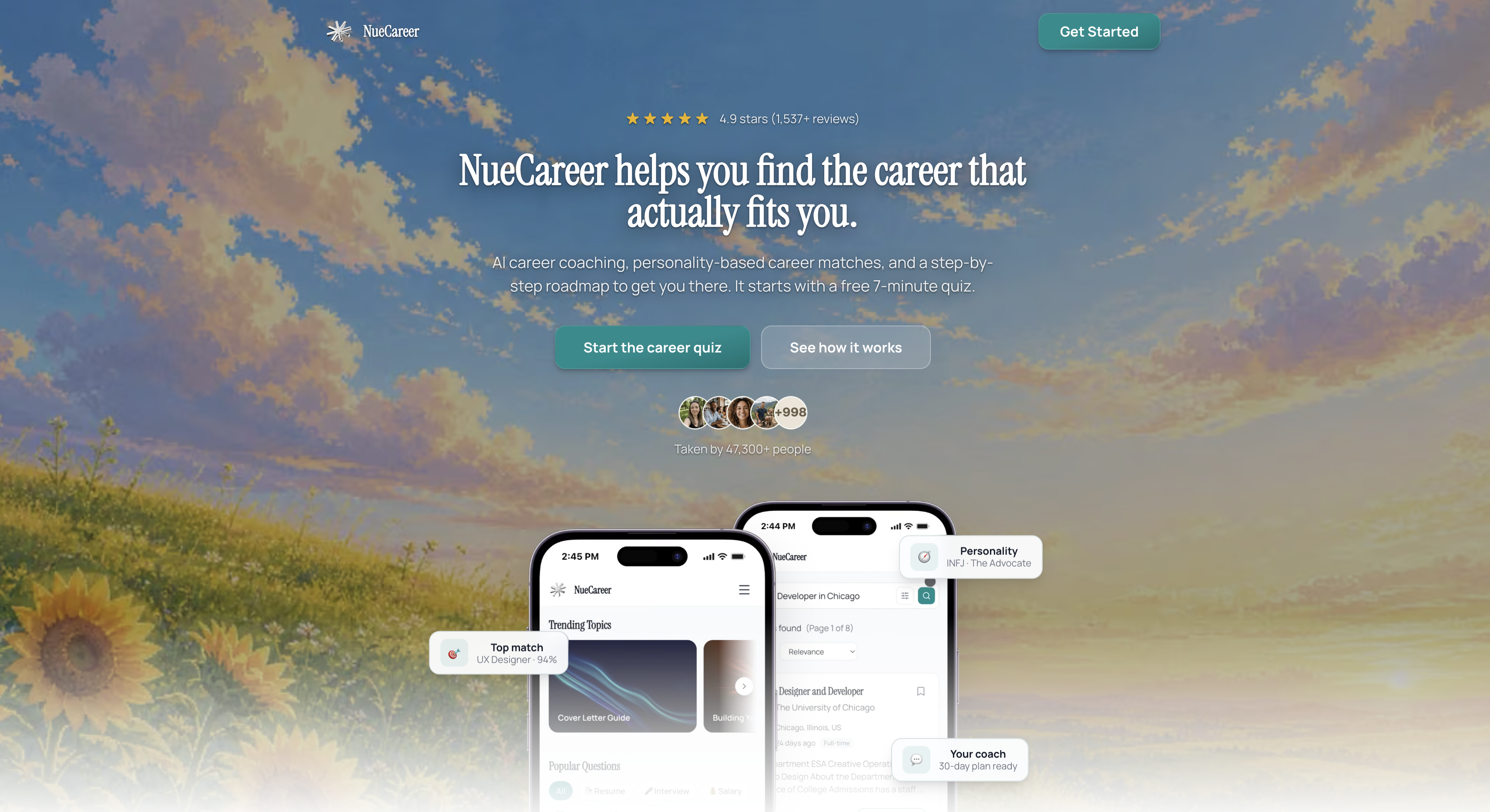
From there, our platform helps you act on what you learn. You get a personalized roadmap, 24/7 coaching chat, and tailored job boards, plus resume, cover letter, mock interview, and ATS checker tools to help you apply with confidence. You can see how it all fits together on our home page. Take the quiz, save your skills summary, and use it as the first row of your worksheet.
FAQ
What are some important work-related skills?
Adaptability, attention to detail, and interpersonal skills top the list for the overall U.S. workforce, according to BLS skills data. The best mix for you depends on the occupation you are aiming for.
What is included in a skills assessment test?
Most assessments ask you to rate yourself across a set of skill areas, then summarize your strengths and suggest matching careers. CareerOneStop's version lets you rate up to 40 areas and matches your answers to O*NET occupations.
What are some common self-assessment techniques?
Common techniques include rating skills on a descriptive scale, writing evidence for each rating, and asking a peer to review your top skills. Structured frameworks and documented evidence make the results more credible.
Is there a free career test for adults?
Yes. CareerOneStop offers a free Skills Matcher, and our 7-Minute Career Quiz is free to take. Both give you a starting list of strengths and matching careers.