

Work strengths are the repeatable behaviors and results that make you effective on the job, things like meeting tight deadlines through careful planning, calming frustrated clients with steady communication, spotting errors before they become costly, or rallying a team around a shared goal. Once you can name a few of your own, pick two or three and prepare one short story for each. That single habit turns vague self-confidence into something you can say out loud in an interview or write down in a review.
TL;DR:
- Match two or three strengths to behaviors repeated in the job posting, then prepare a real example for each with a measurable outcome.
- Structure interview stories around Situation, Task, Action, and Result; keep each answer to 45 to 90 seconds and devote most time to your actions.
- Replace vague labels like “hard worker” with behavior and results, such as keeping response times under 24 hours during a staffing gap.
- A talent is a natural tendency, while a strength combines that tendency with practice and proven results; employers need evidence of the latter.
Table of Contents
- 1. Strengths organized by category with resume-ready phrasing
- 2. How to turn a strength into a STAR interview answer
- 3. Phrases to use in resumes and performance reviews
- 4. Find your strengths faster with a quick self-assessment
- 5. Strengths, skills, and talents are not the same thing
- 6. Using your strengths to grow your career and your search
- 7. Why focusing on strengths changes how people show up at work
- 8. How NueCareer turns your strengths into a career plan
- FAQ
- Sources
1. Strengths organized by category with resume-ready phrasing
Most workplace strengths fall into four practical buckets: executing (getting things done), influencing (moving people and ideas forward), relationship building (working well with others), and strategic thinking (seeing the bigger picture). Sorting your own strengths this way helps you notice patterns across old jobs and match the right strength to the right opening.
Executing strengths show up when something needs to happen reliably, on time, and at the right level of quality.
- Reliability: You hit deadlines by breaking projects into checkpoints and tracking them against a calendar. Resume bullet: "Delivered 100% of assigned projects on or ahead of deadline over 12 months." Review phrasing: "Consistently meets commitments and flags risks early enough for the team to adjust."
- Attention to detail: You catch formatting and data errors before a report goes out the door. Resume bullet: "Reduced reporting errors by auditing data entries against source files before submission." This strength is especially valuable for finance, compliance, and quality assurance roles.
- Organization: You keep shared folders, trackers, and schedules clean enough that teammates can find what they need without asking. Resume bullet: "Built a shared project tracker adopted by three departments."
- Project management: You sequence tasks, assign owners, and keep a project moving even when priorities shift. Resume bullet: "Managed cross-functional launch timeline across five teams, hitting every milestone."
- Data analysis: You pull numbers from messy sources and turn them into a decision someone can act on. Resume bullet: "Analyzed customer churn data to identify the top three drop-off points in the signup flow."
- Problem solving: You diagnose the root cause of a recurring issue instead of patching the symptom. Resume bullet: "Identified a billing system bug causing repeat customer complaints and proposed the fix."
- Adaptability: You adjust your approach when a plan changes midstream without losing momentum.
- Time management: You protect focus time for deep work while still responding to urgent requests.
Influencing strengths matter when you need to move people, not just tasks.
- Persuasive communication: You explain a change in a way that gets buy-in instead of resistance. Resume bullet: "Presented a process change to leadership that was approved and rolled out company-wide." Valuable for sales, marketing, and leadership-track roles.
- Negotiation: You find a middle ground that keeps a deal or a relationship intact. Resume bullet: "Negotiated vendor contract terms that reduced annual costs."
- Public speaking: You present findings clearly to a room, whether it is five people or fifty.
- Strategic influence: You get stakeholders aligned on priorities before a project starts, saving rework later.
- Confidence under pressure: You stay composed when challenged in a meeting and respond with facts, not defensiveness.
- Sales ability: You read what a prospect actually needs and tailor the pitch instead of reciting a script.
Relationship strengths show up in how you treat the people around you.
- Empathy: You notice when a teammate is overwhelmed and adjust how you ask for things. Valuable for client-facing, healthcare, and management roles.
- Active listening: You ask a clarifying question before jumping to a solution, which prevents rework.
- Collaboration: You share credit, loop in the right people early, and make cross-team projects easier instead of harder. Resume bullet: "Partnered with design and engineering to ship a feature two weeks ahead of schedule."
- Conflict resolution: You help two frustrated coworkers find common ground instead of letting a disagreement fester.
- Mentoring: You take time to walk a newer employee through a process instead of just doing it faster yourself.
- Customer service: You turn a complaint into a resolved issue and a customer who stays.
- Cultural awareness: You adjust your communication style for a global team without losing clarity.
Strategic strengths are about seeing where things are headed.
- Big-picture thinking: You connect a small process fix to a larger company goal.
- Critical thinking: You question an assumption everyone else accepted and find the gap in it.
- Decision making: You weigh incomplete information and choose a direction instead of stalling the team.
- Innovation: You propose a new tool or workflow that others had not considered.
- Forecasting: You spot a trend in the data before it becomes a problem.
- Prioritization: You know which three tasks matter most when everything feels urgent.
2. How to turn a strength into a STAR interview answer
The STAR method (Situation, Task, Action, Result) gives interviewers exactly what they are listening for: proof that your strength actually produced something, not just a label you are claiming for yourself. Career center guidance consistently points to this structure as the backbone of a strong interview answer, and warns against vague terms like "perfectionist" that sound rehearsed and tell the interviewer nothing concrete, a point echoed by career coaching guidance from the University at Buffalo.
Before you walk into the room, run through this short checklist:
- Read the job posting and underline the two or three strengths it mentions most, directly or implied.
- Pick one real example from your own work that demonstrates that strength in action.
- Quantify the outcome wherever you can: a percentage, a dollar figure, a timeframe, or a number of people affected.
- Trim the story down to the actions that matter and the result, cutting background detail the interviewer does not need.
Here are three worked examples, each built around a different strength.
Problem solving: "In my last role, our support queue was backing up and customers were waiting over two days for a response. I was asked to find out why. I dug into the ticket data and found that a single product category was generating nearly a third of all tickets due to unclear setup instructions. I rewrote the setup guide and worked with the product team to add an in-app tooltip. Within a month, tickets from that category dropped by half and overall response time improved."
Attention to detail: "Our team published a weekly financial summary that went out to department heads. I noticed the source spreadsheet had a formula error that was quietly understating one region's revenue by a small but consistent margin. I flagged it, corrected the formula, and built a simple validation check so the same error couldn't happen again. Leadership now trusts the numbers in that report without double-checking them."
Collaboration: "A product launch was stalled because design and engineering disagreed on scope. I set up a short working session, asked each side to state their top priority, and found that most of the disagreement came from unclear requirements rather than real conflict. I documented the agreed scope and circulated it the same day. The launch shipped on schedule and both teams asked me to run the next kickoff."
Guidance on preparing these answers, including the recommendation to translate assessment language into plain behaviors paired with a specific result, comes from career development resources at American University's Kogod School of Business.
Pro Tip: Aim to deliver your STAR answer in 45 to 90 seconds. Cut the setup to one sentence, spend most of your time on the action you took, and always land on a measurable result instead of trailing off.
3. Phrases to use in resumes and performance reviews
A strength only lands when it is attached to a behavior and an outcome. Swapping a vague adjective for a specific action is often the single biggest upgrade you can make to a resume or a self-review.
Resume-ready bullets by category:
- Executing: "Streamlined invoice processing, cutting turnaround time from five days to two."
- Influencing: "Pitched a new onboarding format that leadership adopted across two other regions."
- Relationship: "Resolved a recurring client complaint by restructuring the weekly check-in process."
- Strategic: "Identified a gap in the Q3 forecast that prevented a budget shortfall."
Performance review phrasing works best when it names the behavior and the effect it had, from both the employee's and the manager's point of view.
- Employee self-review: "I kept the project on schedule by flagging a resourcing gap two weeks before it would have caused a delay."
- Manager language: "Consistently brings data to back up recommendations, which has sped up decision-making on the team."
- Employee self-review: "I took ownership of a client relationship that was at risk and rebuilt trust through weekly updates."
- Manager language: "Steps in to mentor newer hires without being asked, which has shortened ramp-up time for two new team members."
Before and after:
Before: "Hard worker and team player." After: "Took on two additional accounts during a staffing gap and kept response times under 24 hours."
Before: "Great communicator." After: "Simplified a technical process into a one-page guide that cut onboarding questions by more than half."
Practical guidance on this kind of swap, replacing a broad adjective with a specific capability and an example, is common in career center advising materials.
4. Find your strengths faster with a quick self-assessment
Once you have your results, match them against the four categories above: are your top traits mostly executing and strategic, or more relationship and influence driven? That mapping gives you language you can use immediately in a resume bullet or an interview answer, and it is the same logic behind our guide to interpreting assessment results.
A few free tools can round out the picture:
- The Strengths and Weaknesses Generator turns identified strengths into ready interview phrasing.
- The Career Skills Assessment checks which strengths actually matter for the roles you are targeting.
- Mock Interview Practice, available on our tools hub, lets you rehearse a STAR answer before the real conversation.
Start with the quiz, cross-check with the assessment, then rehearse out loud. That sequence takes a vague sense of "I'm pretty good at this" and turns it into language an employer can actually evaluate.
5. Strengths, skills, and talents are not the same thing
A talent is a natural tendency, something that comes easily without much training, like noticing patterns quickly or staying calm when others panic. A skill is something you learned and can demonstrate on command, like using Excel formulas or speaking a second language. A strength is what happens when a talent gets sharpened by practice and consistently produces good results, like turning a natural tendency to notice details into a reliable habit of catching errors before they ship.

The practical difference matters because interviewers and resumes care about strengths, not raw talent. Saying "I'm naturally detail-oriented" is a talent claim with no proof behind it. Saying "I built a validation check that caught a revenue error before it reached leadership" is a strength, because it shows the talent turned into a repeatable, demonstrated outcome. When you are deciding what to highlight, lead with the strength and let the underlying talent or skill explain why it comes naturally to you.
6. Using your strengths to grow your career and your search
Your strengths are the clearest signal you have for which roles and industries are worth pursuing. Instead of scanning job boards for titles, scan for the behaviors a posting keeps repeating, phrases like "manages competing priorities" or "builds strong client relationships", and check them against your own list. A posting that repeats your strongest strengths back to you is a far better target than one where you would have to stretch to fit.
Strengths also shape how you grow once you are in a role. Asking for projects that use your strongest abilities, rather than only the ones your title technically requires, tends to build both visibility and satisfaction faster. Research on strengths use at work has found that applying your strengths regularly is linked to higher engagement and better mental health, which suggests the payoff is not just a stronger resume but a better day-to-day experience on the job, according to a study published in Frontiers in Psychology. Organizations that invest in developing employee strengths have also seen measurable gains in sales, profit, and engagement, based on research summarized by Harvard Business Review, which is one more reason to bring strengths language into your next performance conversation, not just your next interview.

7. Why focusing on strengths changes how people show up at work
We have spent enough time around career transitions to notice a pattern: people rarely struggle because they lack ability. They struggle because they cannot name what they are actually good at, so they undersell themselves in interviews and over-function in roles that do not fit. We have watched someone move from a generic "administrative support" title into a project coordination role simply by recognizing that their real strength was never typing speed, it was keeping six moving parts organized at once.
Strengths work because they are specific. A label like "hard worker" asks an employer to take your word for it. A described behavior with a result asks them to simply read the evidence.
— Shane
8. How NueCareer turns your strengths into a career plan
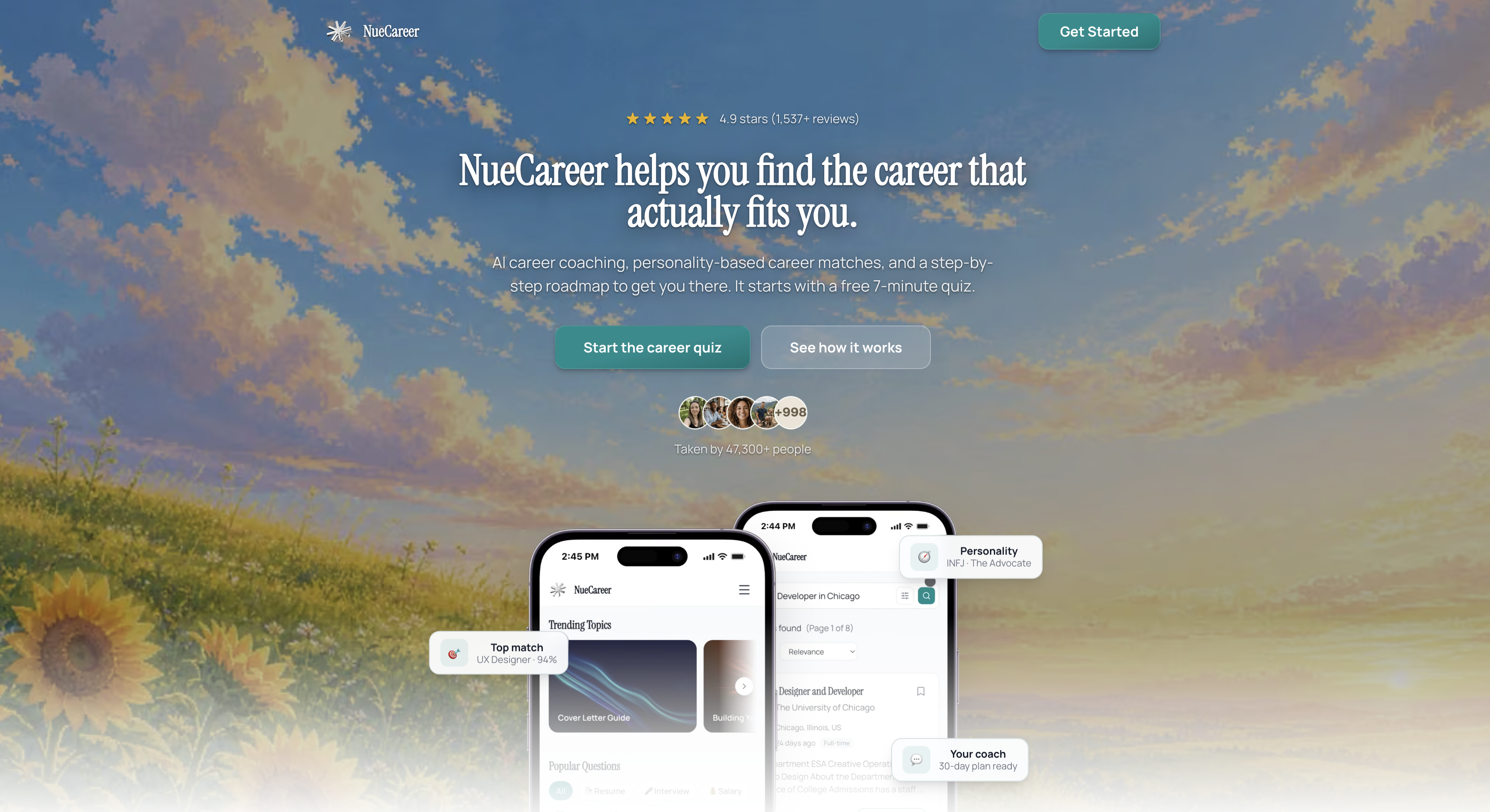
Recognizing your strengths is the first step. Turning them into a job offer is the harder part, and that is the gap we built our platform to close. Start with The 7-Minute Career Quiz, which identifies your core strengths and matches you to career paths built around who you are, including paths you may never have thought to search for. From there, our platform builds a personalized transition roadmap, gives you a Career Directory to explore matched options, and puts 24/7 AI coaching in your pocket for the moments you are stuck on what to say next.
Once you know your direction, our resume and cover letter tools turn the strengths you just identified into copy that reads like you, including an ATS Resume Checker and Cover Letter Generator, plus Mock Interview Practice so your STAR stories are polished before the real conversation. Everything is matched to your target roles, not written as generic advice. If a career change involves going back to school, resources like Univyze's guide to choosing a college major can help you connect strengths to a degree path.
Take the quiz, see your matches, and build the roadmap that gets you from recognizing your strengths to using them every day at work.
FAQ
What are the top 3 strengths of the workplace?
The strengths employers consistently value most are reliability, communication, and problem solving, because they show up across nearly every role and industry. Reliability means projects and commitments get delivered as promised, communication keeps teams and clients aligned, and problem solving shows you can handle the unexpected without needing constant direction.
What are 5 examples of strengths?
Five common work strengths are reliability, attention to detail, collaboration, adaptability, and critical thinking. Each one shows up as a specific behavior, such as meeting deadlines through careful planning or catching errors before they reach a client, rather than as a vague personality trait.
What are some examples of employee strengths?
Employee strengths include things like organizing competing priorities under pressure, mentoring newer teammates, negotiating vendor terms, and spotting trends in data before they become problems. The strongest examples always pair a behavior with a result, such as "reduced reporting errors by auditing entries before submission."
What is your 3 strengths best answer?
The best answer names three strengths that match the job posting, each backed by a brief example with a measurable result, following the STAR structure of situation, action, and outcome. Avoid vague labels like "perfectionist" and instead describe what you actually did and what changed, a approach recommended by career advising guidance from the University at Buffalo.
How do I figure out my own strengths if I'm not sure?
Start by reviewing past performance reviews, project outcomes, and moments when a task felt easy to you but hard for others, since ease is often a sign of a natural strength. A structured tool like The 7-Minute Career Quiz can also surface patterns faster by analyzing how you naturally approach problems, people, and pressure.
Sources
- Interview Questions, Answered: ‘What Is Your Greatest Strength?’ – Career Design Studio | University at Buffalo
- Strengths use and meaningful work study – Frontiers in Psychology
- CliftonStrengths in Interviews – Career Development | American University, Kogod School of Business
- Developing employees' strengths boosts sales, profit, and engagement – Harvard Business Review