
How to Make an Internal Career Change That Actually Gets Approved

Learn how to successfully approach an internal career change by crafting a compelling business case that emphasizes your value to the organization.
An internal career change succeeds when you stop framing it as a personal favor and start presenting it as a forward-looking business proposal: what the organization gains, what capability you bring, and what it costs the company if the move doesn't happen. Three steps get you there:
- Build your evidence file. Pull two to three achievements that map directly to the target role's requirements.
- Draft a one-page business case. Cover organizational value, your relevant capability, and the cost of inaction.
- Write a short transition plan. Name who covers your current duties, for how long, and what risks that create.
Start today by drafting the one-page pitch. Everything else in this article builds from that document.
Key Takeaways
An internal career change succeeds when you replace a personal request with a documented business case, proof of transferable skills, and a written transition plan that removes continuity risk.
| Point | Details |
|---|---|
| Lead with a business case | Structure your pitch around organizational value, your relevant capability, and the cost of inaction. |
| Prepare like an external candidate | Tailor your resume, network with the receiving team, and close skill gaps before you ask. |
| Remove continuity risk | Write a short transition plan naming who covers your duties and the handover timeline. |
| Negotiate on employer savings | Cite reduced recruiter fees and faster ramp time, not just your own preference, to support pay asks. |
| Use NueCareer to build your evidence | Run the free skills assessment and resume tools to prepare your pitch and rehearse it in coaching chat. |
Table of Contents
- What Counts as an Internal Career Change and When It Makes Sense
- What to Prepare Before You Ask for a Move
- How to Pitch an Internal Career Change So Managers Say Yes
- Negotiating Pay and Title for an Internal Move
- The First 90 Days: Landing the Move and Proving It Worked
- Copy-Ready Templates for Your Internal Move
- How NueCareer Fits Into Each Step
- Managing Expectations After the Move
- Building Support and Mentorship in Your New Team
- What to Do if Your Internal Move Gets Declined
- Start Your Internal Move With a Clear Next Step
- Sources
- FAQ
What Counts as an Internal Career Change and When It Makes Sense
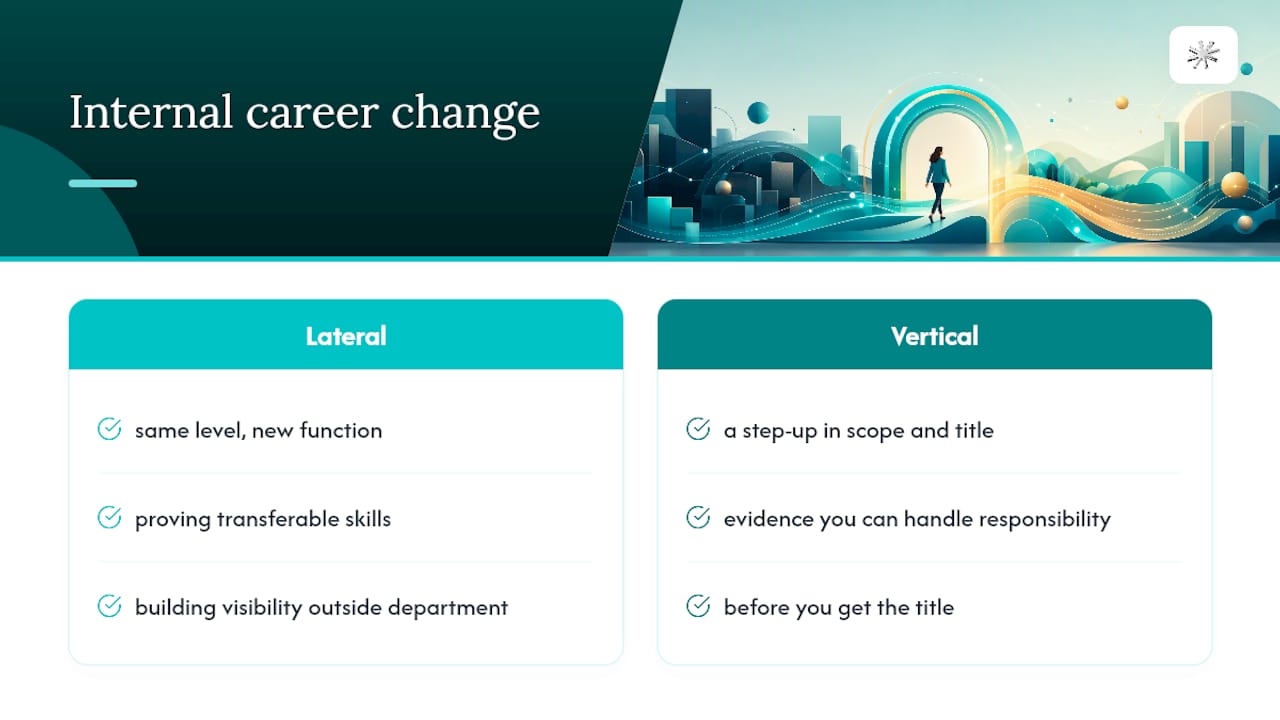
An internal career change means moving into a different role, team, or department at the company where you already work, rather than leaving for a new employer. It can be lateral (same level, new function) or vertical (a step-up in scope and title), and the preparation differs for each. Lateral moves hinge on proving transferable skills and building visibility outside your current department, while vertical promotions require evidence you can already handle broader responsibility before you get the title.
Self-assessment: do you qualify right now?
Ask yourself these questions before you approach anyone:
- Do you have at least one project or result that would resonate with the receiving team's priorities?
- Has your last performance review been strong enough to make your current manager comfortable vouching for you?
- Do you have, or can you quickly build, a relationship with someone on the target team?
- Is your motivation about growth toward something, not just escape from your current role?
Signals that make a move more viable right now
- The target team has open headcount or is actively growing.
- Leadership has publicly discussed internal mobility or cross-training as a priority.
- Your company offers a learning stipend or internal project marketplace you haven't tapped yet.
- 2026 hiring trends favor this timing: many employers now prefer upskilling trusted internal employees to fill tech-enabled roles rather than recruiting externally, which lowers the bar for a well-prepared internal candidate.
Timing matters as much as fit. Six months of strong performance in your current role gives you standing to ask; six weeks after a rocky review does not. Wait if you're mid-project on something critical, but don't wait for "someday" if the target team has an open seat now.
What to Prepare Before You Ask for a Move
Preparation is where most internal candidates undersell themselves. They assume internal name recognition will carry them, and it won't.
Internal resume checklist:
- Rewrite your bullets to show direct transferability, not just a list of past duties.
- Lead with two to three achievements most relevant to the target role, even if they weren't your biggest wins overall.
- Cut anything from your original role description that doesn't map to a specific need on the new team.
Networking and visibility checklist:
- Identify the hiring manager and one or two team members you can talk to informally before any formal request.
- Volunteer for a short cross-team project or working group. Building relationships and contributing before you apply is consistently what separates candidates who get serious consideration from those who get a polite no.
- Map who else influences the decision: HR, your current manager, the receiving manager.
Micro-learning suggestions:
- Take a short course or certification that closes an obvious gap between your background and the new role.
- Ask to shadow someone on the target team for half a day.
- Look for a small piece of that team's work you can contribute to now, even informally.
Pro Tip: Internal decision-makers are often more skeptical about transferability than external recruiters, not less, because they already have a fixed idea of what you do. Show the granular mechanism, exactly how a specific past project maps to a specific need on the new team, rather than a broad claim like "I'm a fast learner."
A tailored internal resume isn't optional. Hiring managers still expect a professional, tailored document even when they already know your name, and NueCareer's career change resume guidance walks through exactly how to reframe past bullets for a role change.

How to Pitch an Internal Career Change So Managers Say Yes
The strongest internal pitches read like a business case, not a request. A successful pitch answers three questions: what the organization gains, what you bring that's directly relevant, and what it costs if the move doesn't happen.
- Organizational value. Name the specific problem the receiving team has and how filling it with an internal hire (faster ramp, no recruiter fee, known quality) benefits the company.
- What you bring. List two or three concrete pieces of evidence, not a personality trait, that prove capability.
- Cost of not moving. State plainly what the team loses by not making this change, whether that's slower delivery, a skills gap, or continued reliance on contractors.
Pair the pitch with a short transition plan covering who takes over your current duties, the timeline, and the biggest continuity risk. A written transition agreement collapses the most common managerial objection before it's even raised: "we need you where you are."
Different stakeholders care about different things. Your current manager wants continuity and a plan for your workload. The receiving manager wants proof of fit and low ramp time. HR wants a clean process that doesn't create precedent problems.
Three common objections and rebuttals:
- "We can't lose you right now." Offer a phased transition with a defined handover window.
- "You don't have direct experience." Point to the specific transferable project, not general enthusiasm.
- "This sets a precedent." Frame the request as aligned with the company's own stated mobility or upskilling goals.
A one-slide pitch structure works well: title and role you're proposing, the problem you'd solve, your relevant capability, the transition plan, and a clear ask.
Pro Tip: Frame the entire pitch as an organizational proposal, not a personal ask. That single shift makes it far easier for multiple stakeholders to approve, since you're giving them a business reason to say yes instead of asking them for a favor.
Negotiating Pay and Title for an Internal Move
Internal moves come with negotiation leverage that's easy to miss. You already know the company's constraints, and you can use that.
- Emphasize the cost savings you represent: no recruiter fee, faster onboarding, lower hiring risk compared to an external candidate.
- Bring market-rate data for the new role, not just your current one, to anchor the conversation.
- If salary is capped by band or policy, ask for a title change, a signing or transition bonus, or a 90-day compensation review tied to specific stretch goals instead of walking away empty-handed.
Internal salary talks work best when you shift the leverage point from "what I deserve" to "what this saves the company compared to hiring externally." That reframing tends to land better with budget-conscious managers than a straightforward raise request.
The First 90 Days: Landing the Move and Proving It Worked
A 30-60-90 plan turns a good pitch into a good outcome. Days 1 to 30: learn systems, meet stakeholders, set two measurable objectives. Days 31 to 60: deliver a first visible win, however small. Days 61 to 90: report progress against your original objectives to both your new manager and your former one.
Handover checklist for your old role:
- Document open projects and their status.
- Train whoever inherits your responsibilities, even informally.
- Flag any risk areas explicitly rather than assuming they're obvious.
- Set two or three specific 30-day goals tied to what you pitched.
- Track and share a short progress update at 60 days, even if no one asks.
- Close the loop at 90 days with a brief summary of wins and next priorities.
Treating the whole transition as a structured process rather than a single approval moment is what makes the difference between a move that sticks and one that quietly unravels in month two.
Copy-Ready Templates for Your Internal Move
Email to your manager: "Do you have 20 minutes this week? I'd like to talk through a growth opportunity I've been thinking about and get your input before I take any next steps."
One-slide pitch outline:
- Title: Proposed move, from role to role
- Problem: What gap this solves for the receiving team
- What I bring: Two to three specific proof points
- Transition plan: Who, timeline, key risk
- Ask: Clear next step (interview, trial project, formal application)
Internal resume bullet examples:
- "Led cross-functional rollout of [process], directly applicable to [target team]'s current workflow gap."
- "Reduced [specific metric] by managing [project], a skill set the target role requires daily."
- "Partnered with [team] on [initiative], building working knowledge of their tools and priorities."
A short written request paired with a one-page slide speeds up how quickly HR and hiring managers can act on your ask.
How NueCareer Fits Into Each Step
NueCareer's tools map directly onto this process. Run the free career skills assessment to identify your strongest transferable skills, then use the resume tools to tailor your internal application, draft your business-case slide, and rehearse objection handling in the 24/7 coaching chat.
- Skills assessment: clarifies what you actually bring before you pitch anyone.
- Resume tailoring: reframes past achievements for the new target role.
- Coaching chat: helps you rehearse the conversation with your manager before it happens.
Start with the assessment. It's the fastest way to know what your business case should lead with.
Managing Expectations After the Move
Even a well-executed internal career change comes with an adjustment period, and expecting instant fluency sets you up for disappointment. You'll likely know less than you think about the new team's day-to-day rhythms, even if you've worked at the company for years. Different departments run on different unwritten rules: how meetings get decided, who actually holds influence, what "urgent" means to this team versus your last one.

Give yourself permission to ask questions a newer hire would ask, even though you're a familiar face. Colleagues sometimes assume internal transfers already know everything, which can leave real knowledge gaps unaddressed. Say plainly what you don't yet know rather than guessing and getting it wrong.
Expect a temporary dip in perceived competence. You were likely strong in your old role, and stepping into unfamiliar territory can feel like a step backward even when it isn't. That's normal ramp time, not a sign the move was a mistake.
Watch for identity friction, too. If people at the company still associate you with your old function, gently but consistently redirect conversations toward your new scope. Update your internal profile, your Slack or Teams status, and how you introduce yourself in meetings. The faster you signal the shift, the faster others adjust their mental model of what you do now.
Cultural adaptation takes longer in a new department than most people expect, often eight to twelve weeks before you feel genuinely settled rather than provisional.
Building Support and Mentorship in Your New Team
Momentum after an internal move depends heavily on who backs you once you're there. Don't wait for mentorship to happen organically. Ask directly, within your first few weeks, whether someone on the team would be willing to be an informal go-to person while you ramp up.
A few moves make this easier:
- Identify one peer mentor (someone at your level who can answer "dumb questions" without judgment) and one senior sponsor (someone who can vouch for you in rooms you're not in).
- Schedule a recurring short check-in with your new manager for the first quarter, even if weekly one-on-ones already exist, specifically to surface ramp friction early.
- Stay visible to your old team, too. A brief update every few weeks maintains the relationship and keeps your former manager as a reference point rather than someone who feels abandoned.
- Join or start an informal peer group with others who've made similar internal moves. Shared experience navigating unwritten rules is often more useful than a top-down mentorship program.
Ongoing support rarely appears automatically just because you're now on the team. It comes from you naming what kind of help you need and asking specific people for specific things, rather than hoping someone notices you're struggling and steps in.
What to Do if Your Internal Move Gets Declined
A "no" on an internal career change is common, and it's rarely final if you handle it well. Start by asking for specific, honest feedback: was it timing, a skills gap, budget, or a stronger internal competitor? Vague feedback like "not the right fit" is not useful. Push politely for something concrete you can act on.
Ask what would need to change for the answer to be different in three to six months, and get it in writing if possible, even just a follow-up email summarizing the conversation. This creates a checkpoint you can both refer back to.
Use the gap constructively. If the feedback pointed to a skills gap, close it visibly: take the course, do the shadow project, deliver the cross-team collaboration you didn't have before. If it was about timing, stay engaged with the team informally so you're still front of mind when the next opening appears.
Don't let a decline damage your standing with your current manager. Thank them for considering it, and reaffirm your commitment to your current role while you keep building toward the next attempt. A graceful response to "no" is often what makes the eventual "yes" possible.
If repeated internal declines suggest a structural ceiling rather than a timing issue, that's useful information too. At that point, it's worth honestly comparing an internal path against switching companies entirely to reach the same career goal.
Common mistakes and the one mindset shift that fixes them
The most frequent mistakes: pitching a personal ask instead of a business case, skipping the transition plan, and assuming tenure alone proves fit. The fix is simple: reframe your request as an organizational proposal, not a favor.
Start Your Internal Move With a Clear Next Step
Unlike waiting on a manager to notice your potential, NueCareer puts the groundwork in your hands. It's built specifically to help you turn vague ambition into the concrete evidence and documents an internal pitch actually needs.
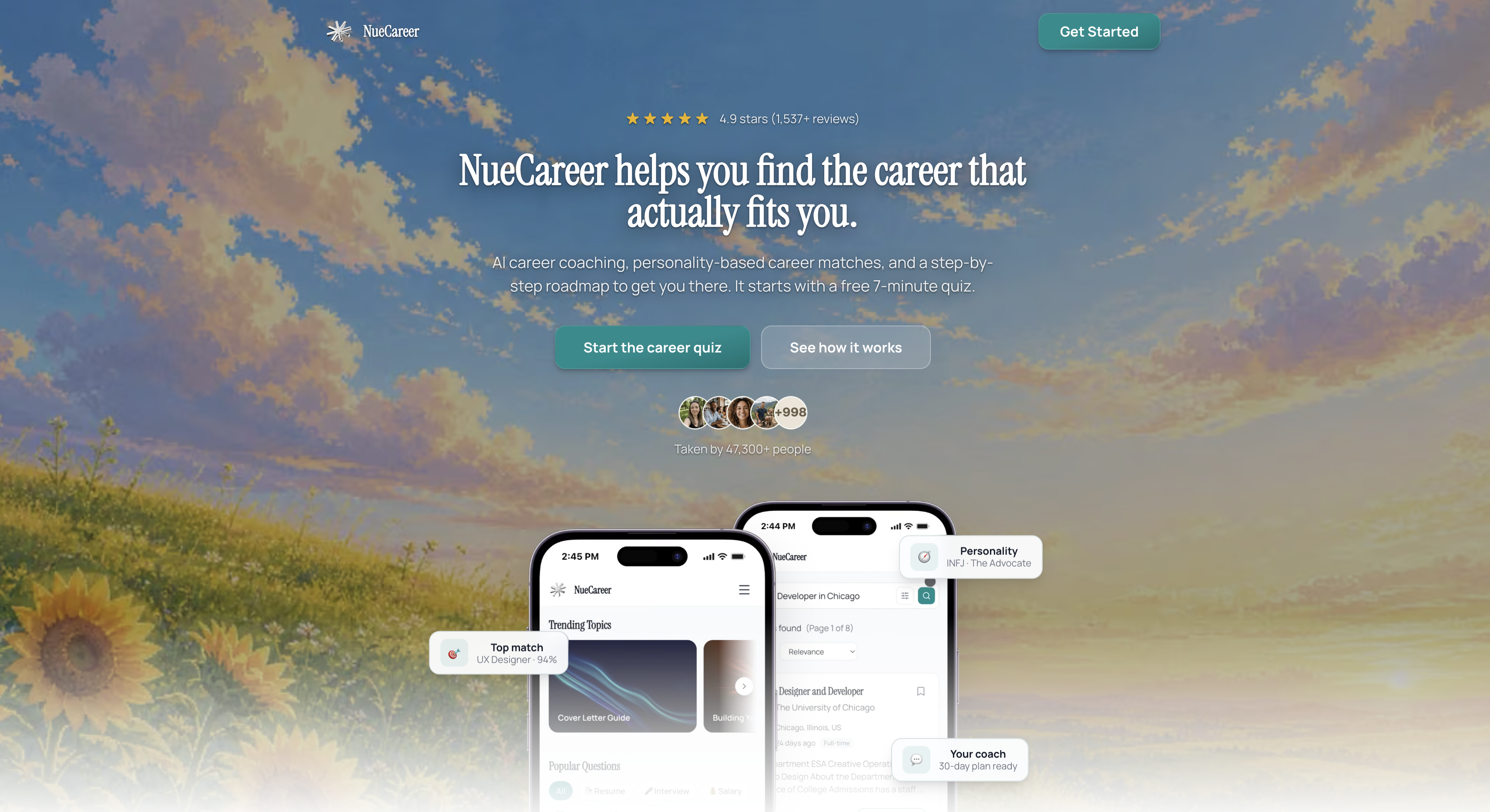
The free career skills assessment identifies your strongest transferable skills in minutes. The resume and cover letter tools help you translate those skills into internal-resume language a hiring manager will recognize instantly. The job description analyzer maps your background against the target role so you know exactly which gaps to address before you pitch. And the 24/7 coaching chat gives you a place to rehearse your business case and objection handling before you're in the room with your manager.
Run the free assessment today. It's the fastest way to find out what your pitch should lead with.
Sources
- Why Your Résumé Is Still Important When Applying Internally — Forbes Coaches Council
- Internal Transfer Pitch: The Presentation That Gets You to the Role You Want — Winning Presentations
- June 2026 career advice: Mastering the internal pivot to beat the skills gap — ResumeHog
- Internal career transitions: HR support guide — Pathwise
- The Inside Scoop: How to Navigate an Internal Job Move — HubSpot careers blog
FAQ
What is the easiest career to switch to internally?
The easiest internal switch is typically to a role that shares tools, stakeholders, or processes with your current job, since that overlap gives you built-in proof of transferability without needing new credentials.
What is the 30-30-30 rule for career change?
There's no single established "30-30-30 rule" in career-change practice; if you've seen it referenced, it likely varies by source. The proven framework for internal moves is the 30-60-90 day plan covered above, which sets clear objectives for your first month, second month, and third month in the new role.
Can you give two weeks' notice for an internal transfer?
Internal transfers rarely require a formal two-week notice like an external resignation, but a written transition plan with a clear handover timeline serves the same purpose and reassures your current manager.
What jobs will still exist after 2030?
Roles built on judgment, relationship management, and adaptive problem-solving, areas like coaching, complex client management, and cross-functional leadership, are expected to remain resilient, and these are also common landing spots for internal career changes since they reward institutional knowledge.
Do I need a resume for an internal job application?
Yes. Hiring managers expect a professional, tailored resume even for internal roles, and NueCareer's resume tools can help you reframe existing achievements for the new position.