
Hidden Job Market: 3 Steps U.S. Jobseekers Use to Reach Unposted Roles

U.S. focused, evidence-backed playbook to access unposted roles. Combine BLS and CareerOneStop hiring signals with a 7 Minute Career Quiz and three simple...
The hidden job market refers to a substantial share of roles employers fill through referrals, internal moves, and recruiter outreach before, or instead of, a public listing. You should work it in parallel with posted jobs, not as a replacement, using networking, informational interviews, recruiters, and targeted cold outreach as your main channels.
TL;DR:
- Most hiring in the hidden job market happens through internal moves, referrals, and recruiter networks during times of organizational change like expansions or leadership shifts.
- Networking channels like employee referrals and informational interviews provide higher chances of success, especially when tailored and based on genuine relationships.
- Employers hiring through hidden channels often begin early signals, such as expansion announcements or new contracts, before roles are publicly posted.
- Maintaining an organized outreach system and a clear value proof boosts efficiency and helps build trust over a slow, relationship-driven process.
- Combining targeted applications, networking, and consistent follow-up enhances chances of uncovering and securing hidden opportunities.
Table of Contents
- What Is the Hidden Job Market, Exactly?
- Where and When Does Hidden Hiring Actually Happen?
- Which Channels Actually Open Hidden Roles?
- How Do You Write Outreach That Actually Gets a Reply?
- Should You Network or Apply? The Honest Answer Is Both
- Keep Your Outreach Organized, or You'll Lose Track of It
- How NueCareer Helps You Target Hidden Opportunities
- Why Patience Beats Urgency in Hidden Hiring
- Turn This Playbook Into Action Today
- Sources
- FAQ
What Is the Hidden Job Market, Exactly?
The hidden job market refers to positions filled without a public job ad ever going live. That includes internal transfers, employee referrals, recruiter-sourced candidates, standing talent pools a hiring manager already trusts, and roles closed informally before HR finishes drafting the posting. You have likely already lived on the other side of this without realizing it, if a former coworker ever pulled you into a role that was never advertised.
Employers use these paths because they cut risk and time. A referral comes with a built-in reference. An internal transfer skips onboarding from zero. A recruiter relationship means someone has already been vetted informally. CareerOneStop's guidance on identifying local employers notes that hiring often begins as an informal conversation between a manager and a known contact, long before a requisition exists in any system. Your goal is to become that known contact before the posting stage ever starts.
Here's where you need to slow down: you have probably seen claims that "70 to 80 percent of jobs are never posted." Treat that kind of rounded number with real skepticism. Measurement here is genuinely messy. Studies count different things, in different industries, at different points in the hiring funnel, so a single clean percentage does not exist in any dataset worth trusting. What is verifiable is that the Bureau of Labor Statistics tracks multiple active job search methods jobseekers use side by side, including contacting employers directly and reaching out to friends or relatives, which tells you networking is a documented, mainstream tactic rather than an exaggerated growth-hack myth.
What actually falls into hidden hiring:
- Internal promotions and lateral moves posted only on an intranet, if at all
- Referral hires where an employee vouches for a candidate before any formal opening
- Recruiter pipelines built for roles a company expects to need again and again
- Contract-to-hire arrangements that start informally through a project or introduction
- Roles created around a specific person's skill set after an informational conversation
Where and When Does Hidden Hiring Actually Happen?
Hidden hiring clusters around moments of change. A company doesn't build a referral pipeline for a role that isn't shifting. It builds one when something is already moving inside the organization, and your job is to notice the signal before the posting catches up.
Watch for these patterns, in roughly this order of reliability:
- Expansion announcements — a new office, a funding round, or a stated headcount target in a press release or earnings call
- New contracts or client wins — public sector awards, major partnership announcements, or new product launches that require staffing fast
- Executive or leadership changes — a new VP or department head almost always reshuffles their team within the first six months
- Steady hiring even without open postings — a company that has hired for a similar title twice in the past year likely has a repeatable process, even if nothing is currently listed
Verify signals before you act on them. Public filings (10-Ks and 10-Qs for public companies), local business journal coverage, and company press pages will confirm an expansion claim faster than a LinkedIn rumor. Employee conversations, particularly informational interviews, often surface the most reliable intelligence, because someone inside the building usually knows a team is stretched thin before any announcement goes out.
Certain roles and industries lean harder on non-public channels than others. Sales, healthcare staffing, skilled trades, and senior technical roles frequently move through referral networks and recruiter relationships because the cost of a bad hire is high and the candidate pool is narrow. Entry-level and high-volume roles, by contrast, tend to stay closer to traditional postings, since employers need broad reach rather than a trusted shortcut.
Which Channels Actually Open Hidden Roles?
Not every tactic deserves equal time. Here's a prioritized order, based on how directly each channel converts into real conversations with people who can hire you.
Employee referrals and internal mobility. This is the highest-yield channel because it arrives with built-in trust. Ask former colleagues, alumni, or people in your existing network if they know anyone at your target company, rather than asking them to "put in a word" cold. A referral works best when the person referring you genuinely understand your work, not just your resume, since employers value referrals precisely because they carry information an application can't. The limit: referrals dry up fast if you overuse the same three contacts, so keep expanding who you know.
Informational interviews. Frame these as learning conversations, never as disguised job pitches. CareerOneStop recommends requesting 15 to 30 minutes to ask about someone's day-to-day work, how their team hires, and what challenges they're facing. Done well, this naturally surfaces hiring signals and earns you a referral to someone else, without you ever having to ask for one directly.
Recruiters. Third-party and in-house recruiters are worth cultivating, but brief them precisely: your target titles, your salary range, your non-negotiables, and two or three companies you're watching. Vague requests ("I'm open to anything") get you generic outreach; specific requests get you considered for roles that match.
Cold outreach and inquiry letters. This is the least comfortable channel and often the most underused. Research the company and the specific person first. An inquiry letter that names a real initiative, a real team gap, or a real product launch outperforms a generic "I'd love to work here" message every time.
Events, alumni networks, and volunteering. Industry meetups, alumni association events, and skilled volunteering put you in rooms where hiring managers talk shop informally. These are slower-burn tactics, but they compound over months.
Social visibility, particularly LinkedIn. Posting thoughtful commentary on your field, engaging with people at target companies, and keeping your profile current make you findable when someone searches internally for a candidate like you.
Pro Tip: Rank your target companies before you start reaching out. Spending equal energy on twenty companies dilutes your effort; spending focused energy on your top six gets you further, faster.
How Do You Write Outreach That Actually Gets a Reply?
Most cold outreach fails for one reason: it leads with a resume instead of a reason. Fix that first, and everything else gets easier.
Build a short "value proof" before you write a single message. It needs four pieces: your target role, two or three strengths relevant to that role, one concrete result you've delivered, and the specific problem you solve for an employer. Keep it to two or three sentences. CareerOneStop's inquiry letter guidance makes the same point: your letter should match your qualifications directly to what the employer needs, and show you've done real homework on the organization, not a mail-merge version of "I'm interested in opportunities."
A working inquiry letter structure looks like this:
- Line 1: A specific, verifiable reason you're reaching out (a launch, an expansion, a mutual contact)
- Lines 2 to 3: Your value proof, tied directly to what you just referenced
- Line 4: A low-pressure ask (a 15-minute call, not a job)
- Sign-off: Your name and a link to a portfolio or LinkedIn, not an attached resume
Do not send a resume in your first message unless someone asks for it. Lead with a question or observation, confirm there's real interest, then offer materials. Attaching a resume too early signals "generic job seeker" rather than "someone who did their homework."
Follow up once, five to seven business days after your initial message, with a short, friendly nudge that adds new information rather than just repeating your first note. If you hear nothing after that, move on. Persistence matters, but it has a ceiling.
Common mistakes worth naming directly: sending the same message to twenty contacts with only the name swapped, asking for a job in the first line instead of a conversation, following up more than twice, and forgetting to say thank you after someone gives you their time.
Pro Tip: Keep your value proof in a single document you can adapt in under two minutes. You'll reuse it more than you expect, and consistency across messages builds a coherent story about who you are.
Should You Network or Apply? The Honest Answer Is Both
Skip the false choice between networking and applying. BLS data on active job search methods shows that jobseekers commonly use several tactics at once, including contacting employers directly, submitting applications, and reaching out to friends and relatives. That pattern exists because each method does something the others can't.
Applications produce a measurable, if modest, return. One BLS analysis found roughly one interview for every six applications in a Current Population Survey supplement, and jobseekers who applied to more roles generally landed more interviews. That's not a reason to mass-apply blindly. It's a reason to keep applications in your rotation while you build relationships that add context an application can't.
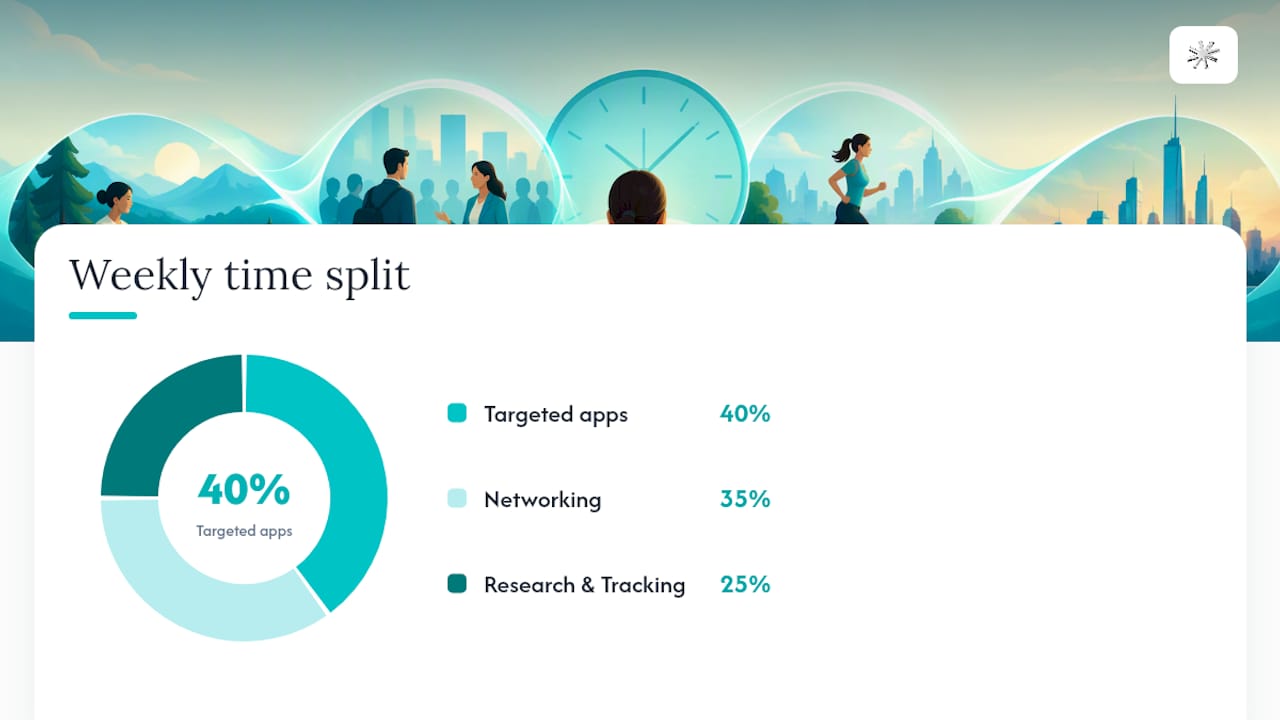
A workable weekly split for most active job seekers:
- 40 percent on targeted applications — quality over volume, tailored resumes for roles that genuinely fit
- 35 percent on relationship building — informational interviews, recruiter check-ins, and referral requests
- 25 percent on research and tracking — verifying hiring signals, updating your pipeline, and refining your value proof
Targeted quality beats mass applying because a tailored application paired with a warm introduction moves faster through a hiring process than a cold application ever will. The two tactics aren't competing for your time. They're solving different problems in the same search.
Keep Your Outreach Organized, or You'll Lose Track of It
Six weeks into a serious search, you will not remember who you talked to, what you said, or when you promised to follow up, unless you write it down somewhere. A simple tracking system prevents you from over-messaging a contact or letting a warm lead go cold.
Track these fields for every contact, at minimum:
- Employer and the specific team or department
- Contact name and role, plus how you connected
- Relationship stage (first outreach, informational interview scheduled, referral discussed, no response)
- Last contact date
- Hiring signal you noticed (expansion, new contract, leadership change, none yet)
- Next step, with a specific date attached
A spreadsheet works fine for most people. Others prefer a lightweight CRM tool or a purpose-built job search organization system that keeps contacts, applications, and follow-up dates in one view instead of scattered across email threads.
Archive a prospect after two unanswered follow-ups with no hiring signal in sight. Double down when a contact responds, even briefly, or when you spot a fresh signal like a new job posting at that company for an adjacent role. That's usually your cue to reach out again with something specific to reference.
How NueCareer Helps You Target Hidden Opportunities
Everything above works better when you know exactly which roles to target and can explain why you fit them in under thirty seconds. That clarity is the part most job seekers skip, and it's the part NueCareer's 7-Minute Career Quiz is built to solve.
The quiz maps your strengths to career paths and feeds into a personalized roadmap that suggests which roles and industries might be worth your outreach energy. That focus is what turns a vague "I'm open to anything" into the kind of specific value proof that gets a reply.
From there, NueCareer's toolset supports the tactics covered above directly:
- 24/7 coaching chat for real-time help drafting outreach messages or prepping for an informational interview
- Tailored job boards matched to your quiz results, so you're not scanning generic listings
- Resume and cover letter tools to move fast once a warm contact asks for materials
- Mock interview practice for when a referral actually turns into a conversation
Pair your quiz results with the inquiry letter structure from earlier, and you have a repeatable outreach system instead of a folder of half-finished drafts.
Why Patience Beats Urgency in Hidden Hiring
Most people treat hidden-market outreach like a sprint, then quit after two weeks of silence. Relationship-based hiring runs on a slower clock than that. Reciprocity matters more than most job seekers expect. The people who get referred are usually the ones who showed up for someone else first, whether that meant sharing a lead, making an introduction, or simply following up with a thank-you note after an informational interview.
Progress in this kind of search rarely looks like a job offer in week three. It looks like a second conversation, a referral to someone new, or a recruiter remembering your name six weeks later. Keep a record of every contact, revisit it monthly, and treat networking as a habit you maintain year-round, not a task you switch on during a search and drop the moment you land something.
— Shane
Turn This Playbook Into Action Today
Reading a strategy and running it are two different things, and the gap between them usually comes down to clarity: knowing exactly which roles to target and having the words ready when an opportunity opens up. NueCareer closes that gap faster than trying to figure it out solo, by giving you a personalized roadmap instead of a blank page.
Start with the 7-Minute Career Quiz to identify the roles worth your outreach energy, including paths you may not have considered on your own. From there, draft your value proof using your quiz results as the foundation, then head to the resume and cover letter toolkit to turn that value proof into materials you can send the moment a contact asks for them. Three steps, done in an afternoon, and you're no longer guessing which door to knock on.
Sources
- Unemployed jobseekers by sex, reason for unemployment, and active job search methods used : U.S. Bureau of Labor Statistics
- How-to Find a job now: Identify local employers | CareerOneStop
FAQ
How Do I Find the Hidden Job Market?
You find it by researching target employers directly, requesting informational interviews, and building referral relationships instead of waiting for postings. CareerOneStop recommends identifying specific employers and decision-makers, then reaching out with a tailored message about what you offer.
What Is an Example of a Hidden Job Market Opportunity?
A common example is a manager who needs a new hire but asks a trusted employee for referrals before HR ever posts the role. Another is a recruiter who keeps your resume on file after an informational interview and contacts you months later when a matching role opens.
What Job Pays $10,000 a Month Without a Degree?
No specific degree-free occupation guarantees that income, since pay depends heavily on industry, experience, location, and licensing requirements. The Bureau of Labor Statistics Occupational Outlook Handbook is the most reliable place to check real compensation ranges before trusting any income claim tied to a single job title.
How Can I Access the Hidden Job Market Effectively?
Prioritize referrals and informational interviews first, since they carry built-in trust and often surface hiring signals before a posting exists. Combine that with recruiter relationships and specific, well-researched cold outreach, and keep applying to posted roles at the same time, since BLS data shows most active job seekers use multiple methods together rather than relying on just one.