
50.3% Hit Rate: What Career Test Accuracy Means for You

Interest inventories match careers 50.3% of the time. Learn what that means, use a short checklist to vet tests, and try the 7-Minute Career Quiz.
Career tests can genuinely point you in the right direction, but they are not fortune tellers. The best available evidence puts the overall predictive hit rate for interest inventories at roughly 50.3%, and accuracy shifts a lot depending on what a test measures and what outcome you care about. Below, we break down what that number means, which test types predict which results and how to evaluate any assessment before you trust it with a decision this important.
TL;DR:
- Interest inventories have about a 50% success rate in predicting suitable careers, but matching specific scales to job criteria can improve accuracy to around 60%.
- Skills and knowledge tests are the most reliable for predicting actual job performance and income, while interest measures mainly predict job satisfaction.
- Career scores can shift over time, especially for younger adults, so retest stability depends heavily on age and the retest interval.
- Evaluation of a career test should include checking for published validity, reliability data, transparency about what it predicts, and appropriate administration methods.
- Combining multiple assessment types with professional guidance creates a more actionable career plan than relying on a single test result.
Table of Contents
- What Career Tests Actually Measure
- How Accurate Are Career Assessments, Really?
- Which Test Predicts Which Career Outcome?
- Can You Trust the Same Test Twice? Reliability Explained
- How to Evaluate a Career Test Before You Trust It
- Turning Test Results Into a Real Career Plan
- Why Integration Beats a Standalone Quiz
- Try the 7-Minute Career Quiz for a Real Starting Point
- Primary Research and Authoritative Reading
- Sources
- FAQ
What Career Tests Actually Measure
"Accuracy" is a meaningless word until you know what a test is trying to predict. A career test is not one thing. It is a family of tools, each built to answer a different question, and lumping them together is why so many people walk away from a quiz feeling misled.
- Interest inventories (built around the RIASEC model of Realistic, Investigative, Artistic, Social, Enterprising, and Conventional types) measure what activities energize you. They are exploratory tools, not performance predictors.
- Personality measures, often based on the Big Five traits, tell you more about environment fit than job performance. They are useful for figuring out whether a fast-paced sales floor or a quiet research lab suits your temperament.
- Cognitive and aptitude tests measure reasoning speed and problem-solving capacity. These have a stronger, more established link to job performance and trainability than interest or personality tools.
- Skills and knowledge tests, including job simulations and work samples, carry the highest predictive validity for actual job performance because they measure what you can already do, not just what you prefer.
Most people encounter these tools in three settings: self-exploration during a career change, academic and guidance counseling, or employer screening during hiring. Each context calls for a different type of test, and confusing them is where accuracy expectations tend to break down.
How Accurate Are Career Assessments, Really?
The number to know: 50.3%. A large-scale quantitative review of interest inventory research found an overall predictive hit rate of about 50.3%, with a confidence interval spanning roughly 47.3% to 53.4%. That means, on average, a little over half of people who take an interest inventory end up in a career that matches what the test suggested.
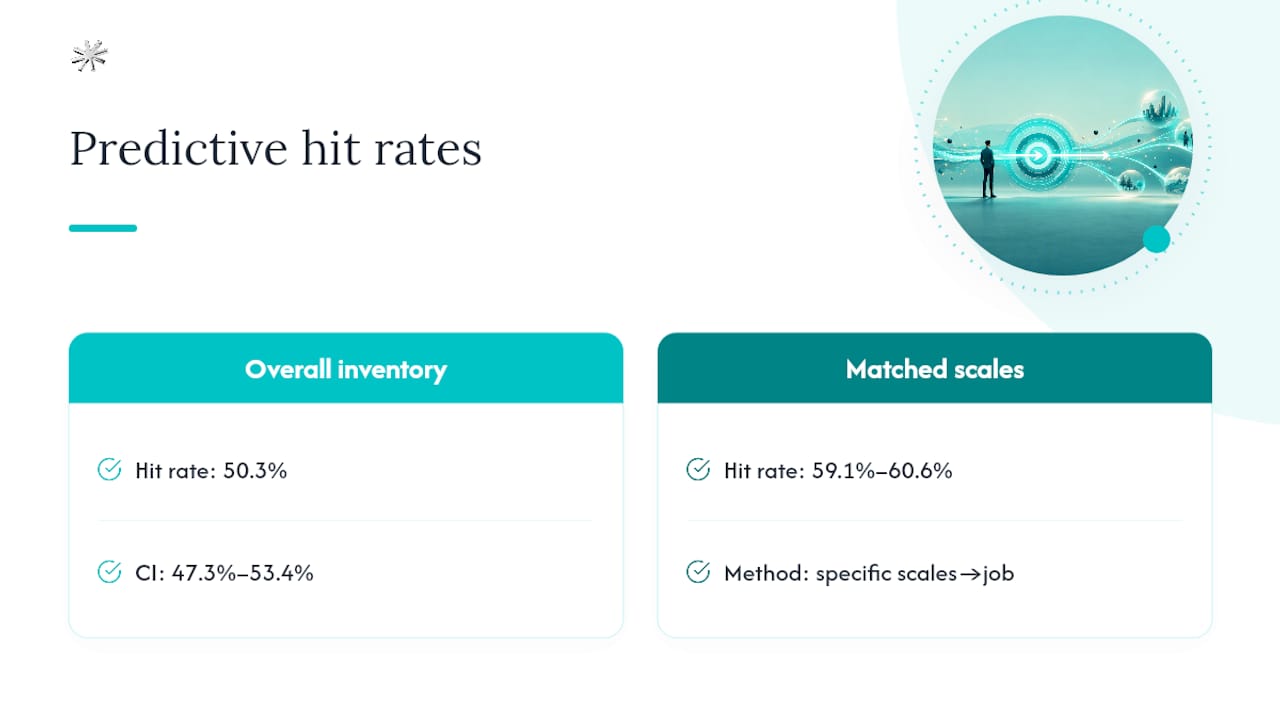
That figure hides an important split. The gap exists because interests can shift, circumstances intervene, and the further out you measure, the more life gets in the way of a tidy match.
Matching method changes the picture too. When researchers directly match an inventory's specific scales to job criteria, rather than relying on broad RIASEC categories alone, hit rates climb to 59.1% to 60.6%. A well-designed test with precise scoring outperforms a generic one built on loose categories.
What does a 50% hit rate mean for you personally? It means a career test is a useful signal, roughly a coin flip better than chance in the strictest predictive sense, but not a verdict. Treat the output as a strong hypothesis worth investigating, not a locked-in answer.
Which Test Predicts Which Career Outcome?
Different assessments were never designed to answer the same question, and a 2024 study published in the Journal of Applied Psychology makes that split explicit. Researchers compared five assessment types against real-world outcomes and found a clear pattern: no single test predicts everything you care about.
- Interest fit best predicts job satisfaction. If you want to enjoy your work, an interest inventory carries real weight.
- Skill and knowledge fit best predicts income and job performance. If the goal is a bigger paycheck or excelling in the role, this is where to focus.
- Personality and values measures contribute weaker but still meaningful signals, often shaping how well you handle a company's culture or management style.
A comprehensive comparison from Michigan State University reinforces this: measuring across multiple domains at once (interests, values, personality, skills, and knowledge) produces a clearer signal than any single test alone. If income and performance matter most to you right now, prioritize skills and cognitive assessments. If satisfaction is the priority, don't skip the interest inventory just because it feels less "scientific" than a skills test.
Can You Trust the Same Test Twice? Reliability Explained
Accuracy and reliability are related but not identical. Reliability asks whether a test gives you a consistent answer if you take it again a few weeks or months later. Test-retest reliability is usually expressed as a correlation coefficient, and a long-standing review of 83 sources covering 62 samples found that stability depends heavily on the retest interval and the person's age.
Typical stability patterns look like this:
- Interest inventories taken by adults, retested within a few months, tend to show moderate to high stability.
- Personality measures generally show similar or slightly higher short-term stability than interest scores.
- Stability drops the longer the gap between test and retest, and it drops further for younger test-takers whose interests are still forming.
If your scores shift meaningfully between two attempts, that is not automatically a flaw in the test. It can reflect real developmental change, especially if months or years passed, rather than measurement error. A short retest interval with a big score swing is a better reason to question the tool itself.
How to Evaluate a Career Test Before You Trust It
Not every quiz that calls itself "scientific" has earned that label. Before you let a result influence a real decision, run it through a short checklist.
- Look for published validity evidence. A credible test can point to peer-reviewed research showing it predicts something real, not just marketing copy claiming it is backed by science.
- Check for reliability coefficients. If a publisher can't tell you how stable scores are over time, that is a gap worth noting.
- Confirm the norming sample. A test normed on a narrow or dated population may not translate well to your background or age group.
- Demand transparency about what it predicts. A test should say plainly whether it targets satisfaction, performance, or fit, not promise all three at once.
- Check the administration method. Timed versus untimed, proctored versus self-administered, and paper versus digital delivery can all shift results.
- See whether professional interpretation is available. Raw scores without context are far easier to misread.
Red flags include vague claims of "scientific accuracy" with no citations, promises of one definitive career match, and an absence of any published psychometric data at all.
Pro Tip: If a test refuses to tell you its predictive validity numbers, assume it doesn't have any. A tool confident in its research will lead with the data, not hide behind buzzwords.
Turning Test Results Into a Real Career Plan
A test result is a hypothesis, not a conclusion. Treat it the way a scientist treats a working theory: worth testing, not worth betting your rent on without verification.
- Validate a suggested career path through informational interviews, short courses, volunteer work, or a small paid project in that field.
- Combine multiple assessment types (interests, skills, and values together) since convergence across domains raises your confidence far more than any single score.
- Seek counselor-guided interpretation when a result feels confusing or contradicts your own sense of yourself, especially for major transitions. Research on RIASEC-based tools shows self-assessments reliably boost exploration behavior, but guidance and context shape whether that exploration turns into a good decision.
- For hiring-related decisions, lean on skills-based evaluations or job simulations rather than personality or interest scores alone, since those tools carry stronger performance validity.
Pro Tip: Run any promising result past someone doing the job today. A 20-minute conversation often reveals more about day-to-day fit than another quiz ever will.
Why Integration Beats a Standalone Quiz
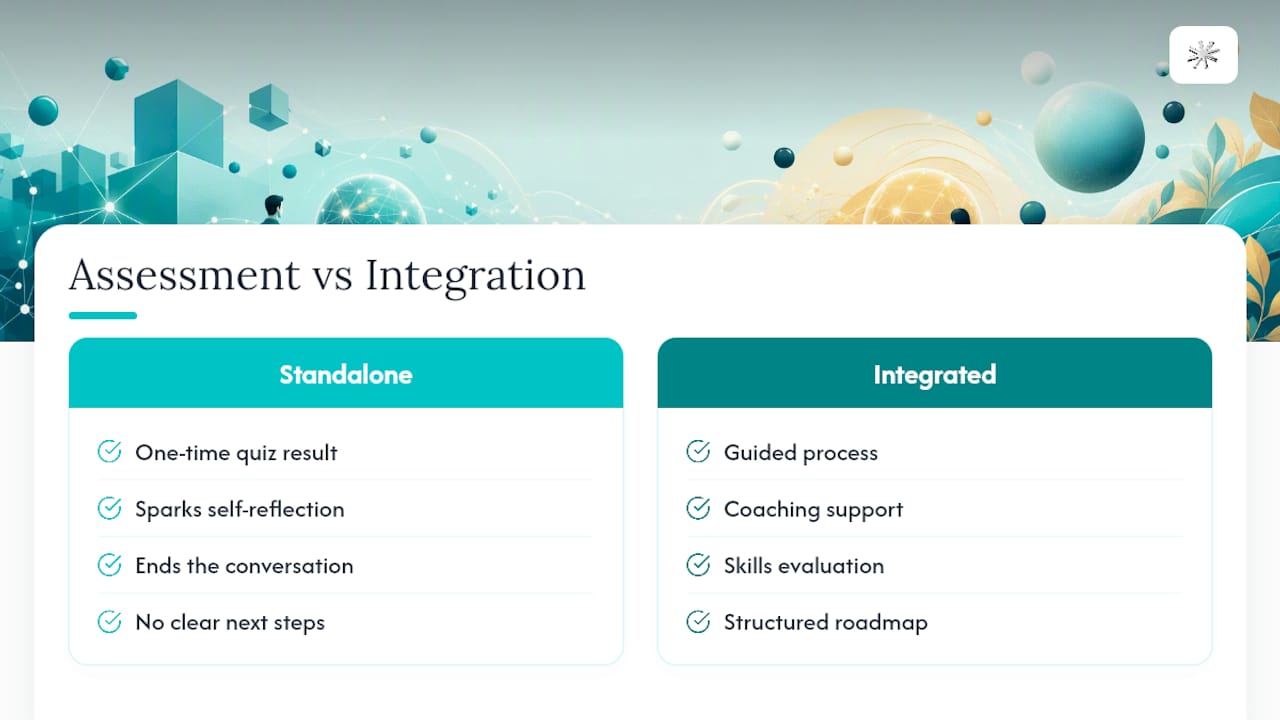
The research is consistent on one point: assessments work best as part of a guided process, not as a one-time verdict. A single quiz can spark useful self-reflection, but pairing that reflection with coaching, skills evaluation, and a structured plan is what actually moves someone from uncertainty to a decision they trust.
A short assessment should be the start of a conversation, not the end of one. Combining a strengths-based quiz with roadmaps, coaching, and application tools gives you something a standalone test can't: a way to act on what you learn instead of just staring at a results page wondering what comes next.
— Shane
Try the 7-Minute Career Quiz for a Real Starting Point
If you want a research-informed starting point without committing to a lengthy assessment battery, The 7-Minute Career Quiz generates career-path hypotheses based on your strengths, then connects those hypotheses to a personalized roadmap, so the results aren't just a label, they're a next step.
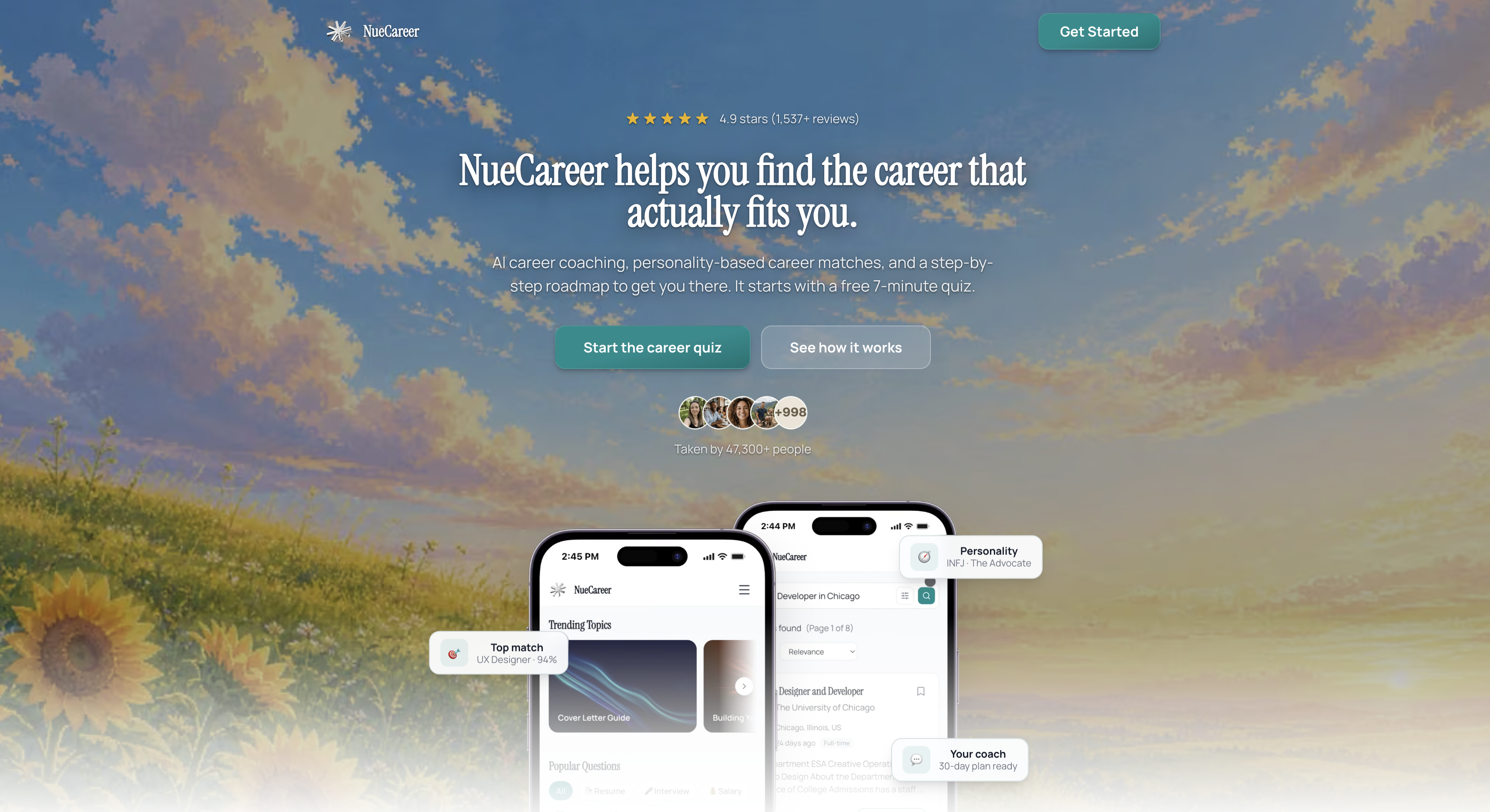
Choose the quiz when you want a fast, integrated read on your strengths and a clear plan to move on it. If you're weighing a major transition that involves formal counseling or hiring decisions, deeper assessment paired with professional guidance makes more sense as a complement. For most people exploring a change, the quiz plus its built-in coaching and job-matching tools helps with figuring out what to do with a results page once you have it. Take the quiz, review your matched paths, and use the roadmap to plan your next real move.
Primary Research and Authoritative Reading
For deeper reading: the interest inventory hit-rate meta-analysis, the Journal of Applied Psychology assessment domains study, the MSU comparison of five assessment types, and a narrative review of RIASEC-based tools. For a practical exercise on aligning strengths with career choices, see this strengths-based career guide.
Sources
- How accurate are interest inventories? A quantitative review of career choice hit rates
- Journal of Applied Psychology study on assessment domains and outcomes
- How well do career fit tests work? New MSU study compares 5 types of assessments
FAQ
How Reliable Are Career Tests?
Reliability varies by test type and retest interval, but well-designed interest and personality measures generally show moderate to high test-retest stability over a few months. Reliability tends to drop the longer the gap between test and retest, especially for younger test-takers.
Which Career Test Is the Most Accurate?
No single test is universally "most accurate" because accuracy depends on the outcome you're measuring. Skills and knowledge tests predict job performance and income best, while interest inventories predict job satisfaction more reliably than they predict long-term occupational choice.
Can You Still Get Hired if You Fail an Assessment Test?
Yes. Employer screening tests are one input among many, and a weak score on one assessment doesn't disqualify a strong candidate overall. Many employers weigh interviews, work samples, and experience alongside test results rather than relying on a single score.
How Much Does the Johnson O'Connor Test Cost?
Pricing for the Johnson O'Connor Research Foundation's aptitude testing is not publicly standardized and varies by location and testing package, so contact the foundation directly for current rates. If you want a lower-commitment starting point, The 7-Minute Career Quiz offers a free, fast alternative for initial career-path hypotheses.