
Career Aptitude Quiz Benefits: Your 2026 Guide

Discover the career aptitude quiz benefits that can enhance your job search. Unlock new opportunities and explore paths you've never considered.
TL;DR:
- Career aptitude quizzes help expand career options and increase self-awareness for better decision-making. They focus on interests and preferences rather than hard skills and should be used as exploration tools rather than definitive answers. Repeating assessments over time with professional support enhances their usefulness, especially for mid-career planning.
A career aptitude quiz is a structured self-assessment that maps your strengths, interests, and preferences to potential career paths. The primary career aptitude quiz benefit is clear: RIASEC self-assessment tools reliably increase career exploration behaviors and expand the number of occupations you seriously consider. That outcome alone makes these tools worth your time, whether you are just starting out or feeling stuck mid-career. Tools like Holland's RIASEC model, assessments featured on Indeed, and resources recommended by UC Davis Student Health and Counseling Services all point to the same conclusion: structured self-reflection opens doors you did not know existed.
1. What are the key career aptitude quiz benefits?
Career aptitude quizzes deliver several concrete advantages that go well beyond a simple list of job titles. Understanding these benefits helps you use the results with the right expectations.
Greater self-awareness
The most immediate benefit is a clearer picture of who you are professionally. Quizzes surface patterns in your interests and working style that you may not have articulated before. That clarity is the foundation for every career decision that follows.

More careers on your radar
Most people consider a narrow range of careers based on what they already know. RIASEC tools increase the variety of occupations you explore. That wider view often leads to options you would never have found through casual browsing.
Stronger decision-making confidence
A meta-analysis found a significant effect on career decision-making self-efficacy, with an effect size of d=0.45 for self-report inventories. In plain terms, people who complete structured assessments feel more capable of making career choices. That confidence matters when you are weighing a major move.
Clearer professional development priorities
Career assessment results show which careers match your profile and which skills you need to build. That dual output turns a quiz into a personal development plan, not just a list of suggestions.
A structured starting point for planning
Career quizzes give you something concrete to react to. Even if a result surprises you, that reaction tells you something useful. The quiz creates a reference point for conversations with mentors, coaches, or counselors.
Pro Tip: Combine your quiz results with a 20-minute reflection session. Write down which suggested careers excite you and which feel wrong. That contrast reveals more than the score alone.
2. How career aptitude quizzes differ from other career assessments
The phrase "aptitude quiz" is widely used, but the industry term for most of these tools is a career interest inventory. Understanding the difference protects you from misreading your results.
UC Davis Student Health and Counseling Services states that many career assessments inventory preferences and values rather than measure hard aptitudes. A true aptitude test measures your capacity to learn a specific skill, such as spatial reasoning or numerical analysis. Most online career quizzes do not do that. They measure what you enjoy, what energizes you, and how you prefer to work.
This distinction matters for three reasons:
- Interpretation accuracy. If you expect a quiz to tell you whether you are "smart enough" for a field, you will misread the output. The quiz tells you where your interests align, not your ceiling.
- Appropriate next steps. Interest-based results point you toward exploration. Aptitude-based results point you toward training decisions. Knowing which type you took shapes what you do next.
- Realistic expectations. Many users misunderstand aptitude quizzes as hard skill measures. Setting the right expectation before you start prevents disappointment after.
You can learn more about how assessments are structured before choosing one, which helps you pick the right tool for your specific question.
3. Which career aptitude quizzes are most effective and why?
Not all career quizzes produce the same results. The research points clearly to tools built on Holland's RIASEC model as the most empirically supported option for increasing career exploration.
| Quiz Type | Primary Focus | Best Used For |
|---|---|---|
| RIASEC/Holland Code | Interests and work environments | Broad career exploration |
| Values-based inventories | Work values and priorities | Narrowing options by lifestyle fit |
| Skills-based assessments | Demonstrated competencies | Identifying transferable strengths |
| Personality-type tools | Behavioral preferences | Team fit and work style awareness |
RIASEC tools categorize people across six dimensions: Realistic, Investigative, Artistic, Social, Enterprising, and Conventional. That framework has decades of research behind it. The effectiveness of RIASEC tools also depends on context. A quiz taken alone produces different results than one interpreted with a career counselor. The counselor adds context, challenges assumptions, and helps you connect the results to real opportunities.
Values-based inventories, such as those offered through Indeed's career assessment guides, work well when you already have a general direction but need to filter options by what matters most to you. Skills-based tools are most useful when you are changing careers and need to identify what transfers. Personality-type tools, while popular, are best used as conversation starters rather than definitive guides.
Pro Tip: Use two different quiz types together, one interest-based and one skills-based. Where the results overlap is where your strongest career fit likely lives.
For a curated comparison of the top options, the best career assessment tools guide covers what each tool measures and when to use it.
4. How to make the most of your career aptitude quiz results
Getting results is step one. What you do next determines whether the quiz changes anything for you.
Treat results as hypotheses, not verdicts. Frontiers in Psychology recommends treating quiz outputs as exploratory guides rather than fixed outcomes. Your results suggest directions worth investigating, not careers you are locked into.
Research the suggested careers in depth. Look up day-to-day responsibilities, salary ranges, and growth outlooks for each suggested path. The O*NET database and the Bureau of Labor Statistics Occupational Outlook Handbook are reliable starting points.
Conduct informational interviews. Reach out to people working in your top-matched fields. A 20-minute conversation with a working professional tells you more than any quiz result. Ask about what they actually do each day and what surprised them about the role.
Try job shadowing or short courses. Shadowing someone in a suggested field for a day gives you direct exposure. Short courses on platforms like Coursera or LinkedIn Learning let you test interest in a subject before committing to a full program.
Work with a career counselor or coach. Adding counselor support significantly enhances how useful and accurately interpreted your assessment results become. A counselor helps you see patterns you might miss on your own.
Revisit your results over time. Career assessments support individuals at every career stage, not just the beginning. Retaking a quiz after a year of new experiences often reveals meaningful shifts in your priorities.
Connect results to your current skills. Use a free career skills assessment to map what you already bring to the table against the requirements of your top-matched careers. That gap analysis tells you exactly where to focus your development.
Key takeaways
Career aptitude quizzes are most valuable as tools for expanding career exploration, not as sources of single definitive answers.
| Point | Details |
|---|---|
| Quizzes expand career options | RIASEC tools increase the variety of occupations you seriously consider. |
| Most quizzes measure interests, not aptitude | UC Davis SHCS confirms most tools inventory preferences, not hard skills. |
| Results build decision confidence | Research shows a meaningful effect on career decision-making self-efficacy. |
| Counselor support amplifies results | Professional guidance improves how accurately you interpret and apply quiz outputs. |
| Results require active follow-through | Treat outputs as starting points for interviews, shadowing, and short courses. |
What I have learned about the real value of career quizzes
Shane here. After years of watching people use career assessments, the pattern is consistent. The people who get the most out of a quiz are not the ones who find a perfect answer. They are the ones who use the results to start moving.
The biggest mistake I see is treating a quiz as a final decision. Someone takes a 10-minute assessment, gets a result they did not expect, and either dismisses it entirely or commits to it without any further investigation. Both reactions miss the point. The quiz is a prompt, not a prescription.
What actually works is using the result to ask better questions. If a quiz suggests you might thrive in a social or investigative role, that is not a career plan. It is a signal to go talk to people in those fields, read about what those jobs actually involve, and notice what resonates. The quiz narrows the search space. You still have to do the searching.
The research backs this up. The most reliable benefit of career quizzes is encouraging broader occupational exploration, not pinpointing a single perfect job. That framing takes pressure off the quiz and puts agency back where it belongs: with you.
One more thing. If you feel uncertain after seeing your results, that is normal. Uncertainty means you are engaging honestly with the process. The goal is not to feel certain immediately. The goal is to feel curious enough to take the next step.
— Shane
Nuecareer's free tools for your next step
Taking a career quiz is a strong first move. Knowing what to do with the results is what separates exploration from real progress.
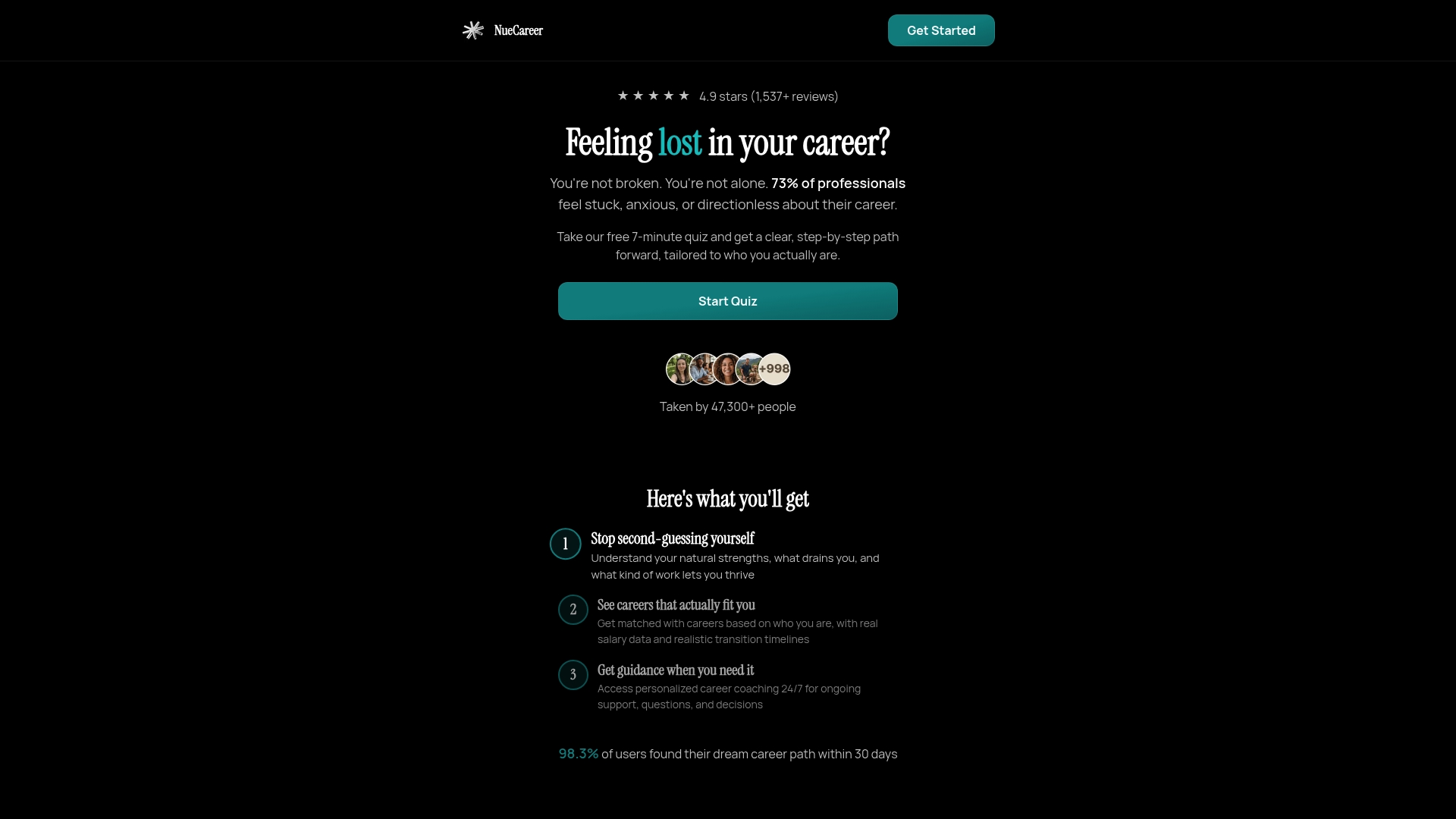
Nuecareer offers a suite of free career tools built specifically for working adults who want clarity without guesswork. The free career clusters quiz matches you to career paths based on your interests and working style. The job application skills tool helps you identify and articulate the strengths you already have, so your applications reflect who you actually are. From there, Nuecareer's personalized roadmaps and 24/7 coaching chat keep you moving forward with confidence. Every tool is free to start and designed to complement the self-awareness you build through assessment.
FAQ
What is the main benefit of a career aptitude quiz?
The primary benefit is increased career exploration. Research shows RIASEC-based tools reliably expand the number of occupations you seriously consider, which leads to better-informed career decisions.
Are career aptitude quizzes the same as aptitude tests?
No. Most career quizzes are interest inventories, not aptitude tests. UC Davis SHCS clarifies that these tools measure preferences and values, not your capacity to learn a specific skill.
How accurate are career aptitude quiz results?
Results are most accurate when used as starting points for exploration rather than fixed answers. Accuracy improves significantly when results are interpreted with a career counselor or coach.
How often should I retake a career assessment?
Retaking an assessment after a year or more of new work experience is worthwhile. Priorities and interests shift over time, and updated results often reflect meaningful personal growth.
Can a career quiz help if I am already mid-career?
Yes. Career assessments support individuals at every stage of their working life. Mid-career adults often find quizzes most useful for identifying transferable strengths and evaluating a potential pivot.