
Future-Proof Career Guide: Build Lasting Job Security

Discover what is a future proof career and how to build lasting job security. Learn key skills for success in a rapidly changing job market.
What is a future-proof career?
A future-proof career is one that stays relevant, in-demand, and secure even as automation, artificial intelligence, and economic shifts reshape the job market. Think of it less as a specific job title and more as a professional identity built on adaptability, transferable skills, and the kind of human judgment that technology cannot easily replicate.
The U.S. Bureau of Labor Statistics projects strong growth for roles in healthcare, data science, renewable energy, and cybersecurity through 2034. Those numbers tell a clear story: the careers holding their ground are the ones where human expertise, ethical judgment, and creative problem-solving sit at the center of the work.
What separates a resilient career from a fragile one comes down to a few core qualities:
- Adaptability: The ability to shift roles, learn new tools, and pivot when the market demands it
- Technical literacy: Enough fluency with digital tools and data to work alongside AI, not against it
- Human-centric skills: Creative thinking, emotional intelligence, and ethical judgment that AI cannot replicate
- Deep domain knowledge: Genuine expertise in a field, paired with broad awareness of adjacent industries
- T-shaped skill profiles: Deep mastery in one area combined with working knowledge across multiple disciplines, a combination hard for AI to replicate
The core insight here is that future-proof careers are less about locking into the right job title and more about building a professional foundation that travels with you across roles, industries, and decades.
Key characteristics that make a career resilient
Resilient careers share a recognizable pattern. They combine technical fluency with deeply human capabilities, and they belong to people who treat learning as a permanent part of the job, not a one-time credential.
Continuous learning as a baseline habit. The professionals who stay relevant do not wait for their employer to send them to a training program. They actively seek out new skills, certifications, and knowledge, often in areas adjacent to their core expertise. This habit keeps their skill set current and their options open.

T-shaped expertise. T-shaped professionals bring deep mastery in one discipline alongside broad competency across technology, business, and communication. A nurse practitioner who understands health informatics, or a data scientist who can translate findings for a non-technical executive, fits this profile. That combination is genuinely difficult for automation to replace.
A "career moat" mindset. Building a defensible career means diversifying your professional identity so that no single role, employer, or technology shift can eliminate your value. This looks like developing multiple income-relevant skills, cultivating a reputation in your field, and staying visible in professional communities.
Key traits that consistently appear in resilient careers:
- Emotional intelligence: Reading people, managing relationships, and navigating conflict in ways AI cannot
- Creative problem-solving: Generating novel solutions in ambiguous situations
- Ethical judgment: Making decisions that require moral reasoning and accountability
- Cross-functional communication: Translating complex ideas across teams, disciplines, and audiences
- Comfort with ambiguity: Thriving in roles where the rules keep changing
The 2026 labor market rewards professionals who combine these human-centric strengths with real technical competency. Neither alone is enough.
10 examples of future-proof careers in the United States
The following roles consistently appear at the top of growth projections, pay well, and require the kind of human-AI collaboration that makes them resistant to full automation.
| Occupation | Projected growth (2024–34) | 2024 median pay |
|---|---|---|
| Wind turbine service technicians | 50% | $62,580/year |
| Solar photovoltaic installers | 42% | — |
| Nurse practitioners | 40% | $129,210/year |
| Data scientists | 34% | $112,590/year |
| Information security analysts | 29% | $124,910/year |
| Medical and health services managers | 23% | $117,960/year |
| Actuaries | 22% | $125,770/year |
| Physical therapist assistants | 22% | $65,510/year |
| Operations research analysts | 21% | — |
| Computer and information research scientists | 20% | $140,910/year |
Source: U.S. Bureau of Labor Statistics, 2024–34 projections
Stat to know: Nurse practitioners earn a median salary of $129,210 with 40% projected growth through 2034, making the role one of the strongest combinations of pay and security in the entire U.S. labor market.
1. Wind turbine service technician
Wind turbine technicians top the BLS growth chart at 50% projected expansion through 2034. The work is physically demanding and highly technical, requiring hands-on diagnostics and mechanical repair that cannot be performed remotely or automated away. Median pay sits at $62,580, and demand is driven by the rapid buildout of U.S. renewable energy infrastructure.
2. Solar photovoltaic installer
Solar PV installation is growing at 42%, fueled by federal clean energy incentives and falling equipment costs. The role requires spatial reasoning, electrical knowledge, and on-site problem-solving. Most positions are accessible with a high school diploma plus vocational training, making this one of the more accessible entry points into a high-growth field.
3. Nurse practitioner
Healthcare's resilience as a sector is well-established, but nurse practitioners occupy a particularly strong position. At a $129,210 median salary and 40% projected growth, the role combines clinical expertise with patient relationship skills that no diagnostic algorithm can fully replace. Graduate-level education is required, typically a Master of Science in Nursing.
4. Data scientist
Data scientists translate raw information into decisions, a skill that becomes more valuable as organizations generate more data. The role pays a median of $112,590 and is growing at 34%. Strong candidates typically hold a bachelor's degree in statistics, computer science, or a related field, often supplemented by graduate study or specialized certifications in machine learning.
5. Information security analyst
Cybersecurity demand is structural, not cyclical. As organizations digitize more operations, the attack surface grows, and information security analysts are projected to grow 29% through 2034 at a median salary of $124,910. Certifications like CISSP and CompTIA Security+ are widely recognized entry credentials.
6. Medical and health services manager
Healthcare administration combines domain expertise with leadership, a pairing that resists automation. At 23% projected growth and a $117,960 median salary, health services managers oversee operations, compliance, and staff in hospitals, clinics, and long-term care facilities. A bachelor's degree in health administration is the typical starting point, with many roles requiring a master's.
7. Actuary
Actuaries apply mathematics and statistical modeling to assess financial risk, primarily in insurance and finance. The 22% projected growth rate reflects steady demand, and the $125,770 median salary reflects the depth of expertise required. Passing the professional exam series from the Society of Actuaries or the Casualty Actuarial Society is the recognized credential path.
8. Physical therapist assistant
Physical therapist assistants work directly with patients to restore mobility and manage pain, a role grounded in human touch and real-time clinical judgment. Projected growth of 22% and a $65,510 median salary make this an accessible healthcare career, typically requiring an associate degree and state licensure.
9. Operations research analyst
Operations research analysts use mathematical modeling to solve complex organizational problems, from supply chain logistics to resource allocation. The 21% projected growth reflects how broadly applicable this skill set is across industries, from defense to retail. A bachelor's degree in operations research, mathematics, or engineering is the standard entry point.
10. Computer and information research scientist
At the frontier of computing, these scientists develop new algorithms, programming languages, and AI systems. The 20% projected growth rate and $140,910 median salary reflect the depth of expertise required, typically a doctoral degree. This is one of the few roles where working on AI directly is itself a future-proof position.
Educational pathways and credentials that matter across these roles:
- Associate and bachelor's degrees in STEM, healthcare, and business administration
- Graduate degrees (MSN, MBA, MS in data science) for senior and specialized roles
- Industry certifications: CISSP, CompTIA Security+, AWS, Google Data Analytics, PMP
- Vocational and apprenticeship programs for trades like solar installation and wind turbine maintenance
- Continuing education through platforms like Coursera, edX, and LinkedIn Learning for ongoing skill development
How to future-proof your own career
The good news: you don't need to predict the future to prepare for it. You need a method for staying adaptable, and that method is learnable.
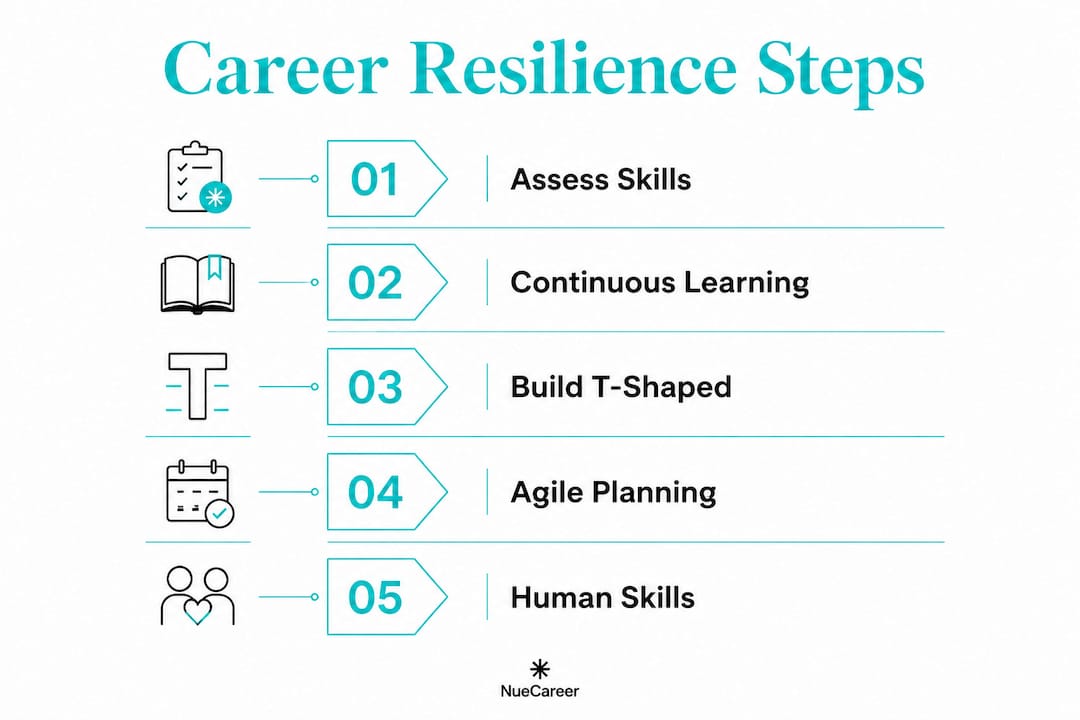
Start with a clear-eyed skills assessment. Before you can build toward a resilient career, you need to know where you stand. A skills assessment helps you identify your transferable strengths and the gaps that could limit your options. This is the foundation of any credible career plan.
Build a diverse skill portfolio. Single-role dependency is the biggest career risk in a shifting economy. Professionals who build a career moat develop skills that apply across multiple roles and industries, so no single disruption can eliminate their value. Think of it as professional diversification.
Use agile career planning. Rather than committing to a fixed five-year plan, run short, low-stakes career experiments. Try a new project, take on a stretch assignment, or explore a certification in an adjacent field. Agile career planning treats your career as an iterative process, not a destination, which keeps you responsive to market shifts without requiring a full pivot every time something changes.

Invest in human-centric skills. Creative thinking, emotional intelligence, and ethical judgment are the skills that differentiate professionals in AI-integrated workplaces. These are also the skills most resistant to automation. Developing them takes deliberate practice: leading teams, navigating conflict, mentoring others, and taking on work that requires genuine judgment.
Build your network with intention. Mentors who are already working in the roles you want can compress your learning curve significantly. Professional associations, alumni networks, and industry conferences all create the kind of relationships that surface opportunities before they're publicly posted. If you're considering a career pivot, a strong network makes the transition faster and less risky.
Practical steps to start this week:
- Identify two skills adjacent to your current role and research how to develop them
- Schedule one informational conversation with someone in a field you're curious about
- Audit your current credentials and identify one certification worth pursuing in the next six months
- Set a 90-day learning goal with a specific, measurable outcome
Pro Tip: Before you use AI to complete a complex task, try working through it yourself first. Engaging with difficult problems independently builds the judgment and oversight skills that make you genuinely valuable in an AI-driven workplace, not just a capable prompt writer.
U.S. labor market trends shaping future-proof careers
The data paints a clear picture of where the American job market is heading, and it rewards those who pay attention.
Nearly 12 million U.S. workers may need to change occupations by 2030 as AI and automation reshape entire industries. That figure isn't a reason to panic. It's a reason to plan. The workers most at risk are those in routine, rule-based roles with limited human interaction. The workers best positioned are those building the T-shaped profiles and human-centric skills described throughout this article.
| Occupation | Projected growth (2024–34) | 2024 median pay |
|---|---|---|
| Wind turbine service technicians | 50% | $62,580/year |
| Solar photovoltaic installers | 42% | — |
| Nurse practitioners | 40% | $129,210/year |
| Data scientists | 34% | $112,590/year |
| Information security analysts | 29% | $124,910/year |
| Medical and health services managers | 23% | $117,960/year |
| Actuaries | 22% | $125,770/year |
| Physical therapist assistants | 22% | $65,510/year |
| Operations research analysts | 21% | — |
| Computer and information research scientists | 20% | $140,910/year |
Source: U.S. Bureau of Labor Statistics
AI is accelerating disruption, but it's also creating new categories of work. The professionals who treat AI as a partner rather than a threat, while continuing to strengthen their own judgment and expertise, are the ones building genuinely durable careers. Practicing complex tasks without AI support, as noted in the how-to section, preserves the decision-making depth that makes a professional hard to replace.
Regional demand also matters. Healthcare roles are growing across the country, but particularly in rural and underserved areas where nurse practitioners often serve as primary care providers. Renewable energy jobs are concentrated in states with aggressive clean energy mandates, including California, Texas, and the Midwest wind corridor. Cybersecurity demand is geographically distributed, with strong clusters in the Washington, D.C. metro area, Northern Virginia, and major tech hubs like Austin and Seattle. Understanding where your target field is growing gives you a geographic edge in your job search.
If you're thinking through how to make a move, a structured career change roadmap can help you sequence the steps without feeling overwhelmed by the scope of the transition.
Discover your path with Nuecareer

Knowing what a future-proof career looks like is one thing. Knowing which one fits you is where most people get stuck. Nuecareer's free career skills assessment takes seven minutes and gives you a clear picture of your strengths, your gaps, and the career paths most aligned with who you actually are, including ones you may never have considered. From there, Nuecareer provides personalized roadmaps, 24/7 coaching chat, and job boards tailored to your target roles. You don't have to figure this out alone.
Key Takeaways
A future-proof career is built on adaptable, human-centric skills and deep domain expertise, not on any single job title or employer.
| Point | Details |
|---|---|
| Definition of future-proof careers | Resilient careers combine technical literacy, human judgment, and adaptability to stay relevant through market shifts. |
| Fastest-growing U.S. roles | Wind turbine technicians (50% growth) and nurse practitioners (40% growth, $129,210 median pay) lead BLS projections through 2034. |
| AI displacement risk | Nearly 12 million U.S. workers may need to change occupations by 2030, making adaptability a core career skill. |
| T-shaped skills are the standard | Deep expertise in one area plus broad cross-functional knowledge is the profile hardest for AI to replicate. |
| Agile planning beats fixed plans | Running short career experiments and continuously reassessing your skill portfolio keeps you responsive to change. |
FAQ
What careers are considered future-proof?
Careers in healthcare (nurse practitioners, health services managers), data science, cybersecurity, renewable energy, and actuarial science consistently rank as future-proof based on BLS growth projections through 2034. These roles require human judgment, domain expertise, and adaptability that automation cannot easily replicate.
Which jobs will survive AI after 2030?
Roles centered on human relationships, complex judgment, and physical dexterity in unpredictable environments are most likely to survive AI disruption. Nurse practitioners, cybersecurity analysts, physical therapists, and operations research analysts all fit this profile, combining technical knowledge with irreplaceable human skills.
What makes a career stable long-term?
Long-term stability comes from building a T-shaped skill profile, maintaining continuous learning habits, and developing human-centric competencies like emotional intelligence and ethical reasoning. A career moat built on diverse, transferable skills is far more durable than expertise in a single role or tool.
How do I choose a career that will last?
Start with a clear assessment of your strengths and interests, then cross-reference those with fields showing strong BLS growth projections and high demand for human judgment. Nuecareer's free skills assessment can help you identify which high-growth paths align with your actual strengths.
Do future-proof careers require a four-year degree?
Not always. Wind turbine technicians and solar PV installers enter through vocational training and apprenticeships. Physical therapist assistants typically need an associate degree. Many cybersecurity roles are accessible through certifications like CompTIA Security+ without a traditional four-year degree, though advanced roles in data science and healthcare often require graduate-level credentials.