
What Is a Generalist Career Path? Your 2026 Guide

Discover what a generalist career path is and how it can enhance your skills across fields. Learn to adapt and thrive in today's market.
TL;DR:
- A generalist career path develops broad skills across multiple fields while anchoring deep expertise in at least one area.
- It suits professionals who thrive in variety and cross-disciplinary roles, especially during early to mid-career stages.
- Broad experience combined with genuine depth enhances adaptability, leadership, and marketability in rapidly changing environments.
A generalist career path is defined as a professional approach that builds broad skills and experience across multiple fields rather than deep expertise in one. This model produces professionals who can connect ideas across disciplines, lead cross-functional teams, and adapt quickly when markets shift. The T-shaped professional framework captures this best: wide knowledge across many areas anchored by genuine depth in at least one. Horizontal career transitions are increasingly common as modern organizations reduce vertical advancement opportunities, making broad skills more valuable than ever. If you are weighing your career path options, understanding what a generalist career path offers is the right place to start.
What is a generalist career path and who does it suit?
A generalist career path suits professionals who thrive on variety, context-switching, and connecting dots across domains. Unlike a specialist who goes deep into one discipline, a generalist builds competence across several, such as marketing, operations, finance, and people management. This breadth makes generalists natural candidates for roles that require coordination, oversight, and rapid problem-solving.

The T-shaped model is the most useful framework for thinking about this. The horizontal bar represents broad knowledge across many fields. The vertical bar represents one area of genuine depth. Without that vertical bar, a generalist risks being seen as superficial. With it, they become one of the most versatile professionals in any organization.
Generalist roles appear across industries. Project managers, operations leads, chief of staff positions, management consultants, and startup founders all require the kind of cross-disciplinary thinking that defines a generalist. Employers value generalists in roles requiring cross-functional collaboration, strategic oversight, and quick adaptation to changing needs. That demand is not shrinking.
What are the key benefits of choosing a generalist career path?
The benefits of being a generalist go well beyond flexibility. Generalists are built for leadership because leadership itself requires understanding multiple functions at once. A VP of Operations who has worked in finance, logistics, and customer success brings context that a pure specialist cannot.
Here are the core advantages generalists hold:
- Adaptability in turbulent markets. When industries shift, generalists pivot faster because they are not locked into one skill set or one job title.
- Cross-functional credibility. Generalists can communicate effectively with engineers, marketers, and finance teams because they understand each domain's language and priorities.
- Reduced risk of obsolescence. Roles that rely on a single technical skill are more vulnerable to automation. Broad skills create a wider safety net.
- Leadership readiness. Generalists develop versatility, agility, and pattern recognition across disciplines, which are exactly the skills that senior leadership demands.
- Broader job market appeal. A generalist can apply credibly to a wider range of roles, which matters most during economic downturns or career transitions.
Pro Tip: When you apply for roles, frame your breadth as a feature, not a gap. Use language like "cross-functional experience" and "end-to-end ownership" to signal that your range is intentional and valuable.
Adding a language skill, for example, can further expand your reach. Chinese language skills are one concrete example of how generalists layer additional competencies to stay competitive in global markets.
How does a generalist career path compare with specialist paths?
The generalist vs specialist debate is not about which is better. It is about which fits your career stage and the market you are entering.
| Factor | Generalist path | Specialist path |
|---|---|---|
| Skill focus | Broad across multiple domains | Deep in one discipline |
| Best career stage | Early to mid-career exploration | Mid to senior-level depth |
| Leadership fit | High, especially cross-functional roles | High within a specific function |
| Job market range | Wide range of roles | Narrower but often higher-paying niche |
| Risk of obsolescence | Lower due to breadth | Higher if the specialty becomes automated |
| Ideal environment | Startups, consulting, operations | Research, engineering, medicine |
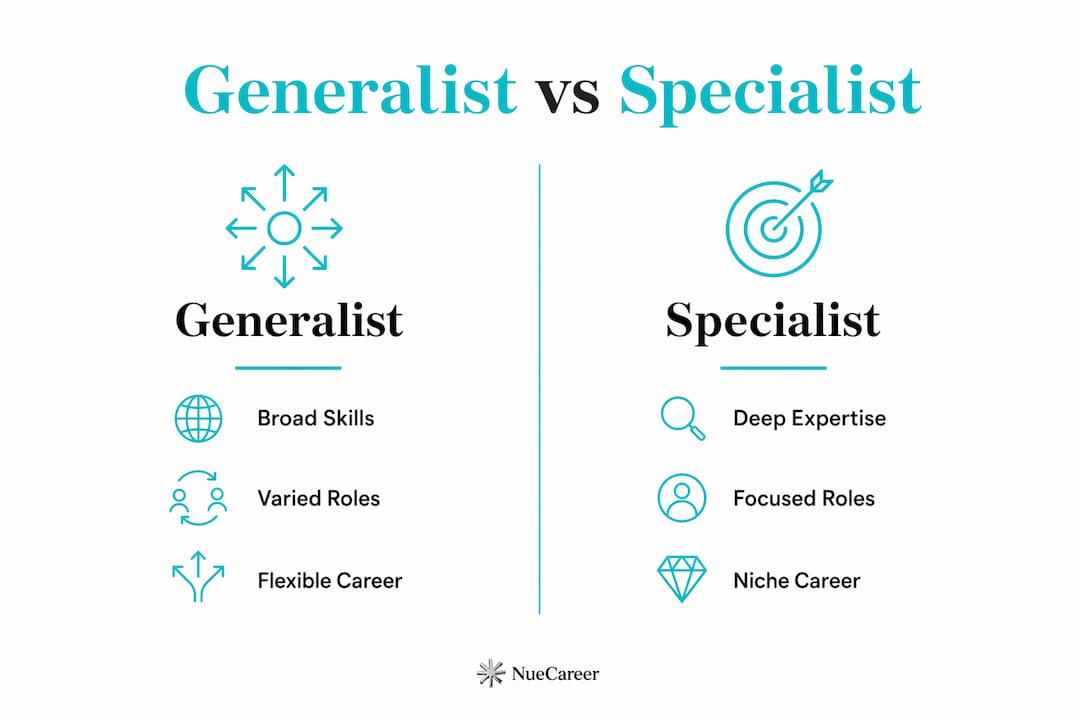
Early career years are the best time to build breadth and gather signals about your strengths. Mid-career is the optimal stage for developing deep expertise within a chosen domain. This means the two paths are not permanent choices. Many professionals start as generalists and develop a specialty once they identify where they create the most value.
The danger of staying purely broad is real. Generalists who lack genuine depth risk being seen as having superficial knowledge. The strongest generalists anchor their breadth with at least one area of deep expertise. That depth is what earns trust and opens senior doors.
Pro Tip: Audit your skills every year. Ask yourself: "Where am I genuinely better than most people?" That answer points to your vertical bar in the T-shaped model. Build there deliberately.
What practical steps can help you build a successful generalist career?
Planning a generalist career requires structure, not just curiosity. The A/B/Z career planning method is one of the most practical frameworks available. Plan A is your current direction. Plan B is a pivot you could make if Plan A stalls. Plan Z is your fallback, the safe option that keeps you stable while you experiment. Structured career review every 6–24 months with this approach helps you avoid stalling and make confident next moves.
Here is a step-by-step process for building your generalist path:
- Map your current skills. Use a tool like Nuecareer's free skills assessment to identify what you already bring across domains. Most professionals underestimate their breadth.
- Run cheap career experiments. Informational interviews, short freelance projects, and volunteer roles are low-cost ways to test new directions. Career experiments like brief research and short projects are more effective than endless introspection.
- Accumulate signals, not just experiences. After each experiment, ask what energized you, what drained you, and where you performed above expectations. Those signals guide your next move.
- Identify your depth anchor. Once you have explored broadly, pick one area to deepen. This is not abandoning the generalist path. It is completing the T-shape.
- Build a career change roadmap. A step-by-step career roadmap helps you sequence your moves so breadth builds on itself rather than scattering your focus.
- Review and adjust regularly. Career success depends less on a fixed identity and more on aligning your approach with your career stage and market needs.
Treating career planning like scientific experimentation accelerates your progress. Testing hypotheses with small, practical experiments avoids costly missteps and builds real confidence faster than any amount of planning on paper.
What challenges do generalists face and how can they overcome them?
Generalist career paths carry a real stigma. The phrase "jack of all trades, master of none" follows generalists into interviews and performance reviews. Generalist paths are often misunderstood as lacking focus, when in reality they represent a deliberate commitment to cross-disciplinary depth. The challenge is communicating that distinction clearly.
Here are the most common obstacles generalists face, and direct ways to address each:
- Perception of unfocus. Hiring managers sometimes see a varied resume as indecision. Counter this by writing a clear narrative that connects your roles. Show how each move built a specific capability you now use.
- Difficulty proving value early on. Specialists can point to a credential or a measurable output in one domain. Generalists need to demonstrate value through outcomes that required breadth, such as launching a product that needed marketing, operations, and finance alignment.
- Risk of spreading too thin. Without deliberate depth, a generalist's knowledge stays surface-level. The fix is to anchor breadth with deep expertise in at least one area, which builds the credibility that breadth alone cannot.
- Accountability gaps. Generalists who move frequently can struggle to show sustained impact. Staying long enough to see results, and documenting those results clearly, solves this problem.
- Resume presentation. A varied background requires a resume that tells a story, not just lists jobs. Career change resume strategies help generalists frame diverse experience as an asset rather than a liability.
The professionals who thrive as generalists are not those who avoided depth. They are the ones who built depth in the right place at the right time, then used their breadth to multiply that depth's impact.
Key Takeaways
A generalist career path succeeds when broad experience is anchored by genuine depth in at least one domain, matched to the right career stage, and communicated with a clear professional narrative.
| Point | Details |
|---|---|
| Define your T-shape | Build wide knowledge across domains, then develop real depth in one area to earn credibility. |
| Match path to career stage | Use early career years for breadth and signal-gathering; deepen expertise in mid-career. |
| Experiment before committing | Run low-cost career experiments like informational interviews before making major pivots. |
| Reframe your narrative | Present diverse experience as cross-functional strength, not a lack of direction. |
| Review your plan regularly | Reassess your career direction every 6–24 months using an A/B/Z planning structure. |
Why I think generalists have the advantage right now
The conventional wisdom says specialists win because they are irreplaceable in their niche. I disagree with that framing, at least for the next decade. The roles that are disappearing fastest are the ones that require only one skill done repeatedly. The roles that are growing, chief of staff, operations lead, product generalist, growth manager, all require someone who can hold multiple domains in their head at once and make decisions across them.
What I have seen, working with professionals at every stage, is that the generalists who struggle are not struggling because they are too broad. They are struggling because they never picked a depth anchor. They kept exploring without ever planting a flag. The T-shaped model is not a metaphor. It is a practical instruction. Pick one thing to be genuinely excellent at. Then let your breadth do the connecting.
The non-linear career path also carries less stigma than it did five years ago. Hiring managers who once wanted a straight line on a resume now often see a varied background as evidence of resilience and range. If you are a student or a professional who feels like your career does not fit a clean category, that is not a weakness. That is the profile that complex organizations need most. Own it, articulate it clearly, and build the depth that makes it credible.
— Shane
How Nuecareer supports your generalist career path
Knowing you want a generalist path is one thing. Knowing which roles fit your specific mix of skills is another challenge entirely.

Nuecareer's free job skills tool maps your existing competencies across domains and shows you exactly which roles they match. The free job description analyzer breaks down what employers actually want so you can tailor your application with precision. The free cover letter generator helps you frame your broad experience as a strength for each specific role. All three tools are free and built for professionals who bring more to the table than one job title can capture.
FAQ
What does a generalist do in their career?
A generalist builds skills and experience across multiple fields rather than specializing in one. They typically work in roles that require coordination, cross-functional oversight, or broad problem-solving, such as project management, operations, consulting, or general management.
Is a generalist career path better than a specialist path?
Neither path is universally better. Early career professionals benefit most from generalist breadth to gather signals and explore options, while mid-career professionals often benefit from deepening expertise in one area to build credibility and earning power.
How do I know if a generalist career path fits me?
You are likely a strong generalist candidate if you get energized by variety, learn new domains quickly, and find yourself naturally connecting ideas across different fields. Tools like the Nuecareer career fit evaluation can help you assess your personal alignment with this path.
What are the most common generalist job roles?
Project manager, operations manager, chief of staff, management consultant, startup founder, and general manager are among the most common generalist job roles. These positions require cross-functional thinking, adaptability, and the ability to communicate across departments.
How can a generalist stand out in a job search?
A generalist stands out by telling a clear career narrative that connects diverse experiences to a specific outcome. Framing varied roles as cross-functional expertise, backed by at least one area of genuine depth, is the most effective way to differentiate yourself to hiring managers.