
What Is a Nonlinear Career Path? Your 2026 Guide

Discover what a nonlinear career path is and why embracing it can lead to greater job satisfaction and opportunity. Explore your future today!
TL;DR:
- A nonlinear career path involves lateral moves, industry switches, and skill stacking rather than a traditional upward climb. These diverse experiences enhance judgment, adaptability, and leadership qualities, making professionals more competitive in dynamic economies. Overcoming misconceptions and framing these paths intentionally can lead to greater career momentum and fulfillment.
A nonlinear career path is a professional trajectory defined by lateral moves, industry pivots, skill stacking, and intentional pauses rather than a straight upward climb through a single field. This model of career development is not a fallback for people who lost their way. It is increasingly the norm. Work life expectancy is projected to grow from 40 to 60 years, making a single-track career not just limiting but genuinely unsustainable for most people. If your resume looks more like a mosaic than a ladder, you are not behind. You may actually be ahead.
What is a nonlinear career path vs. a traditional linear one?
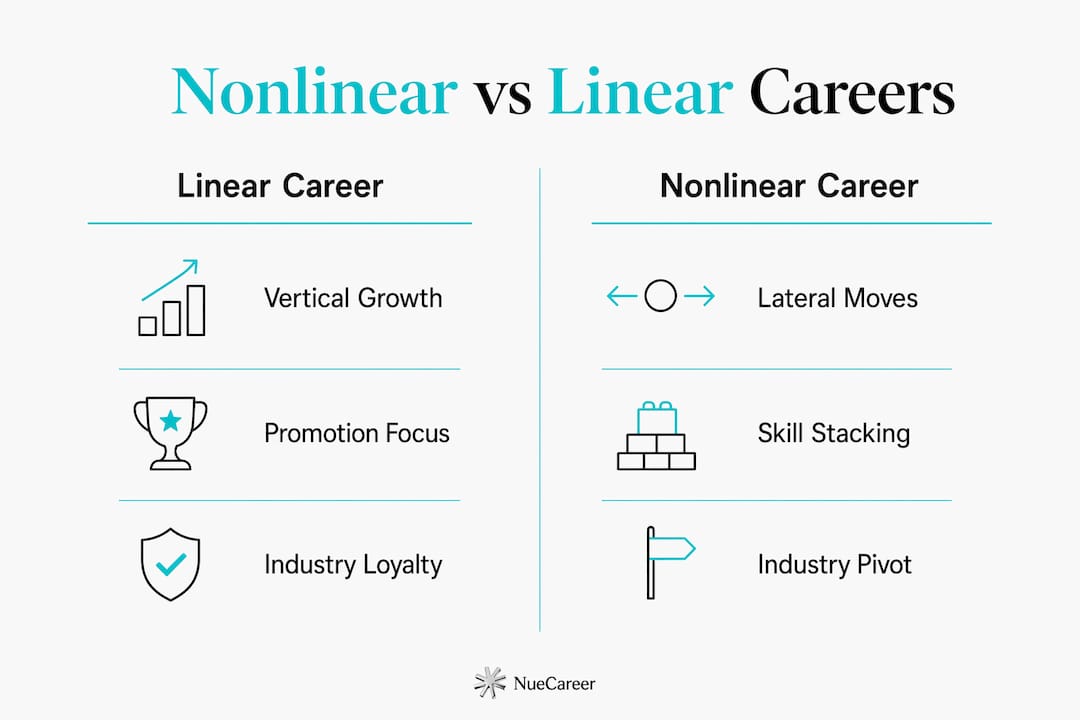
A linear career path follows a predictable sequence: entry-level role, promotion, senior role, management, repeat within one industry or function. A nonlinear career path, by contrast, moves across roles, industries, and skill sets in ways that do not follow a predetermined sequence. The progression is real, but it looks different on paper.

The clearest way to understand the difference is through the types of moves each model involves. Linear careers reward tenure and title accumulation. Nontraditional career paths reward skill accumulation and adaptability. Skill-based pathways are replacing title-based progression, with employees moving from roles like "Content Writer" to "Video Storyteller" by acquiring new competencies rather than waiting for a promotion.
| Point | Linear career | Nonlinear career |
|---|---|---|
| Progression style | Vertical, title-driven | Lateral, skill-driven |
| Role variety | Low, within one function | High, across functions or industries |
| Skill acquisition | Deep in one domain | Broad across multiple domains |
| Risk profile | Lower short-term, higher long-term | Higher short-term, lower long-term |
| Leadership readiness | Narrow but deep | Wide and adaptive |
Three common nonlinear moves include lateral shifts within a company (moving from marketing to operations), full industry switches (leaving finance for education technology), and deliberate pauses for retraining, caregiving, or entrepreneurship. Each of these can feel disorienting in the moment. Over time, they build what career researchers call "career surface area," the total range of contexts and problems you have worked through. Professionals with diverse experiences learn faster and adapt better in dynamic economies, precisely because their surface area is wider.
Pro Tip: When describing your career to a recruiter or hiring manager, lead with the skill thread that connects your roles, not the job titles themselves. "I have spent ten years building audience trust across media, nonprofit, and tech" lands better than a list of unrelated titles.
What are the key advantages of nonlinear career development?
The benefits of a diverse career path go well beyond flexibility. They compound in ways that linear careers rarely do.
- Systems intelligence. Women's nonlinear career trajectories build leadership qualities overlooked by traditional models, specifically enhanced pattern recognition and judgment under uncertainty. When you have worked in three different industries, you recognize structural patterns that specialists inside one field simply cannot see.
- Faster learning curves. Each new domain you enter forces you to learn quickly. That learning muscle strengthens with use. Nonlinear professionals often describe accelerating, not slowing, as their careers progress.
- Higher leverage in the job market. Nonlinear careers stack previous experiences rather than resetting progress. A former teacher who moves into instructional design at a software company brings classroom empathy, curriculum structure, and communication skills that a pure technologist cannot replicate.
- Leadership readiness. Organizations increasingly need leaders who can manage ambiguity, translate across teams, and make decisions with incomplete information. These are exactly the skills that nonlinear career development builds.
- Career momentum through overlap. Nonlinear professionals often run side projects, fractional roles, or learning sprints alongside their primary work. This overlap creates momentum that a single-track career cannot generate.
The deeper advantage is psychological. People who have navigated multiple pivots develop a genuine tolerance for uncertainty. That tolerance is not just a soft skill. It is a competitive asset in any leadership role.
Pro Tip: Frame your nonlinear background as a feature, not a bug, when writing your resume or LinkedIn summary. Use language like "cross-functional expertise" or "multi-sector experience" to signal intentionality rather than drift.
What challenges and misconceptions come with nonlinear careers?
The most persistent misconception about nonlinear career paths is that they signal a lack of focus. Hiring managers trained on linear models sometimes read a varied resume as evidence of instability. That perception is changing, but it has not disappeared.
Here are the challenges you are most likely to face:
- The job-hopping stigma. Short tenures across multiple roles can raise red flags. The solution is not to hide the moves but to frame them. Crafting a coherent throughline narrative connects diverse roles positively and shifts the reader's interpretation from "unfocused" to "intentional."
- Resume structure. Traditional chronological resumes favor linear careers. A skills-based or hybrid resume format works better for nontraditional career paths because it leads with competencies rather than titles.
- Financial risk during transitions. Career pivots carry real financial exposure. Career guidance from 2025 advises replacing at least 60% of your income through new ventures or side projects before leaving a current role. This staged approach reduces the pressure that forces premature decisions.
- Narrative clarity. The most frequent resume mistake is hiding nonlinear moves instead of framing them as skill stacking. If you cannot explain the logic of your career arc in two sentences, a recruiter will not do that work for you.
"A nonlinear career is not backward progress. It is layered growth that creates unique leverage and future momentum." This reframe matters because it changes how you present yourself, not just how you feel about your path.
The professionals who navigate these challenges best are the ones who invest time in their personal story. They know exactly why each move made sense and they communicate that clearly. You can use a career path fit evaluation to stress-test your next pivot before committing to it.
How can professionals effectively navigate and build nonlinear careers?
Navigating a nonlinear career is not about following a fixed plan. It is about building the habits and structures that keep you moving with purpose.
Map your transferable skills before each move. Before pivoting, take stock of what you already own. A free career skills assessment can surface strengths you have undervalued and gaps worth closing before you apply.
Embrace fractional and project-based work. Fractional work and side projects accelerate professional growth by providing diverse experience in condensed time. A three-month consulting engagement in a new industry can teach you more than a year of reading about it.
Deliberately put yourself in novice positions. Adopting the mindset of being the least knowledgeable person in the room when entering a new field accelerates learning and prevents the arrogance that stalls growth. This is not humility for its own sake. It is a practical strategy for absorbing new domains quickly.
Build a personal brand that spans your roles. Your LinkedIn profile, portfolio, and professional bio should tell one coherent story across all your roles. The thread might be "building trust with audiences" or "solving operational problems in high-growth environments." The specific industries matter less than the consistent value you deliver.
Use internal opportunities before external ones. Many organizations now offer internal gig programs, cross-functional project teams, and job shadowing. These are low-risk ways to test a new direction without leaving your current employer. If your company offers them, use them first.
Invest in continuous learning with a purpose. Not all learning is equal. Prioritize skills that sit at the intersection of your current strengths and your target direction. Platforms like Coursera, LinkedIn Learning, and Google Career Certificates offer structured paths that hiring managers recognize.
Pro Tip: When you are ready to make a formal pivot, read the job descriptions of your target roles carefully. A job description analyzer can show you exactly which of your existing skills map to what employers want, so you apply with confidence rather than guesswork.
The professionals who thrive with nonlinear career development treat each role as a deliberate investment, not just a paycheck. They ask: what skill am I building here, and how does it connect to where I am going? That question alone separates intentional nonlinear careers from accidental ones. For a structured approach to making the switch, the 8-step career switching guide from Nuecareer walks you through the process from assessment to application.
Key takeaways
A nonlinear career path builds compounding leverage through skill stacking, systems intelligence, and adaptability that linear careers structurally cannot replicate.
| Point | Details |
|---|---|
| Definition is clear | A nonlinear career path involves lateral moves, pivots, and skill stacking rather than vertical title progression. |
| Advantages compound | Diverse experience builds pattern recognition, leadership readiness, and faster learning across domains. |
| Challenges are manageable | Replace 60% of income before pivoting and craft a coherent narrative to counter job-hopping perceptions. |
| Navigation requires intention | Map transferable skills, use fractional work, and build a personal brand that connects all your roles. |
| Skills beat titles | Skill-based pathways are replacing title-driven progression, making nonlinear experience increasingly valuable. |
Why I think the zigzag is the smartest career move you can make
I have watched professionals with picture-perfect linear resumes get outmaneuvered by people whose careers looked messy on paper. The difference was never credentials. It was judgment. The person who had worked in three industries, managed a side project, and taken a deliberate pause to retrain could read a room, adapt a strategy, and make a call under pressure in ways that the straight-line climber simply could not.
The conventional wisdom says that focus is everything. Stay in your lane, build depth, become the expert. That advice made sense when careers lasted 40 years and industries changed slowly. It does not hold when work life expectancy stretches to 60 years and the skills that matter today may be automated or obsolete within a decade.
What I have found is that the professionals who own their nonlinear paths, who stop apologizing for the pivots and start explaining the logic, are the ones who get hired for the most interesting roles. They are not hired despite their varied backgrounds. They are hired because of them. Nonlinear careers silently build superior judgment and adaptability, and those traits are exactly what leadership in unpredictable environments demands.
Stop treating your zigzag as something to explain away. Start treating it as the most honest record of how you actually grow.
— Shane
How Nuecareer helps you build a nonlinear career with confidence
If your career path does not fit a neat template, you are not alone and you do not need to figure it out by yourself.
Nuecareer is built for exactly this situation. The 7-minute career quiz identifies your strengths and matches you to career paths built around who you are, including roles you may never have considered. From there, you get personalized roadmaps, 24/7 coaching chat, and a full suite of resume and cover letter tools tailored to your target roles. Whether you are mapping transferable skills with the free skills tool or exploring what your next pivot could look like, Nuecareer gives you the structure to move forward with clarity rather than anxiety.
FAQ
What is a nonlinear career path in simple terms?
A nonlinear career path is a professional trajectory that includes lateral moves, industry switches, pauses, and pivots rather than a straight upward climb within one field. It is defined by skill stacking and adaptability rather than title progression.
Are nonlinear career paths becoming more common?
Yes. Work life expectancy is projected to grow from 40 to 60 years, making career pivots and lateral moves structurally necessary for most professionals over a full working life.
How do I explain a nonlinear career on my resume?
Frame your diverse roles around a consistent skill thread or value you have delivered across contexts. Avoid hiding the moves. Instead, use a skills-based or hybrid resume format and craft a two-sentence career narrative that connects your experiences intentionally.
What is the biggest financial risk of a nonlinear career?
The biggest risk is leaving a stable role before your new direction generates income. Career experts advise replacing at least 60% of your current income through side projects or fractional work before making a full transition.
Do employers value nonlinear career experience?
Increasingly, yes. Organizations moving to skill-based hiring models actively seek candidates with cross-functional experience, systems thinking, and adaptability. These are traits that nonlinear career development builds directly.