
What Is a Freelance Career Path? Your 2026 Guide

Discover what is a freelance career path and how it offers autonomy, income potential, and diverse opportunities. Start your journey today!
TL;DR:
- A freelance career involves working as an independent contractor, selling your skills to multiple clients.
- Success depends on defining your niche, building strong business systems, and maintaining consistent outreach.
A freelance career path means working as an independent contractor, selling your skills directly to multiple clients rather than holding a permanent job with one employer. You choose your clients, set your own schedule, and take full responsibility for your business. Platforms like Upwork have made this model accessible to millions of professionals across every industry. The appeal is real: more autonomy, more variety, and the ability to build income around your strengths. The trade-off is equally real. You manage your own taxes, benefits, and client pipeline from day one.
What is a freelance career path and how does it work?
A freelance career path is defined as self-employment through services sold on a contract basis to multiple clients, with no single permanent employer. You are the business. That means you set rates, negotiate terms, deliver work, and invoice clients directly. Unlike a traditional job, no one hands you a salary, a benefits package, or a defined promotion track.
The core distinction from traditional employment comes down to three things: client choice, schedule control, and business ownership. A salaried employee works for one organization under its rules. A freelancer works for several clients under terms they negotiate themselves. This independence is the main draw for professionals who feel constrained by conventional career structures.
Freelancing spans nearly every professional field. Writers, software developers, graphic designers, consultants, data analysts, and marketing specialists all build thriving independent practices. The common thread is a marketable skill that clients need but do not want to hire for full time. If you can solve a specific problem for a business, you have the foundation of a freelance career.
What are the essential steps to start a freelance career?
Starting freelancing without a clear plan is the fastest way to stall. These steps give you a repeatable framework to launch with confidence.
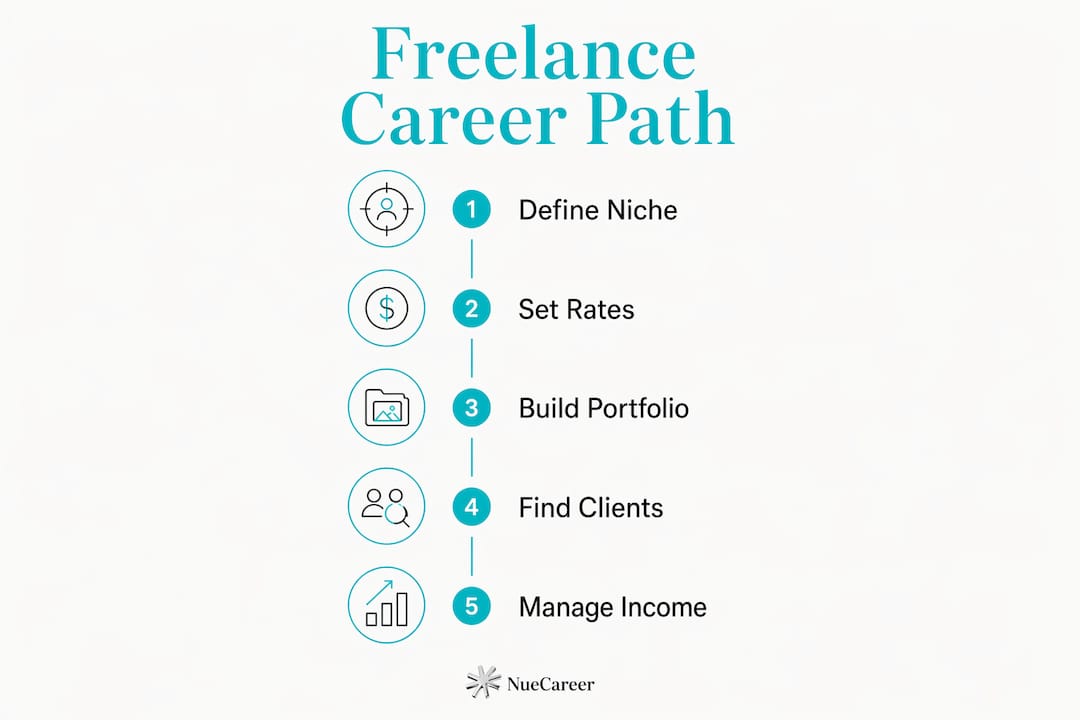
Identify your core skill and narrow your niche. Generalists struggle to stand out. Specialists win clients. Instead of "I do marketing," define your offer as "I write email sequences for SaaS companies." Specializing your service aligns your offer directly to a client's problem and increases your chance of being hired.
Define your ideal client. Know the industry, company size, and specific pain point you solve. This shapes every pitch you write and every platform you use to find work.
Build a portfolio before you pitch. Clients buy proof, not promises. Volunteer work, discounted projects, and personal samples all count as portfolio material early on. Three strong case studies beat a long list of vague claims.
Set up your business foundations. Register your business if required in your state, open a separate bank account, and set your pricing. Use Form 1040-ES for quarterly estimated taxes and track every business expense from the start. Skipping this step creates painful surprises at tax time.
Start part time. Many successful freelancers begin as a side hustle while keeping their current job. This reduces financial pressure and lets you test whether the freelance lifestyle fits before you commit fully.
Find your first clients. Post your services on platforms like Upwork or browse top freelance websites to match your skill to the right marketplace. Warm outreach to your existing network often lands the first paid project faster than any platform.
Pro Tip: Set your rate 20% higher than you think you deserve. You can always negotiate down. You cannot easily raise a rate once a client anchors to a lower number.
Which freelance career options are in high demand in 2026?
Not all freelance roles pay equally. The highest-paying freelance jobs in 2026 cluster around technology, AI, and specialized consulting. Top freelancers in these fields earn six-figure incomes when they combine strong portfolios with consistent client relationships.
Here are the roles generating the most demand right now:
- Machine learning engineers. Companies need AI model builders but cannot always justify a full-time hire. Freelance ML engineers command premium rates per project.
- Cybersecurity consultants. Every business with a digital presence needs security audits. This is a high-trust, high-fee niche with repeat client potential.
- Data analysts. Businesses collect more data than their teams can interpret. Freelance analysts who can turn raw numbers into decisions are in constant demand.
- Digital marketers. SEO specialists, paid media buyers, and content strategists all find steady freelance work across industries.
- Business consultants. Experienced professionals who can diagnose operational problems and recommend fixes charge consulting rates that reflect their expertise.
| Freelance role | Earning potential | Key strength needed | Main challenge |
|---|---|---|---|
| Machine learning engineer | Very high | Python, model training | Staying current with AI tools |
| Cybersecurity consultant | High | Risk assessment, compliance | Building client trust |
| Data analyst | High | SQL, data visualization | Explaining findings clearly |
| Digital marketer | Moderate to high | Campaign strategy, analytics | Proving ROI to clients |
| Business consultant | High | Industry expertise | Winning first clients |
Your portfolio drives your rate in every one of these roles. A data analyst with three published case studies charges more than one with only a resume.
How do freelancers manage business operations and sustain income?
Freelancing is running a business, not just doing skilled work. Many freelancers underestimate the administrative workload involved in contracts, invoicing, and taxes. Setting up these systems before you land your first client saves significant stress later.
The core business responsibilities every freelancer carries include:
- Contracts. Use a written agreement for every project. Define scope, payment terms, revision limits, and ownership of deliverables.
- Invoicing. Send invoices promptly and follow up on late payments. Tools like Wave or FreshBooks automate this process.
- Taxes. File quarterly estimated taxes using Form 1040-ES. Track deductions for home office, software, and professional development throughout the year.
- Pricing. Raise your rates as your portfolio grows. Staying at your starting rate for years is the most common way freelancers leave money on the table.
Income variability is the hardest adjustment for new freelancers. Building multiple client relationships smooths out the gaps between projects. Aim for at least three active clients at any time so that losing one does not create a financial crisis.
Consistent client outreach while you are working on current projects is the discipline that separates sustainable freelancers from those who cycle through feast and famine. Marketing is not something you do when work dries up. It is something you do every week.

Pro Tip: Set aside 25–30% of every payment for taxes before you spend anything. Treat it as money that was never yours to begin with.
What are the best practices for building a lasting freelance career?
Long-term freelance success is built on systems, not luck. These practices separate freelancers who thrive for years from those who burn out after six months.
Treat every project as a marketing asset. Deliver quality work, then ask for a testimonial and permission to use the project as a case study. Early projects build a pipeline of social proof that generates future business without extra effort.
Never stop pitching while you are working. The biggest income gap in freelancing comes from finishing a project and then starting to look for the next one. Pitch new clients every week, even when your schedule feels full.
Invest in continuous learning. The freelance roles commanding the highest rates in 2026 require skills that did not exist five years ago. Dedicate time each month to learning new tools, earning certifications, or deepening your specialty.
Build relationships, not just transactions. Repeat clients cost far less to retain than new clients cost to acquire. Follow up after projects end, share relevant resources, and stay visible to past clients.
Use platforms and tools strategically. If you are considering a broader career switch into freelancing, map out your transferable skills before you pick a niche. The clearer your positioning, the faster you attract the right clients.
Key Takeaways
A freelance career path succeeds when you combine a clearly defined niche, strong business systems, and consistent client outreach from the very first week.
| Point | Details |
|---|---|
| Define your niche first | Specializing in one service for one type of client wins more work than broad generalist positioning. |
| Build business systems early | Set up contracts, invoicing, and quarterly tax payments before landing your first client. |
| Start part time to reduce risk | Testing freelancing alongside your current job lets you build a client base without financial pressure. |
| Treat projects as marketing assets | Collect testimonials and case studies from every project to attract higher-paying clients over time. |
| Pitch consistently, not reactively | Reaching out to new clients every week prevents the income gaps that end most freelance careers. |
Why the freelance path rewards patience more than hustle
Shane here. I have watched a lot of people launch freelance careers with enormous energy and burn out within a year. The pattern is almost always the same. They sprint hard at the start, land a few clients, get busy, stop pitching, finish the work, and then panic when the pipeline is empty.
The freelance career path is not a sprint. It is a slow build that rewards consistency over intensity. The professionals I have seen succeed long term are not necessarily the most talented. They are the ones who treated their freelance practice like a real business from week one. They set up their contracts before they needed them. They raised their rates before they felt ready. They kept pitching even when their calendar looked full.
The other thing most guides will not tell you: niche clarity is not a one-time decision. Your niche will evolve as you learn what you are actually good at and what clients will actually pay for. The freelancers who adapt that positioning every year or two stay relevant. The ones who lock in a niche at the start and never revisit it often find themselves underpriced and overworked three years later.
If you are considering this path, start part time. Give yourself six months to test the fit before you make any dramatic moves. The freedom is real. So is the discipline it requires.
— Shane
Nuecareer tools that support your freelance career
Building a freelance career starts with knowing exactly what skills you bring to the table and how to present them to clients.
Nuecareer's free skills identification tool helps you pinpoint your strongest marketable skills and frame them clearly for any client or application. The free cover letter generator creates tailored pitches for specific roles, which is exactly what freelancers need when applying to project listings. Nuecareer also offers a job description analyzer that breaks down what clients actually want so you can tailor your proposals with precision. All of these tools are free and available at Nuecareer.
FAQ
What is the difference between freelancing and self-employment?
Freelancing is a form of self-employment where you sell services to multiple clients on a contract basis. All freelancers are self-employed, but not all self-employed people are freelancers. Some self-employed individuals run product businesses or agencies rather than selling personal skills directly.
How long does it take to build a stable freelance income?
Most freelancers reach stable income within six to twelve months of consistent client outreach and portfolio building. Starting part time while keeping a current job reduces financial pressure during this period.
Do freelancers need to register a business?
Registration requirements vary by state, but setting up business systems including a separate bank account and legal structure is recommended from the start. At minimum, freelancers must file taxes as self-employed individuals using Schedule C and Form 1040-ES.
What freelance career options pay the most in 2026?
Machine learning engineers, cybersecurity consultants, and data analysts rank among the highest-paying freelance roles in 2026. Strong portfolios and repeat client relationships are the primary drivers of top-tier earnings in these fields.
Can I freelance while working a full-time job?
Yes. Starting freelancing part time is one of the most effective ways to test the model before committing fully. Most professionals begin with evenings and weekends until their freelance income justifies a full transition.