
What Does Dream Job Mean? A Clear, Honest Guide

Discover what does dream job mean in this clear guide. Learn the six key criteria and take the first step toward your ideal career.
TL;DR:
- A dream job meets six specific criteria: engaging work, positive impact, skill use, supportive colleagues, positive environment, and work-life fit. These conditions evolve over a career, requiring ongoing recalibration as personal priorities change. Building skills and self-awareness is more effective than chasing passion or prestige for long-term fulfillment.
A dream job is defined as a role that meets six specific, evidence-based criteria centered on daily engagement, meaningful impact, skill use, supportive colleagues, a positive work environment, and compatibility with your life outside work. This definition comes from 60+ studies reviewed by career research organization 80,000 Hours, and it deliberately excludes income and status as primary factors. Only 14% of American adults are currently working in what they consider their dream job, while 66% are open to switching careers to find one. Understanding what does dream job mean at this level of specificity is the first step toward actually getting there.
What does dream job mean? The six-criteria definition

A dream job is not a vague feeling of happiness at work. It is a role that consistently satisfies six measurable conditions, according to 80,000 Hours research built on decades of positive psychology.
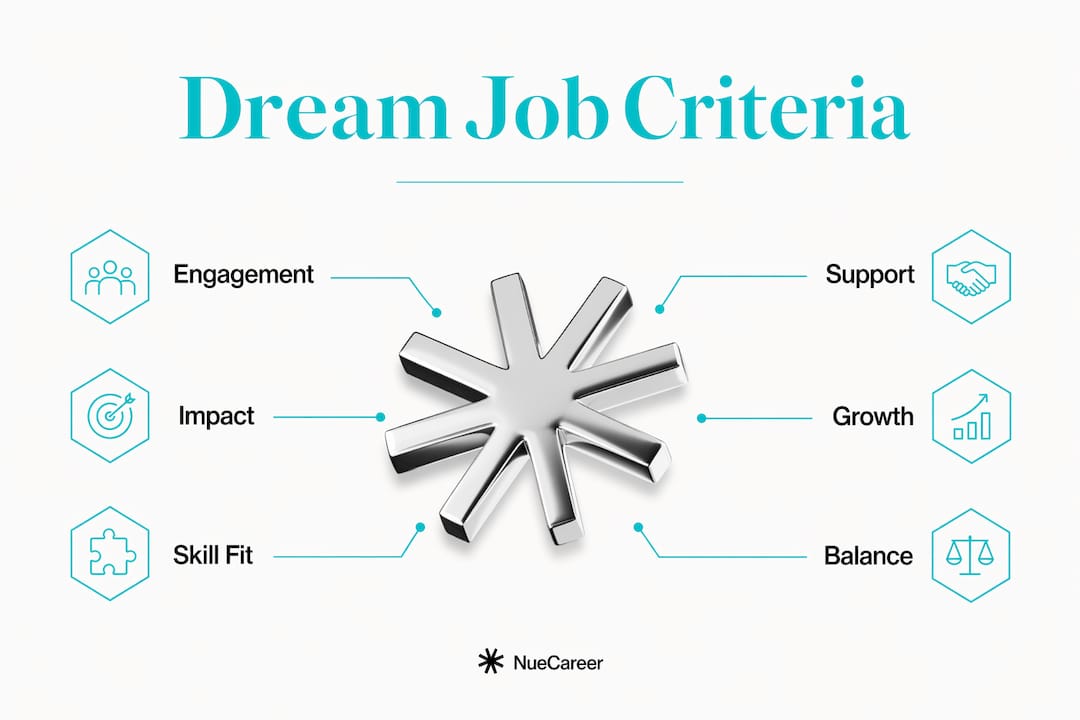
The six criteria are:
Engaging daily work. You find your day-to-day tasks absorbing, not draining. Work consumes about 33% of waking hours on weekdays, which means daily engagement is the single strongest predictor of career satisfaction. A title you love means nothing if the actual work bores you.
Positive impact. Your work helps others in a way you find meaningful. This does not require saving lives. A software developer who builds tools that reduce stress for thousands of users is creating real impact.
Tasks you are skilled at. Competence builds confidence. When you regularly use your strongest abilities, you enter a state psychologists call "flow," where effort feels natural and time passes quickly.
Supportive colleagues. Supportive colleagues and the absence of major negatives like unfair pay or a punishing commute are critical to sustaining satisfaction. You do not need to be best friends with your coworkers. You do need to feel respected and supported.
A positive work environment. This covers culture, management quality, physical space, and psychological safety. A toxic environment will erode satisfaction regardless of how well the other five criteria are met.
Work-life fit. The role must be compatible with your personal responsibilities, health, and values outside the office. A job that pays well but destroys your relationships or sleep is not a dream job by any meaningful definition.
Income and status are excluded from this framework because research consistently shows they produce short-term satisfaction, not sustained fulfillment. A higher salary stops feeling meaningful within months. Daily engagement does not.
Pro Tip: Before applying to any new role, score it against all six criteria. A job that scores high on five but fails completely on one, such as a toxic manager, will not feel like a dream job within a year.
| Criterion | What it means in practice |
|---|---|
| Engaging daily work | Tasks hold your attention and match your natural energy |
| Positive impact | Your output helps real people in ways you care about |
| Skill alignment | You use your strongest abilities regularly |
| Supportive colleagues | Coworkers respect you and collaborate well |
| Positive environment | Culture, management, and space support your performance |
| Work-life fit | Hours and demands are compatible with your personal life |
How does a dream job evolve over your career?
A dream job is rarely a fixed destination. It is an evolving set of conditions that requires periodic recalibration as your skills, values, and life circumstances change. This is one of the most misunderstood aspects of career fulfillment.
Think about how priorities shift across a career lifespan:
- Early career: Learning speed, mentorship quality, and skill-building opportunities matter most. A junior designer at a creative agency may prioritize feedback and growth over salary or autonomy.
- Mid-career: Impact and recognition become more central. A marketing manager with ten years of experience may now need to feel that their work shapes real outcomes, not just executes tasks.
- Later career: Flexibility, legacy, and alignment with personal values often rise to the top. A senior consultant may redefine their dream job entirely around remote work and projects that reflect their deepest interests.
The "one perfect job" myth treats career fulfillment as a single destination you either reach or miss. The reality is that maintaining satisfaction requires ongoing adjustment to work conditions as your personal and professional circumstances evolve. Someone who loved a fast-paced startup at 28 may find the same environment exhausting and unfulfilling at 42. Neither version of that person is wrong. They have simply changed.
Recognizing this dynamic nature of career fulfillment is freeing. You are not searching for one perfect answer. You are building a working life that fits who you are right now, with the understanding that you will need to revisit and adjust that fit over time.
What are the biggest misconceptions about dream jobs?
The most damaging myth about dream jobs is the "follow your passion" model. It tells you to identify what you love and then find a job doing it. Career researcher Benjamin Todd of 80,000 Hours argues that following passion as a starting point is often backwards. Passion tends to emerge from doing meaningful work well, not the other way around. Building skills in work that matters leads to fulfillment. Waiting for passion to appear before committing to a direction leads to paralysis.
"The key question is not 'what am I passionate about?' but 'what work will I find meaningful and become excellent at?'" — 80,000 Hours
A second major misconception is that a dream job is defined by salary or prestige. Nearly 33% of employees are disengaged in their current roles, and many of those roles come with competitive pay and impressive titles. Disengagement at that scale shows that compensation alone does not create fulfillment.
A third misconception is that a dream job must feel perfect every single day. Every role has frustrating tasks, difficult periods, and moments of doubt. The difference between a dream job and a wrong job is not the absence of hard days. It is whether the core six criteria are consistently met over time.
Pro Tip: Reframe your goal from "finding the perfect job" to "building conditions for consistent fulfillment." That shift makes the search feel less overwhelming and more achievable.
How can you identify and create your own dream job?
Identifying your dream job starts with structured self-reflection, not a job board search. The question "What is your dream job?" is best understood as a tool for uncovering your values and preferred environments, not a search for a singular perfect role. Used that way, it becomes genuinely useful.
Here are the most effective methods for identifying and shaping your dream job:
- Reflect on energy peaks. Track which tasks leave you energized versus drained over two to four weeks. The pattern reveals your natural engagement zones more accurately than any personality label.
- Audit your skills honestly. List what you do well, what others consistently ask you for help with, and what you learn quickly. Skill assessments and career quizzes help align personal strengths with roles that maximize fulfillment.
- Define your environment non-negotiables. Write down the work conditions you absolutely need: remote flexibility, collaborative culture, mission-driven organization, or something else entirely. These are your filters, not your wishes.
- Explore your career identity. Understanding how your values, strengths, and personal history connect to specific types of work gives you a much clearer target than browsing job titles.
- Job craft your current role. Before switching jobs entirely, test whether you can reshape your current position to better meet the six criteria. Negotiate for different projects, seek out mentors, or shift your focus toward higher-impact tasks.
| Method | Best for | Time investment |
|---|---|---|
| Energy tracking | Identifying natural engagement zones | 2–4 weeks |
| Skills assessment quiz | Matching strengths to career paths | 30–60 minutes |
| Environment audit | Defining non-negotiable work conditions | 1–2 hours |
| Career identity reflection | Connecting values to work direction | Ongoing |
| Job crafting | Improving fit in your current role | Weeks to months |
The goal is not to find a role that checks every box on day one. The goal is to move consistently toward conditions that align with who you are and what you do well. Career quizzes designed for adults exploring new directions are particularly useful here because they surface options you may never have considered on your own.
Key Takeaways
A dream job is defined by six evidence-based criteria, not by passion, salary, or prestige, and it requires active recalibration as your skills and values evolve over time.
| Point | Details |
|---|---|
| Six-criteria definition | A dream job meets six conditions: engagement, impact, skill use, supportive colleagues, positive environment, and work-life fit. |
| Passion follows skill | Building competence in meaningful work creates passion. Waiting for passion before acting leads to stagnation. |
| Dream jobs evolve | Your definition of a fulfilling role will change across career stages. Periodic recalibration is normal and necessary. |
| Salary is not the measure | High pay does not guarantee fulfillment. Nearly 33% of employees are disengaged despite competitive compensation. |
| Self-assessment is the starting point | Energy tracking, skills audits, and career quizzes are the most reliable tools for identifying your best-fit career path. |
The myth I wish someone had told me earlier
The version of "dream job" I absorbed early in my career was a destination. You found it, you arrived, and then life felt complete. That framing caused more confusion than clarity.
What the research actually shows, and what I have seen play out repeatedly, is that the most fulfilled professionals are not the ones who found their perfect job. They are the ones who got clear on what they needed from work and then built toward it deliberately. They used tools like skills assessments and honest self-reflection. They were willing to recalibrate when their priorities shifted. They did not wait for passion to strike before taking action.
The six-criteria framework from 80,000 Hours changed how I think about this entirely. It replaced a vague aspiration with a concrete checklist. That shift is not a downgrade from dreaming. It is what makes the dream achievable.
If you are feeling stuck or uncertain about your career direction right now, that feeling is not a sign that you are behind. It is a sign that you are ready to get specific. Start with what engages you daily. Build from there.
— Shane
Start identifying your strengths with free Nuecareer tools
Knowing what a fulfilling career looks like in theory is one thing. Knowing which specific roles fit your strengths is another. Nuecareer offers a suite of free tools built exactly for this gap. The job application skills tool helps you identify and articulate the strengths most relevant to your target roles. The free job description analyzer shows you exactly what employers want so you can match your experience to their language. The free cover letter generator tailors your application to any role in minutes. These tools work together to move you from clarity about what you want to confidence in how you apply.
FAQ
What is the simplest definition of a dream job?
A dream job is a role that consistently meets six criteria: engaging daily work, positive impact, skill alignment, supportive colleagues, a positive environment, and work-life fit. Income and status are not part of the core definition.
Why do so few people have their dream job?
Only 14% of American adults report working in their dream job, largely because most people search based on titles or salary rather than the specific conditions that drive sustained fulfillment.
Can a dream job change over time?
Yes. A dream job is an evolving set of conditions, not a fixed destination. As your skills, values, and life circumstances shift, your definition of a fulfilling role will shift with them.
Is following your passion the best way to find a dream job?
No. Research from 80,000 Hours shows that passion follows skill and meaningful work, not the other way around. Building competence in work that matters is a more reliable path to fulfillment than waiting for passion to appear first.
How do I start identifying my dream job?
Track which tasks energize you over two to four weeks, take a structured career strengths quiz, and define your non-negotiable work environment conditions. These three steps give you a concrete foundation to build from.