
What Does Career Transition Mean? Your 2026 Guide

Explore what does career transition mean in 2026. Learn strategies to shift your professional path with confidence and clarity.
TL;DR:
- A career transition is a strategic process that involves redefining one’s professional identity, skills, and purpose, beyond merely changing jobs. It requires careful planning, emotional adjustment, and deliberate skill development to succeed in moving into a new field or role. Approaching it as a strategic opportunity rather than a crisis enables more effective preparation and ultimately leads to better outcomes.
A career transition is defined as the strategic process of moving from one professional path to another, requiring a fundamental shift in identity, skills, and purpose rather than simply switching employers. This goes far deeper than what most people call a "job change." According to the Bureau of Labor Statistics, the average worker holds approximately 12 jobs during their career, and many of those moves involve substantive career changes rather than simple lateral steps. Understanding what does career transition mean at its core gives you a critical advantage: you stop treating it as a crisis and start treating it as a deliberate strategy. The difference in outcome is significant.
What does career transition mean vs. a job change?
A career transition and a job change are not the same thing, and confusing the two leads to poor planning. A job change is transactional. You move from one employer to another in the same field, doing essentially the same work for different pay or conditions. A career transition is something deeper. Experts recognize it as a strategic recalibration of your identity and value proposition, not just your title or paycheck.
Here is how the two differ in practice:
- Job change: A software engineer moves from Google to Microsoft for a higher salary. Same skills, same role type, different employer.
- Career transition: That same engineer leaves tech entirely to become a high school math teacher. New credentials, new audience, new professional identity.
- Lateral move: A marketing manager shifts to a project manager role within the same company. Adjacent skills, modest identity shift.
- Career pivot: A nurse practitioner moves into healthcare consulting. Significant domain overlap but a new value delivery model.
The career change meaning matters because it determines your preparation strategy. A job change needs an updated resume. A career transition needs a rebuilt professional identity, new skills, and a longer runway.
Pro Tip: Before you plan anything, ask yourself one honest question: Am I changing what I do, or am I changing who I am professionally? The answer tells you whether you are making a job change or a true career transition.

What psychological challenges does a career transition involve?
The emotional weight of a career transition is real and often underestimated. You are not just changing tasks. You are letting go of a professional self you spent years building. Career transition planning specialists note that this process involves grieving the old professional self, and that emotional adjustment timeline should be treated as separate from your job search timeline. Rushing the emotional work tends to produce poor decisions.
The psychological challenges most people face include:
- Identity loss. Your job title is often tied to how you introduce yourself and how others see you. Losing that anchor feels disorienting.
- Imposter syndrome. Entering a new field as a beginner, after years of expertise elsewhere, triggers self-doubt that is both normal and temporary.
- Fear of income loss. Transitioning often means accepting a temporary pay cut or starting at a lower seniority level. That financial uncertainty amplifies stress.
- Social pressure. Family and peers may question your decision, especially if you are leaving a stable or prestigious career.
- Decision fatigue. The number of new choices, from certifications to networking events to job boards, can feel paralyzing without a clear framework.
"The emotional adjustment period during a career transition is not a detour from the process. It is part of the process. Separating your emotional timeline from your job search timeline leads to better decisions and better outcomes." — Career transition planning specialists, SkillPanel, 2026
The practical challenges are equally real. Successful career transitions require skill acquisition, certifications, networking in entirely new industries, and often a temporary reduction in income or seniority. These are not reasons to avoid the transition. They are reasons to plan it carefully.
Pro Tip: Give yourself a defined "exploration window" of 30–90 days before you start applying anywhere. Use that time purely for research, informational interviews, and emotional processing. You will make sharper decisions from a calmer place.
What are the essential steps to navigate a career transition?
A career transition process works best when it follows a deliberate sequence. Skipping steps, especially the early ones, is the most common reason transitions stall or fail. Here is a step-by-step career transition framework built around what actually works.
Conduct a deep self-assessment. Sharon Redd of the Asia Pacific Career Development Association identifies understanding core personal values as the foundational prerequisite for any successful transition. Map your strengths, non-negotiable values, and the work conditions where you perform best. Tools like the Nuecareer 7-minute quiz are built precisely for this step.
Research target career options. Spend time inside the world you want to enter before committing to it. Read industry publications, follow practitioners on LinkedIn, and attend virtual events. You are building a mental model of what the work actually looks like day-to-day, not just what it looks like from the outside.
Identify transferable skills and gaps. Mapping transferable skills against new role requirements is a key differentiator between successful career changers and those who stall. Use job postings in your target field to identify the language, credentials, and competencies that matter most.
Test the new career at low risk. Low-fidelity testing through volunteer work, freelancing, or informational interviews validates your interest before you make major commitments. A marketing professional considering UX design, for example, might take on a freelance usability project before enrolling in a full bootcamp.
Build a bridge document, not just a resume. Career transition experts recommend creating a document that directly matches your transferable skills to the requirements of your target roles. This is more effective than repurposing an old resume, because it reframes your experience in the language of the new field.
Create a realistic timeline and financial plan. Most career transitions take 6–18 months from decision to landing. Build a financial cushion if possible, and set milestone checkpoints so you can measure progress without losing momentum.
Engage your new network. Networking in a new industry feels awkward at first. Start with informational interviews, which carry no pressure and often yield genuine insight. The career path clarity you gain from talking to people already doing the work is irreplaceable.
| Step | Primary Focus | Common Mistake |
|---|---|---|
| Self-assessment | Values, strengths, work style | Skipping this to jump straight to job boards |
| Career research | Industry knowledge, role realities | Relying on surface-level job descriptions only |
| Skill mapping | Transferable skills vs. gaps | Undervaluing existing experience |
| Low-risk testing | Freelancing, volunteering, interviews | Waiting for perfect readiness before testing |
| Bridge document | Reframing experience for new field | Submitting an unchanged old resume |
| Timeline and finances | Realistic planning with milestones | Underestimating the time and cost involved |
What are the most common career transition types?
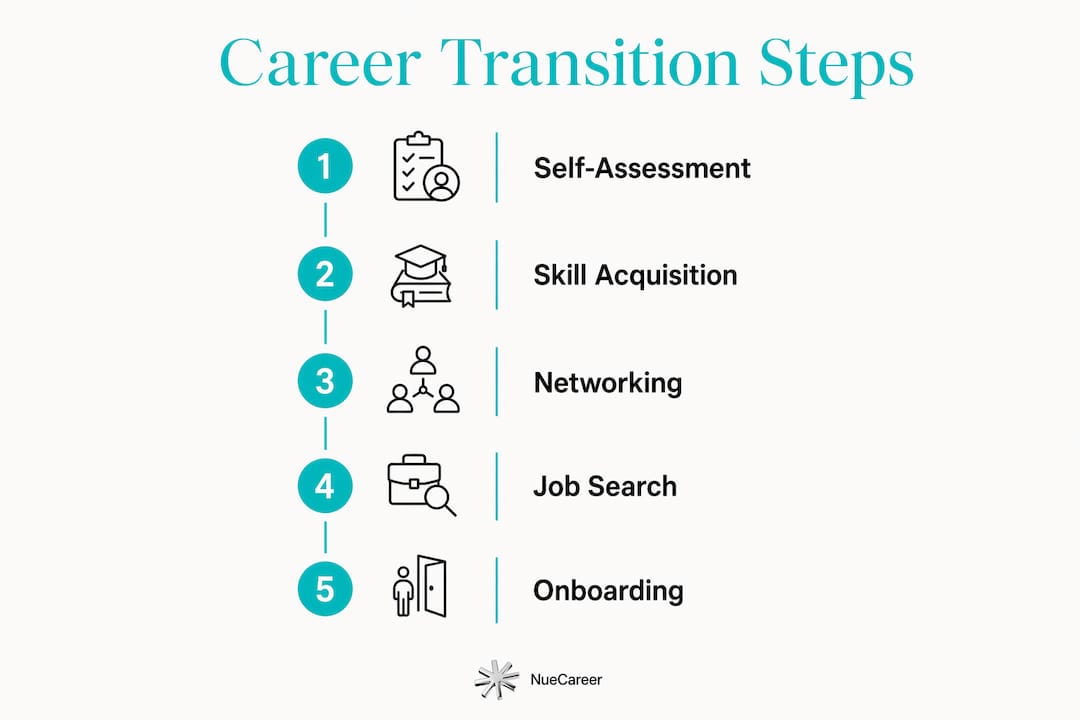
Career transitions are not one-size-fits-all. Understanding the type of transition you are making shapes everything from your preparation time to your financial expectations. Career changes can be lateral, vertical, or dramatic shifts requiring entirely new credentials and a rebuilt professional identity.
The four most common types are described below.
Career pivot involves moving to an adjacent field where your existing skills transfer with some reframing. A nurse practitioner moving into healthcare consulting is a classic pivot. The domain knowledge carries over; the delivery model changes. Economic disruption and AI are making career pivots increasingly necessary for long-term professional resilience.
Dramatic career shift involves crossing into an entirely different field, often requiring new credentials and a willingness to start at a more junior level. A lawyer becoming a chef or a teacher moving into financial planning are examples. These transitions take longer and cost more, but they also tend to produce the highest alignment between work and personal values.
Planned vs. reactive transitions differ in their emotional and financial starting points. A planned transition gives you time to build skills and savings before you leave. A reactive transition, triggered by layoff, burnout, or industry collapse, compresses that timeline and raises the emotional stakes. Both are manageable, but they require different strategies.
| Transition Type | Skill Overlap | Typical Timeline | Example |
|---|---|---|---|
| Career pivot | High | 3–9 months | Nurse to healthcare consultant |
| Lateral move | Moderate | 1–3 months | Marketing manager to project manager |
| Dramatic shift | Low | 12–24 months | Lawyer to chef |
| Vertical transition | Moderate to high | 6–12 months | Accountant to financial planner |
For mature career changers considering major shifts, real-life pivot examples from people who have made dramatic transitions later in life offer both practical insight and genuine encouragement.
Key takeaways
A career transition is a strategic identity shift, not just a job change, and it succeeds when you combine honest self-assessment with deliberate skill-building and low-risk testing before committing fully.
| Point | Details |
|---|---|
| Career transition vs. job change | A transition redefines your professional identity; a job change only moves your employer. |
| Psychological preparation matters | Grieving your old professional self is a real step; separate it from your job search timeline. |
| Transferable skills are your foundation | Map existing skills to new role requirements before you apply anywhere. |
| Test before you commit | Freelancing, volunteering, and informational interviews validate fit at low cost. |
| Planning timeline is critical | Most transitions take 6–18 months; build financial and emotional runway accordingly. |
Career transition is a strategy, not a setback
Here is what I have seen consistently after years of watching people navigate career transitions: the ones who struggle most are not the ones with the biggest skill gaps. They are the ones who treat the transition as a failure to fix rather than a direction to choose.
Experts at Global Excellence Digest put it plainly: career transition is increasingly a proactive strategy for sustainable growth, not a reactive or risky detour. That framing matters more than most people realize. When you see your transition as a strategy, you plan differently. You give yourself permission to take the time it actually requires.
The professionals I have seen thrive are the ones who treat their existing experience as an asset to be translated, not a liability to apologize for. A decade in sales is not irrelevant to a career in organizational psychology. It is a foundation. The work is in learning to articulate that connection clearly.
My honest advice: stop waiting until you feel ready. Readiness is built through action, not through more research. Take the first small step, whether that is one informational interview or one freelance project, and let the clarity come from doing rather than planning. Purpose serves as a compass here. When you know what you are moving toward and why, the uncertainty becomes far more tolerable.
— Shane
Start your career transition with the right tools
Knowing what a career transition involves is the first step. Knowing where you fit in a new field is the next one.
Nuecareer is built for exactly this moment. The 7-minute career quiz identifies your strengths and matches you to career paths you may never have considered, including ones that align with who you already are. From there, Nuecareer gives you personalized roadmaps, 24/7 coaching chat, and a full suite of resume and cover letter tools. You can also use the free AI skills identifier to surface your transferable skills and present them in the language of your target field. If you want to decode exactly what a new employer is looking for, the job description analyzer does that in seconds. Your next career path is closer than you think.
FAQ
What is a career transition in simple terms?
A career transition is the process of moving from one professional field or career path to another, involving a shift in identity, skills, and goals rather than simply changing employers.
How long does a career transition typically take?
Most career transitions take between 6 and 18 months from initial decision to landing a role in the new field, depending on the size of the skill gap and the amount of preparation involved.
What is the difference between a career change and a career pivot?
A career change typically involves moving to an entirely different field, often requiring new credentials. A career pivot moves to an adjacent field where existing skills transfer with some reframing.
How do i know if i am ready for a career transition?
Readiness is less about feeling confident and more about having clarity on your values, a mapped set of transferable skills, and at least one low-risk test of the new field through freelancing or informational interviews.
What does changing careers involve practically?
Changing careers involves self-assessment, skill gap analysis, networking in a new industry, possible certification or training, and rebuilding your professional materials to speak the language of your target field.