

TL;DR:
- Career alignment measures how well your values, skills, and work conditions fit with your organization. It influences your engagement, purpose, and long-term satisfaction by considering multiple layers, including structural fit. Regular assessment and adjustments help maintain alignment, preventing burnout and enhancing career fulfillment.
Career alignment is defined as the degree of fit between your personal values, skills, and work preferences and the structural conditions of your job and organization. This goes well beyond simply being good at your work. Organizational psychology research frames this as person–environment fit, a measurable interaction between who you are and how your workplace actually operates. When that fit is strong, you feel energized, purposeful, and engaged. When it breaks down, even high performers burn out. Understanding career alignment is the first step toward building a career that sustains you long term.
What does career alignment mean at its core?
Career alignment is not a single dimension. Work alignment research defines it as an interaction between a person and their environment, not just a measure of skill competence. That distinction matters enormously. You can be technically excellent at a job and still feel drained, disengaged, or out of place. The reason is usually a mismatch at a deeper layer than skill.

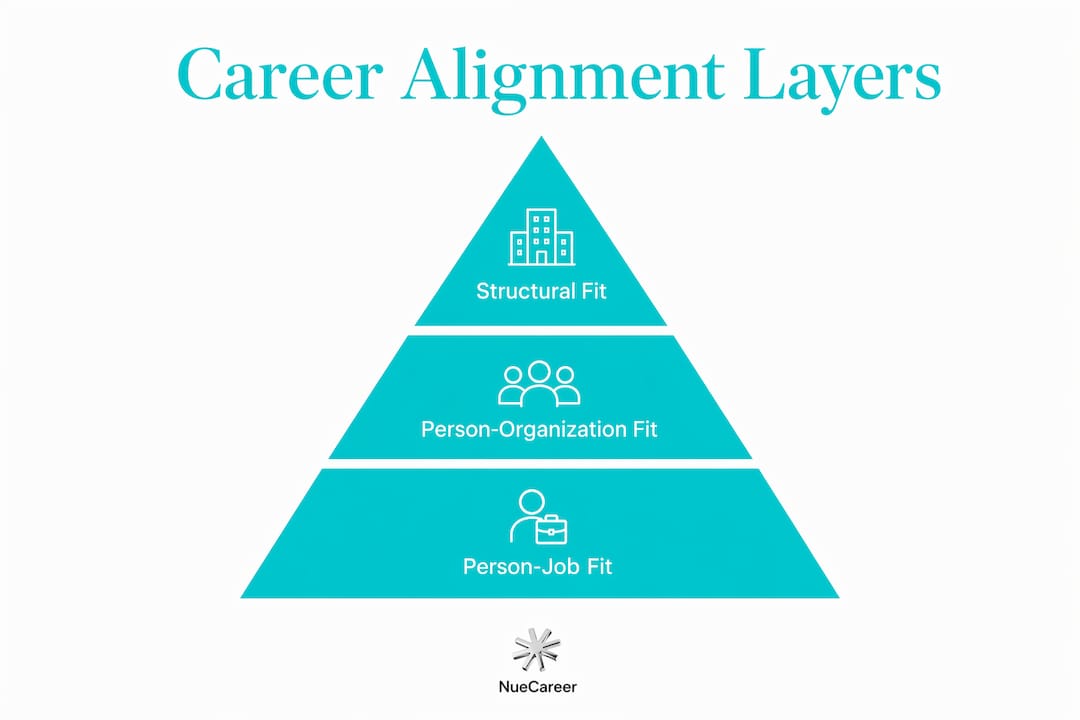
Three distinct layers make up career alignment, and each one affects your experience at work differently.
| Layer | What it measures | Impact when misaligned |
|---|---|---|
| Person–job fit | How well your skills and tasks match | Low performance, frustration |
| Person–organization fit | How well your values match company culture | Disengagement, low loyalty |
| Structural fit | Autonomy, feedback, workload, flexibility | Fatigue, burnout, resentment |
Person–job fit predicts job engagement, while person–organization fit predicts organizational engagement. Both matter, but they operate through different mechanisms. Ignoring one while focusing on the other leaves a gap that shows up over time.
Structural fit is the layer most professionals overlook. Poor structural fit causes fatigue even when skill performance is high. A talented project manager who thrives on autonomy but works under micromanagement will eventually disengage, not because of incompetence, but because the conditions drain their energy daily.
Pro Tip: When evaluating a role, audit all three layers separately. Ask yourself: Do I have the skills? Do I share the values? Do the daily conditions match how I work best? All three answers need to be "yes" for alignment to hold.
Why is career alignment important for engagement and retention?
Career alignment directly shapes how engaged you feel at work and how long you stay. This is not a soft claim. A 2026 two-wave study confirmed that value congruence predicts work engagement and mediates the positive effect of leadership behavior on engagement over time. That means even good leadership cannot fully compensate for a values mismatch between you and your organization.
The research on retention tells a similarly clear story. Person–organization fit reduces turnover intention both directly and indirectly by increasing the sense of meaning you find in your work. When your values match your organization's values, your work feels purposeful. That sense of purpose is what keeps people committed through difficult periods.
"Person–organization fit negatively predicts turnover intention both directly and indirectly by increasing perceived meaning in work, moderated by ethical climate. Employees who experience autonomy to act on their values show the strongest and most sustainable engagement."
Ethical climate plays a moderating role here. When organizations give employees the autonomy to act on their values, the connection between value fit and meaningful work grows stronger. That autonomy is not just a perk. It is a structural condition that determines whether your alignment translates into real, lasting engagement. You can read more about how career identity and values shape this dynamic in depth.
How can you diagnose your career alignment effectively?
Most professionals assess alignment through gut feeling alone. That approach is unreliable. Systematic interviews and evidence gathering reduce uncertainty in career fit better than introspection alone, improving your confidence in the choices you make. The goal is to treat alignment like a hypothesis you test, not a feeling you wait to arrive.
Here is a practical process for diagnosing your alignment across all three layers:
List your top five work values. Examples include autonomy, creativity, stability, impact, and collaboration. Be specific. "Meaningful work" is too vague to audit against real conditions.
Map your current role conditions. Write down what your day actually looks like: how decisions get made, how feedback flows, how much control you have over your time and methods.
Compare values to conditions honestly. Where do they match? Where do they conflict? A conflict between your value of autonomy and a role that requires constant approval is a structural misfit, not a skill problem.
Talk to people already in the role. Structured interviews with experienced insiders have the strongest predictive power for fit. Ask them what the job actually demands day to day, not what the job description says.
Test your hypotheses through experience. Take on a project, a short contract, or a shadowing opportunity. Real experience surfaces misalignments that no amount of research can predict.
One critical caution: do not rely on mission statements to assess organizational values. Authentic values alignment requires auditing specific daily workplace conditions, because stated values and lived values often diverge. A company can claim to value work-life balance while routinely rewarding 60-hour weeks. The lived conditions are what you will actually experience.
Pro Tip: If you are preparing for interviews, practicing your answers with AI-assisted interview tools can help you articulate your values and fit clearly, which also forces you to clarify what alignment actually looks like for you.
What are the signs of career misalignment and how do you fix them?
Misalignment rarely announces itself clearly. It tends to accumulate as a low-grade dissatisfaction that professionals often attribute to stress, personality, or the nature of work itself. Recognizing the actual source is what makes correction possible.
The most common signs of career misalignment include:
- Persistent fatigue despite adequate rest. This often signals structural misfit, not overwork. The conditions of the role are draining your energy even when the workload is manageable.
- Competence without satisfaction. You perform well but feel empty. This points to a values mismatch, not a skill gap.
- Disengagement from the organization's goals. You do your job but feel no connection to why the organization exists. This is a person–organization fit problem.
- Resentment of colleagues who seem energized. When others thrive in the same environment where you struggle, the environment itself is likely the mismatch, not your effort.
- Frequent fantasizing about different careers. This is your mind signaling that something fundamental does not fit.
Misalignment symptoms persist because professionals focus only on skill fit and ignore structural and cultural misfits that drain energy over time. Recognizing which layer is broken tells you what kind of correction to pursue.
Your options depend on the source of the misalignment. A skill gap can be addressed through training and development. A structural misfit, such as a lack of autonomy or poor feedback systems, can sometimes be negotiated within your current role. A values mismatch with the organization's culture is the hardest to fix without changing roles entirely. Knowing the difference saves you from investing energy in the wrong solution. Exploring a career change roadmap can help you plan that transition if a full shift is what the diagnosis calls for.
Key Takeaways
Career alignment is the measurable fit between your values, skills, and work conditions, and it directly determines your engagement, sense of purpose, and long-term career satisfaction.
| Point | Details |
|---|---|
| Alignment has three layers | Assess person–job fit, person–organization fit, and structural conditions separately. |
| Values mismatch drives disengagement | Value congruence predicts work engagement more reliably than skill competence alone. |
| Mission statements are not enough | Audit actual daily role conditions, not stated company values, to find real fit. |
| Misalignment is diagnosable | Use structured interviews, evidence gathering, and real experience to test fit hypotheses. |
| Correction depends on the source | Skill gaps, structural misfits, and values mismatches each require a different response. |
Career alignment is a process, not a destination
I have worked with enough professionals to know that the biggest mistake people make with career alignment is treating it as a one-time discovery. They take a quiz, read a framework, and expect clarity to arrive fully formed. It does not work that way.
Alignment is dynamic. Your values shift as you grow. Organizations change culture, leadership, and direction. A role that fit you well at 30 may feel suffocating at 40. The professionals I see sustain genuine career satisfaction are the ones who treat alignment as an ongoing practice, not a solved problem.
What I find most useful is the scientific framing: treat your current career as a hypothesis, gather evidence, and update your conclusions. Career changers benefit most from this iterative approach because they are working with less data than someone who has spent years in a field. The instinct to wait until you are "sure" before making a move is exactly what keeps people stuck. Certainty comes from evidence, and evidence comes from action.
The other thing I want to push back on is the idea that alignment means finding your one true calling. That framing creates paralysis. Alignment is not about finding a perfect role. It is about understanding your values and conditions clearly enough to make informed choices and negotiate better ones. That is a skill you build, not a revelation you receive.
— Shane
How Nuecareer helps you find your fit
Knowing what career alignment means is one thing. Knowing where you actually stand is another.
Nuecareer's free career skills assessment gives you a clear picture of your strengths and gaps across the skills that matter most for your target roles. The free strengths and weaknesses generator goes further, helping you articulate what you bring to a role in language that resonates with hiring managers. Both tools are built for working professionals who want precision, not generic advice. If you are ready to move from uncertainty to clarity, Nuecareer gives you the structure to do it.
FAQ
What is the career alignment definition in simple terms?
Career alignment is the fit between your personal values, skills, and work preferences and the actual conditions of your job and organization. It goes beyond skill competence to include cultural and structural factors.
How does career alignment affect job satisfaction?
Strong alignment, particularly value congruence with your organization, predicts higher work engagement and a greater sense of meaning in your work. Research confirms it also reduces the likelihood of wanting to leave your role.
What are the signs of career misalignment?
Common signs include persistent fatigue despite manageable workloads, high competence paired with low satisfaction, and disengagement from your organization's goals. These often point to a values or structural mismatch rather than a skill problem.
How do I achieve career alignment in a new role?
Audit the role across three layers: skill fit, values fit, and structural conditions like autonomy and feedback. Talk to people already in the role and test your assumptions through real experience before committing fully.
Can career alignment change over time?
Yes. Your values and priorities evolve, and organizations change their culture and direction. Treating alignment as an ongoing process rather than a fixed state is what sustains long-term career satisfaction.