
What Is Career Path Mapping? A 2026 Guide

Discover what career path mapping is and how it helps you strategically plan your future career. Take control of your professional journey today!
TL;DR:
- Career path mapping visually connects your current role with future career goals by pinpointing necessary skills and milestones. It offers flexible, personalized planning that includes lateral moves and specialized tracks, unlike traditional linear career pathing. Regularly updating and actively using your map enhances career growth, internal mobility, and long-term success.
Career path mapping is the process of visually defining the steps, skills, and milestones needed to move from your current role to a specific future career goal. Think of it as a structured plan that connects where you are today with where you want to be, making the path forward concrete rather than abstract. Unlike vague career ambitions, a well-built career map identifies the exact competencies, experiences, and checkpoints you need to progress. Tools like skills assessments, career quizzes, and frameworks from platforms such as Nuecareer and AIHR make this process accessible to both working professionals and students who want clarity on their next move.
What is career path mapping and what does it include?
Career path mapping is defined as the structured practice of visually planning career progression from a current position to a target role, specifying the skills, experiences, and education required along the way. The output is a career map: a document or visual tool that links your starting point to your destination with clear markers in between. This is the standard industry term you will encounter in HR, talent development, and professional coaching contexts.

The process draws on several frameworks and tools. Skills assessments help you identify what you already bring to the table. Career quizzes, like the free one offered by Nuecareer, surface strengths and potential paths you may not have considered. Competency frameworks from organizations like SHRM or AIHR provide structured language for describing what progression looks like at each level.
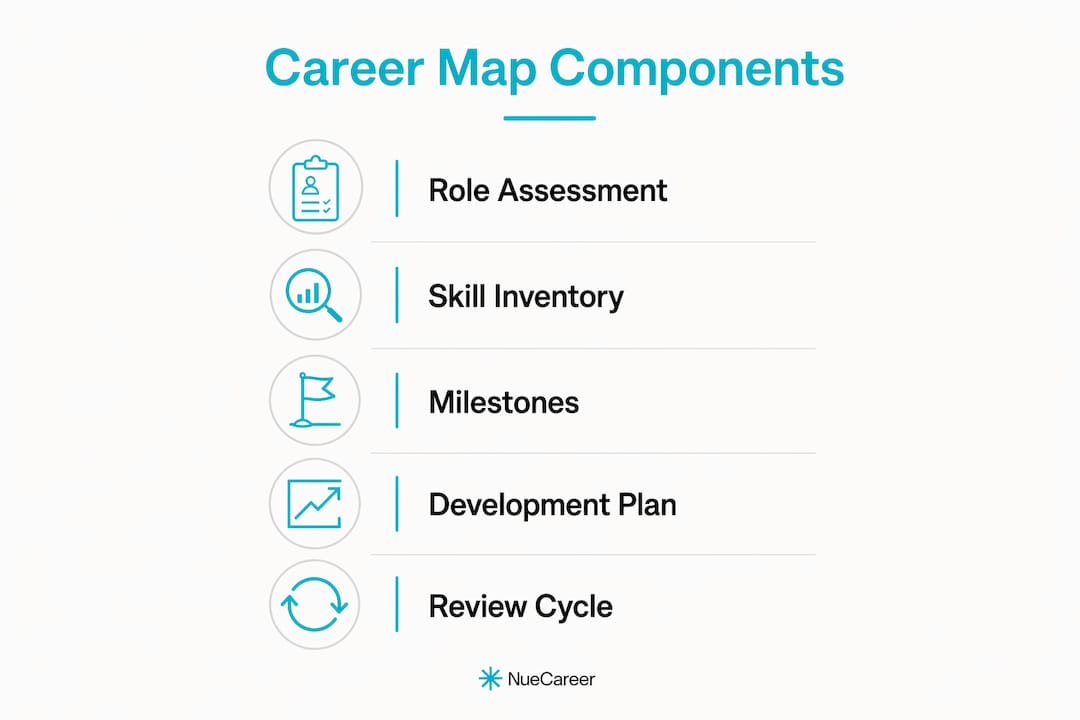
The five core components of a career map
A well-structured career map includes five key elements that work together to make your plan both realistic and motivating:
- Current position assessment. This is your baseline: your current role, responsibilities, and the skills you already demonstrate. Honest self-assessment here prevents you from building a map on faulty assumptions.
- Target future roles. Identify one or two roles you want to reach within a two to five year horizon. Specificity matters. "Senior Product Manager at a SaaS company" is more useful than "a better job in tech."
- Skills and competencies gap analysis. Compare what you have now with what your target role requires. Tools like Nuecareer's free skills assessment make this comparison structured and clear.
- Development activities. These are the training programs, stretch assignments, mentorships, and project opportunities that close your skills gaps. A common mistake is filling this section with courses alone. Real project experience carries more weight with hiring managers.
- Measurable milestones and timelines. 30/60/90-day checkpoints and quarterly reviews keep your map active rather than decorative. Without time markers, a career map becomes a wish list.
Pro Tip: When writing your milestones, describe them in observable terms. "Led a cross-functional project with three stakeholders" is measurable. "Improved my leadership" is not. Observable criteria make your map useful during performance reviews and job applications.
| Component | What to include |
|---|---|
| Current role assessment | Job title, key responsibilities, demonstrated skills |
| Target role | Specific title, industry, two to five year timeline |
| Skills gap analysis | Competencies needed minus competencies held |
| Development activities | Projects, mentorships, certifications, stretch roles |
| Milestones and timelines | 30/60/90-day and quarterly progress checkpoints |
How does career path mapping differ from career pathing?
Career path mapping and career pathing are often used interchangeably, but they describe meaningfully different approaches. Understanding the distinction helps you choose the right framework for your situation.
Career pathing typically refers to a linear, organizationally defined sequence of roles. It implies moving up a predetermined ladder, often within a single company or function. Many traditional HR systems use career pathing to show employees the next one or two promotions available to them.
Career path mapping is broader and more flexible. Mapping is holistic, reflecting diverse career progression options that go well beyond vertical promotion. A career map can include lateral moves into adjacent roles, specialist tracks that deepen expertise without adding management responsibility, and cross-functional pivots into entirely new fields. This flexibility is what makes mapping more relevant in 2026, when career trajectories rarely follow a straight line.
| Concept | Approach | Direction | Flexibility |
|---|---|---|---|
| Career pathing | Organizational role sequences | Primarily upward | Low |
| Career path mapping | Individual-driven visual planning | Upward, lateral, specialist, cross-functional | High |
The practical benefit of mapping over pathing is that it acknowledges reality. Lateral and specialist tracks are important career map components, not consolation prizes. A marketing manager who maps a lateral move into product management is not stalling. She is building a more versatile profile that opens more doors later. If you are considering a significant shift, resources on switching careers effectively can complement your mapping process.
Why is career path mapping important for professional growth?
Career path mapping matters because it replaces vague advancement conversations with clear frameworks linking roles, skills, and milestones. Without a map, career development tends to happen reactively. You wait for a manager to notice you, apply for roles without a clear strategy, or accept the next available promotion even when it does not align with your long-term goals.
With a map, you take ownership. You can walk into a performance review with specific evidence of progress. You can identify which projects to pursue because you know what skills you need next. You can have a direct conversation with your manager about where you want to go and what support you need to get there.
The benefits extend beyond the individual. Mapping supports retention and internal mobility by showing employees transparent opportunities within their organizations. Companies that invest in visible career development frameworks see stronger engagement and lower turnover, because people stay where they can see a future.
"Career mapping gives professionals a language for their ambitions. It turns 'I want to grow' into 'I need these three skills, this project experience, and this certification by Q3.' That specificity changes everything."
For students, career path mapping serves a slightly different purpose. It helps translate academic strengths and interests into real-world roles, reducing the paralysis that comes from facing an overwhelming number of options. A career path assessment early in your professional life can save years of trial and error.
How to map a career path effectively
Building a career map that you will actually use requires more than filling out a template. Here is a practical process that works for both professionals mid-career and students just starting out.
Anchor your map with a target role. Start by identifying a role you want to reach within two to five years. You do not need certainty. You need a working hypothesis. Building a career map anchored by a target role two to five years out, with your current state and measurable milestones, increases the map's effectiveness significantly. If you are unsure where to start, a career quiz can surface options aligned with your strengths.
Assess your current position honestly. Document your current role, the skills you use daily, and the gaps between where you are and where you want to be. Be specific. Use job descriptions for your target role as a reference point for what competencies to prioritize.
Identify multiple routes, not just one. Career growth is not strictly linear. Your map should include at least two viable routes to your target role: a direct path and a lateral or cross-functional alternative. This protects you when the direct path is blocked and keeps your options open.
Set observable milestones with deadlines. Progression criteria with measurable and observable terms are critical for executing career maps successfully. Assign each milestone a specific deadline and name the person or resource that will support it. "Complete a data analysis project by Q2 with feedback from my manager" is a milestone. "Get better at data" is not.
Balance training with real project experience. Career maps that overemphasize courses reduce practical value. Pair each learning activity with a real opportunity to apply it. If you are building project management skills, volunteer to lead a cross-functional initiative, not just enroll in a certification.
Review and update your map regularly. Treating career mapping as flexible and iterative is more effective than searching for a single perfect path. Review your map every quarter. Update it when your interests shift, when market conditions change, or when a new opportunity appears that was not on your original radar.
Pro Tip: Use the career quizzes designed for adults to stress-test your target role assumptions. Sometimes the role you think you want does not align with how you actually work best. A quiz can surface that misalignment early, before you invest months of development in the wrong direction.
The most effective career maps also include a mentor or sponsor. 80,000 Hours recommends prioritizing immediate decisions that advance your career rather than fixating on an idealized end goal. A mentor who has walked a similar path can help you identify which next steps carry the most leverage.
Key takeaways
Career path mapping is most effective when it combines a clear target role, observable milestones, and the flexibility to include lateral and cross-functional routes alongside vertical progression.
| Point | Details |
|---|---|
| Define the target role first | Anchor your map with a specific role two to five years out before identifying gaps. |
| Use observable milestones | Write progression criteria in measurable terms to make your map useful in reviews. |
| Include multiple routes | Map lateral and specialist paths alongside upward moves for a realistic plan. |
| Balance learning with doing | Pair every training activity with a real project opportunity to build applied skills. |
| Treat the map as a living document | Review and update your career map quarterly as interests and markets evolve. |
Why most career maps collect dust (and how to avoid that)
I have reviewed a lot of career maps over the years, and the ones that fail share a common trait: they are built once and never touched again. Someone spends an afternoon filling out a template, files it away, and calls it career planning. Six months later, nothing has changed.
The maps that actually work are the ones treated as working documents, not finished products. The professionals I have seen make the most progress are the ones who bring their map to every performance review, update it after every major project, and use it to drive specific conversations with their managers about what comes next.
There is also a mental shift worth making. Most people still think about careers as ladders: you go up, or you are standing still. Career path mapping challenges that assumption directly. Some of the most interesting career trajectories I have encountered involved deliberate lateral moves that looked like sideways steps but were actually strategic positioning. A finance analyst who moved into operations for two years came back to finance as a director because she understood the business in a way her peers did not.
The other trap is perfectionism. People spend months trying to find the "right" path before they will commit to a map. That search for certainty is a delay tactic. Pick a direction that feels aligned with your strengths and values, build the map, and adjust as you learn more. The map is a tool for making better decisions now, not a contract about your entire future.
— Shane
Start mapping your career path with Nuecareer
If you are ready to move from thinking about your career to actively planning it, Nuecareer gives you the tools to do exactly that.
Start with the free Career Clusters Quiz to identify career paths that match your strengths and interests, including options you may never have considered. From there, use Nuecareer's skills gap analysis tool to pinpoint exactly what you need to develop for your target roles. The platform also offers personalized roadmaps, 24/7 coaching chat, and a full suite of resume and cover letter tools so you can move from planning to applying with confidence. You do not need to figure this out alone.
FAQ
What is career path mapping in simple terms?
Career path mapping is the process of creating a structured, visual plan that connects your current role to a future career goal by identifying the skills, milestones, and experiences you need along the way. It turns career ambitions into a concrete, actionable plan.
How is career path mapping different from career pathing?
Career pathing typically describes a linear, organizationally defined sequence of promotions, while career path mapping is broader and includes lateral moves, specialist tracks, and cross-functional pivots. Mapping gives you more flexibility and personal ownership over your career direction.
How long does it take to create a career map?
A working career map can be built in a few hours using a structured template, a skills assessment, and a clear target role. The map should be reviewed and updated quarterly as your goals and market conditions evolve.
What tools help with career path mapping?
Skills assessments, career quizzes, competency frameworks, and job description analyzers are the most practical tools for building a career map. Platforms like Nuecareer offer free versions of these tools specifically designed for working adults and students.
Can career path mapping work if I do not know what I want to do?
Yes. Starting with a career quiz or strengths assessment helps surface potential directions when your goals are unclear. Career path mapping is designed to create clarity, not require it upfront.