

Yes, you can switch to a data analyst role while keeping your paycheck. Start by learning SQL, choosing one BI tool, and mapping your current job's problems into a portfolio project. Your next milestone: finish a small SQL exercise and publish a one-page project summary this week.
TL;DR:
- Mastering SQL is essential and should be practiced against real datasets until queries like joins become second nature.
- Building a portfolio of projects tied to actual business problems, including an interactive dashboard and a clear recommendation, is key to credibility.
- Most first roles are achievable within 4 to 12 months, and strong domain expertise combined with two completed projects can accelerate hiring.
- Prioritize domain skills and practical work over certificates, as a well-developed portfolio consistently outperforms pedigree in hiring decisions.
- Gaining experience can be done through internal projects, freelance work, or volunteering, without quitting your current job or changing titles.
Table of Contents
- How Do You Switch to Data Analyst From Another Career?
- Which Skills Should You Learn First?
- What Portfolio Projects Actually Get You Hired?
- How Can You Gain Experience Without Quitting Your Job?
- How Do You Apply and Interview as a Career Changer?
- How Long Does It Take and What Will You Earn?
- What Working Professionals Get Wrong About This Switch
- Where NueCareer Fits Into Your Transition
- Sources
- FAQ
How Do You Switch to Data Analyst From Another Career?
The switch works best as a sequence, not a scramble. Career changers who succeed tend to activate their existing domain knowledge first, then layer technical skills on top of it, rather than trying to become a generalist data scientist overnight. That order matters because hiring managers reward demonstrated capability over pedigree, and domain expertise is what makes your portfolio projects credible instead of generic.
Here's the order that gets working professionals hired, and roughly how long each phase takes at 10 to 15 hours a week:
- Assess transferable skills (1 to 2 weeks). Inventory what you already track, report, or forecast in your current role. If you manage inventory, budgets, or customer data in any form, you're closer than you think.
- Learn SQL (4 to 6 weeks). This is the single highest-leverage skill; almost every analyst job posting lists it first.
- Add Excel and one BI tool (4 to 6 weeks). Power BI or Tableau, not both.
- Cover basic statistics and storytelling (2 to 3 weeks). Enough to explain a trend, not enough to pass a PhD qualifying exam.
- Build two to three portfolio projects (6 to 10 weeks). This phase overlaps with the last two.
- Apply (ongoing, 4 to 8 weeks to first offer).
That adds up to a 4 to 6 month focused timeline for many part-time learners, though some stretch to 12 months depending on how much time they can protect each week. You're ready to start applying once you have two finished projects, one interactive dashboard, and enough SQL fluency to write a join without looking it up twice.
Which Skills Should You Learn First?
Skill order isn't a matter of taste. It follows what actually shows up in job postings and technical screens, and getting it backwards is the most common reason career changers stall out.
- SQL, first and non-negotiable. Screening tasks almost always include filtering, joining, and aggregating tables. Practice writing queries against a public dataset until
GROUP BYandLEFT JOINfeel automatic. - Excel, because it never leaves the workplace. Pivot tables and lookups still run half the reporting in most companies, regardless of what fancier tools sit on top.
- One BI tool, chosen by target industry. Power BI fits companies already inside the Microsoft ecosystem; Tableau shows up more in marketing, consulting, and media shops. Pick one and go deep rather than sampling both shallowly.
- Python or advanced statistics, later, not first. Python is optional for most entry-level roles and becomes necessary only once you're doing predictive work or automation, not standard reporting.
Pro Tip: Practice turning a finding into a single paragraph a non-technical manager would actually read. If you can't summarize a chart in three sentences, you don't understand it well enough yet.
What Portfolio Projects Actually Get You Hired?
Three project types cover almost everything a hiring manager wants to see, and each one should answer a real business question rather than replicate a tutorial.
- An exploratory analysis of a dataset tied to your former industry (retail sales patterns, patient scheduling gaps, service ticket volume).
- An interactive dashboard built in Power BI or Tableau that a stakeholder could actually open and use.
- A domain-problem-and-recommendation project, where you identify an issue, analyze it, and write a one-paragraph recommendation as if presenting to a director.
Source data ethically: pull from public datasets, request a sanitized CSV export from your current employer, or use a free API. Scope each project tight enough to finish in two to three weeks. Unfinished projects don't count.
What you publish matters as much as what you build. A hiring-ready project package includes a short README, a clear business question, your SQL or notebook files, visuals or a dashboard link, and a one-paragraph recommendation written for a non-technical reader.
The most common mistake: cloning a Kaggle tutorial and calling it a portfolio. Domain-native projects tied to real business questions from your prior industry outperform generic tutorial clones in hiring outcomes, because they prove you understand the problem, not just the syntax.
How Can You Gain Experience Without Quitting Your Job?
You don't need a new job title to start doing analyst work. You need one manager's approval or one small client.
- Pitch an internal project to your manager. Frame it as solving a reporting gap they already complain about, not as a career change request. A short note proposing a two-week trial run on one dashboard usually lands better than announcing your ambitions.
- Take on a scoped freelance or pro bono project. Local nonprofits, small businesses, and community organizations often have messy spreadsheets nobody has time to clean. Cap the scope at a defined deliverable and a two to four week window.
- Volunteer for a single recurring report. Internal transfers and volunteer reporting tasks often lower the hiring bar enough to produce the same evidence as a paid junior role within a few months.
- Track the impact, not just the task. Note time saved, errors caught, or decisions influenced. That number becomes your resume bullet and your interview story.
How Do You Apply and Interview as a Career Changer?
Your resume should lead with domain expertise, not apologize for it. Put your industry knowledge in the summary line, list SQL, Excel, and your BI tool clearly, and link directly to your portfolio, not just a LinkedIn profile. Career-change resume framing works best when it quantifies impact ("reduced reporting time by 6 hours weekly") rather than listing duties.
Search titles beyond "Data Analyst": look for "Reporting Analyst," "Business Analyst," and "Insights Analyst," and read the job description for domain language you already speak fluently.
Interview prep checklist:
- Practice five to ten SQL questions covering joins, aggregation, and window functions.
- Prepare a case walkthrough structure: business question, approach, finding, recommendation.
- Rehearse presenting one portfolio project in under three minutes.
- Have a two-sentence answer ready for "why the switch," grounded in your domain, not a generic passion statement.
Interview answer templates built for career changers can help you avoid sounding rehearsed while still hitting the points that matter.
How Long Does It Take and What Will You Earn?
Most part-time learners land a first analyst offer somewhere between 4 and 12 months after starting, depending on how many hours they protect weekly and how quickly their portfolio comes together. Career changers with strong domain expertise and two finished projects tend to land on the faster end of that range.
Salary snapshot: median U.S. data analyst pay sits around $90,000, though entry-level offers for career changers typically start below that median and climb as domain expertise and portfolio strength get demonstrated on the job.
Demand for analytical roles remains steady; the Bureau of Labor Statistics tracks continued hiring across analyst occupations. To negotiate a stronger starting offer, emphasize your domain fluency and any quantified impact from internal or freelance projects. That combination, not a certificate list, is what moves an offer number.
What Working Professionals Get Wrong About This Switch
The biggest misread is treating certificates as the goal instead of the receipt. A certificate tells an employer you finished a course. A portfolio tells them you can do the job. Every credible path into this field, including the transition to product management or UX roles that many former analysts eventually make, runs on the same principle: show the work, don't list the coursework.
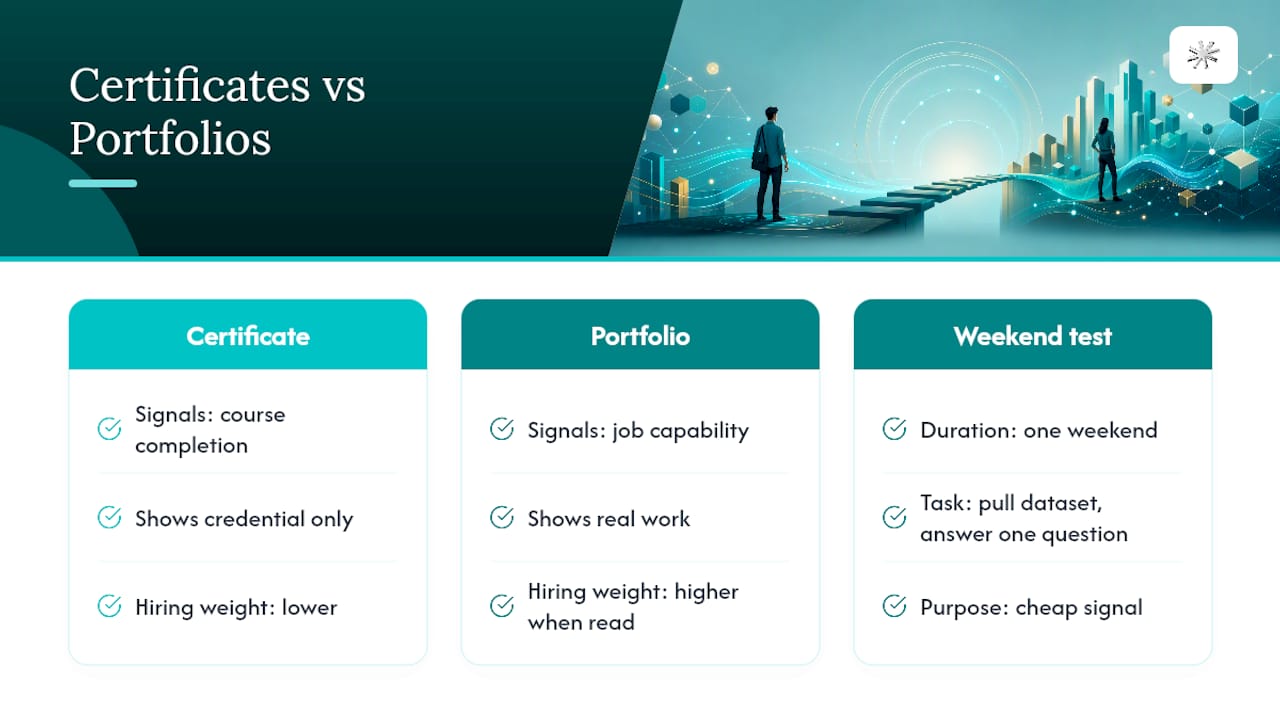
Test the field cheaply before committing months to it. Spend one weekend pulling a small dataset from your current industry and answering one question with it. If that exercise energizes you rather than drains you, you've got real signal. If it feels like a chore, that's useful information too, and it's better to learn it in a weekend than six months in.
Portfolio beats pedigree, every time a hiring manager actually reads the submission. Build accordingly.
— Shane
Where NueCareer Fits Into Your Transition
You don't have to build this roadmap alone or guess whether data analytics is even the right target. NueCareer's 7-Minute Career Quiz maps your existing strengths, including ones you might not think to list on a resume, against career paths that fit who you are, data analyst roles included.
Once you know the path fits, NueCareer builds a personalized roadmap around your actual timeline and current skill level, backed by 24/7 coaching chat for the moments you're stuck on a SQL query at 9 p.m. or unsure how to frame a portfolio project. The platform's resume and cover letter tools, plus its job application skills tool, help you translate domain expertise into language hiring managers recognize immediately. Take the quiz now and see whether data analyst is the strongest match on your list, or whether something you haven't considered fits even better.
Sources
- 9 project ideas for your data analytics portfolio (SNHU / Career360)
- Occupational Outlook Handbook: Operations Research Analysts (BLS)
FAQ
Is 35 Too Late to Switch Careers?
No. Career changers with strong domain expertise often move faster because their projects gain credibility with hiring managers.
Is a Data Analyst Role Still Worth Pursuing?
Yes. Analytical occupations show steady demand according to the Bureau of Labor Statistics, and the skills (SQL, Excel, BI tools) transfer across industries if you later want to move again.
Will AI Replace Data Analysts?
AI tools are changing how analysts work, automating routine queries and chart-building, but the judgment to frame the right business question and communicate a recommendation to stakeholders remains a human task for the foreseeable future.
Can You Make $200,000 as a Data Analyst?
It's uncommon at the analyst title level; median U.S. pay runs closer to $90,000. Reaching six-figure territory well above that median usually requires moving into senior analyst, analytics manager, or specialized roles after a few years of demonstrated impact.
Do You Need a Degree to Become a Data Analyst?
No. A focused roadmap prioritizing SQL, Excel, and one BI tool is a credible path without a degree, provided your portfolio proves the skills a diploma would otherwise signal.