
Make $15K–$20K More: 4 Certifications That Boost Salesforce Admin Salary in the US

2026 U.S. Salesforce admin salary synthesis: $92K–$100K baseline, Agentforce can add $15K–$20K. See four high-return certifications, negotiation steps,...
The typical U.S. Salesforce Administrator earns around the mid $90,000s to low $100,000s a year, with a common working range stretching from mid $70,000s to mid $120,000s depending on experience. Seniority, certifications, AI skills like Agentforce, and metro location explain most of that spread. If you want to move up the band fast, the Advanced Administrator and Platform App Builder credentials paired with a shipped Flow or Agentforce project are the highest leverage moves available to you right now, and mastering Salesforce Commerce Cloud SEO Automation can further enhance your automation skills.
TL;DR:
- Salesforce Admin salaries typically range from mid $70,000s to mid $120,000s, with the average around $92,000 to $100,000 based on multiple data sources.
- Experience levels significantly influence pay, with mid-level admins earning around $92,000 and senior or specialist roles reaching $130,000 to $173,000 if they acquire advanced certifications or AI skills.
- Certifications such as Advanced Administrator and Platform App Builder can increase salaries by up to 18%, with AI skills like Agentforce adding premium pay of $15,000 to $20,000.
- Negotiation success depends on clear targets, evidence of impactful projects, and understanding local industry demand, especially when role location and certification impact pay scales.
Table of Contents
- What Is the Average Salesforce Admin Salary in the US?
- How Much Do Salesforce Admins Make by Experience Level?
- Which US Cities Pay Salesforce Admins the Most?
- What Actually Moves Your Salesforce Admin Pay?
- Which Certifications Give the Best Return on Salary?
- How Do You Negotiate a Higher Salesforce Admin Offer?
- What the Salary Data Really Tells Job Seekers
- Turn This Salary Data Into Your Next Move
- Where This Salary Data Comes From
- Sources
- FAQ
What Is the Average Salesforce Admin Salary in the US?
Four major trackers land within a few thousand dollars of each other, which is unusual for a role this broad. Glassdoor puts the average base pay near $99,877, based on roughly 3,917 self-reported salaries, with the middle half of admins earning between $80,438 and $125,200. ZipRecruiter's estimate sits at $98,862 a year, or about $47.53 an hour, with a 25th to 75th percentile band of $75,500 to $119,000 and a 90th percentile near $140,000.
Salary Snapshot: National average across major trackers: $92,000 to $100,000. Typical working range: $75,000 to $125,000. Top decile: $140,000+.
Indeed's figure runs a bit lower at $91,690, and Salary.com comes in at $89,996, or around $43 an hour. That $10,000 spread between the highest and lowest headline numbers isn't a contradiction. It's a methodology difference.
- Glassdoor and ZipRecruiter lean on self-reported salary data, which tends to skew toward admins motivated enough to submit their pay, often those in larger or better-paying organizations.
- Indeed aggregates figures from job postings and listed salary ranges, which can undercount unposted or negotiated compensation.
- Salary.com models employer-side pay data, which tends to run conservative because it reflects budgeted midpoints rather than actual offers extended.
- Salesforce Ben, a community-focused publication, surveys working admins directly, which captures real-world variance that job boards miss.
The practical takeaway: treat $92,000 to $100,000 as your baseline, not your ceiling. If an offer lands meaningfully below $85,000 for a mid-level role outside a low-cost market, that's worth questioning before you accept it.
How Much Do Salesforce Admins Make by Experience Level?

Pay in this field tracks responsibility more tightly than it tracks tenure alone. A junior admin resetting passwords and managing basic user permissions is not doing the same job as someone architecting a multi-org data model, and the pay gap reflects that.
Salesforce Ben's 2025-26 survey breaks the U.S. market into four rough tiers:
- Junior (0 to 2 years): around $78,000 median. Duties center on user management, basic workflow rules, standard reports and dashboards, and routine support tickets.
- Mid-level (3 to 5 years): around $92,000 median. This is where you're expected to "own an org," meaning you handle Flow automation, manage integrations, and make architecture decisions without heavy oversight.
- Senior (5-plus years): around $110,100 median, though ZipRecruiter's data shows top performers clearing $119,000 to $140,000 when they hold specialist skills.
- Lead or Admin Architect: often $130,000 to $173,000, particularly when the role folds in Agentforce strategy, multi-cloud governance, or team leadership.
The jump from junior to mid is mostly about demonstrated independence. The jump from mid to senior is usually about scope. Are you supporting one team, or are you the person three departments call when something breaks?
Which US Cities Pay Salesforce Admins the Most?
Where you sit still matters, even in a market that talks a lot about remote flexibility. Metro cost of living and local demand for Salesforce talent create real, persistent premiums.
- San Francisco Bay Area: commands roughly 25% to 32% above the national baseline, driven by dense SaaS and enterprise software concentration.
- New York City: runs about 15% above baseline, reflecting the city's finance and consulting sector demand.
- Seattle: sits around 13% above baseline, tied to its cloud and enterprise tech presence.
- Austin: carries a smaller but real premium, a byproduct of the tech relocation wave over the past several years.
Remote work complicates this picture. Many companies in 2026 still price remote roles against the employer's home office location rather than the employee's zip code, which means a fully remote admin working from a lower cost-of-living state can end up paid below the metro rate for the same responsibilities. That gap is usually negotiable if you raise it before signing, not after.
Pro Tip: Before your final interview, search for the role's posted salary range in your state. Thirteen states and Washington, D.C. now require employers to disclose pay ranges in job postings, which gives you a documented anchor for negotiation instead of a guess.
Researching local compensation is straightforward: cross-check two or three trackers for your specific metro, then weight toward the self-reported sources if you're in a high-demand city and toward employer-modeled sources if you're in a smaller market.
What Actually Moves Your Salesforce Admin Pay?
Certifications, skills, industry, and company size don't all carry equal weight. Ranking them by typical impact helps you decide where to spend your time.
Impact Ranking: Certifications add the most reliable baseline lift. AI-related skills add the largest single jump. Industry and company size shift the ceiling more than the floor.
Certifications typically add 6% to 18% per credential. Salesforce Ben's research found this holds fairly consistently for the Advanced Administrator and Platform App Builder credentials, and the effect compounds when you stack two or three relevant certs rather than one.
AI-related skills currently carry the steepest premium in the market. Admins with hands-on Agentforce experience are seeing roughly $15,000 to $20,000 in uplift at the mid-career level, and niche AI specialists in Data Cloud work are commanding premiums in the 20% to 40% range over generalist peers. This is the single fastest-moving lever in the market right now, and it's still underpriced relative to demand.
Industry and company size matter too, though less predictably:
- SaaS and enterprise software companies tend to pay above the median, since they're often Salesforce customers themselves with complex, layered implementations.
- Financial services and consulting firms pay well but often demand broader scope, including client-facing work.
- Smaller companies and nonprofits frequently pay below the national baseline, though they sometimes offer faster paths to senior titles.
Contracting changes the math entirely. Hourly rates for contract admins typically run $75 to $150-plus depending on seniority, which sounds like a huge premium over salaried pay. In practice, once you subtract lost benefits and account for bench time between contracts, the real annualized take-home often narrows close to salaried-equivalent numbers. Contracting can still make sense for flexibility or portfolio-building, just don't assume the hourly rate translates directly into a raise.
Which Certifications Give the Best Return on Salary?
Not every credential is worth the same time investment, and chasing certifications without projects to back them up caps how much they actually move your pay.
- Advanced Administrator. This is the highest-leverage first move for anyone past their first year. Expect a few months of study if you're already working in an org daily, and the exam runs a standard Salesforce certification fee. It signals depth beyond basic configuration.
- Platform App Builder. This pairs naturally with Advanced Admin because it demonstrates you can design solutions, not just maintain them. Most candidates study for six to eight weeks after already knowing the platform.
- Agentforce Specialist. Given the current $15,000 to $20,000 uplift tied to Agentforce experience, this is the fastest-appreciating credential on the market. If you can pair the certification with a real deployed use case, even a small one, you're ahead of most applicants.
- Platform Developer I. Worth pursuing only if you're aiming toward a hybrid admin-developer track, since it requires actual Apex and coding fluency.
Pro Tip: A certification tells an employer you know the theory. A shipped project tells them you can execute. If you only have time for one more certification this year, spend the rest of your hours building and documenting one measurable automation, like a Flow that cut manual data entry by a specific percentage, instead of stacking a fourth badge nobody asked for.
In interviews, frame certifications as context and projects as proof. Say what the certification taught you, then immediately pivot to the specific problem you solved with it.

How Do You Negotiate a Higher Salesforce Admin Offer?
Turning this data into an actual raise or better offer takes a specific sequence, not just a vague sense that you deserve more.
- Set three numbers before you talk to anyone: your target (what a strong offer looks like given your metro and level), your target range (a realistic band, usually $10,000 to $15,000 wide), and your walk-away number (the floor below which you decline).
- Collect your evidence first. Pull together specific projects, metrics, and certifications. "I built a Flow that reduced case resolution time by two days" beats "I'm skilled in automation" in every negotiation.
- Use a direct script when the offer lands low. Something close to: "Based on current market data for admins with my certifications in this metro, I was expecting a range closer to [X]. Is there flexibility here?" Calm, specific, and backed by numbers works better than an emotional appeal.
- Choose your path to the next band deliberately. Internal promotion tends to be slower but lower risk. Contracting can accelerate income short term but adds instability. A lateral move into a higher-paying industry, like finance or SaaS, often delivers the fastest jump if you're willing to relearn some domain context.
Pro Tip: Write your negotiation counter before the call, not during it. Reading from a prepared point, even loosely, keeps you from underselling yourself when the recruiter pushes back.
If you're not sure where you currently sit relative to these bands, NueCareer's 7-Minute Career Quiz can help map your existing skills against roles and pay ranges you may not have considered, including adjacent paths that pay more for similar work.
What the Salary Data Really Tells Job Seekers
Most advice in this space treats certifications like a ladder. Climb enough rungs, and pay follows automatically. That's not what the data shows. The bigger jumps come from judgment: knowing which automation to build, which AI tool to learn before your peers do, and how to talk about that work in dollar terms an employer understands.
The Agentforce premium is the clearest signal of this shift. Admins who treat AI skills as optional are leaving $15,000 or more on the table. Give yourself three to six months of focused effort, one certification plus one real project, before expecting a meaningful jump in your negotiating power. Anyone promising faster than that is selling something.
— Shane
Turn This Salary Data Into Your Next Move
Knowing the numbers is the easy part. Figuring out where your specific skills fit into this pay ladder, and whether Salesforce administration is even the strongest path for you, is harder. NueCareer's 7-Minute Career Quiz matches your strengths to career paths built around who you actually are, including roles adjacent to Salesforce admin work that you may not have considered and that could pay more for similar skills.
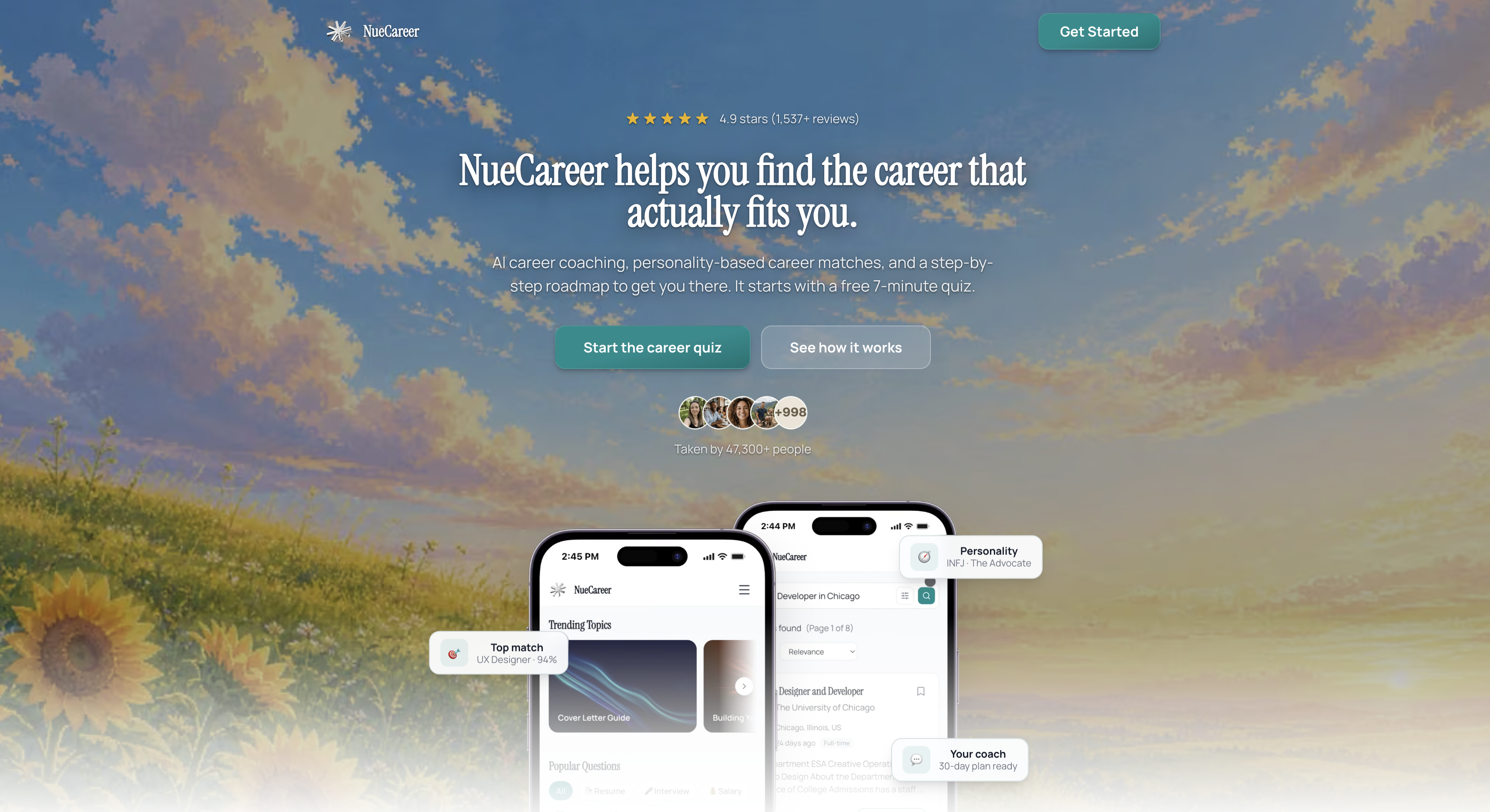
Once you know your target path, the rest of the toolkit picks up where the quiz leaves off. NueCareer's resume and cover letter tools help you translate certifications and projects into language hiring managers respond to, and the coaching chat is available around the clock if you're prepping for an interview at 11 p.m. because that's when you finally have time. Start with the quiz, see where you land, and build your application from there.
Where This Salary Data Comes From
These figures draw on Glassdoor's self-reported salary data, ZipRecruiter's aggregated estimates, Indeed's job-posting analysis, Salary.com's employer-side modeling, and Salesforce Ben's community survey of working admins. Broader labor market context comes from BLS occupational data on adjacent technical roles. Cross-referencing these sources matters because each one samples a different slice of the market, and agreement across all five is what makes the $92,000 to $100,000 baseline trustworthy.
Sources
- Salesforce Administrator: Average Salary & Pay Trends 2026
- Salary: Salesforce Administrator (Sep, 2026) United States
- Salesforce Admin Salary Guide 2026: Key Trends and Analysis
- Bureau of Labor Statistics — Computer systems analysts
FAQ
Is Being a Salesforce Admin Worth It?
For most career changers, yes: the national baseline of $92,000 to $100,000 sits well above the median U.S. salary, and the path to senior roles paying $130,000-plus is achievable within five to seven years for admins who add certifications and AI skills. Whether it's worth it for you specifically depends on whether you enjoy problem-solving and process design, since that's the daily reality of the job.
Is Salesforce a High-Paying Job?
Salesforce administration pays above the U.S. median technical role, with ZipRecruiter reporting a 90th percentile near $140,000 for experienced admins. It's not the highest-paying corner of the Salesforce ecosystem, developers and architects typically earn more, but it offers one of the more accessible entry points into six-figure tech pay.
Is Salesforce Admin in High Demand?
Yes. Demand has stayed strong as more companies adopt AI-driven tools like Agentforce, which require admins who can configure and manage them. Broader technical occupation growth tracked by the Bureau of Labor Statistics supports continued demand for admin-adjacent technical roles through the rest of the decade.
Is Salesforce Admin an IT Job?
It typically sits within a company's IT or operations department, though the work leans more toward business process design than traditional IT infrastructure. Admins spend more time on workflow automation, user permissions, and reporting than on servers or networks, which makes it a hybrid role between IT and business analysis.