
13 States and D.C. Now Require Pay Ranges — Employer Checklist, Applicant Steps

Mid-2026: 13 states plus D.C. require pay ranges. Read a U.S. state-by-state breakdown with an employer compliance checklist and step-by-step actions for...
As of mid-2026, 13 states plus [Washington, D.C.] require employers to disclose pay ranges(https://clockspot.com/articles/pay-transparency-laws-by-state) in some form, with Virginia and Maine joining that list this year. California, Colorado, New York, and Washington require the range right in the job posting. If you're hiring, post your ranges and document how you set them. If you're job hunting, treat every posted range as your opening line in salary talks.
TL;DR:
- Employers must understand and comply with varying thresholds and disclosure requirements across states and cities, especially for remote roles.
- Posting pay ranges is mandatory in most Tier 1 states, while others require disclosure only upon request or under specific conditions.
- Employer obligations are heavily influenced by the worker’s location, not the company's headquarters, complicating multi-state hiring.
- Job seekers should verify if postings are covered by law, understand what the pay range includes, and benchmark independently before negotiating.
- Salary history bans and pay transparency laws are separate, with some states implementing both, providing candidates with stronger negotiating positions.
Table of Contents
- Which States Have Salary Transparency Laws Right Now?
- How Do Pay Transparency Laws Actually Group Into Tiers?
- What Should Employers and Job Seekers Do Right Now?
- Salary History Bans vs. Pay Transparency Laws: What's the Difference?
- Turning a Posted Range Into a Real Career Move
- Why the Pay Transparency Patchwork Cuts Both Ways
- Ready to Act on a Salary Range You Just Saw Posted?
- Sources
- FAQ
Which States Have Salary Transparency Laws Right Now?
The list of salary transparency states has grown fast, but not evenly. California, Colorado, Connecticut, Hawaii, Illinois, Maryland, Massachusetts, Minnesota, New Jersey, New York, Rhode Island, Vermont, Washington, and Washington, D.C. all have effective pay-transparency laws. Virginia's law kicked in July 1, 2026, and Maine's followed on July 29, 2026. Delaware is next, with a law scheduled to take effect in late 2027.
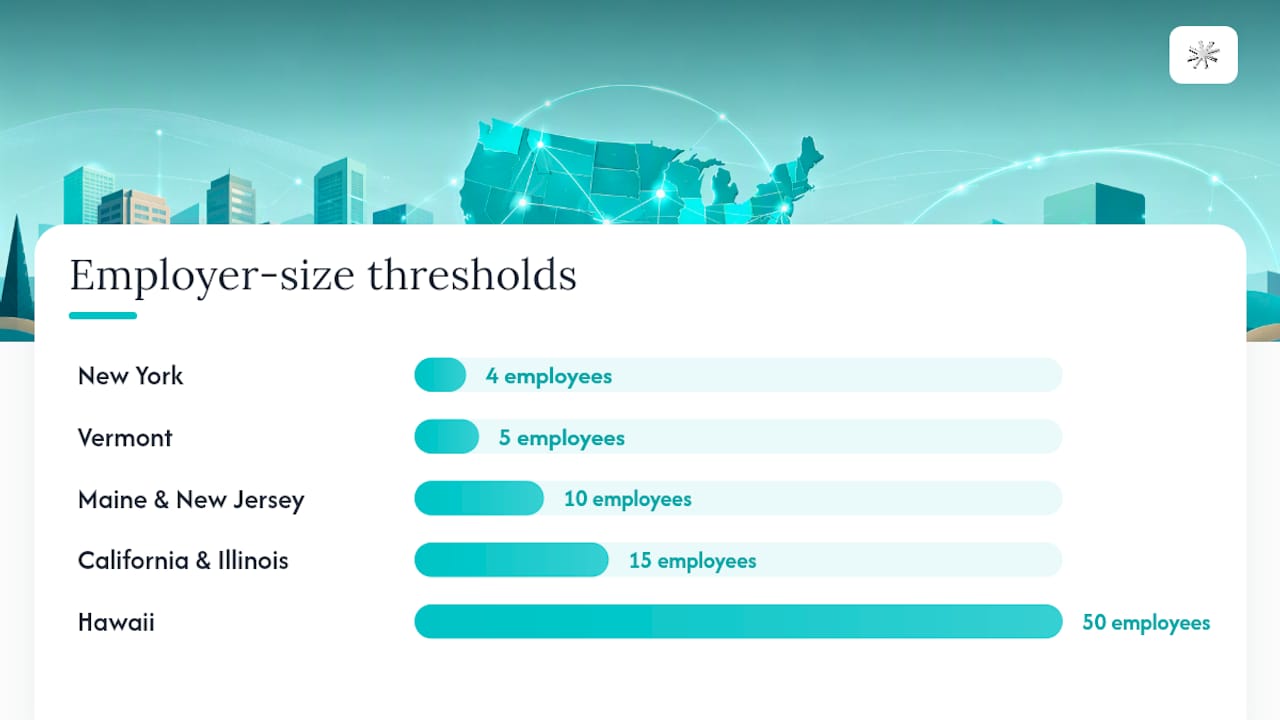
That's the headline count. The details underneath it matter more, because no two states wrote the same rulebook. Some force employers to publish a number in the posting. Others only require disclosure if a candidate asks, or after an interview, or only to people already on payroll. Employer size thresholds swing from four employees in New York to fifty in Hawaii. And enforcement ranges from a state Department of Labor with the power to fine you, to giving employees the right to sue.
Here's how the current landscape breaks down, state by state.
Employer-size thresholds are where a lot of businesses get tripped up. New York's law applies at just four employees; Vermont's kicks in at five, Maine and New Jersey at ten, California and Illinois at fifteen, Massachusetts at twenty-five, Minnesota at thirty, and Hawaii doesn't apply until you cross fifty. A small business that feels exempt in one state might be fully covered the moment it posts a remote role open to New Yorkers.
City ordinances add another layer entirely, and some are stricter than the state law sitting above them. New York City, Jersey City, Ithaca, Cincinnati, Toledo, Cleveland, and Columbus all have local pay-transparency rules that can trigger at lower employee counts than the state threshold, and New York City's ordinance carries penalties that can be substantial for willful violations. If your company posts jobs in any of these cities, check the local ordinance separately. It doesn't automatically match the state rule, and in some cases it's the only rule that applies.
How Do Pay Transparency Laws Actually Group Into Tiers?
Once you strip away the statute numbers, salary disclosure laws sort into three practical buckets. Knowing which bucket a state falls into tells you almost everything you need about how to write a job posting there.
- Tier 1: posting duty. California, Colorado, New York, Washington, Illinois, New Jersey, Minnesota, Vermont, Hawaii, and D.C. all require the pay range to appear in the job posting itself. This is the strictest and fastest-growing tier, and it's where most new state laws are landing.
- Tier 2: on-request or pre-offer disclosure. Connecticut, Rhode Island, and Maryland require the range to be shared when a candidate asks, or before an offer is extended, but not necessarily in the ad itself. Nevada takes a related approach, requiring disclosure after an interview.
- Tier 3: limited or employee-only disclosure. A handful of jurisdictions only require sharing pay data with current employees, or apply narrower duties tied to specific triggers like a promotion or internal transfer request.
Employer thresholds cut across all three tiers, and remote work is the wild card that trips up multi-state employers most often. If a job can be performed by someone sitting in Colorado, Colorado's Tier 1 posting duty applies, even if your company is headquartered in Texas and Texas has no transparency law at all. The practical rule: the law follows the worker's location, not the employer's.
Enforcement varies just as much as disclosure timing. Virginia gives employers a 15-business-day notice-and-cure window before penalties attach. Washington and New York allow employees to sue directly, with fines that escalate for repeat violations. D.C. and several other jurisdictions rely on administrative penalties instead, which are handled through a state agency rather than the courts. None of that patchwork is going away soon. Federal bills aiming to standardize the rules, including the Salary Transparency Act introduced in the House, haven't been enacted, so the state-by-state approach remains the law of the land.
What Should Employers and Job Seekers Do Right Now?
Compliance isn't complicated once you break it into steps, but skipping even one of them is how companies end up defending a lawsuit they didn't see coming. Here's the order that actually works.
For employers:
- Map which laws apply to you. List every state and city where you currently have employees or where a posted remote role could be performed, and cross-reference that against the tiers above.
- Audit every posting, including third-party job boards. A compliant posting on your careers page doesn't help if the same listing goes up on a job board without the range attached.
- Set defensible ranges, and write down why. The safest posture for multi-state employers is to include a real pay range in every public posting and keep documentation showing how that range was calculated. A "good faith" range that's too wide to mean anything invites scrutiny.
- Update your applicant tracking system and posting templates. Build the range field into your workflow so it's never an afterthought someone forgets to fill in.
- Train hiring managers and recruiters. The people writing job ads and fielding candidate questions need to know which state's rule applies to which role.
- Monitor remote postings separately. A single remote listing open nationwide may need to satisfy the strictest applicable state law, not just your home state's.
- Build a cure-period response process where the law allows one, so a posting error gets fixed fast instead of turning into a formal complaint.
For job seekers:
- Check whether the posting is even covered. Confirm the employer's size and location against the thresholds in the table above before assuming a missing range is a violation.
- Read what the range actually includes. A posted number might be base salary only, or it might fold in bonus and equity. Ask before you anchor your expectations to it.
- Ask targeted questions in the interview, like where your experience level would land within the posted band, not just "what's the range."
- Benchmark independently before you respond with a number, using percentile data rather than the employer's word alone.
- Build your negotiation approach around the midpoint, not the floor, especially if your experience matches or exceeds the role's requirements. NueCareer's guide on how to negotiate salary walks through exactly how to frame that ask.
Pro Tip: A "good faith" range spanning $70,000 to $140,000 for the same role is a red flag, not transparency. HR professionals warn that wide good-faith ranges can technically satisfy the law while telling candidates almost nothing. If you see one, ask directly what a typical new hire at your experience level actually earns, and whether the range reflects a single role or several levels bundled together.
Salary History Bans vs. Pay Transparency Laws: What's the Difference?
These two get confused constantly, and the mix-up causes real problems on both sides of the hiring table. A salary history ban stops an employer from asking what you made at your last job. A pay transparency mandate requires the employer to tell you, upfront or on request, what the new role pays. One restricts a question. The other creates a disclosure duty. They are not the same law, and having one does not mean a state has the other.
- Salary history bans exist in a long list of states, including California, Colorado, Connecticut, Delaware, Hawaii, Illinois, Maine, Maryland, Massachusetts, Nevada, New Jersey, New York, Oregon, Rhode Island, Vermont, Virginia, Washington, and D.C.
- A ban alone guarantees nothing about pay ranges. Employment law experts point out that history bans reduce a specific kind of inquiry, but only a transparency mandate forces the employer to show you a number.
- Some states run both laws at once, like California, Colorado, and Washington, which gives candidates the strongest position: no pay-history question, plus a posted range to negotiate against.
- Other states have one but not the other, which means a candidate could face a compliant posting with zero range attached because the state's only rule is a history ban.
For hiring managers, this distinction changes what you're actually required to do. Not asking about past pay is table stakes in most of the country now. Publishing a range is a separate obligation that only exists where a transparency law specifically requires it. For applicants, the practical lesson is simple: don't assume a history ban means you'll see a number in the posting. Check the state's transparency status separately.
Turning a Posted Range Into a Real Career Move
A salary range on a job posting only helps if you know whether the role is actually right for you and whether that number reflects what you should be earning. That's the gap NueCareer's tools are built to close.
Start with The 7-Minute Career Quiz. It matches your strengths and interests to career paths, including ones you may not have considered, so you can tell whether a posted range reflects a role you actually want or one you'd be settling for. A posted salary means little if the job itself is a poor fit.
From there, NueCareer's free compensation tools help you act on the numbers you're seeing:
- Salary Percentile Check shows where a posted range sits against real market data for your role and experience level, so you're not negotiating blind.
- Pay Raise Calculator quantifies exactly what percentage increase you should be asking for, whether you're negotiating a new offer or a raise in your current job.
- Severance Pay Calculator helps you understand what you're owed if a transition isn't voluntary, a detail that matters more in states with looser disclosure rules.
Job seekers who benchmark before responding to an offer tend to negotiate from a stronger position; treating a posted range as an opening anchor rather than a final number is the practical takeaway from most transparency-law guidance. The workflow is straightforward: take the quiz to confirm the role fits, benchmark the posted range against real data, then use NueCareer's Salary Negotiation Email Generator to put your ask in writing.
Why the Pay Transparency Patchwork Cuts Both Ways
The state-by-state approach to pay transparency creates a strange kind of inequality. A candidate applying to the same remote job might see a full salary range if they're sitting in Colorado, and nothing at all if they're sitting in Texas. That's not a bug in the system. It's the system working exactly as each state legislature designed it, and it means your rights as a job seeker depend more on your zip code than on the job itself.
Employers who treat this as a checkbox exercise are missing the bigger opportunity. A defensible, well-documented pay structure protects you legally, but it also signals something to candidates in a market where trust is thin. The companies posting real, narrow ranges instead of padded "good faith" bands are the ones building reputations as places worth applying to twice.
For candidates, the honest reminder is that a posted number is a starting point, not a ceiling or a guarantee. Use it to anchor your research, not to end it.
— Shane
Ready to Act on a Salary Range You Just Saw Posted?
Knowing your state requires a pay range is only useful once you know what to do with the number in front of you. NueCareer gives you the tools to move from "here's a posted range" to "here's my next career move," starting with The 7-Minute Career Quiz, which matches your strengths to roles you may not have considered instead of just the ones you already know how to search for.

Once you know your fit, NueCareer's full toolkit helps you build the resume, cover letter, and negotiation materials to go after it, all in one place instead of scattered across five different apps. If a posted range left you wondering whether the role is even worth pursuing, consider starting with a career assessment quiz to better understand if that number aligns with your strengths and goals.
Sources
- Pay transparency laws by state: Clockspot (state summaries, May 2026)
- Pay transparency laws by state (ClearMoneyGuide)
- SHRM: Delaware pay-transparency coverage
- U.S. Pay transparency laws 2026: RemoteLaws guide
FAQ
What States Can You Not Ask About Current Salary?
Salary history bans, which prohibit asking about a candidate's past pay, apply in California, Colorado, Connecticut, Delaware, Hawaii, Illinois, Maine, Maryland, Massachusetts, Nevada, New Jersey, New York, Oregon, Rhode Island, Vermont, Virginia, Washington, and D.C. These bans are separate from pay-range disclosure requirements, so a state having a history ban doesn't mean it also requires posted salary ranges.
What Are the Pay Transparency Laws in Different States in 2026?
As of mid-2026, 13 states plus D.C. have effective pay-transparency laws, with requirements ranging from posting a range in every job ad to disclosing pay only on request or to current employees. Virginia's law took effect July 1, 2026, Maine's followed July 29, 2026, and Delaware's law is scheduled for September 26, 2027.
Which US State Has the Lowest Salary?
Salary levels vary by occupation and cost of living far more than by transparency-law status, so there isn't one fixed answer to "lowest paying state" that applies across every job. If you want role-specific numbers, NueCareer's salary-by-state data for specific occupations is a more useful starting point than a single statewide figure.
Which US State Pays the Highest Salary?
Like the lowest-paying question, this depends heavily on the occupation and industry you're comparing, not just the state. The most reliable way to answer it for your own situation is to benchmark your specific role and experience level using percentile tools rather than relying on a single statewide average.
Does NueCareer Help With Salary Negotiation?
Yes. NueCareer offers a free Salary Negotiation Email Generator and a Pay Raise Calculator to help you quantify and word your ask, alongside The 7-Minute Career Quiz to confirm the role is the right fit before you negotiate for it.