

The best way to handle your first 90 days in a new role is to treat them as three 30-day phases: learn, contribute, then show you can own the work. Set two or three measurable goals for each phase, agree on them with your manager, and check in every week. That gives you structure while everything around you is still unfamiliar.
If you just changed jobs, or changed careers entirely, it is normal to feel a mix of excitement and doubt. We built this guide so you can replace that uncertainty with a clear sequence of steps.
TL;DR
- Split the 90 days into three phases: learning (days 1-30), contributing (days 31-60) and demonstrating skill (days 61-90).
- Pick two to three measurable goals per phase, and confirm them with your manager in writing.
- Spend the first month listening, mapping the team and asking why things are done the way they are, before you try to change anything.
- Hold a one-on-one with your manager every week, and use it to adjust the plan as you learn.
- Pick early wins that solve a real problem without creating new complexity for the team.
Table of Contents
- Why the first 90 days carry so much weight
- Before day one: define your starting point
- Days 1-30: learn and absorb
- Days 31-60: plan and contribute
- Days 61-90: demonstrate ownership
- A sample 30-60-90 plan at a glance
- How to work with your manager
- How to measure your progress
- If you changed careers, adapt the plan
- Perspective
- Build your direction with NueCareer
- Common mistakes to avoid
- FAQ
- Sources
Why the first 90 days carry so much weight
The first three months are when people form their lasting impression of how you work, and when you form yours of the job. Nobody expects you to be fully productive on day one, but everyone is quietly noticing how you learn, how you communicate and whether you follow through.
A written plan helps because it gives you, your manager and your team the same picture. A 90-day plan can serve as a single reference point for resources, support, and clarity on your responsibilities and goals. When you feel lost in week three, you can open it and see where you are headed.
The common structure is simple. Harvard Business School's alumni platform describes a successful onboarding approach as a 90-day plan divided into three 30-day segments. You can see a phased 90-day onboarding plan structure applied to a sales leadership role, which shows how the same rhythm adapts to a specific job.

Before day one: define your starting point
The plan begins before you walk in the door. If you have a week or two between accepting the offer and starting, use it.
A 2026 first-90-days guide suggests writing down four things before you start: the scope of the role, what success looks like, your existing commitments, and any known constraints. You will not have every answer yet, and that is fine. The point is to see what you know and what you still need to ask.
Here is a short pre-start checklist:
- Write down what you think the role is for. Use the job posting and your interview notes. What problem is this position meant to solve?
- List your questions. Who will you work with most? What does a good first quarter look like to your manager?
- Review any materials you were sent. Org charts, product pages, recent news about the company.
- Handle logistics. Benefits paperwork, equipment, commute or remote setup, so your first week is about people and not forms.
- Sort what you know from what you assume. Mark each item as known, assumed or unknown. The same guide recommends this distinction so that unverified assumptions do not quietly become priorities.
If you are moving into a different field and are not sure your skills line up, our 90-day skill gap analysis for career changers walks you through spotting gaps early, so you can pick the right things to learn first.
Days 1-30: learn and absorb
The first month is about learning. Monday.com's 2026 guide describes days 1-30 as the learning and absorption phase, built around relationship building and understanding processes. The same 2026 Story of Entrepreneur guide frames it as a diagnosis phase: map the business and talk to the people closest to the work before attempting any changes.
What to learn
Berkeley Executive Education advises asking about priorities, team objectives, wins and roadblocks, and what success looks like. Observe the workplace norms too: how meetings run, how decisions get made, who people go to for answers.
Try these questions in your first few weeks:
- What are the team's top three priorities this quarter?
- What has gone well recently, and what has been frustrating?
- How will you and the company judge whether I am succeeding in this role?
- Who should I get to know outside my immediate team?
- Why is this process done this way? (Ask with curiosity, never with criticism.)
That last question matters more than it seems. Berkeley's experts suggest observing patterns and asking why things are done a certain way, because it reveals meaningful areas for improvement later, once you understand the context.
Who to meet
Build a short list of people: your manager, direct teammates, the people who depend on your work, and one or two colleagues in other departments. Book 20 to 30 minutes with each. Ask open-ended questions and listen more than you talk. UC Davis's onboarding toolkit points to one-on-one check-ins, open-ended questions and active listening as the foundation of working relationships.
Goals for the first 30 days
Berkeley recommends two to three measurable goals for each phase. For month one, they might look like this:
- Complete all required training and onboarding tasks.
- Hold introductory conversations with every key teammate and stakeholder.
- Write a one-page summary of how the team works, its goals and its biggest open questions, and review it with your manager.
Days 31-60: plan and contribute
By month two you have context. Now you start to use it. Monday.com describes days 31-60 as the phase of planning and contribution, such as setting priorities and delivering early value.
Choose early wins carefully
An early win builds credibility, but only if it is the right one. The Story of Entrepreneur guide says that quick wins should solve a real problem without creating future complexity. A flashy fix that someone else has to maintain for a year is not a win.
A good early win usually has these traits:
- Your manager or team already cares about the problem.
- You can finish it with the access and skills you have now.
- The result is visible and easy to describe in a sentence.
- It does not depend on changing how three other teams work.
Connect your work to team goals
HubSpot's guidance is to connect your responsibilities to your team's goals, and to use specific measurements to track progress. If your team cares about response time, show how your work affects response time. If it cares about renewals, tie your tasks to renewals. This keeps your effort pointed at what your manager values.
Avoid overcommitting
It is tempting to say yes to everything in month two. Resist it. A useful plan, as monday.com's Ben Kazinik argues, balances relationship building with actual task delivery. If your calendar is full of coffee chats and your deliverables are slipping, rebalance. If you are heads-down on tasks and have stopped talking to people, rebalance the other way.
When a new request lands, a good response is: "I can take that on. Here is what I am working on now. Which should come first?" It shows you are willing and that you think about priorities.
Goals for days 31-60
- Deliver one small project or improvement from start to finish.
- Take over a recurring task or responsibility from your onboarding list.
- Present your first set of observations or recommendations to your manager.
Days 61-90: demonstrate ownership
The last phase is about showing you can work independently. The sample plan in HubSpot's guide moves from learning in the first 30 days to contributing in the next 30 and demonstrating skill mastery in the last 30. UC Davis notes that at the 60-90 day mark, employees often work with increasing autonomy and decreasing supervision.
This is also when your earlier observations become useful. The patterns you noticed in month one, and the questions you asked about why things work as they do, can turn into proposals. You now have standing to say, "I noticed this, here is what I think we could try, and here is how I would measure it."
Goals for days 61-90
- Run a project or process with minimal supervision.
- Propose one improvement based on what you learned in the first two months.
- Agree on goals for the next quarter with your manager.
A sample 30-60-90 plan at a glance
| Phase | Focus | Example goals | How to check |
|---|---|---|---|
| Days 1-30 | Learn and absorb | Finish training, meet key stakeholders, write a team summary | Manager confirms the summary is accurate |
| Days 31-60 | Plan and contribute | Deliver one small project, take on a recurring task | Project completed, feedback from the people who rely on it |
| Days 61-90 | Demonstrate ownership | Work independently, propose one improvement | Agreed metrics reviewed with your manager |
If you would rather not build this from a blank page, our 30-60-90 day plan generator gives you a draft tailored to your role that you can edit and bring to your manager.
How to work with your manager
Your manager is the most important relationship in your first 90 days. The HBS process recommends communicating openly about what you plan to do, why, and how you will execute it. No surprises is a good rule.
Set a weekly rhythm
HubSpot recommends weekly meetings with your manager to track performance metrics and gauge progress. UC Davis says frequent one-on-ones are essential for trust, accountability and positive working relationships. Atlassian's Jamey Austin notes that consistent, frequent check-ins prevent friction and clarify expectations early rather than waiting until day 90.
A simple agenda for each weekly meeting:
- What I finished since last time.
- What I am working on next.
- Where I am stuck or need a decision.
- One question about priorities or expectations.
Ask for feedback early
Berkeley's 2025 article says that asking for feedback early, from both managers and peers, signals a willingness to grow and leaves time for adjustments. Try this around day 30: "What is one thing I am doing well and one thing you would like me to do differently?" Then adjust the plan, in writing, so your changes are visible.
Write good goals
The HBS alumni insights describe the ACHIEVE model for goal setting. The letters stand for Action-Oriented, Consequential, Hard not Herculean, Integrated, Explicit, Visualized, and Endpoint-focused. In plain terms: a goal should name an action, matter to the business, stretch you without being impossible, fit with others' work, be clearly stated, be easy to picture, and have an end date.
How to measure your progress
Progress is easier to discuss when it is concrete. HubSpot gives examples such as average post views or qualified leads, depending on the job. Not every role has a number like that, so mix measures. Monday.com suggests that success indicators for each phase can include quantitative measures such as completion rates and qualitative measures such as stakeholder feedback.
For each phase, ask yourself:
- What did I finish? Tasks, projects, training.
- What did I learn? Processes, people, vocabulary, unwritten rules.
- What did others say? Comments from your manager, peers and the people who use your work.
- What will I change next? One adjustment for the next 30 days.
At day 90, sit down with your manager and review the plan together. Bring a one-page summary of what you achieved, what you learned and what you propose for the next quarter.
If you changed careers, adapt the plan
Career changers often carry extra worry: Do I belong here? Is my background enough? The 90-day structure helps, with a few adjustments:
- Spend more of month one on vocabulary. Every field has its own terms. Keep a running glossary.
- Find a translator. Ask a patient teammate to explain context you are missing.
- Name your transferable strengths. Tie what you did before to what the team needs now, in small, specific examples.
- Be patient with the timeline. Our guide to a realistic career transition timeline explains why the adjustment takes time and what to expect along the way.
You were hired because someone saw potential in you. The plan is how you turn that potential into proof.
Perspective
We hear from many working adults who landed a new role and then felt a wave of doubt. The job was a good match on paper, but the first weeks felt like starting from zero.
Our view is that the first 90 days go better when the match was right to begin with. When a role lines up with your strengths and the way you like to work, learning feels like momentum and not like strain. That is why we start with a 7-minute quiz that identifies your strengths and matches you to career paths, including ones you may never have considered.
From there, a personalized roadmap, 24/7 coaching chat and tools for resumes, cover letters and interview practice help you move from "I want something different" to "I know exactly what I am doing next." We designed NueCareer so that the confidence you build while applying carries into day one, and into your 30-60-90 plan.
You do not need to have it all figured out. You need a direction, a plan and someone in your corner.
Shane
Build your direction with NueCareer
If you are still working out which role fits you, or you are preparing to apply for one, we can help you get there with more confidence. Start with the 7-minute career quiz to see career paths matched to your strengths, then use your personalized roadmap, job boards and application tools to go after them.
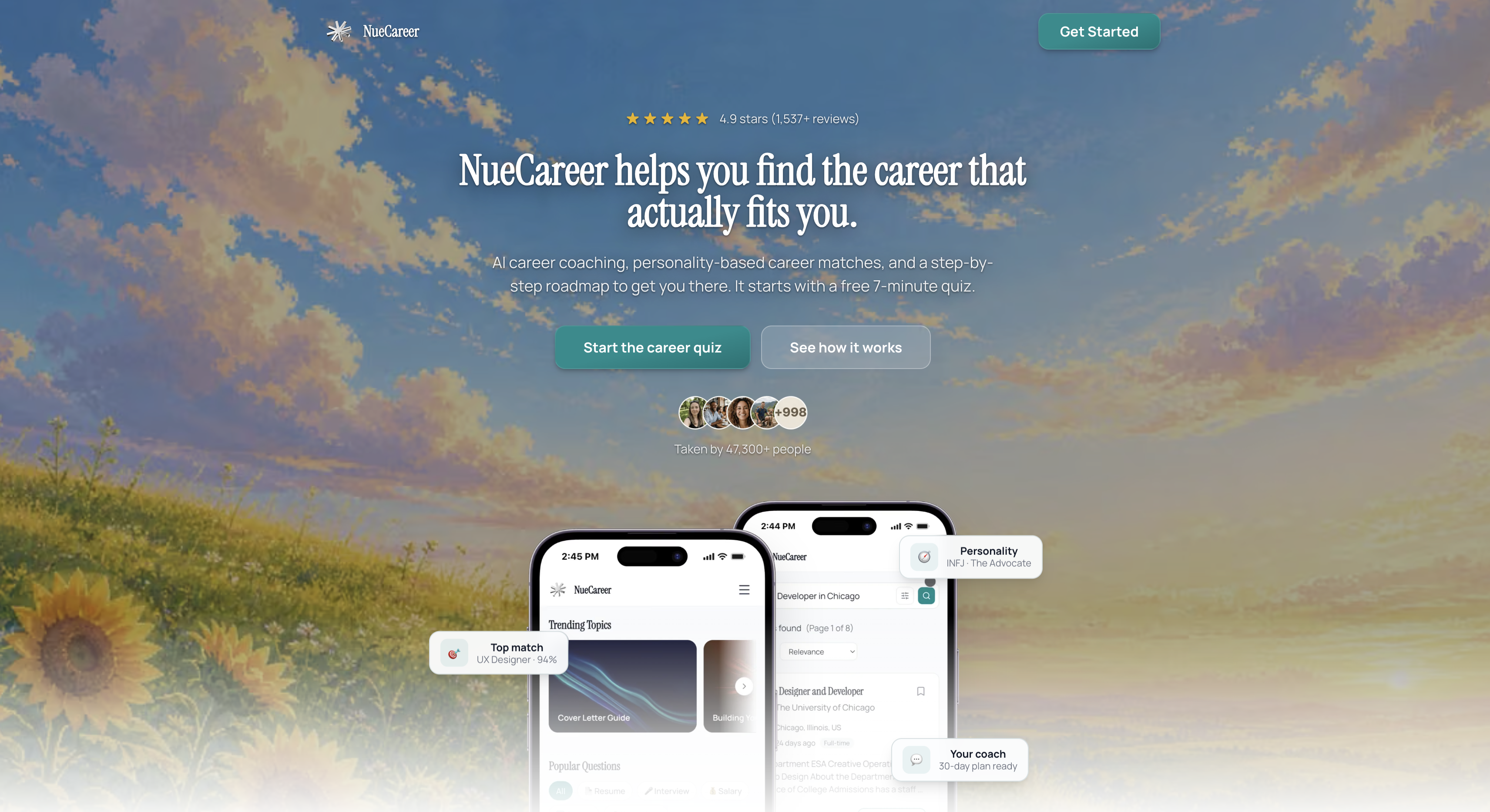
The platform also includes AI-powered resume and cover letter tools, mock interview practice and 24/7 coaching chat. You can explore the full set of free tools to get started.
Common mistakes to avoid
- Changing things too soon. Give yourself the first month to understand why things work as they do.
- Keeping the plan to yourself. Share it, and revise it with your manager.
- Skipping the relationship work. Results matter, but so do the people who will vouch for you.
- Chasing flashy wins. Choose wins that solve a real problem and are easy for the team to sustain.
- Waiting for feedback. Ask at week three or four, not at day 90.
- Treating the plan as fixed. Regular check-ins exist so you can review and adjust it as needed.
FAQ
What should I focus on in the first 30 days of a new job?
Focus on learning: how the team works, what its priorities are, and what success looks like in your role. Meet your key colleagues, ask open-ended questions and complete required training. Hold off on major changes until you understand the context.
How is a 30-60-90 day plan structured?
It splits your first three months into three 30-day phases. Days 1-30 are for learning, days 31-60 for planning and contributing, and days 61-90 for demonstrating skill and working more independently. Each phase has two or three measurable goals that you agree on with your manager.
How often should I meet with my manager?
Weekly one-on-ones are a widely recommended rhythm, because they let you track progress, ask questions and adjust your plan before small issues grow. Keep each meeting short and focused, with a clear agenda. If your manager has a different cadence, ask what works for them and follow it.
What if I am not hitting my goals?
Talk to your manager early, with specifics: what is blocking you and what you have tried. The plan is meant to be reviewed and adjusted, and goals can shift as you learn more about the role. Raising a problem in week five looks far better than explaining it at day 90.
Can I use a 90-day plan when changing careers?
Yes. The structure works for any new role, and it is especially useful when the field is unfamiliar. Add time for learning vocabulary and tools, and pair your goals with small, concrete examples of how your past experience applies.
Sources
- Your Blueprint for Success: The First 90 Days at a New Job, Berkeley Executive Education
- Tackle the First 90 Days of Your Next Role, Harvard Business School Alumni
- The First 90 Days: From Learning through Executing, UC Davis
- How to write the perfect 90-day plan, Atlassian
- First 90 Days Plan, Story of Entrepreneur
- 30 60 90 Day Plan: Templates, Examples, And How To Write One, monday.com
- The Best 30-60-90 Day Plan for Your New Job, HubSpot