

TL;DR:
- Career path clarity provides working adults with a definitive understanding of their goals, growth milestones, and necessary skills. It enhances engagement, loyalty, skill development, and decision-making confidence, especially during career transitions. Building clarity through self-assessment and tools like Nuecareer can significantly improve outcomes and reduce uncertainty in a competitive job market.
Career path clarity is defined as a clear, conscious understanding of your professional direction, including your goals, expected growth milestones, and the skills you need to get there. For working adults weighing a career change, this kind of clarity is not a luxury. It is the foundation of every confident decision you will make next. The benefits of career path clarity extend well beyond knowing your job title. They shape your engagement, your loyalty, your skill development, and your ability to adapt in a job market increasingly reshaped by AI. Platforms like Nuecareer exist precisely because most adults never receive this clarity by default. They have to build it deliberately.
1. Benefits of career path clarity on employee engagement
Career path clarity is one of the strongest predictors of employee engagement, and the data from Gallup makes this concrete. Highly engaged teams deliver 23% higher profitability, 18% higher productivity, and 51% less turnover than disengaged ones. That gap does not come from perks or pay alone. It comes from people knowing where they are headed and why their work matters.

Clarity about expectations and growth is the mechanism behind that engagement. When you understand your career direction, you show up differently. You prioritize better, you ask sharper questions, and you invest more in your performance because you can see how it connects to something larger.
For mid-career adults considering a change, this matters in a very personal way. Disengagement often signals not laziness but misalignment. You are not checked out because you stopped caring. You are checked out because the path stopped making sense.
- Clarity reduces ambiguity, which is the single biggest driver of disengagement for mid-career professionals.
- Clear growth expectations signal to your brain that effort has a payoff, which sustains motivation over time.
- Defined next steps make it easier to have productive conversations with managers about your development.
Pro Tip: If you feel disengaged at work, map out what your next two career moves would look like. The act of mapping often reveals whether the problem is the role or the direction.
2. How clarity drives loyalty and reduces turnover
Loyalty in the modern workforce is not bought with salary alone. Millennial loyalty hinges on clear growth paths and skill development opportunities, according to HR Dive research. This finding reframes the retention conversation entirely. It means that if you are considering leaving a job, the real question may not be about compensation. It may be about whether you can see a future there.
The research shows that 79% of millennial knowledge workers are satisfied with their current roles but will only stay long-term if clear career development exists. Satisfaction without direction is a temporary state. It erodes. And when it does, turnover follows.
For career changers, this insight cuts both ways. It explains why you may be leaving a role that looks fine on paper. It also tells you what to look for in your next position. A new job with a clear growth path will hold your commitment far longer than a higher salary with no defined direction.
Pro Tip: Before accepting any new role, ask directly: "What does a successful two-year trajectory look like in this position?" The quality of the answer tells you everything about whether clarity exists there.
3. Career clarity advantages for skill development
A defined career direction transforms how you approach learning. Without it, professional development feels like collecting random credentials. With it, every course, certification, or project connects to a specific destination. That shift from scattered to purposeful is one of the most underrated career clarity advantages available to working adults.
The University of Phoenix 2026 research found that workers whose employers have clear AI-enabled growth plans report 87% job satisfaction, compared to 72% among those without such clarity. A 15-point satisfaction gap driven entirely by whether a growth plan exists. That is a measurable return on the simple act of defining a direction.
Clarity also helps you build a skill map. Once you know your target role or field, you can identify exactly which skills you have, which you are missing, and which to prioritize. Tools like the free skills assessment from Nuecareer make this process concrete rather than abstract.
- Identify your skill gaps by comparing your current profile against the requirements of your target role.
- Prioritize high-leverage skills that appear across multiple roles in your target field, not just one job description.
- Track progress against a defined endpoint so learning feels cumulative, not circular.
The Deloitte Global Gen Z and Millennial Survey 2026 found that 44% of Gen Z and 45% of millennials prefer steady career progress over rapid promotions. This preference for sustainable growth over title racing means clarity must emphasize consistent skill-building, not just the next rung on a ladder.
4. How clarity improves decision-making during a career change
Career changes involve a series of high-stakes decisions: which field to enter, which skills to build first, which roles to apply for, and which opportunities to decline. Without a clear direction, each of these decisions feels like a guess. With clarity, they become logical steps in a defined sequence.
Here is how career path clarity reshapes the decision-making process for career changers:
- It creates a filter for opportunities. When you know your direction, you can evaluate any job offer, course, or networking connection against a single question: does this move me closer to where I am going?
- It reduces decision fatigue. Clarity narrows your option set. Instead of researching 40 possible career paths, you are comparing three. That reduction in cognitive load is significant.
- It builds confidence for pivots. Research shows that half of workers say AI knowledge increases their confidence in pivoting to new roles. Workers with AI literacy report 75% optimism about job opportunities versus 63% overall. Clarity about where AI fits in your target field gives you a concrete advantage.
- It supports internal mobility. If you are changing careers within your current organization, clarity about your target role makes it easier to have structured conversations with managers about lateral moves or new assignments.
- It helps you assess organizational realities honestly. Even with a clear path, staffing constraints are cited as the greatest barrier to goal achievement by 37% of workers, compared to just 8% who cite unclear standards. Clarity helps you distinguish between a path that is blocked by circumstances and one that is genuinely unavailable.
The goal is not to eliminate uncertainty. Career changes are inherently uncertain. The goal is to reduce unnecessary uncertainty so your energy goes toward execution, not deliberation.
5. Career clarity vs. unclear direction: what the research shows
The contrast between having a clear career path and operating without one is not subtle. It shows up in measurable outcomes across engagement, retention, and satisfaction.
| Outcome | With career path clarity | Without career path clarity |
|---|---|---|
| Employee engagement | Higher engagement tied to 23% more profitability | Disengagement costs U.S. employers $2 trillion annually |
| Loyalty and retention | 79% of millennials stay when growth paths exist | Turnover rises sharply without visible development options |
| Job satisfaction | 87% satisfaction with clear AI growth plans | 72% satisfaction without defined career pathways |
| Skill development | Purposeful, targeted learning aligned to goals | Scattered credential collection with no clear endpoint |
| Decision confidence | Structured choices filtered by a defined direction | High decision fatigue and anxiety around career moves |
The pattern is consistent. Clarity does not just feel better. It produces better outcomes across every metric that matters to a working adult considering a change. The importance of career direction is reinforced by Gallup data showing that 35% of employees say better communication about expectations would most help them regain engagement. That is not a small signal. It means one in three workers is disengaged primarily because no one has clearly defined the path forward.
Managers account for 70% of the variance in team engagement, which means the clarity you receive at work is often a function of who you report to, not just the organization you work for. If your manager is not providing that clarity, you may need to seek it yourself through structured career planning tools and self-assessment.
Key takeaways
Career path clarity is the single most reliable lever working adults have for improving engagement, loyalty, skill development, and decision confidence during a career change.
| Point | Details |
|---|---|
| Clarity drives engagement | Defined career direction connects daily effort to long-term purpose, reducing disengagement. |
| Loyalty follows growth visibility | 79% of millennials stay loyal only when clear development paths exist in their organization. |
| Skill development becomes purposeful | Clarity turns scattered learning into a targeted skill map aligned to a specific destination. |
| Decision-making gets sharper | A defined direction filters opportunities and reduces the cognitive load of career transitions. |
| AI literacy amplifies clarity | Workers with clear AI growth plans report 87% job satisfaction versus 72% without them. |
Why I think most career changers underestimate this
When I talk with working adults who are stuck, the conversation almost always circles back to the same place. They know they want something different. They just cannot name what it is. And because they cannot name it, they cannot move toward it. That ambiguity is not a personality flaw. It is a structural problem. Most careers are built reactively, one opportunity at a time, without anyone ever sitting down to ask: what do you actually want your professional life to look like?
The conventional advice is to "follow your passion" or "network more." Neither of those helps if you do not know your direction. Passion without direction is just restlessness. Networking without clarity produces a lot of coffee meetings and very little momentum.
What actually works, in my experience, is starting with a structured self-assessment. Not a vague journaling exercise, but a real inventory of your strengths, your values, and the types of problems you are energized to solve. From there, you can find your career purpose and build outward. The clarity does not arrive all at once. It builds through a series of small, honest decisions about what fits and what does not.
The 2026 job market rewards people who know what they want. Employers can tell the difference between a candidate who has thought carefully about their direction and one who is applying broadly out of desperation. Clarity signals confidence. And confidence, in a career change, is not just a feeling. It is a competitive advantage.
— Shane
Start building your career clarity with Nuecareer
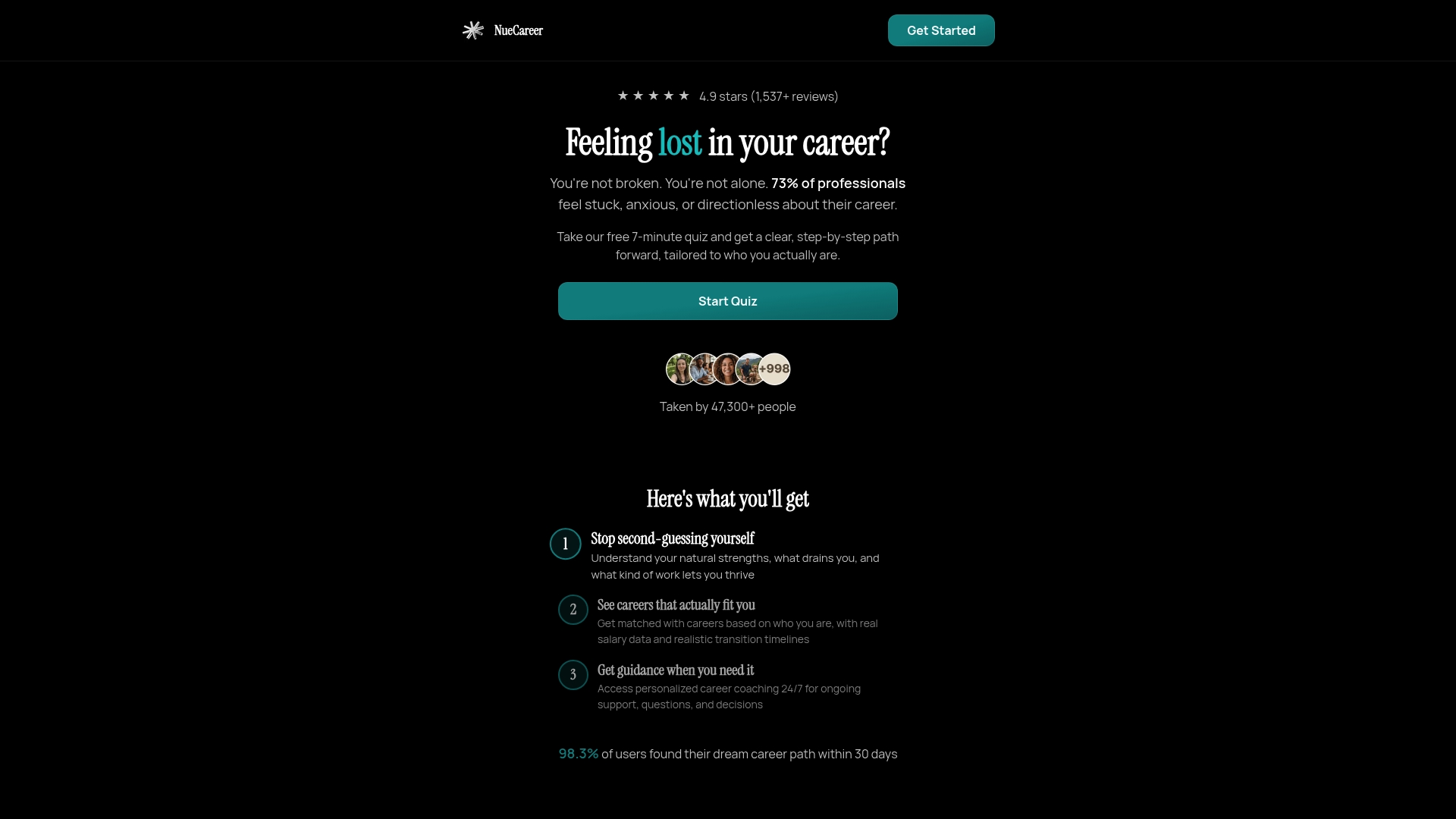
If you are ready to move from uncertainty to direction, Nuecareer gives you the tools to get there without the guesswork. The 7-minute career clusters quiz identifies your strengths and matches you to career paths built around who you are, including options you may never have considered. From there, Nuecareer's career discovery platform provides personalized roadmaps, 24/7 coaching chat, and a full suite of resume and cover letter tools so you can apply with real confidence. Whether you are just starting to explore or ready to make a move, Nuecareer meets you where you are and helps you build the clarity that makes everything else easier.
FAQ
What does career path clarity actually mean?
Career path clarity is a defined understanding of your professional direction, including your goals, the skills you need, and the steps required to get there. It goes beyond knowing your job title to encompass growth expectations and development milestones.
How does career clarity affect job satisfaction?
Workers with clear career growth plans report significantly higher satisfaction. Research shows 87% job satisfaction among those with defined AI-enabled growth paths, compared to 72% among those without clear direction.
Can career clarity help me decide whether to change careers?
Yes. A clear sense of your professional direction helps you evaluate whether your current role can support your goals or whether a change is necessary. It turns an emotional decision into a structured one by giving you a filter for assessing opportunities.
How do I start building career clarity if I feel completely lost?
Start with a structured self-assessment that maps your strengths, values, and interests to real career options. Tools like the Nuecareer skills assessment and career clusters quiz provide a concrete starting point. You can also explore switching careers with a step-by-step framework designed for working adults.
Does career clarity guarantee a smooth career transition?
Clarity significantly improves your odds, but organizational constraints like staffing shortages can still create barriers. Gallup research identifies staffing as the top barrier to goal achievement for 37% of workers. Clarity helps you distinguish between a path that is temporarily blocked and one that requires a different direction entirely.