
How to Change Careers Without Taking a Pay Cut

Learn how to successfully change careers while avoiding a pay cut. Discover strategies that help maintain your salary and showcase your value.
Yes, you can often avoid a pay cut when changing careers, but it depends entirely on which transition shape you pick. Full pivots into unrelated fields typically bring a 10 to 25% first-year cut with recovery landing between 18 and 36 months, while adjacent moves and internal transfers routinely preserve pay or come close to it. Your odds improve the moment you stop chasing a new job title and start proving transferable value.
Here's the prioritized playbook we walk people through at Nuecareer:
- Choose the income-preserving shape first. Internal transfers and adjacent laterals protect salary far more reliably than a cold jump into an unrelated field, according to research from JobGetter.
- Build evidence or bridge income before you leap. Two paid projects, a portfolio piece, or a consulting client gives hiring managers proof, not promises, per Forbes.
- Negotiate with tradeable terms, not just base salary. Signing bonuses, performance kickers, and accelerated reviews often move when base pay won't.
Tools like the JobLabs framework and Nuecareer's own roadmapping process both point to the same conclusion: the shape of your move matters more than the industry you're leaving.
Key Takeaways
Avoiding a pay cut during a career change depends far more on choosing the right transition shape than on the industry you're leaving or entering.
| Point | Details |
|---|---|
| Shape determines outcome | Internal transfers and adjacent laterals protect pay; full unrelated pivots often bring a 10 to 25% first-year cut. |
| Evidence beats credentials | Two paid projects or a portfolio piece can reduce or eliminate the pay gap employers price in. |
| Negotiate beyond base pay | Signing bonuses and 6-month performance kickers often move even when base salary won't. |
| Runway should match risk | Save 90 days for a bridge tactic and 180 days for a full unrelated pivot. |
| Nuecareer maps your shape | The free skills assessment matches your background to the pivot shape most likely to protect your salary. |
Table of Contents
- How Do You Change Careers Without Taking a Pay Cut?
- How Do You Negotiate Salary When Changing Careers?
- How Much Runway Do You Need Before You Switch Careers?
- What Are the Best Bridge Tactics to Preserve Income?
- What Does the Data Say About Pay Cuts and Recovery Time?
- Pre-Resignation Checklist: Are You Ready to Move?
- Why Transferable Value Beats Job Titles Every Time
- Get a Personalized Roadmap to Protect Your Pay
- Sources
- FAQ
How Do You Change Careers Without Taking a Pay Cut?
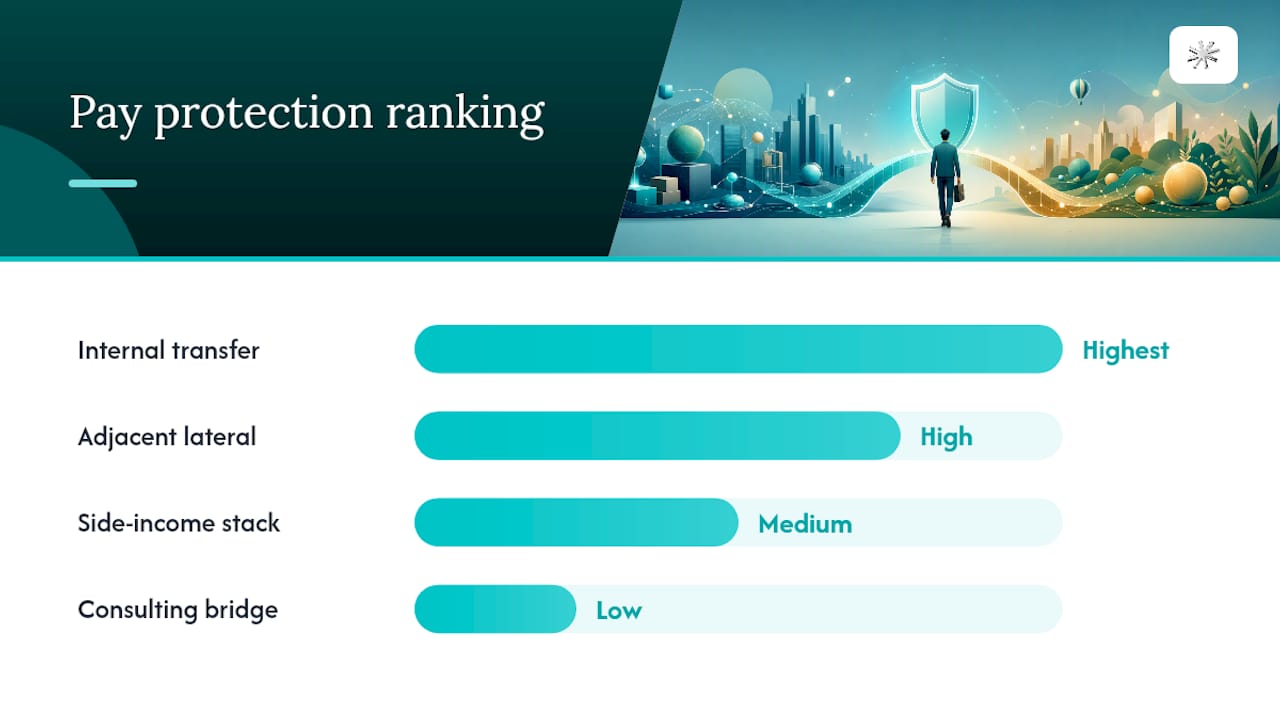
The path that preserves your paycheck almost always runs through one of four shapes, and they are not interchangeable. Ranked by speed and salary protection, they are: internal transfer, adjacent lateral, side-income stack, and consulting bridge. An internal transfer is fastest and safest because your current employer already trusts you and your pay history sets the floor. An adjacent lateral, where you move to a role that shares core skills with your current one, usually preserves pay because the role level stays the same even though the industry shifts. Side-income stacking and consulting bridges take longer to build but let you test a new field without quitting your income source first.
Once you've picked a shape, the real work is translating what you've done into language the new field recognizes. Start with a skills audit: list your last two years of measurable wins, then strip out the industry jargon. Map each win to a target role using this kind of substitution.
| Transferable skill (your language) | How to phrase it for the target role |
|---|---|
| Managed a team budget | Owned P&L for a cross-functional department |
| Ran client onboarding calls | Led customer success and retention workflows |
| Built internal reporting dashboards | Delivered data-driven operational reporting |
| Trained new hires | Designed and led onboarding programs |
After the audit, spend a week on target-role mapping. Pull five to ten job postings in your target field and pull them apart for repeating phrases and required outcomes. Then spend two to four weeks building evidence: a certification, a freelance project, or a volunteer initiative that produces something you can point to. Only after that should you start outreach. Informational interviews and warm introductions convert far better than cold applications, and they let you test your pitch before it matters. A career change resume built around outcomes, not job titles, does most of the heavy lifting here.
Pro Tip: Pull five to ten job descriptions in your target field, paste them into a document, and highlight every phrase that repeats three or more times. That's the vocabulary hiring managers are actually screening for, and it should show up almost verbatim in your resume summary and cover letter.
How Do You Negotiate Salary When Changing Careers?
Open the conversation with value, not apology. Career changers often undersell themselves because they assume a lack of direct industry experience weakens their position. It doesn't, if you anchor the conversation in outcomes. A workable script sounds like this: "In my last role, I managed a $2 million budget and cut vendor costs by double digits. I'm applying that same operational discipline here, and based on my research, this role typically pays between $X and $Y."

Anchor high within a realistic range pulled from Glassdoor, LinkedIn Salary, or PayScale, and let the employer respond before you move. If the first offer comes in lower than expected, a counteroffer template helps: "I appreciate the offer. Given my experience with [specific transferable skill] and the market range for this role, I was expecting something closer to $X. Is there flexibility there?"
When base salary is genuinely fixed, ask for tradeable elements instead:
- A signing bonus to offset the immediate gap
- A performance-based kicker tied to a 6-month review
- An accelerated first review, moved up from 12 months to 6
- Additional equity or a professional development stipend
- A remote or hybrid allowance if location flexibility has value to you
Hiring managers frequently have more room to approve a one-time bonus or a 6-month performance kicker than they do to raise a starting salary, since bonuses don't touch the pay band. Bring salary up only after you've established interest on both sides, ideally after a second interview, and never before you understand the role's actual scope.
Pro Tip: If you have a competing offer, disclose the number, not just its existence. "I have another offer at $X" gives a hiring manager something concrete to match or beat, while a vague mention of "other opportunities" gives them nothing to act on.
How Much Runway Do You Need Before You Switch Careers?
Your financial cushion should match how risky your chosen shape is. An internal transfer needs almost no extra runway since your paycheck never stops. A side-income stack or consulting bridge is safer with 90 days of expenses saved, since income arrives in bursts rather than steady biweekly deposits. A full pivot into an unrelated field, especially one with an unpaid ramp-up period, deserves 180 days of runway if you can build it.

Nearly one-third of major job switches involve some deliberate trade-off between pay and fit, and the people who handle that trade-off well are the ones who planned their budget first.
Build a simple monthly budget split into fixed costs (rent, insurance, minimum debt payments) and flexible costs (subscriptions, dining out, discretionary shopping).
Before you resign, run a full total-compensation audit, not just a base-salary comparison:
- Base salary and any guaranteed bonus
- Employer retirement match, converted to a monthly dollar figure
- Health insurance premiums, since a worse plan can cost you hundreds a month
- Paid time off, converted to its dollar value at your current rate
What Are the Best Bridge Tactics to Preserve Income?
Bridge tactics exist for exactly one reason: they let you build credibility in a new field without cutting off the paycheck that's currently funding your life. The four realistic options, in order of how fast they work, are internal transfer, adjacent lateral, side-income stack, and consulting bridge.
An internal transfer starts with a direct pitch to your manager: "I've been developing skills in [target area] and I'd like to explore how I could apply them here, even in a hybrid capacity." A consulting bridge starts smaller and slower, pitched to former colleagues or your existing network: "I'm taking on a limited number of consulting clients in [target area]. Would you be open to a short project?"
Two consulting clients at roughly 15 billable hours each is a realistic model that can approach full-time income for senior operators within 12 to 18 months, without requiring you to quit anything first. One underused version of this is the overlapping role: a hybrid position that blends your current responsibilities with new ones for a year or more, which preserves pay while building target-field experience in the background.
Before committing to any bridge, ask yourself:
- Do I have leverage with my current employer to propose a hybrid role?
- Do I have 5 to 10 hours a week free for a side project or consulting client?
- Is my employer flexible enough to consider a nontraditional arrangement?
If the answer to all three is no, a bridge tactic probably isn't realistic yet, and you're better served building evidence quietly for a few more months. Networking through career change networking strategies tends to surface both internal and consulting opportunities faster than cold outreach does.
What Does the Data Say About Pay Cuts and Recovery Time?
The numbers are more forgiving than most people expect, but only for the right kind of move. Full pivots into unrelated fields commonly bring a 10 to 25% first-year pay cut, with recovery in 18 to 36 months. Adjacent moves, by contrast, tend to hold pay steady or increase it, since the role level and core skills carry over directly.
| Source | Typical claim | When it applies |
|---|---|---|
| JobLabs | 10 to 25% first-year cut; 18 to 36 month recovery | Full pivot into an unrelated industry |
| JobGetter | Minimal or no cut | Internal transfer or adjacent lateral shift |
| Forbes | Cut reduced or eliminated with portfolio evidence | Career changers who ship 2+ paid projects pre-move |
The gap between these numbers isn't contradiction, it's shape. The pay cut shows up almost entirely in the full, unrelated pivot category. Every other shape either shrinks it or removes it, which is exactly why picking your shape before you start applying matters more than almost any other decision in this process.
Pre-Resignation Checklist: Are You Ready to Move?
Before you hand in a notice or accept a lower offer, run through this short checklist:
- Skills audit completed and mapped to at least three target roles
- Two to three portfolio pieces or case studies ready to show
- Two paid side projects completed, or one serious internal conversation had
- Three months of runway saved, or a bridge income source already active
- A negotiation plan drafted, including your anchor number and your tradeable terms
Use simple decision rules to avoid second-guessing yourself. If you have less than three months of runway and no bridge income, pursue an internal transfer or delay resignation until one of those gaps closes. If you have runway but no portfolio evidence, spend 30 more days building it before you apply anywhere. For a more tailored version of this roadmap, Nuecareer's free skills assessment maps your specific background to the shape most likely to protect your income.
Why Transferable Value Beats Job Titles Every Time
The biggest mistake I see career changers make is treating the job title as the goal instead of the outcome. A title tells an employer what box you fit into. Transferable value tells them what problem you solve. When you lead with a title, you invite comparison against people who've held that exact title for years. When you lead with a specific, measurable outcome, you make the comparison irrelevant.
The shape-first approach works because it front-loads risk reduction. An internal transfer or adjacent lateral removes most of the uncertainty an employer would otherwise price into a lower offer. That's not a workaround, it's just how hiring actually functions. If you want to see this in practice, our career change guide walks through the full roadmap version of the shape-first strategy.
Get a Personalized Roadmap to Protect Your Pay
Nuecareer is built for exactly the moment you're in right now, deciding which shape to pursue before you commit to anything. Instead of guessing which transferable skills matter or writing a resume that undersells your experience, you get a roadmap built around your actual strengths and the pay data for your target roles.

The workflow is simple: take the free career skills assessment, which maps your strengths to career paths you may not have considered, then get a personalized roadmap that includes salary benchmarks and application steps for your specific situation. From there, 24/7 chat coaching helps you prepare for negotiation conversations before you're in the room, and the built-in resume and cover letter tools translate your experience into the language your target field actually screens for. If you're weighing a move and want to know which shape fits your background, start with the assessment. It takes about seven minutes and gives you a concrete next step instead of another list of tips.
Sources
- How do I change careers without taking a pay cut? | JobLabs
- How to Change Careers Without Losing Income | JobGetter
- 10 Tips For Making A Career Change Without A Pay Cut — Forbes
- Taking a salary cut to change careers | Ask The Headhunter
FAQ
How Can You Change Careers Without Taking a Pay Cut?
Prioritize an internal transfer or adjacent lateral move, build two paid projects or a portfolio in your target field first, and negotiate with tradeable terms like signing bonuses when base pay is fixed.
Is It Normal to Take a Pay Cut When Switching Careers?
It's common for full pivots into unrelated fields, where first-year cuts of 10 to 25% are typical, but adjacent moves and internal transfers usually avoid a cut entirely.
What Is the 30-30-30 Rule for Career Change?
Definitions of this rule vary across sources, and it isn't a standard framework we can confirm, so treat any specific breakdown you see elsewhere with caution rather than as an established rule.
What Job Pays $400,000 a Year Without a Degree?
High six-figure roles without a degree are rare and usually require years of demonstrated, specialized experience, most often in sales, trades, or entrepreneurship, rather than any single guaranteed path.
How Long Does It Take to Recover a Pay Cut After a Career Change?
Most career changers who take an initial cut recover within 18 to 36 months as they gain domain experience and move up in their new field.