

An applicant tracking system (ATS) is software that collects, parses, stores, and ranks job applications so recruiters can manage hiring at scale. That's it. No mystery, no black box magic, just a database with a search engine and a scoring model bolted on.
Here's why that matters to you. Over 97% of Fortune 500 companies use some form of ATS, according to background documented in the Wikipedia entry on applicant tracking systems, which means your resume rarely lands in front of a human first. It lands in a system. For recruiters, that system means consistent workflows across hundreds of candidates. For you, it means:
- Your resume gets converted into structured data before anyone reads it
- Formatting choices can determine whether a human ever sees your application
- Keyword alignment with the job description matters more than clever phrasing
- Tools like Nuecareer's Free ATS Resume Checker can show you exactly how a parser sees your resume before you hit submit
TL;DR:
- Most ATS rely heavily on standard formatting and exact keyword matches, so unconventional resumes are often filtered out before human review.
- Parsing errors frequently occur with multi-column layouts, graphics, or decorative fonts, making simple, plain formats the safest choice.
- Matching your resume's language precisely to the job description improves your chances of passing keyword filters, especially when using common terminology.
- Automated workflows and audit trails streamline hiring for recruiters but can inadvertently penalize qualified candidates with atypical formatting or transferable skills.
- Using free tools like ATS checkers and job description analyzers can significantly increase your success rate by optimizing format and language before applying.
Table of Contents
- What an ATS Does: Core Functions at a Glance
- How Does ATS Work? Parsing, Indexing, and Matching
- ATS Benefits and Limits: What the Software Actually Delivers
- What ATS Means for Job Seekers: A Resume Checklist That Works
- How Recruiters Use ATS in the Hiring Workflow
- How Nuecareer Helps You Apply Successfully to ATS-Driven Jobs
- How Common Is ATS Use Across the Hiring Market?
- Try These Free Tools Before Your Next Application
- A Coaching Note on the Most Common ATS Mistake
- Key Takeaways
- Sources
- FAQ
What an ATS Does: Core Functions at a Glance
An ATS is not one feature. It's a bundle of connected functions that together replace what used to be a filing cabinet, a spreadsheet, and a lot of manual email chasing. Understanding each piece helps you see why the system behaves the way it does.
- Collects applications from multiple channels. Job boards, career sites, referrals, and LinkedIn all feed into one inbox instead of scattering across email threads. Most platforms integrate directly with job boards, career sites, calendar tools, and background check vendors to keep candidates moving through the pipeline without manual re-entry, according to Workday's overview of ATS functionality.
- Builds a central candidate database with an audit trail. Every status change, from "applied" to "rejected" to "hired," gets logged for compliance and reporting purposes.
- Automates repetitive workflow tasks. Posting a job to a dozen boards, scheduling interviews, and sending status notifications all happen without a recruiter manually clicking through each step, a shift the Greenhouse glossary frames as the core efficiency gain of moving away from paper-based hiring.
- Provides search, filtering, and reporting. Recruiters can pull up every candidate who applied for a role in the last six months, filter by skill tags, or run analytics on time-to-hire across departments.
Put together, these functions turn hiring from a series of one-off decisions into a repeatable, trackable process, which is precisely why companies with high application volume rarely operate without one.
How Does ATS Work? Parsing, Indexing, and Matching
Once you hit "submit," your resume goes through a pipeline most candidates never see. Understanding it changes how you write your resume.
Step one: parsing. The system extracts your resume's raw text and attempts to sort it into structured fields, your name, work history, dates, skills, education. This is where formatting choices start to matter. A technical guide to ATS architecture describes this as part of a consistent seven-step pipeline across most platforms: ingest, parse, index, match, score, route, and report. When a parser hits a two-column layout or a resume built from a table, it can misread which text belongs to which field, sometimes merging your job title with your company name or dropping content entirely.
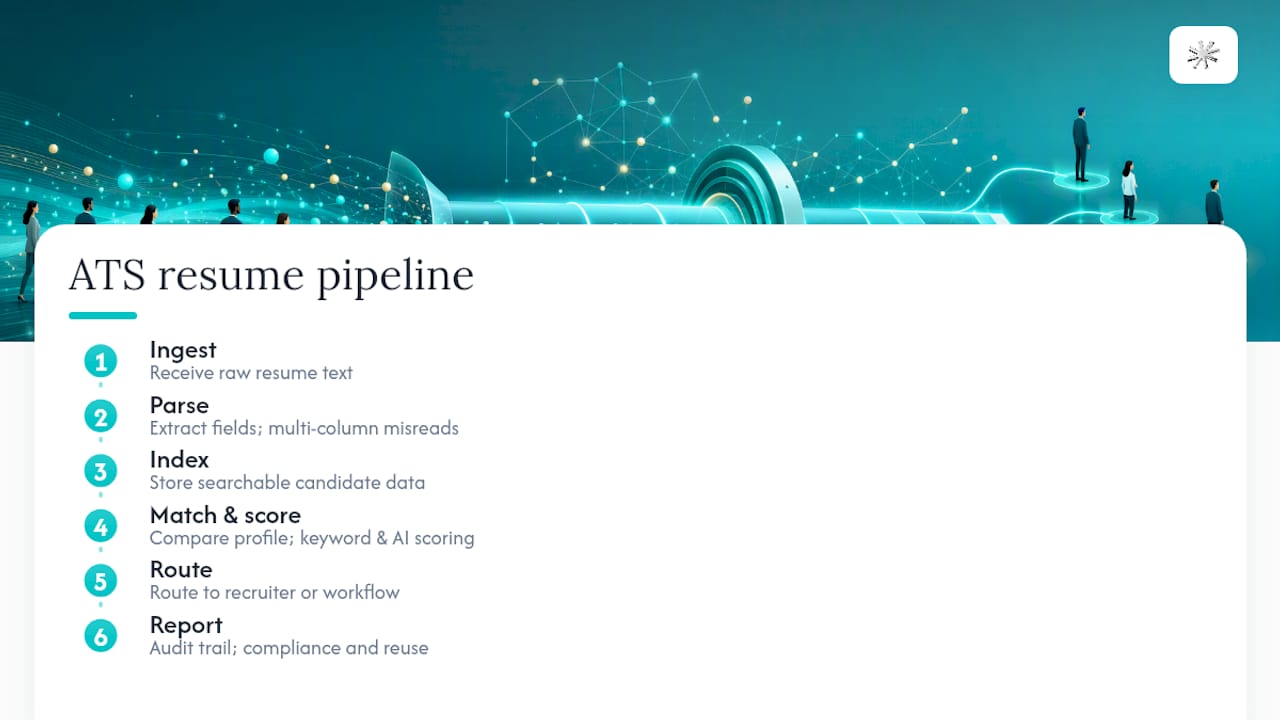
Step two: indexing. Once parsed, your data gets stored in a searchable index, similar in concept to how a search engine indexes web pages. This lets a recruiter type "project manager" plus "Salesforce" and instantly retrieve every candidate whose parsed resume contains both terms, rather than manually reading a thousand PDFs.
Step three: matching and ranking. This is where the real filtering happens. The system compares your parsed profile against the job requirements using keyword overlap, Boolean logic (some platforms let recruiters build searches like "Python AND (AWS OR Azure)"), and knockout questions that automatically screen out candidates who don't meet hard requirements like work authorization or minimum years of experience.
Fast fact: According to Workday's breakdown of ATS mechanics, the ranking engine compares your profile against the job posting using keywords, skills, and experience level, and increasingly, AI-driven scoring that looks beyond exact keyword matches.
Some modern platforms now layer in predictive scoring: instead of only checking if you have "five years of experience," they weigh signals correlated with past hiring success. Workday notes that AI-enabled ATS platforms increasingly aim to predict candidate success rather than simply match keywords, a shift that recruitment technology analysts see continuing as machine learning models mature.
Every step of this pipeline also feeds the compliance side of things. The audit trail logs each transition, applied, screened, interviewed, rejected, or hired, which matters for equal opportunity reporting and for defending hiring decisions if they're ever challenged. That trail is a feature built for the employer, but it's worth knowing it exists: your application history inside a company's ATS doesn't disappear after a rejection. It often gets referenced again if you apply to a different role at the same company later.
ATS Benefits and Limits: What the Software Actually Delivers
An ATS earns its keep by automating the parts of hiring that don't require human judgment. But it also has real blind spots, and pretending otherwise does nobody favors.
What it delivers for employers:
- Faster time-to-hire by automating job posting, scheduling, and candidate notifications
- Consistent evaluation criteria across every applicant, reducing the risk of one recruiter judging resumes by gut feeling while another uses a checklist
- Pipeline analytics that show where candidates drop off, whether that's after the initial screen or post-interview
- Centralized candidate data that makes it possible to search past applicants when a similar role opens later
Where it falls short:
- Parsing errors can misread legitimate qualifications, especially from resumes with unconventional formatting
- Heavy reliance on exact keyword matches can produce false negatives, screening out qualified candidates who described their experience differently than the job posting did
- Configuration varies wildly between companies. A technical guide to ATS architecture points out that the same resume can be surfaced by one company's system and filtered out by another, because administrators tune knockout questions, keyword weighting, and required fields differently
- Over-automation can strip away the nuance a human recruiter would catch, like a career changer whose transferable skills don't map cleanly to standard job titles
Pro Tip: Don't assume a rejection means you're unqualified. It often means your resume's formatting or wording didn't match how that specific company's ATS was configured to search. A different phrasing, or a cleaner file, can produce a completely different outcome for the same qualifications.
What ATS Means for Job Seekers: A Resume Checklist That Works
If an ATS reads your resume before a person does, the goal is simple: make the parsing step as easy as possible. Here's what actually works, based on how these systems process documents.
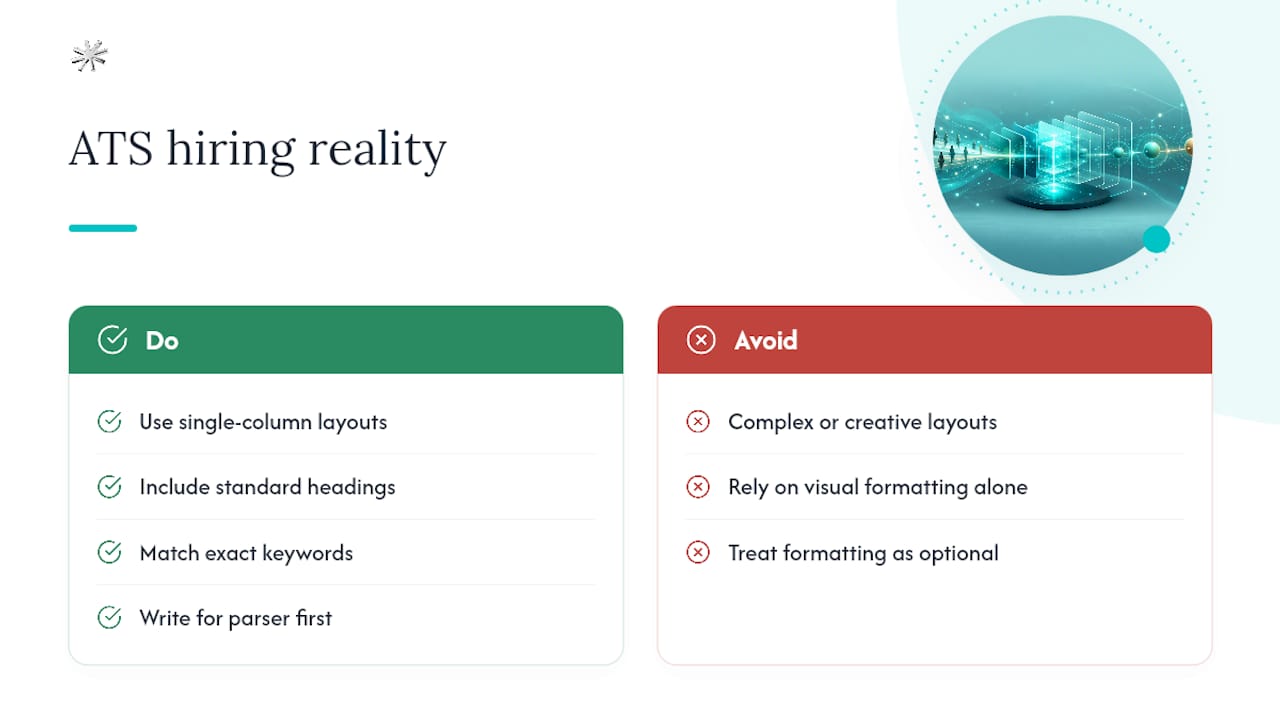
- Use a single-column layout with standard section headings. "Work Experience," "Education," and "Skills" parse correctly; creative labels like "My Journey" or "What I Bring" often don't map to any recognized field.
- Avoid graphics, tables, text boxes, and unusual fonts. Parsers read left to right, top to bottom, in plain text. A common cause of parsing failure is multi-column layouts, embedded images, and decorative fonts that the software simply can't decode into structured data, so a single-column resume in a standard font remains the safest fix.
- Mirror the exact language from the job description. If the posting says "project management," don't write "managed projects" and assume the system will connect the dots. Some platforms do fuzzy matching, but many still rely on exact or near-exact phrase matches.
- Export as a DOCX or a simple, text-based PDF, never a scanned image or a design-heavy PDF built in a graphics program.
- Validate before you submit. Run your resume through an ATS checker to catch parsing issues before a recruiter ever sees the result. Nuecareer's Free ATS Resume Checker flags formatting problems and shows keyword coverage against a specific job description, and pairing it with a job description analyzer helps you catch which exact phrases to mirror.
- Apply through the company's own career site when possible, and keep a simple tracker of where and when you applied, since the same resume may need slight tailoring for each posting.
| Checklist Item | Why It Matters |
|---|---|
| Single-column format | Prevents the parser from merging or dropping fields |
| Exact keyword matches | Aligns with how most ranking engines search for skills |
| Standard file type | DOCX and simple PDFs parse more reliably than image-based files |
| Pre-submission check | Catches formatting errors before a recruiter sees a broken resume |
This isn't about gaming a system. It's about removing avoidable friction so your actual qualifications get read.
How Recruiters Use ATS in the Hiring Workflow
For recruiters, the ATS isn't a single tool, it's the backbone connecting every stage of hiring. A typical flow looks like this:
- Sourcing and distribution: One job posting pushes out to multiple boards simultaneously, and every application funnels back into a single dashboard.
- Filtering and scoring: Knockout questions and keyword matching narrow hundreds of applicants down to a manageable shortlist, often within hours instead of days.
- Scheduling and structured feedback: Interviews get booked automatically based on calendar availability, and interviewer scorecards feed back into the candidate's record for comparison.
- Pool management and re-engagement: Strong candidates who didn't get the current role stay searchable for future openings, which is part of why the centralized database is considered the backbone of modern recruitment.
Each stage reduces manual work while creating a paper trail that supports fair, consistent decision-making across every requisition.
How Nuecareer Helps You Apply Successfully to ATS-Driven Jobs
Knowing how an ATS works is only useful if you can act on it. That's the gap Nuecareer's tools are built to close.
- The Free ATS Resume Checker scans your resume for formatting problems, checks keyword coverage against a job description, and flags parser-readability issues before you submit.
- The 7-Minute Career Quiz matches you to career paths built around your actual strengths, which matters because a resume aimed at the right role naturally carries stronger keyword and skills alignment than one written for a mismatched target.
- The job description analyzer pulls the exact phrases a posting uses, so you know what language to mirror.
- Resume and cover letter tools help you translate your background into the standard, parser-friendly format the checklist above describes.
A resume that's technically accurate but poorly matched to the role you actually want rarely performs well, no matter how clean the formatting is. Fixing the target and fixing the format have to happen together.
How Common Is ATS Use Across the Hiring Market?
If you've applied to more than a handful of jobs recently, you've almost certainly gone through an ATS, whether the company mentioned it or not. Adoption isn't limited to giant corporations anymore. Small businesses and startups increasingly run entry-level and mid-size hiring through the same class of software once reserved for large HR departments, largely because cloud-based pricing brought the cost down.
This widespread adoption is exactly why resume formatting advice has converged so tightly across career sites and coaching services. When nearly every mid-size or large employer filters applications through similar parsing logic, the practical guidance, single-column layouts, standard headings, exact keyword matches, stops being a suggestion and becomes close to a requirement for getting past the first automated pass.
The Wikipedia entry on applicant tracking systems traces this evolution and notes that as ATS use spread, so did the parallel practice of applicants optimizing resumes specifically to pass parsing and filtering, a dynamic that resembles search engine optimization more than traditional resume writing. That's not a loophole. It's simply what happens when a software layer sits between every applicant and every recruiter.
For job seekers, the takeaway is straightforward: you're not writing a resume for a person's first impression anymore. You're writing it for a parser's first pass, then a person's second look.
Try These Free Tools Before Your Next Application
Most rejections that feel unfair aren't about your qualifications. They're about a resume that never made it past the parsing step in the first place.
Nuecareer's Free ATS Resume Checker shows you exactly how a parser reads your resume, formatting issues, keyword gaps, and structural problems, all before you submit anything. And if you're not even sure the roles you're applying to are the right fit in the first place, the 7-Minute Career Quiz matches your strengths to career paths you may not have considered, then builds a personalized roadmap for pursuing them. Pairing the two means you're not just passing the software filter, you're applying to roles built around what you're actually good at. Take the quiz first to find your direction, then run your resume through the checker before you send it out.
A Coaching Note on the Most Common ATS Mistake
The biggest mistake candidates make isn't bad writing, it's assuming a rejection means they're unqualified when it often means the parser never read their resume correctly. Fix the format first, then worry about the wording.
— Shane
Key Takeaways
An ATS parses, indexes, and ranks every resume it receives, which means formatting and keyword alignment often matter more than raw qualifications in getting past the first screen.
| Point | Details |
|---|---|
| ATS defined simply | Software that collects, parses, stores, and ranks applications so recruiters can hire at scale. |
| Formatting drives parsing success | Single-column layouts and standard headings avoid the errors that break most parsers. |
| Keywords must mirror the job posting | Matching engines often rely on exact or near-exact phrase matches, not synonyms. |
| Recruiters gain speed and consistency | Automated workflows and audit trails reduce manual work and standardize evaluation. |
| Nuecareer offers direct next steps | The Free ATS Resume Checker and 7-Minute Career Quiz help you match format and fit before applying. |
Sources
- What is an Applicant Tracking System? | Workday US
- What is an applicant tracking system (ATS)? | Greenhouse
- Applicant tracking system - Wikipedia
FAQ
What Is ATS in Simple Terms?
An ATS, or applicant tracking system, is software that collects, parses, stores, and ranks job applications so recruiters can manage hiring across many candidates at once.
What Does ATS Stand For?
ATS stands for applicant tracking system, referring to the software companies use to manage the recruiting and hiring pipeline.
How Does ATS Rank Candidates?
Most systems compare your parsed resume against the job posting using keyword overlap, required qualifications, and knockout questions, with some platforms adding AI-based scoring for predicted job success.
Can a Good Candidate Get Filtered Out by ATS?
Yes. Parsing errors, unusual formatting, and strict keyword matching can screen out qualified candidates whose resumes weren't structured for how the software reads documents.
How Can I Check if My Resume Passes ATS Screening?
Run it through a dedicated tool like Nuecareer's Free ATS Resume Checker, which flags formatting issues and keyword gaps before you submit an application.