

TL;DR:
- An encore career is a purposeful, part-time second profession after age 50 that offers health and financial benefits. It emphasizes social impact, personal meaning, and transferable skills, lasting typically five to fifteen years. Planning with self-assessment, community mapping, and gradual testing helps ensure a successful transition.
An encore career is defined as a purposeful second professional act pursued after age 50, combining income, personal meaning, and social impact. Unlike a casual retirement job, this is a deliberate choice to keep contributing at a high level while gaining flexibility and fulfillment. Most encore careers run 20–30 hours weekly, generating annual income in the range of $19,200–$40,000 for entry to mid-level roles, and well above $50,000 for high-skill positions. If you have decades of experience and want your next chapter to matter, the encore career model was built for you.

What is an encore career, and what makes it different?
An encore career is not retirement and not a full-time grind. It sits in the middle: purposeful, paid, and personally meaningful work that typically begins after age 50. The term gained traction in the early 2000s as researchers and career experts recognized that millions of experienced adults wanted more than leisure after their primary careers ended.
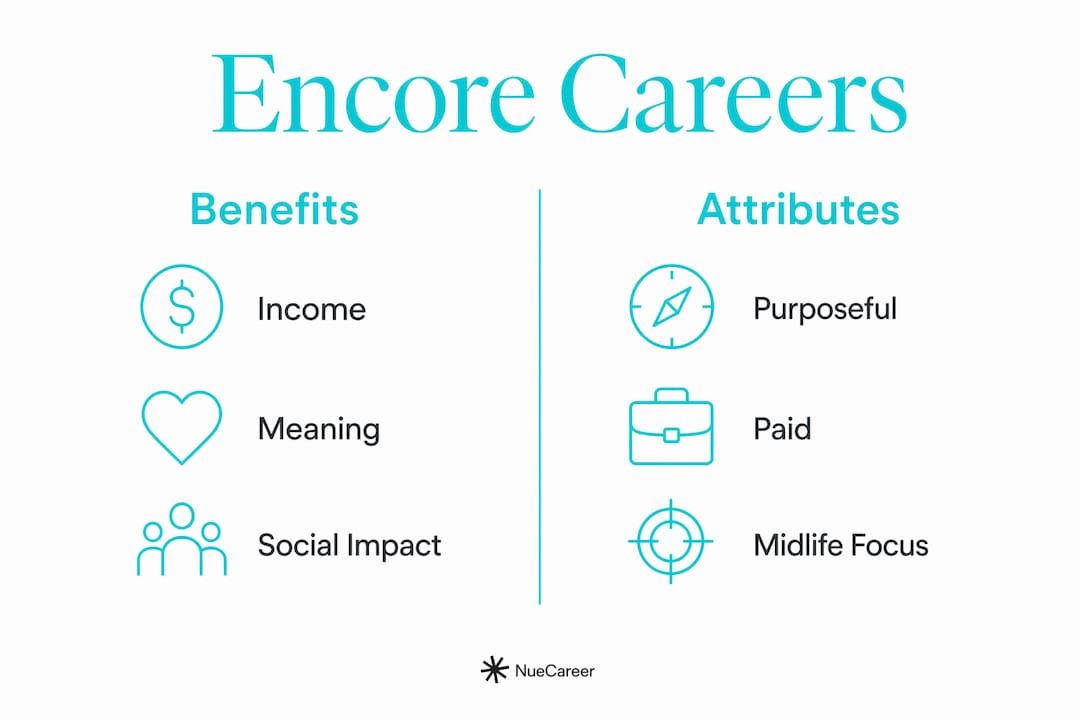
Three elements define the encore career model. First, income: you earn real money, not just a token stipend. Second, meaning: the work connects to your values and uses skills you have spent decades building. Third, social impact: the role contributes to something larger than a corporate bottom line, whether that is education, healthcare, nonprofit leadership, or community development.
The standard industry term for this phase is "encore career," though you will also hear it called a "third act career" or "post-primary career." All three phrases describe the same concept. What they share is the idea that your best professional contribution may not be behind you.
What benefits do encore careers offer to adults over 50?
The benefits of encore careers go far beyond a paycheck. Research shows that purposeful work after retirement reduces mortality risk, cognitive decline, and depression while improving sleep among adults over 50. That is not a minor finding. It means the decision to pursue meaningful work is also a health decision.
Here is what the research points to most clearly:
- Reduced mortality risk: Adults who maintain purposeful engagement after 50 live longer on average than those who disengage entirely from professional life.
- Cognitive protection: Regular mental stimulation from work tasks slows cognitive decline and keeps problem-solving skills sharp.
- Lower rates of depression: Social connection through work provides structure and belonging, two of the strongest buffers against depression in older adults.
- Better sleep: Adults in purposeful roles report more consistent sleep patterns compared to those in full retirement.
- Preserved professional identity: Encore careers let you stay "someone who does something," which matters more than most people expect.
The financial benefits are equally real. Supplemental income from an encore career reduces drawdown on retirement savings and enables phased retirement rather than a hard stop. That flexibility protects your nest egg and gives you more control over when and how you fully step back. Careful planning around Social Security timing, Medicare eligibility, and tax implications is part of the process, but the financial upside is significant.
Experts also frame encore careers as a key innovation for aging populations, offering routine, social contact, and cognitive stimulation that full retirement simply cannot replicate. The social dimension alone, the colleagues, clients, and communities you engage with, provides a level of connection that keeps people mentally and emotionally well.
How is an encore career different from bridge employment?
This is where many people get confused, and the distinction matters. Bridge employment refers to transitional work taken between a primary career and full retirement. It is typically shorter, less planned, and focused primarily on income continuity. An encore career is something else entirely.
| Factor | Encore career | Bridge employment | Casual part-time work |
|---|---|---|---|
| Duration | 5–15 years | 1–3 years | Open-ended, indefinite |
| Planning required | 6–18 months | Minimal | None |
| Primary motivation | Purpose and impact | Income continuity | Supplemental income |
| Hours per week | 20–30 | Variable | Under 20 |
| Skills usage | Deep, transferable | Partial | Minimal |
| Social impact focus | High | Low | Low |
Bridge jobs are typically shorter and less planned, while encore careers involve deliberate transition and a clear focus on social impact. That planning gap is the biggest practical difference. An encore career requires you to think carefully about what you want, what you offer, and where those two things intersect with real community needs.
Pro Tip: If you are not sure whether you want a bridge job or an encore career, ask yourself this: "Would I still do this work if I did not need the money?" If the answer is yes, you are describing an encore career.
Casual part-time retirement work, think seasonal retail or occasional consulting, fills time and adds income. It does not build on your strengths or connect to a larger purpose. The encore career model demands more preparation but delivers far greater returns in meaning, health, and financial stability.
What are the common misconceptions about encore careers?
The biggest misconception is that you have to start over from scratch. You do not. An encore career focuses on alignment with personal strengths and values, not total reinvention. Your leadership experience, problem-solving ability, and institutional knowledge are assets, not liabilities.
Here are the most common myths, and what is actually true:
- Myth: You must reinvent yourself completely. Reality: Transferable skills like mentorship, strategic thinking, and project management are exactly what mission-driven organizations need most.
- Myth: Employers will see you as overqualified. Reality: This is a real risk, but it is manageable. Emphasizing impact over seniority in your resume and interviews prevents you from being seen as a threat and opens more doors.
- Myth: Encore careers are full-time commitments. Reality: Most encore careers run 20–30 hours per week, which is a deliberate design choice, not a compromise.
- Myth: You will lose your professional identity. Reality: The identity shift is real, but reframing your identity around mentorship and strategic oversight rather than technical execution is a growth move, not a loss.
The identity gap deserves its own attention. Moving from a high-status primary career to a mission-driven role can feel disorienting. You may go from managing a team of 50 to volunteering alongside people half your age. That shift requires emotional preparation, not just a resume update. Reframing your value around wisdom, perspective, and impact rather than title and authority is the core psychological work of the encore transition.
Pro Tip: When updating your resume for encore career roles, lead with the outcomes you created, not the titles you held. "Reduced staff turnover by 30% through mentorship programs" lands better than "Senior Vice President of Operations."
If you are exploring career exploration for your future, understanding your transferable skills is the first and most important step.
How do you plan and prepare for an encore career transition?
Planning for an encore career typically takes 6–18 months, and most people underestimate how much of that time is internal work rather than job searching. The psychological identity gap is often more challenging than the job search itself. Here is a practical sequence that works.
Start with self-assessment. Identify your core values, the skills you genuinely enjoy using, and the patterns that have defined your best work. Tools like the Nuecareer skills assessment can surface strengths you may have stopped noticing because they came so naturally.
Map your strengths to community needs. Look at sectors like education, healthcare, nonprofit management, environmental work, and public policy. These fields actively recruit experienced professionals who bring leadership and perspective.
Start small before committing. Volunteer, consult on a project, or take a board seat in your target sector. This gives you real experience, builds new networks, and tests your assumptions before you make a full transition.
Consider additional training if needed. Adult education programs, including options like going back to school as an adult, can fill specific skill gaps without requiring a full degree program.
Run the financial numbers. Understand how encore income affects your Social Security timing, Medicare premiums, and tax bracket. A financial advisor familiar with phased retirement planning is worth the consultation fee.
Build your transition roadmap. A career roadmap gives you a structured timeline with milestones, so you are not just hoping things fall into place.
Get coaching support. Career coaching for adults provides accountability, perspective, and practical guidance during the transition. It is especially valuable during the identity shift phase.
The encore career is not something you stumble into. It is something you design. The adults who succeed at it treat the planning phase with the same seriousness they brought to their primary careers.
Key Takeaways
An encore career is the most purposeful and health-protective form of post-50 work, combining income, meaning, and social impact in a part-time structure that most adults can sustain for 5–15 years.
| Point | Details |
|---|---|
| Clear definition | An encore career blends income, meaning, and social impact, typically 20–30 hours per week after age 50. |
| Proven health benefits | Purposeful work after 50 reduces mortality risk, cognitive decline, and depression. |
| Different from bridge jobs | Encore careers last 5–15 years and require 6–18 months of deliberate planning, unlike bridge employment. |
| No reinvention required | Transferable skills like leadership and mentorship are the core assets, not liabilities, in an encore career. |
| Financial upside | Supplemental encore income reduces retirement savings drawdown and enables phased retirement on your terms. |
Why encore careers deserve more credit than they get
I have spent years watching people treat the post-50 career question as a problem to solve rather than an opportunity to design. The conventional wisdom says: wind down, simplify, step back. That advice works for some people. For many others, it quietly erodes the sense of purpose that kept them sharp and engaged for decades.
What strikes me most about encore careers is that they are not about proving something. They are about continuing to contribute in a way that fits who you are now, not who you were at 35. The adults I have seen thrive in this phase are not the ones who worked the hardest. They are the ones who got honest about what they actually valued and then found a field where that value was needed.
The identity shift is real, and I would not minimize it. Going from a title that opened doors to a role where you are building credibility again takes humility. But the adults who reframe that shift as growth rather than loss tend to find the encore phase more satisfying than their primary careers. They work with more autonomy, less politics, and a clearer sense of why the work matters.
My honest advice: do not wait until you are burned out or pushed out to start thinking about this. The best encore careers are designed from a position of strength, not desperation. Start the self-assessment now. Give yourself the 6–18 months the process deserves. And resist the pressure to rush into the first thing that looks reasonable.
— Shane
Nuecareer can help you find your next chapter
If you are over 50 and wondering what your strengths actually point toward, you are not alone. Most people have spent so long doing what they are good at that they have lost sight of what they genuinely want to do next.

The free career skills assessment from Nuecareer takes about 7 minutes and surfaces the strengths and gaps that matter most for your encore career transition. From there, Nuecareer matches you to career paths built around who you are, including paths you may never have considered. You also get personalized roadmaps, 24/7 coaching chat, and a full suite of resume tools so you can move from clarity to confidence without losing momentum. Your next chapter is worth planning well.
FAQ
What does encore career mean?
An encore career is a purposeful second career pursued after age 50, combining income, personal meaning, and social impact. It differs from casual retirement work by its deliberate planning, longer duration, and focus on contributing to something larger than income alone.
How long does an encore career typically last?
Encore careers typically last 5–15 years, far longer than bridge employment or casual part-time retirement jobs. That duration reflects the depth of planning and personal alignment that goes into building one.
What are common encore career ideas for retirees?
Common encore career paths include nonprofit leadership, education and tutoring, healthcare advocacy, environmental consulting, and public policy roles. These fields actively recruit experienced professionals who bring leadership, mentorship, and strategic perspective.
How do I start transitioning to an encore career?
Start with a self-assessment of your values, skills, and the work patterns that energized you most. Then map those strengths to sectors with real community needs, and give yourself 6–18 months to plan, test, and build your transition before committing fully.
Will an encore career affect my Social Security or Medicare benefits?
Encore income can affect Social Security timing, Medicare premiums, and your tax bracket, so financial planning is a required part of the transition. Consulting a financial advisor familiar with phased retirement before you start is the most effective way to protect your benefits.