
What Does Career Exploration Mean for Your Future?

Discover what career exploration means for your future! Learn how this ongoing process can align your skills and interests for success.
TL;DR:
- Career exploration is a cyclical, structured process of self-assessment, research, and goal setting to find career options aligned with personal skills and values. It is essential for adults to revisit regularly, especially amid evolving industries driven by AI and technological change, to maintain career relevance and confidence. Effective activities include assessments, informational interviews, shadowing professionals, and journaling, which build informed decision-making and adaptable career paths.
Career exploration is defined as the active, ongoing process of discovering, researching, and reflecting on career options that align with your interests, skills, values, and personality. Unlike a one-time decision, it is a cyclical process that evolves as you gain new experiences and information. Frameworks from organizations like Orchard Careers and iCEV treat it as a structured discipline, not a casual exercise. Tools like career assessments, job shadow programs, and career fairs are all formal components of this process. Whether you are a student or a working adult feeling stuck, understanding what career exploration means is the first step toward building a career that genuinely fits who you are.
What does career exploration mean as a structured process?
Career exploration is not a single event. It is a repeatable framework built around four interconnected stages, each one feeding into the next.
Self-assessment. The process starts by identifying your interests, strengths, values, and personality traits. Career assessments and quizzes provide personalized insights that make this stage more precise than guesswork. Tools like the NueCareer skills quiz or formal instruments like the Strong Interest Inventory help you name what you bring to the table.
Career research. Once you know yourself better, you research specific roles, industries, and day-to-day realities. This means reading job descriptions, watching day-in-the-life content, and talking to people already working in fields that interest you. The goal is to test your assumptions against reality before committing time or money.
Education and training mapping. After identifying target roles, you map the credentials, certifications, or experience required to reach them. This stage prevents the common mistake of pursuing expensive degrees for roles that value portfolio work or licensure instead.
Goal setting and reflection. Effective career exploration connects research to a concrete plan. You set realistic short-term goals, act on them, then reflect and adjust. This is where exploration becomes direction.
Pro Tip: Experts recommend revisiting your career exploration process every 6 to 24 months. Job markets shift, your skills grow, and what felt like the right fit at 28 may not resonate at 35.
The cyclical nature of this process is what separates career exploration from a one-time career quiz. You are not looking for a final answer. You are building a habit of self-awareness and informed decision-making that serves you across decades.

How does career exploration differ from work-based learning?
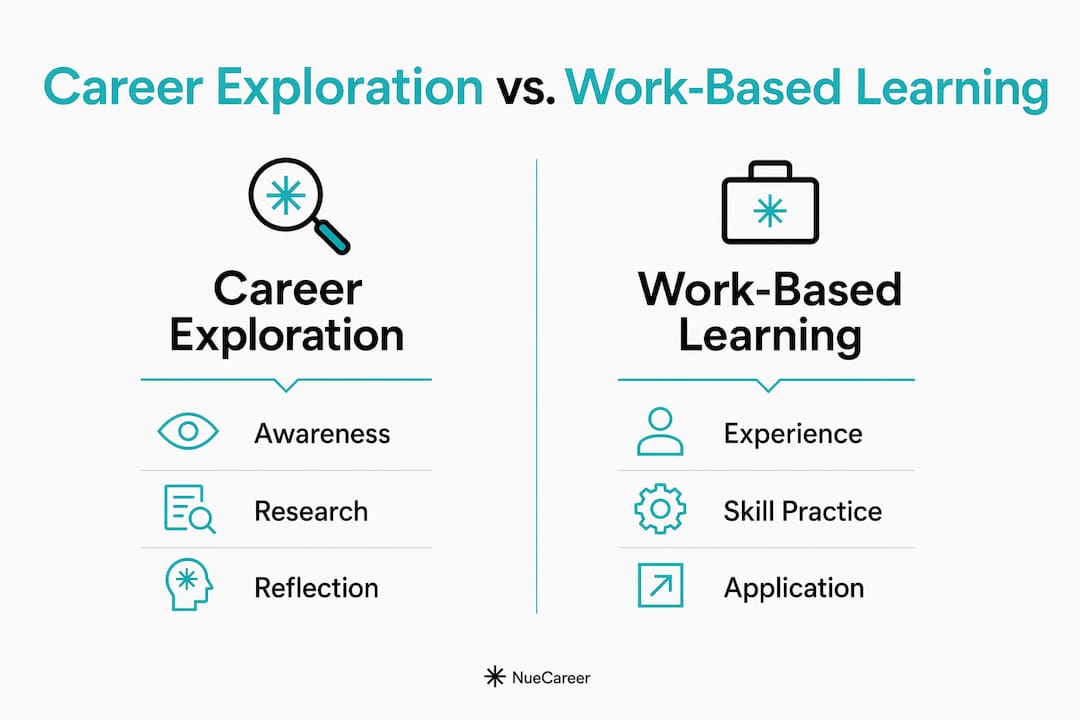
These two terms are frequently used interchangeably, but they describe distinct phases of career readiness. Understanding the difference helps you know exactly where you are in your development and what comes next.
| Concept | Definition | Examples |
|---|---|---|
| Career exploration | Building awareness of career options through observation and research | Job shadows, career fairs, industry tours, informational interviews |
| Work-based learning | Gaining direct workplace experience through structured participation | Internships, apprenticeships, project-based employer partnerships |
| Career-connected learning | A combined approach that integrates both exploration and work-based experience | School programs that blend classroom learning with employer engagement |
Career-connected learning combines both approaches to prepare individuals more thoroughly for workplace success. Career exploration mostly occurs earlier in the process, building awareness before you commit to hands-on experience. Work-based learning then deepens that awareness through direct participation.
The practical implication is this: if you have never shadowed a professional in a field you are considering, you are not ready to commit to an internship or training program in that field. Exploration comes first. It reduces the risk of investing time and money in a direction that does not fit. For working adults considering a career switch without starting over, this distinction matters even more because the stakes are higher.
Why career exploration matters more than ever in 2026
The labor market is not the same place it was five years ago. AI technologies are reshaping entire industries, making it necessary for career exploration to include evaluating how roles evolve to ensure sustainable career paths. A job title that exists today may look completely different by 2028, or may not exist at all.
"Modern career exploration is not just about existing jobs. It is about adaptability to AI-driven changes and building a career that remains relevant as the tools and demands of work continue to shift."
This means the importance of career exploration has expanded beyond initial job selection. It now includes continuous re-evaluation of your skills against market demand. A graphic designer who explored careers in 2019 may need to revisit that exploration today to understand how generative AI tools have changed what clients expect and what skills command premium pay.
Career exploration builds confidence in decision-making by helping individuals identify interests and abilities and align their paths accordingly. That confidence is not a soft benefit. It translates directly into better applications, stronger interviews, and more purposeful networking. When you know why you are pursuing a role, it shows.
Pro Tip: When researching any career path in 2026, search for "[job title] + AI impact" alongside standard job descriptions. This gives you a realistic picture of how the role is evolving, not just what it looks like today.
For those exploring second careers with fast licensing paths, understanding AI's impact on target industries is now a non-negotiable part of the research stage. Choosing a field with strong human-skill requirements, like healthcare, skilled trades, or education, offers more insulation from automation than roles centered on repetitive information processing.
What career exploration activities can you start today?
Knowing the definition of career exploration is useful. Having a concrete list of activities you can act on this week is better. Here are the most effective approaches, ordered from lowest to highest time commitment.
Take a career assessment or quiz. Tools like Nuecareer's free skills assessment identify your strengths and match you to career paths you may not have considered. This takes under 10 minutes and gives you a starting point grounded in data rather than assumption.
Attend a career fair or virtual industry event. Career fairs expose you to multiple industries and roles in a single session. They also give you low-stakes practice articulating your background to professionals. Many are now virtual, removing the geographic barrier entirely.
Conduct informational interviews. Reach out to two or three people working in roles that interest you and ask for a 20-minute conversation. Ask about their daily work, what skills matter most, and what they wish they had known earlier. This is one of the most underused and highest-value career exploration activities available to adults.
Shadow a professional for a day. Job shadowing gives you direct observation of a role before committing to training or a job application. Many professionals are willing to accommodate a shadow request when approached respectfully and with a clear purpose.
Journal on your values and energy patterns. Write down which past work experiences gave you energy and which drained you. Patterns emerge quickly. This reflection, combined with a structured tool like Nuecareer's career identity framework, helps you connect self-knowledge to specific career directions.
Set and revise career goals on a schedule. Write down your top three career directions today, then revisit them in 90 days with new information. Embedding this habit into your routine, rather than treating exploration as a one-time event, is what separates people who find direction from those who stay stuck.
The most important thing is to start. Curiosity and reflection are as important as certainty in career planning. You do not need a clear destination to begin exploring.
Key takeaways
Career exploration is a structured, cyclical process of self-assessment, research, and goal setting that must be revisited regularly to stay aligned with both personal growth and labor market changes.
| Point | Details |
|---|---|
| Core definition | Career exploration is an active, ongoing process of matching interests, skills, and values to career options. |
| Four-stage process | Self-assessment, career research, education mapping, and goal setting form the repeatable framework. |
| Exploration vs. work-based learning | Exploration builds awareness first; work-based learning deepens it through direct participation. |
| AI and 2026 relevance | Roles are evolving rapidly, making regular career re-evaluation a practical necessity, not optional. |
| Best starting activity | A structured career assessment gives you data-driven direction in under 10 minutes. |
Career exploration is a habit, not a phase
I have worked with a lot of people who treat career exploration as something you do once, usually when you are lost or desperate. That framing makes it feel like a problem to solve rather than a practice to maintain. The adults I have seen build genuinely satisfying careers are the ones who stay curious about their own development long after they land a role they like.
What surprises most people is how much their interests and values shift over a decade of working. The skills that energized you at 25 may feel hollow at 40. That is not failure. That is growth. The mistake is ignoring those signals because re-exploring feels like admitting something went wrong.
The other thing I would push back on is the idea that exploration is only for people who are lost. Some of the most purposeful career moves I have seen came from people who were doing fine but decided to evaluate their career path fit proactively, before dissatisfaction set in. They used that clarity to negotiate better roles, pivot into adjacent fields, or build skills that made them genuinely hard to replace.
Treat career exploration the way you treat physical health. You do not wait until you are sick to pay attention. You build habits that keep you aware, informed, and ready to move when the right opportunity appears.
— Shane
Start your career exploration with Nuecareer's free tools
Nuecareer is built for working adults who feel stuck or unsure about their next move. The platform's free career skills assessment takes about seven minutes and identifies your core strengths, then matches you to career paths built around who you actually are, including options you may never have considered. From there, Nuecareer gives you personalized roadmaps, a 24/7 coaching chat, and a full suite of resume and cover letter tools to help you apply with confidence. If you are ready to move from uncertainty to direction, the full toolkit is free to explore and built specifically for where you are right now.
FAQ
What does career exploration mean for adults?
Career exploration for adults is the process of actively researching and reflecting on career options that align with your current skills, values, and goals. Unlike students, adults bring existing experience to the process, which makes self-assessment tools and informational interviews especially effective starting points.
How often should you revisit career exploration?
Experts recommend revisiting career exploration every 6 to 24 months. Job markets shift and personal priorities evolve, so regular re-evaluation keeps your career direction aligned with both external opportunities and internal growth.
What is the difference between career exploration and career planning?
Career exploration is the research and discovery phase where you identify options and build self-awareness. Career planning is the structured process of setting goals and mapping steps toward a specific chosen path. Exploration always comes before planning.
What are the best career exploration activities for working adults?
The most effective activities include taking a structured career assessment, conducting informational interviews with professionals in target roles, and journaling on past work experiences to identify patterns. Tools like career assessment platforms make this process faster and more precise than unstructured reflection alone.
Does career exploration only apply to students?
Career exploration applies to anyone evaluating their professional direction, regardless of age or experience level. Career exploration activities like job shadows and career fairs are commonly associated with school settings, but the underlying process of self-assessment and career research is equally relevant for adults considering a transition or seeking greater alignment in their work.