

TL;DR:
- A second act career is a purposeful pivot into work aligned with personal values, often after ten or more years in a primary career. It focuses on reusing existing skills and networks rather than starting over, emphasizing flexibility and meaning. Nuecareer's tools help adults identify their strengths and navigate this transition with clarity and confidence.
A second act career is a deliberate, purposeful pivot into new work that prioritizes alignment with personal values, meaningful work, and flexibility over traditional income or hierarchy goals. It typically occurs after 10 or more years in a primary career, often after age 30 or 50, and takes forms like freelancing, consulting, part-time work, or mission-driven entrepreneurship. This is not a crisis move. It is a calculated evolution. Adults who pursue second act careers are not starting over. They are redirecting decades of experience toward work that actually fits who they are now. Nuecareer helps you do exactly that, with tools built for the adult career changer who is ready to move with clarity.
What is a second act career, and how does it differ from a regular job change?

A second act career is defined by purpose, not just a paycheck. That distinction separates it from a standard job change, where you move between similar roles in the same field. A second act involves a genuine shift in direction, often toward work that feels more aligned with your values, your lifestyle, and the person you have become over time.
Traditional employment centers on climbing a defined ladder: title, salary, seniority. A second act career replaces that model with a different set of priorities. You might trade a corner office for a four-day week. You might leave a director role to consult independently. The structure changes because what you want from work has changed.
The hiring environment supports this shift more than ever. 85% of employers now hire based on demonstrated skills rather than academic degrees. That means your track record, your judgment, and your transferable competencies carry real weight, even in fields you have never formally worked in.
The most important reframe here is the concept of career capital repackaging. Successful second act transitions repurpose existing reputation, knowledge, and networks rather than resetting to entry-level status. You are not starting from zero. You are repositioning what you already have.
- Purpose over prestige: Second act careers prioritize meaning and alignment, not rank.
- Flexibility as a feature: Part-time, freelance, and consulting arrangements are common and intentional.
- Skills over credentials: The shift to skills-based hiring benefits adults with deep, demonstrated competencies.
- Repackaging, not resetting: Your experience is the foundation, not a liability.
Pro Tip: Before you label your situation a "career change," ask whether you are changing fields or just changing how you apply your existing strengths. The answer shapes your entire strategy.
How do you know if a second act career is right for you?
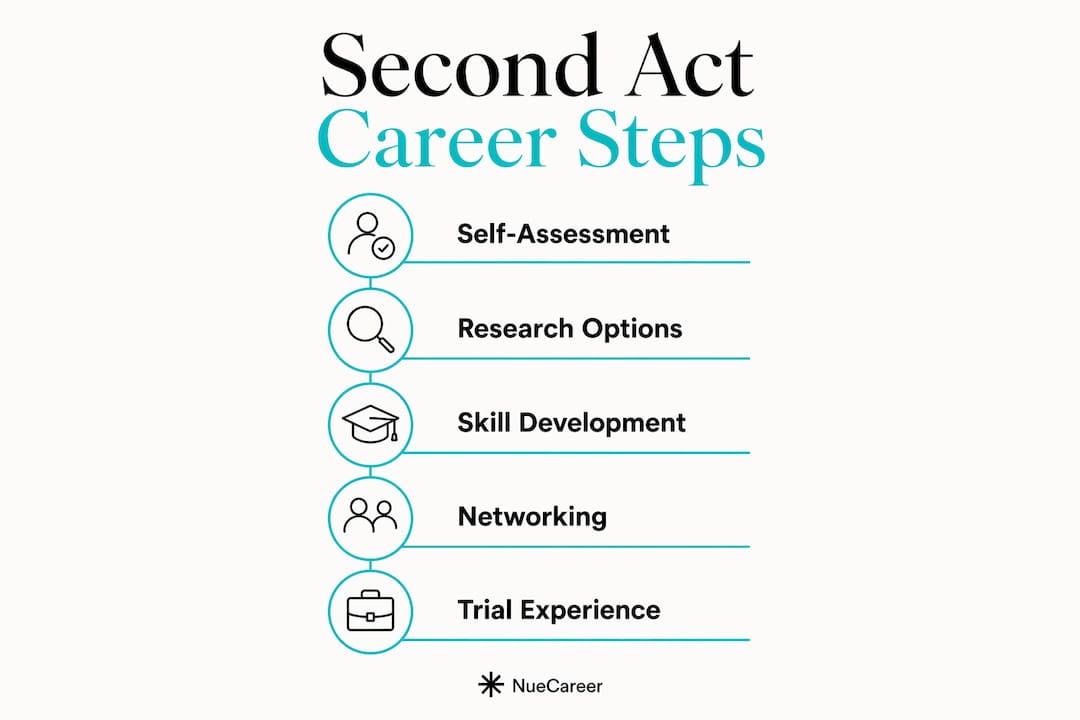
Self-assessment is the starting point for any successful career pivot. The goal is not to find a trendy new field. The goal is to identify where your existing strengths, your energy, and your values intersect with real market demand.
The process for evaluating a second act career begins with auditing your flow triggers and career capital. Flow triggers are the tasks and contexts where you lose track of time because the work feels natural and engaging. Career capital includes your skills, your reputation, and the professional relationships you have built. Both are assets you can redirect.
Work through these steps before making any major move:
- List what energizes you vs. what drains you. Be specific. "Strategy work" is too vague. "Designing training programs for new hires" is useful data.
- Audit your transferable skills. Use a structured tool like Nuecareer's free skills assessment to identify strengths you may be undervaluing.
- Consult your household. A second act often involves income changes, schedule shifts, or retraining costs. Your family's input is not optional.
- Research the financial reality. Map out how long you can sustain a trial period before your new path reaches a living wage.
- Test before you commit. Volunteering, consulting, or shadowing while still employed reduces risk and validates fit before you make a full leap.
The self-assessment process also benefits from outside perspective. A career coach or a structured platform like Nuecareer can surface blind spots that are hard to see from inside your own experience. Nuecareer's career path evaluation tools are built specifically for adults navigating this kind of pivot.
Pro Tip: Run a 90-day shadow experiment. Spend one to two hours per week in your target field through informational interviews, volunteer work, or a small freelance project. You will learn more in 90 days than in 90 hours of research.
What are the best second career options for adults in 2026?
The best second career options combine strong growth projections, transferable skill requirements, and realistic timelines to a living wage. Ten high-growth paths stand out for adults making this transition: data analytics, cybersecurity, project management, healthcare administration, digital marketing, instructional design, UX research, technical writing, nonprofit leadership, and executive coaching.
Your motive shapes which path fits best. The reason behind your second act matters as much as the field itself. Adults driven by financial necessity need faster paths to income. Adults driven by purpose may accept a longer runway. Adults seeking freedom prioritize flexibility over salary ceiling.
| Career option | Entry requirements | Timeline to living wage | Growth outlook |
|---|---|---|---|
| Data analytics | Certificate program, portfolio | 12–18 months | Faster than average |
| Cybersecurity | CompTIA Security+, bootcamp | 12–24 months | Much faster than average |
| Project management | PMP or CAPM certification | 6–12 months | Steady, broad demand |
| Healthcare administration | Bachelor's or certificate | 12–24 months | Strong, aging population |
| Digital marketing | Portfolio, Google certifications | 6–12 months | High demand, flexible roles |
| Instructional design | Portfolio, e-learning tools | 12–18 months | Growing with remote work |
| Executive coaching | ICF certification | 18–36 months | Strong for experienced adults |
Transferable skills are the deciding factor in how fast you move. A former operations manager entering project management is not starting over. A former teacher entering instructional design is repackaging what they already do. Bilingual professionals carry an additional edge in roles requiring cross-cultural communication, particularly in healthcare, education, and global business contexts.
- Match the field to your existing strengths first. Speed of entry depends on how much repackaging is required versus how much retraining.
- Prioritize roles with certificate-level entry. Many high-growth fields do not require a new degree.
- Factor in your timeline honestly. A 24-month runway to income requires a different financial plan than a 6-month one.
What are the biggest challenges in a second act career transition?
Health insurance is the most underestimated obstacle for adults making a career change before age 65. Leaving a corporate role often means losing employer-sponsored coverage. Common solutions include COBRA continuation coverage, individual market plans through the ACA marketplace, or taking a part-time role with a major employer that offers benefits. Research your options before you resign, not after.
Financial planning during a transition period requires a different mindset than standard budgeting. You are not just managing expenses. You are funding a career experiment with a defined runway. Set a clear timeline for when your new path needs to generate income, and build a monthly budget that accounts for retraining costs, reduced income, and unexpected delays.
Skill gaps are real but rarely as wide as they feel. Certificate programs in fields like cybersecurity, data analytics, and project management often run under 12 months and cost a fraction of a traditional degree. Bootcamps and community college programs offer structured, affordable paths to job-ready skills. The key is selecting programs with strong employer recognition, not just low price tags.
- Solve healthcare before you leave. Map your coverage options at least 60 days before your last day.
- Set a financial runway with a hard deadline. Knowing your limit creates urgency and focus.
- Choose certificate programs with employer credibility. CompTIA, Google Career Certificates, and PMI certifications carry real weight with hiring managers.
- Test new roles without quitting prematurely. Freelance work, consulting, or part-time arrangements let you validate the path while maintaining income.
Pro Tip: Treat your transition like a funded pilot project. Give it a defined budget, a timeline, and clear success metrics. That framing reduces anxiety and keeps you moving forward with intention.
Key Takeaways
A second act career succeeds when you repackage existing career capital into a new direction rather than attempting a complete reset.
| Point | Details |
|---|---|
| Definition matters | A second act career is a purposeful pivot toward values-aligned work, not just a job change. |
| Skills beat degrees | 85% of employers now hire based on demonstrated skills, lowering barriers for adult career changers. |
| Repackage, don't reset | Leverage your existing reputation, networks, and expertise as the foundation for your new path. |
| Test before committing | Shadowing, consulting, and short projects validate fit before you make a full transition. |
| Solve healthcare first | Research COBRA, ACA plans, or part-time benefits before leaving employer-sponsored coverage. |
Why your experience is the asset, not the obstacle
I have worked with a lot of adults who walk into a second act conversation convinced they are behind. They see younger professionals in the field they want to enter, and they assume age is a disadvantage. That assumption is wrong, and the data backs it up.
Age is an asset in a second act. Employers value judgment, reliability, and work ethic that come with decades of real experience. A 52-year-old entering executive coaching or healthcare administration brings something a 26-year-old cannot: a track record of navigating complexity under pressure. That is not a liability. That is a premium.
The adults I have seen struggle most are the ones who try to erase their past instead of redirecting it. They downplay their experience on applications. They accept entry-level framing when they deserve mid-level positioning. The smartest second act pivots are designed evolutions, not impulsive escapes. They position existing assets at a new intersection, not at the bottom of a new ladder.
My honest advice: be patient with the timeline, but be aggressive about testing. Do not spend six months researching a field you could shadow for six weeks. Get into the room. Talk to people doing the work. Run a small project. The clarity you get from direct experience is worth more than any amount of planning. And if you want a structured starting point, Nuecareer's career identity tools help you articulate who you are now, not just who you were.
— Shane
Nuecareer's tools for your second act career
Starting a second act career is clearer when you have the right tools behind you. Nuecareer's 7-minute career quiz identifies your strengths and matches you to career paths built around who you are today, including paths you may never have considered.
From there, Nuecareer gives you personalized roadmaps, a 24/7 coaching chat, job boards tailored to your target roles, and a full suite of resume and cover letter tools. You can also use the free career clusters quiz to explore options grouped by your skills and values. Every tool is built for working adults who are ready to move with intention, not guesswork. Your next chapter has a clearer path than you think.
FAQ
What is a second act career, exactly?
A second act career is a deliberate professional pivot taken after 10 or more years in a primary career, prioritizing purpose, flexibility, and values alignment over traditional advancement. It often takes the form of freelancing, consulting, part-time work, or mission-driven entrepreneurship.
Is a career change after 50 realistic?
A career change after 50 is realistic and increasingly common. With 85% of employers now using skills-based hiring, adults with deep experience and transferable competencies are well-positioned to enter high-growth fields within 12–24 months.
How do I start a second career without losing income?
Test your new direction while still employed through consulting, volunteering, or part-time work in your target field. This approach validates fit, builds relevant experience, and reduces financial risk before you make a full commitment.
What are the most accessible second career options?
Project management, digital marketing, and instructional design offer strong entry points for adults with transferable skills. Many roles require only a certificate program rather than a new degree, with timelines to employment ranging from 6–18 months.
How does Nuecareer help with a second act career transition?
Nuecareer's 7-minute quiz matches you to career paths based on your strengths and values. The platform also provides personalized roadmaps, coaching support, job boards, and application tools tailored to your target roles.