
What Does Career Confidence Mean for Professionals?

Discover what does career confidence mean and how to enhance it. Learn to overcome self-doubt and build skills for workplace success.
TL;DR:
- Career confidence is a learnable skill rooted in self-efficacy that influences career growth and decision-making.
- Building confidence involves daily practices like maintaining a success record, reframing doubt, and acting before feeling ready.
Career confidence is defined as the belief in your ability to perform professional tasks, make sound career decisions, and navigate workplace challenges effectively. Psychologists call this construct professional self-efficacy, a term rooted in Social Cognitive Career Theory (SCCT). Self-doubt affects 58% of workers and limits their career growth. That number matters because it shows that low professional confidence is not a personal failure. It is a widespread, addressable barrier. Career confidence is not a fixed personality trait you either have or lack. It is a learnable skill, and understanding that distinction changes everything about how you build it.
What does career confidence mean, and why does psychology back it?
Career confidence, in psychological terms, is your belief that you can succeed at specific professional tasks. Social Cognitive Career Theory identifies three pillars that drive career behavior: self-efficacy (your belief in your ability), outcome expectations (what you think will result from your actions), and personal goals (what you are working toward). All three interact. When self-efficacy is low, professionals set smaller goals and avoid opportunities that feel risky.

This is why career confidence shapes more than just how you feel at work. It shapes which jobs you apply for, which conversations you start, and whether you persist after a setback. A professional who believes she can learn a new skill will pursue a stretch role. One who doubts that belief will stay put, even when staying costs her more in the long run.
Career confidence also differs from general personality traits like extroversion or optimism. Personality traits are relatively stable across situations. Confidence is a skill that involves acting despite doubt, not the absence of doubt. That reframe is critical. You do not need to feel certain before you act. You need a stable enough relationship with yourself to act anyway.
Pro Tip: When you notice self-doubt before a big career move, treat it as a signal that the opportunity matters to you, not as evidence that you are unqualified.
How career confidence differs from self-esteem
Self-esteem is your overall sense of worth as a person. It is relatively stable and global. Career confidence is context-specific and fluctuates based on your experience with particular tasks and environments. Career confidence and self-esteem are related but not the same thing. Conflating them creates a real problem: when work goes badly, professionals who tie confidence to self-esteem end up feeling worthless, not just underprepared.
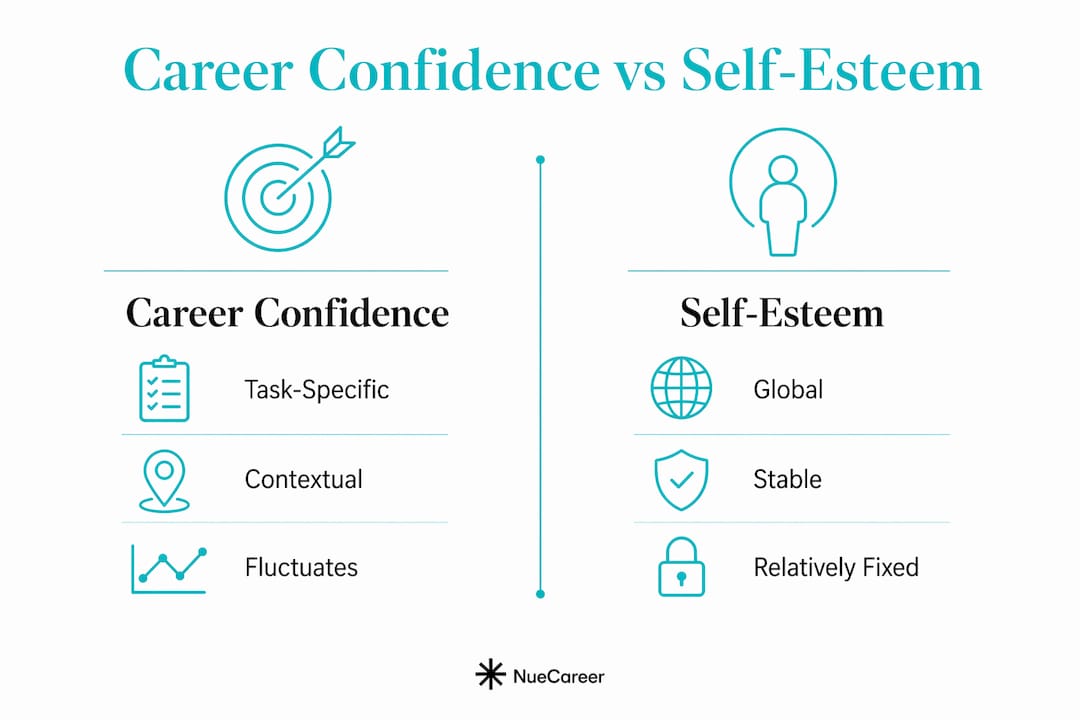
Think of it this way. A skilled nurse moving into hospital administration may feel highly confident in clinical settings and genuinely uncertain in budget meetings. Her self-esteem does not change. Her career confidence in a new context dips temporarily. That dip is normal and expected.
This distinction protects you. When you recognize that a confidence drop at work is situational, you stop interpreting it as a verdict on your value as a person. You start treating it as feedback about where to build new skills.
Pro Tip: Keep your sense of self-worth separate from your performance in any single role or task. One bad interview does not define your professional capability.
| Concept | Nature | Scope | Changes with context? |
|---|---|---|---|
| Self-esteem | Stable, global | Overall sense of worth | Rarely |
| Career confidence | Flexible, learned | Task and role specific | Yes, regularly |
How to build career confidence through daily practice
Career confidence is cultivable in weeks through consistent daily and weekly practices. The key is building evidence of your own capability, because confidence follows action, not the other way around.
Start a confidence file. A confidence file is a running document of your wins, positive feedback, and problems you have solved. Maintaining a confidence file acts as a factual circuit breaker when impostor syndrome tells you that you are not good enough. Review it before interviews, performance reviews, or any high-stakes conversation.
Run weekly behavioral reviews. Set aside 15–20 minutes each week to identify moments when you acted confidently and moments when doubt held you back. This practice builds self-awareness and reveals patterns. You start to see which situations drain your confidence and which ones build it.
Reframe doubt as a growth signal. Doubt tends to appear at the edge of your current capability. That is exactly where growth happens. When you feel uncertain about a new project or role, that feeling signals that you are stretching, not failing.
Use communication to project and build confidence. How you talk about yourself shapes how others perceive you and how you perceive yourself. Replace "I think I might be able to" with "I will." Replace "I just do X" with "I specialize in X." Language is not decoration. It is part of how confidence is built and recognized.
Take one small action before you feel ready. Growth precedes confidence. Waiting until you feel certain before applying for a role, speaking up in a meeting, or reaching out to a contact stalls your progress. Confidence is built retrospectively, through evidence of what you have already done.
Pro Tip: Pair your confidence file with a career strengths assessment to ground your self-perception in verified data, not just memory.
What impact does career confidence have on job search and career growth?
Career confidence directly affects the quality and quantity of opportunities you pursue. Self-confidence links to better job performance and faster career progression. That connection is not abstract. It shows up in specific, measurable behaviors.
- Interview performance. Confident professionals communicate their value clearly and recover from difficult questions without visibly unraveling. Interviewers read composure as competence.
- Networking. Professionals with higher career confidence initiate more conversations, follow up more consistently, and ask for referrals more directly. Each of those behaviors increases job search outcomes.
- Risk-taking. Confidence influences whether you apply for a role you are 70% qualified for or wait until you feel 100% ready. The 70% application wins more often than the wait.
- Setback recovery. A rejection letter lands differently when you have career confidence. Instead of confirming your worst fears, it becomes data. You adjust and move forward.
- Sustained motivation. Confidence sustains effort over time. Professionals who believe their actions will lead to results keep going through slow periods. Those who doubt that connection quit earlier.
Career confidence also affects financial outcomes. Professionals who negotiate salaries, ask for promotions, and advocate for themselves at work earn more over time. That advocacy requires believing your contribution is worth the ask.
Common challenges in building career confidence and how to handle them
Building career confidence is not a straight line. Most professionals hit predictable obstacles, and knowing what they are makes them easier to manage.
- Impostor syndrome. 65% of leaders experience impostor syndrome. That statistic matters because it shows that feeling like a fraud is not a sign of actual incompetence. It is a near-universal experience, even at the top. The confidence file practice described earlier is the most direct tool for managing it.
- Confidence dips during transitions. Feeling like a novice in a new role is normal and temporary. Professionals who understand this ride out the dip instead of concluding they made the wrong move.
- Waiting to feel ready. This is the most common confidence trap. The belief that confidence must come before action keeps professionals stuck. Action creates the evidence that builds confidence. The sequence runs in that order, not the reverse.
- Negative self-talk in high-stakes moments. Internal language shapes external performance. Professionals who rehearse failure in their minds before an interview tend to deliver that performance. Replacing catastrophic thinking with factual self-assessment changes outcomes.
Pro Tip: Before any high-stakes career conversation, read three entries from your confidence file. You are not pumping yourself up. You are reminding yourself of what is factually true.
Key Takeaways
Career confidence is a learnable, context-specific skill that directly drives career persistence, opportunity uptake, and professional advancement.
| Point | Details |
|---|---|
| Career confidence defined | It is professional self-efficacy: the belief you can perform tasks and navigate challenges. |
| Distinct from self-esteem | Confidence is task-specific and fluctuates; self-esteem is stable and global. |
| Growth precedes confidence | Acting before you feel ready builds the evidence that confidence requires. |
| Confidence file practice | Documenting wins creates a factual tool to counter impostor syndrome. |
| Impact on outcomes | Confidence shapes interview performance, networking, risk-taking, and salary negotiation. |
Why I think most career advice gets confidence backwards
Most career advice tells you to build confidence before you act. Get more certifications. Practice more. Wait until you feel ready. That advice sounds reasonable, and it is almost entirely wrong.
Every professional I have seen make a meaningful career move did it before they felt fully prepared. They applied for the role that seemed slightly out of reach. They raised their hand in the meeting before they had all the answers. They sent the cold email without knowing if it would land. The confidence they now project came after those actions, not before.
The psychological research on career identity and alignment supports this. When your work aligns with who you are, confidence builds faster because the feedback loop is tighter. You are not just performing tasks. You are reinforcing your sense of self. That is a fundamentally different experience.
My honest advice: stop waiting for the feeling and start collecting the evidence. Take the action, document the result, and let the confidence catch up. It always does. Every professional can build career confidence. The only requirement is a willingness to act before the feeling arrives.
— Shane
Nuecareer can help you build confidence from the inside out
Knowing what career confidence means is the first step. Knowing where you stand is the second.
The 7-minute career quiz from Nuecareer identifies your strengths and matches you to career paths built around who you actually are, including paths you may never have considered. From there, Nuecareer gives you personalized roadmaps, 24/7 coaching chat, and a full suite of resume and cover letter tools. If you want to go deeper, the free career tools collection includes skills assessments and job description analyzers that help you apply with clarity and purpose. Self-knowledge is the fastest path to professional confidence, and Nuecareer is built to give you both.
FAQ
What does career confidence mean in simple terms?
Career confidence is the belief that you can perform professional tasks, handle setbacks, and make sound career decisions. Psychologists call it professional self-efficacy.
Is career confidence the same as self-esteem?
No. Self-esteem is your overall sense of worth and stays relatively stable. Career confidence is task-specific and fluctuates depending on your experience and environment.
Can you build career confidence if you have always struggled with self-doubt?
Yes. Career confidence is a learnable skill, not a fixed trait. Daily practices like journaling, behavioral reviews, and maintaining a confidence file build it over weeks.
Why does career confidence drop when you change roles?
Confidence is context-specific. Feeling less certain in a new role is normal and temporary, not a sign that you made the wrong move. Mastery in the new context rebuilds it.
How does career confidence affect job search results?
Higher career confidence leads to more applications, stronger interview performance, and more direct salary negotiation. Self-confidence links to faster career progression across industries and roles.