
$171K vs $230K: What Product Managers in the US Actually Earn

Compare the BLS $171,200 median with Levels.fyi tech medians, see why figures diverge, and use those insights to negotiate offers and plan a higher paying...
The median Product Manager salary in the US sits at $171,200, with a slightly higher mean, according to the Bureau of Labor Statistics. Aggregators like Built In show total compensation closer to around $152,500, while Levels shows total medians notably higher at leading tech firms. The gap comes down to one thing: total compensation means base salary plus bonus plus equity, and how much equity gets counted changes everything.
TL;DR:
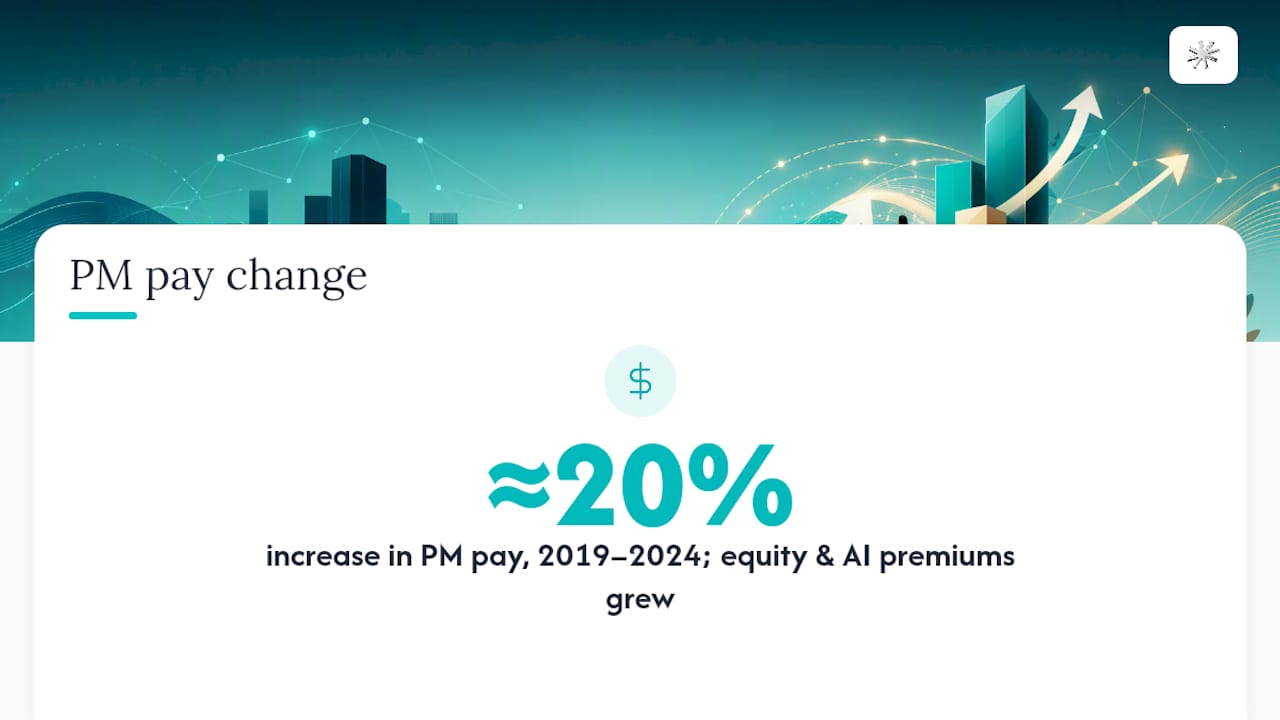
- Product Manager total compensation has increased roughly 20% since 2019, with equity becoming a larger part of earnings at tech firms.
- Salaries vary significantly based on data source, with large tech companies typically offering above $200,000 in total pay, including bonuses and stock.
- Location and industry heavily influence pay, with big tech hubs and sectors like AI and fintech commanding higher premiums, but cost of living can offset these gains.
- Negotiation should focus on the entire package, including base salary, bonuses, equity, and benefits, while emphasizing your impact and specialized skills.
- Remote roles in lower-cost states or moving to a more senior or specialized position can substantially boost pay, especially when aligned with market and firm size factors.
Table of Contents
- Why Product Manager Salary US Data Varies So Widely
- What Actually Makes Up Your Total Compensation
- What Do Product Managers Earn at Each Career Level?
- Which Cities and Industries Pay Product Managers the Most?
- What Levers Actually Move Your Product Manager Pay?
- How Should You Negotiate a Product Manager Offer?
- How Has Product Manager Pay Changed Over Time?
- Product Manager vs. Product Owner vs. Project Manager vs. Engineering Manager
- Startup vs. Big Tech vs. Consultancy: Where Should You Work?
- Benefits and Perks That Quietly Add to Your Paycheck
- Does a High Salary in One City Mean More Buying Power?
- Turning Salary Data Into a Career Plan
- Target Higher-Paying PM Roles With a Plan, Not Guesswork
- Where These Numbers Come From
- Sources
- FAQ
Why Product Manager Salary US Data Varies So Widely
Ask three sources for a Product Manager salary and you'll get three different numbers, and none of them are wrong. They're just measuring different things.
The BLS OEWS survey collects broad employer payroll data across the US, making it a strong baseline for national median salary estimates. But it also averages together PMs at a 50-person startup and PMs at Google, which flattens the picture at the top.
Statistic Snapshot: BLS reports a $171,200 median and $187,990 mean for Product Managers nationally. Built In's 2026 snapshot shows average base pay near $133,231 plus roughly $19,231 in additional cash for a total around $152,462. ZipRecruiter's September 2026 data lands close by, at roughly $159,405.
Here's how to pick the right number for the right job:
- Use BLS OEWS when you want the most defensible national baseline for general planning.
- Use Levels.fyi when you're benchmarking against large public tech companies specifically.
- Use Built In or ZipRecruiter when you want a realistic cross-market average that includes smaller employers.
Salary data from Salary Atlas suggests PM pay has climbed roughly 20% since 2019, so older salary guides you find online are probably underselling the current market.
What Actually Makes Up Your Total Compensation
Your offer letter rarely tells the whole story. Total compensation for a Product Manager breaks into three pieces: base salary, an annual cash bonus, and equity, usually in the form of RSUs that vest over several years.
Built In's data indicates average base salaries in the low $130,000s, with bonuses and extra cash compensation contributing to the total. Equity is the wildcard. At a public tech company, RSUs often vest over four years, typically with a one-year cliff before anything vests at all.
Before you sign anything, ask about:
- Base salary and whether it's negotiable
- Annual bonus target and how often it's actually hit
- Equity grant size, vesting schedule, and refresh policy
- Sign-on bonus and any clawback conditions
Pro Tip: A lower base with a big equity grant can outperform a higher base with none, but only if the company's stock holds value. Weigh equity at a discount, not face value, when comparing two offers.
What Do Product Managers Earn at Each Career Level?
Titles inflate faster than pay does, so a "Senior PM" at one company might do the job of a mid-level PM somewhere else. Still, rough bands hold up across the market.
- Associate/APM: Typically the entry point for PM careers, often filled by MBA graduates or engineers moving into product; Salary data shows this band running well below the national PM median.
- Product Manager (mid-level): Lands closest to the BLS median of $171,200, usually after two to five years owning a product area.
- Senior Product Manager: Commands a premium over the median, often into the low $200,000s in total compensation at mid-size to large tech companies.
- Director and above: Enters leadership pay territory, where equity and scope of responsibility (managing PMs, owning a P&L) drive comp well past $250,000.
The jump between bands rarely comes from tenure alone. Employers pay up for PMs who can point to a shipped feature that moved a real metric, not just a busy roadmap.
Which Cities and Industries Pay Product Managers the Most?
Location still matters enormously, even with remote work reshaping the market. The San Francisco Bay Area, Seattle, New York City, and Boston consistently post the highest premiums over the national median, often 15% to 30% above baseline.
That premium looks better on paper than in your bank account. As Built In's compensation data suggests, a $30,000 bump in the Bay Area can shrink to almost nothing after San Francisco rent and California state income tax take their share.
Industry matters just as much as zip code:
- Big tech and enterprise SaaS companies pay the highest base and equity combinations.
- Fintech often matches tech-level base pay with somewhat smaller equity grants.
- AI and machine learning product roles currently command a hiring premium as companies compete for scarce specialized talent.
- Traditional industries (retail, manufacturing, insurance) tend to pay below the national median but sometimes offer more stable bonus structures.
Remote roles increasingly get paid on a location-adjusted scale, so a remote PM living in a lower cost-of-living state may see a lower number than a Bay Area peer doing identical work.
What Levers Actually Move Your Product Manager Pay?
Some factors are outside your control. Company size, industry, and the state of the hiring market all shape what's on the table before you even walk into a negotiation. But several levers are entirely yours to pull.
- Ship something measurable. A feature that moved retention, revenue, or activation by a specific percentage is worth more in a promotion case than three years of "managed the roadmap."
- Specialize in a scarce skill. PMs who can speak fluently about AI/ML systems, data infrastructure, or platform architecture currently out-earn generalists.
- Expand your scope before you ask for the raise. Owning a second product line or managing junior PMs builds the case for a title (and pay) bump before you request one.
- Time your move. Company-to-company jumps almost always outpace internal raises, especially in a hiring market where demand for specialized PMs is climbing.
Pro Tip: Track your wins in a running document as they happen. Trying to reconstruct your impact from memory during review season almost always undersells what you actually did.
How Should You Negotiate a Product Manager Offer?
Negotiating well starts before the recruiter calls with a number. Walk in knowing your target total compensation, not just a target salary.
- Research your specific level, company tier, and metro using at least two sources (BLS for a baseline, Levels.fyi for company-specific data).
- Set a target total comp number, not just a base salary number, before any conversation starts.
- Ask for adjustments in a specific order: base first, then sign-on bonus, then equity refresh timing.
- Confirm the vesting schedule and cliff in writing before you compare two competing offers.
When you evaluate the offer itself, check the vesting schedule, performance targets tied to bonus payout, equity refresher policy, benefits, and severance terms.
Two phrases worth having ready: "Based on my research for this level and market, I was expecting total compensation closer to [X]. Is there flexibility in the base or equity to get there?" and "I have another offer at [total comp]. Can we revisit the structure here before I make a decision?"
Pro Tip: Never negotiate against your current salary. Negotiate against the market rate for the role you're stepping into.
How Has Product Manager Pay Changed Over Time?
Product Manager compensation has moved up substantially over the past several years, and the shift isn't just inflation catching up. Demand for PMs who can operate in AI-driven product development, data-heavy environments, and platform-scale systems has outpaced the supply of qualified candidates.
Salary Atlas data points to roughly a 20% increase in PM pay from 2019 through 2024, a period that includes both the pandemic-era hiring surge and the sharp tech layoffs that followed. What's notable is that pay kept climbing even through the layoff cycle, largely because companies cut headcount rather than cut compensation for PMs they wanted to keep.
The bigger structural shift is in how compensation gets built. A decade ago, PM offers leaned more heavily on base salary. Today, especially at public tech companies, equity makes up a much larger share of total compensation, which means your actual earnings now track the stock market almost as closely as they track your performance review.
Specialization has also reshaped the pay curve. A generalist PM and an AI-focused PM with comparable tenure can see a real gap in total compensation, and that gap has widened noticeably over the past two years as companies compete for people who understand both product strategy and machine learning constraints.
Expect that trend to continue rather than reverse. As more product work touches AI features directly, the premium for PMs who can bridge technical and business conversations is likely to keep growing faster than the market baseline.
Product Manager vs. Product Owner vs. Project Manager vs. Engineering Manager
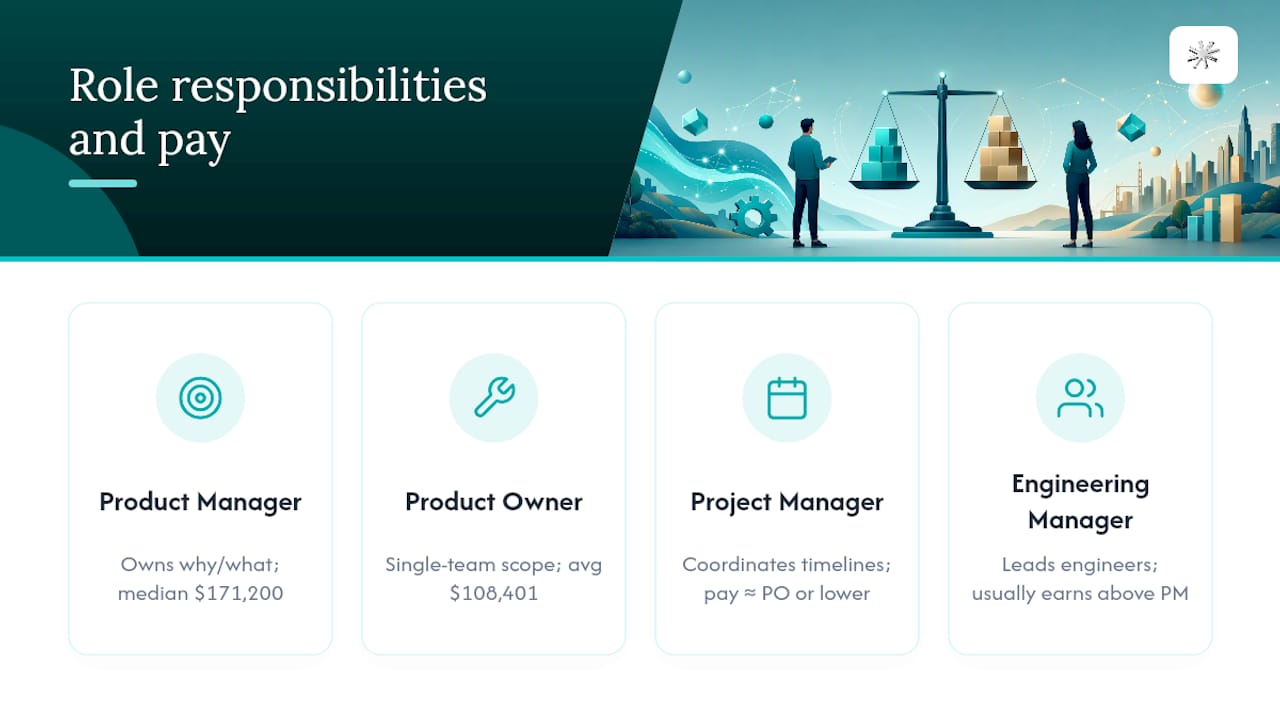
These four titles get confused constantly, and the pay gaps between them are real. A Product Manager owns the "why" and "what" of a product, a Product Owner typically executes within an Agile framework at a narrower scope, a Project Manager coordinates timelines and delivery, and an Engineering Manager leads the technical team building the thing.
Built In's data puts average Product Owner pay around $108,401, meaningfully below the PM median of $171,200. That gap reflects scope more than skill: Product Owners generally work within a single team's backlog, while PMs often own strategy across multiple teams or an entire product line.
Project Managers, who focus on execution and timelines rather than product strategy, typically land in a similar or slightly lower band than Product Owners, depending on industry. Engineering Managers usually out-earn PMs at the same company, since they carry direct people-management responsibility for larger, often more technical teams, and many engineering compensation structures include richer equity grants tied to technical leadership levels.
If you're deciding which path to pursue, know that PM roles offer the clearest path into general management and eventually the C-suite, while Engineering Manager roles offer a faster route to higher pay if you're staying technical. Product Owner roles work well as a stepping stone into full PM responsibilities, particularly for people moving out of technical or operations backgrounds.
Startup vs. Big Tech vs. Consultancy: Where Should You Work?
Company type changes your Product Manager salary as much as your title does, and each option trades one kind of value for another.
Startups often offer lower base salaries, sometimes 10% to 20% below the national median, but compensate with larger equity stakes that carry real upside (and real risk) if the company succeeds. Early-stage startups may also hand you broader scope faster than a large company would, which builds your resume even if the paycheck lags for a few years.
Large tech companies are where the Levels.fyi $230,000 median total comp figure mostly comes from. These employers pay competitive base salaries, structured annual bonuses, and substantial RSU grants refreshed yearly, but the roles come with more process, more stakeholders, and slower individual impact on any single decision.
Consultancies tend to sit in the middle, often matching or slightly exceeding the BLS national median on base pay, with smaller bonus structures and little to no equity. What consultancies offer instead is breadth: PMs rotate across client industries and problem types faster than they would inside one company, which can accelerate skill-building even if the ceiling on total comp is lower.
If maximizing near-term total compensation is your priority, big tech generally wins. If you want faster scope and are comfortable with risk, a startup can pay off disproportionately if the equity matures. Consultancy work suits PMs who want variety and a stable base while they figure out what specialization to pursue next.
Benefits and Perks That Quietly Add to Your Paycheck
Salary numbers rarely include everything an employer actually gives you, and for PM roles, the gap between "salary" and "total value" can run into tens of thousands of dollars a year.
Health insurance quality varies enormously between employers, and a plan with a low deductible and strong dependent coverage can be worth $5,000 to $10,000 a year compared to a bare-bones plan. Retirement matching, typically a 401(k) match up to 4% to 6% of salary at larger tech companies, is effectively free money that rarely shows up in salary comparisons.
Other perks that matter more than they get credit for:
- Professional development budgets for courses, certifications, or conferences relevant to product specialization
- Flexible or unlimited PTO policies, which have real dollar value even though they're hard to quantify
- Parental leave that extends well beyond the federal minimum, increasingly common at larger tech employers
- Equity refresh grants, which extend beyond your initial offer and can matter more than your starting grant over a multi-year tenure
When you're comparing two offers with similar base pay, these extras are often the real tiebreaker. A PM job with a slightly lower base but a generous 401(k) match and strong parental leave can outperform a higher-base offer with thin benefits once you calculate total value over a few years.
Does a High Salary in One City Mean More Buying Power?
Not necessarily, and this is where a lot of PMs make an expensive mistake when weighing a relocation or a remote offer against a higher-paying city.
A Product Manager earning $210,000 in San Francisco and one earning $160,000 in Austin may end up with nearly identical discretionary income once you account for California's state income tax, San Francisco's housing costs, and the lower overall cost of living in Texas. Built In's compensation analysis points to exactly this pattern: geographic salary premiums often shrink dramatically once taxes and housing enter the picture.
The math gets more complicated with remote roles paid on location-adjusted scales. A company might pay a remote PM in a lower cost-of-living state 10% to 15% less than a peer in Seattle or New York, which can feel unfair until you run the actual take-home numbers side by side.
Before accepting a relocation or comparing two offers in different cities, run both salaries through a cost-of-living calculator that accounts for state and local taxes, typical rent for your situation, and everyday expenses like groceries and transportation. The headline number in the higher cost-of-living city is almost always smaller in practice than it looks on the offer letter.
Turning Salary Data Into a Career Plan
Salary numbers only help if you know where you actually fit in the market, not just where the averages sit. NueCareer builds that context into personalized transition roadmaps, pairing compensation data with an honest read on your strengths and target roles.
If you're not sure whether product management is even the right direction, the 7-Minute Career Quiz is a fast way to find out before you spend months chasing a title that doesn't fit how you actually work.
— Shane
Target Higher-Paying PM Roles With a Plan, Not Guesswork
Knowing the numbers in this article is one thing. Knowing whether Product Manager is even the right fit for your strengths, or which specialization actually gets you into that senior band faster, is another problem entirely. That's the gap NueCareer's 7-Minute Career Quiz closes.

The quiz matches your strengths to specific career paths, then builds a personalized transition roadmap around that match. From there, NueCareer's toolkit backs up the negotiation and application steps covered above: a resume and cover letter generator, an ATS resume checker, and mock interview practice, all built around your target role. If you're actively planning a move into a higher-paying PM position, take the quiz and see what roadmap it builds for you.
Where These Numbers Come From
For readers who want to verify these figures directly or track updates over time:
- Bureau of Labor Statistics OEWS for the official national median and mean wage data
- Levels for company-level total compensation figures at large tech employers
- ZipRecruiter for a broad market snapshot with percentile bands useful for offer benchmarking
Cross-checking two or three of these before you set a target number will give you a far more accurate picture than relying on any single source.
Sources
- Bureau of Labor Statistics — Occupational Employment and Wage Statistics (OEWS) May 2024
- Built In — 2026 Product Manager salary in US
- Levels
FAQ
Is Product Manager a high-paying job?
Yes. The BLS reports a national median of $171,200, which puts PM roles well above the median for most professional occupations, and total compensation at large tech companies often exceeds $200,000 once equity is included.
Why is Product Manager salary so high?
PM roles sit at the intersection of business strategy, user experience, and technical execution, a skill combination that's genuinely scarce, and companies pay a premium for PMs who can move a product metric rather than just manage a process.
Is Product Manager a stressful job?
Most PMs report the role as demanding due to cross-team accountability without direct authority over engineering or design, though stress levels vary widely by company culture and how clearly leadership defines the PM's decision-making authority.
What jobs pay $500,000 a year in the US?
Roles that reach that level typically sit in senior technical leadership, executive management, or specialized finance and medicine, and within product organizations it usually takes a VP of Product or Chief Product Officer title at a large public company to approach that figure through base pay and equity combined.
How does Product Owner pay compare to Product Manager pay?
Product Owner pay averages around $108,401 according to Built In, noticeably below the Product Manager median of $171,200, largely because Product Owner roles typically carry narrower scope within a single Agile team.