

Yes, you can build a real career in tech without writing a line of code. The best non-technical tech jobs right now include product associate, customer success manager, technical writer, technical recruiter, sales development representative, UX researcher, business analyst, IT support specialist, QA tester, and marketing or content manager. These roles rely on communication, organization, and problem-solving instead of programming languages.
If you want the fastest way in, start with roles that have shorter learning curves and high demand: IT help desk, sales development, customer success, QA testing, and technical writing. These positions tend to hire based on demonstrated skills and coachability rather than a computer science degree, which makes them the most realistic entry points for career changers.
Here's the shortlist worth exploring first:
- Fastest to break into: help desk / IT support, SDR, customer success
- Best for writers and communicators: technical writer, content/marketing manager
- Best for analytical thinkers: business analyst, QA tester, UX researcher
- Best for relationship builders: technical recruiter, customer success, sales
Employers increasingly hire on demonstrable skills. Practical experience, certifications, and portfolio projects now carry as much weight as a diploma for many entry-level tech roles, and a lot of these jobs are learn-on-the-job by design.
Before you apply anywhere, spend seven minutes taking The 7-Minute Career Quiz to see which of these paths actually fits how you think and work. Guessing your way into a role wastes months. Matching your strengths to a role first saves you from applying blind.
Key Takeaways
Non-technical tech jobs succeed on communication, tool fluency, and demonstrated results, not on coding ability, and the fastest entry points are help desk, SDR, customer success, and QA testing.
| Point | Details |
|---|---|
| Coding isn't required | Roles like product manager, CSM, technical writer, and QA tester rely on communication and analysis, not programming. |
| Fastest entry points | Help desk, SDR, customer success, and QA testing hire the most career changers with the shortest ramp-up. |
| Pay scales with proximity to revenue | Sales and customer success roles often out-earn support roles at senior levels due to commission and bonus structures. |
| Certifications beat waiting for a degree | CompTIA A+, Google IT Support, and role-specific micro-credentials open doors faster than a second degree. |
| Match strengths before applying | Taking The 7-Minute Career Quiz helps you target the right role before you spend time on resumes or certifications. |
Table of Contents
- Non-Technical Tech Jobs Worth Pursuing Right Now
- What Non-Technical Tech Jobs Actually Pay
- A 5-Step Plan for Landing a Non-Coding Tech Role
- Where Non-Technical Tech Roles Can Lead
- Remote and Entry-Level Options Worth Targeting
- How Nuecareer Helps You Go From Exploring to Applying
- The Soft Skills and Technical Literacy These Roles Actually Require
- Common Misconceptions About Non-Technical Tech Careers
- What Work Actually Looks Like in These Roles
- Staying Sharp: Learning and Networking Resources Worth Using
- Why Action-First Role Matching Beats Generic Career Advice
- Ready to Find Your Non-Technical Tech Role?
- Sources
- FAQ
Non-Technical Tech Jobs Worth Pursuing Right Now
Not every non-coding role in tech is created equal. Some demand years of adjacent experience before anyone will consider you; others will hire a motivated career changer within weeks of a certification. Here's how the major roles break down.
Associate product manager. You'll coordinate between engineering, design, and business teams to decide what gets built and why. This role fits people who like structure, prioritization, and translating customer complaints into a roadmap. Most companies want some experience, whether that's a related internship, a business background, or a stint in customer-facing work, though a handful of associate PM programs hire directly from college. Remote friendliness is moderate. Many product teams still want overlap hours for stand-ups and planning sessions.
Customer success manager (CSM). You own the relationship after the sale, making sure customers actually get value from the product so they renew. It fits people who are patient, proactive, and good at reading between the lines of a frustrated email. Entry often comes through customer support or account management, though some SaaS companies hire junior CSMs directly. This is one of the more remote-friendly roles in tech since the job runs almost entirely on video calls, email, and shared dashboards.
Technical writer. You turn complex product features into documentation, help articles, and guides a non-engineer can actually follow. It suits people who write clearly, ask good clarifying questions, and don't mind reading changelogs for fun. A humanities or journalism background works well here, and a portfolio of sample documentation often matters more than a degree. Technical writing is highly remote-friendly, since the deliverable is a document, not a meeting.
Technical recruiter. You source and vet candidates for engineering and product roles, which means learning enough tech vocabulary to hold a real conversation with a hiring manager. It fits people who are naturally curious about people's career stories and comfortable with rejection-heavy work. Most recruiters start in general HR or staffing agency roles before specializing in tech. Remote work is common, especially at agencies and mid-size companies.
Sales development representative (SDR). You prospect and qualify leads before handing them to an account executive. This is one of the most accessible entry-level tech positions that exists, and companies frequently hire people with zero tech background as long as they can handle rejection and hit activity targets. It's a launchpad role: most SDRs plan to move up within 12 to 18 months. Remote SDR jobs are widespread, though some companies still prefer a hybrid setup for coaching purposes.
UX researcher or designer. You study how real people use a product and push for changes that reduce friction. It fits people with backgrounds in psychology, anthropology, or design who like structured problem-solving. Entry usually requires a portfolio, whether from bootcamp projects, freelance work, or a design certificate, since this field is more competitive at the junior level. Remote work is common, particularly for research roles built around interviews and surveys.
Business analyst. You translate business problems into requirements that technical teams can act on, often working in spreadsheets, dashboards, and stakeholder meetings. It suits people who like connecting the dots between "what leadership wants" and "what's actually feasible." A business or finance degree helps, but analysts increasingly come from operations, consulting, or even teaching backgrounds. Remote friendliness is decent, though some BA roles need in-person access to stakeholders.
IT support or help desk specialist. You troubleshoot software and hardware issues for employees or customers, which builds foundational tech literacy fast. This is arguably the easiest tech job to get without a degree, since many companies hire based on a CompTIA A+ certification and a good attitude rather than a resume full of tech jobs. It's a genuine on-ramp into non-coding tech roles like systems administration or IT project management. Remote help desk jobs exist but are less common than fully in-office ones, since some issues require hands-on hardware access.
QA tester. You find bugs before customers do, running through features methodically and documenting what breaks. It fits detail-oriented people who like breaking things on purpose. Manual QA testing rarely requires coding knowledge and is one of the more common entry points for career changers moving from retail, hospitality, or admin work. QA is often remote, since testing usually happens on a laptop with access to a staging environment.
Digital marketing or content manager. You plan and execute campaigns, write copy, and track what's actually driving signups or downloads. It fits people who like a mix of creativity and data. A marketing degree helps, but a strong portfolio of writing samples or campaign results often matters more. This role is highly remote-friendly, especially at companies that run marketing as a fully async function.
Roles like help desk, SDR, and QA testing are commonly entry-level. Product management, UX design, and senior business analyst roles usually expect at least a year or two of relevant experience first.
What Non-Technical Tech Jobs Actually Pay
Compensation in non-technical tech roles varies more by function and seniority than by whether the job "sounds technical." Entry-level positions like SDR, help desk, and junior QA testing typically start modestly but climb fast once you have a year or two of proven results. Customer success, business analysis, and technical writing sit in the middle, with senior individual contributors often out-earning first-line managers in other departments.
Roles that touch revenue directly, like sales and account management, tend to pay more at the senior level because compensation includes commission or bonus structures tied to company growth. Non-revenue roles like technical writing or QA can be more stable but usually have a lower ceiling unless you move into management.
The clearest example of just how high the ceiling goes: senior communications and strategy leaders at major tech companies are now earning compensation packages as high as $1.2 million a year, driven largely by demand for people who can manage public narrative and strategy around AI. That's an outlier, not a starting point, but it shows non-technical expertise commands real money at the top.
What actually moves your salary:
- Company size and stage. Larger, later-stage companies generally pay more cash but may offer less equity upside than a startup.
- Specialization. A technical writer who understands API documentation earns more than a generalist content writer.
- Location and remote policy. Fully remote roles sometimes pay on a national band; hybrid roles near major tech hubs often pay more.
- Revenue proximity. Sales and customer success roles with quota or renewal targets typically have higher pay ceilings than support roles.
- Years of experience. Moving from entry to mid-level in most of these roles can meaningfully increase base pay within two to three years.
A 5-Step Plan for Landing a Non-Coding Tech Role
Getting hired for IT jobs for non-techies takes a plan, not just a resume overhaul. Here's the order that actually works:
Pick one target role. Don't apply broadly to "anything in tech." Choose one role from the list above based on what you already do well, whether that's writing, relationship management, or troubleshooting.
Learn the core tools and vocabulary. Every non-technical role has a baseline literacy requirement. CSMs need to understand CRMs like Salesforce or HubSpot. QA testers need to know what a bug ticket and a regression test are. Spend two to three weeks getting fluent.
Get one focused certification. For IT support, that's CompTIA A+ or Google IT Support. For security-adjacent roles, CompTIA Security+. For product or UX, a short micro-credential works better than a full bootcamp.
Build two or three portfolio pieces. A technical writer needs sample documentation. A UX researcher needs a mock usability study. A business analyst needs a case study showing how they'd solve a real business problem.
Apply and network with tailored materials. Generic resumes get filtered out. Customize your resume and outreach for each role, and use your network to get past the algorithm entirely.
Pro Tip: Turn volunteer work, class projects, or a small freelance gig into a real portfolio case study. Employers care far more about what you produced than who paid you to produce it.
If you're not sure how to reframe your existing experience for a tech resume, career change resume tips can help you translate past work into language hiring managers recognize.
Where Non-Technical Tech Roles Can Lead
Entry-level non-coding jobs are rarely the destination. They're the on-ramp to bigger, better-paid roles once you've proven yourself.
- Help desk → IT operations or systems administration, often within 12 to 24 months once you've picked up scripting basics or a second certification.
- Customer success → director of customer success, typically by demonstrating renewal rates, expansion revenue, or churn reduction you can point to directly.
- SDR → account executive → sales leadership, usually the fastest financial climb of any entry role, often within 18 months for strong performers.
- Associate product manager → product manager → senior/product lead, which requires learning to read analytics dashboards and speak fluently about product metrics.
The common thread across all four paths: get cross-functional exposure early, learn enough analytics to speak the language of the team you want to join, and document your impact in numbers, not adjectives. Career change networking strategies can help you find mentors already doing the job you want next.
Remote and Entry-Level Options Worth Targeting
Remote hiring favors roles where the output is written, measurable, or asynchronous. Customer support, technical writing, digital marketing, QA testing, and data analysis all fit that mold, which is why they dominate remote job boards.
When searching, use specific phrasing instead of broad terms: "remote customer success," "entry-level technical support remote," or "remote QA tester no experience." Vague searches like "remote tech jobs" bury you under postings you're not qualified for yet.
Remote employers generally expect:
- Time zone overlap with your core team, even if the job is fully remote.
- Writing samples that prove you can communicate clearly without a video call to clarify.
- Comfort with async tools like Slack, Notion, Asana, or Loom, since remote teams run on documentation, not hallway conversations.
How Nuecareer Helps You Go From Exploring to Applying
Reading about roles is useful. Knowing which one actually fits you is the harder part, and that's exactly what The 7-Minute Career Quiz is built to solve. It maps your strengths and preferences against the roles covered in this article, whether that's the structured problem-solving of a business analyst or the relationship-building of a customer success manager, then hands you a personalized roadmap instead of a generic list.
From there, Nuecareer's tools carry you through the harder parts of the transition:
- A resume and cover letter generator that translates your existing experience into tech-relevant language
- A free skills assessment to identify gaps before you apply
- 24/7 coaching chat for real-time questions as you prepare
- Tailored job boards matched to your target roles
Pro Tip: Take the quiz before you touch your resume. Knowing your target role first means every resume edit and cert you pursue actually points somewhere.
The Soft Skills and Technical Literacy These Roles Actually Require
None of these roles require you to code, but every one of them expects a working knowledge of the tools your team runs on. A customer success manager who can't navigate a CRM dashboard will struggle regardless of how personable they are. A QA tester who doesn't understand what a bug ticket needs to include will slow down the whole engineering team.
Soft skills tend to matter more than raw technical knowledge for success in these roles. Communication, stakeholder management, and critical thinking are usually the difference between someone who gets promoted and someone who plateaus. A technical writer's real skill isn't grammar. It's the ability to ask an engineer the right clarifying question and turn a messy answer into something a customer can follow.
That said, technical literacy at the tooling level is non-negotiable. You don't need to write SQL, but you do need to read a dashboard. You don't need to build an API, but you do need to understand what one does well enough to write documentation about it. Think of it as fluency, not fluency in code, but fluency in how your product actually works and how the teams around you talk about it. Most of that literacy gets built on the job within the first 90 days, which is exactly why employers weigh attitude and adaptability so heavily in interviews for these positions.
Common Misconceptions About Non-Technical Tech Careers
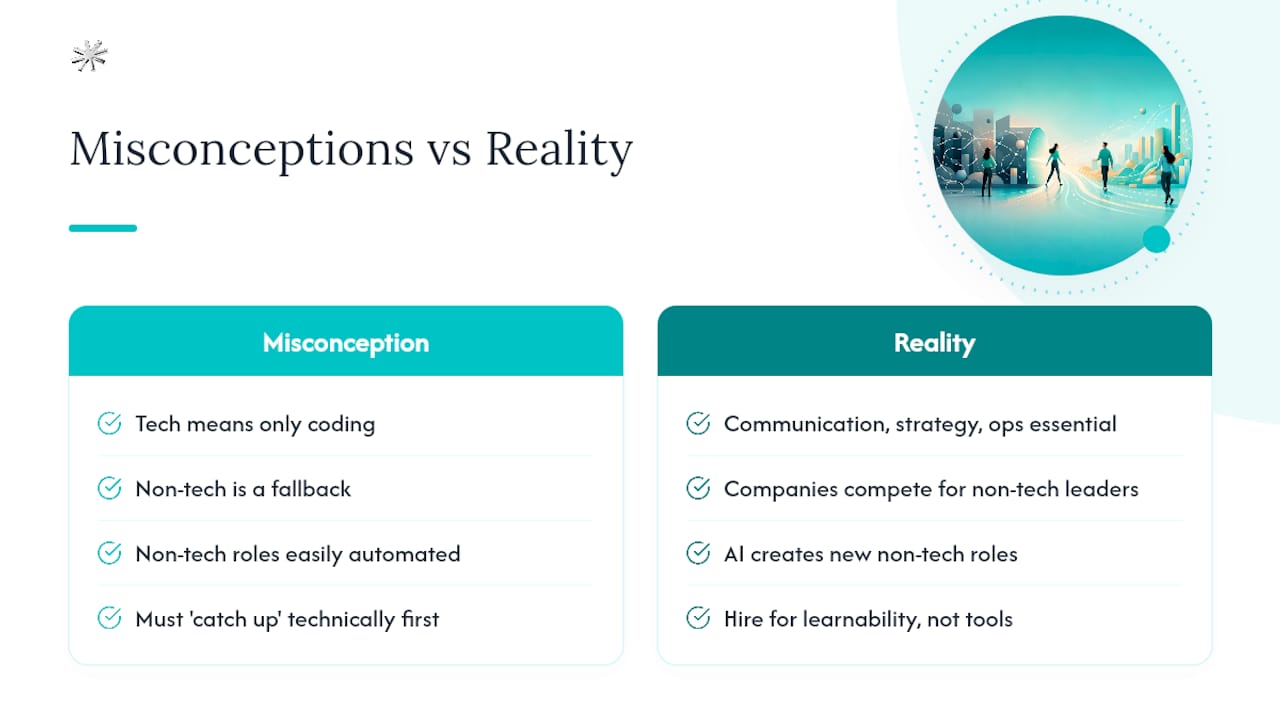
The biggest misconception is that "tech job" automatically means "coding job." In reality, a huge share of the industry runs on communication, strategy, and operations, and those people are just as essential to a product's success as the engineers building it. Someone has to explain the product to customers, manage the roadmap, test for bugs, and write documentation that doesn't sound like a legal contract.
A second misconception is that non-technical roles are somehow a fallback or lesser path into tech. That framing gets it backwards. Companies actively compete for skilled CSMs, product managers, and technical writers, and the compensation ceiling for senior non-technical leadership proves it.
A third misconception, growing more common as AI reshapes the industry, is that these roles are more vulnerable to automation than technical ones. The opposite dynamic is playing out in some cases: AI is creating brand-new non-technical roles, including people who audit AI outputs, train models on quality data, and review AI-generated content for accuracy and tone. Someone still has to decide whether the machine got it right, and that judgment call is a distinctly human skill.
Finally, a lot of career changers assume they need to "catch up" technically before applying. In practice, most hiring managers care more about whether you can learn the specific tools their team uses than whether you already know them.
What Work Actually Looks Like in These Roles
Non-technical tech roles rarely live in isolation. A customer success manager works alongside sales, product, and support, sitting in the middle of the customer relationship and translating feedback in both directions. A technical writer usually reports into either product or engineering and spends a chunk of every week interviewing developers to understand what just shipped.
Team structures vary by company size. At a startup, you might be the only person doing your job, wearing three hats and reporting directly to a founder. At a larger company, you'll likely sit on a specialized team with a manager, peers doing the same role, and clearer boundaries around your responsibilities. Neither setup is inherently better. Startups offer faster exposure to different parts of the business; larger companies offer more structured mentorship and a clearer promotion path.
Most of these roles run on a mix of synchronous and asynchronous work. Expect daily or weekly stand-ups, regular one-on-ones with a manager, and a lot of time in shared tools like Slack, Jira, Notion, or a CRM. Cross-functional meetings are common, especially for product, business analyst, and customer success roles, since your job often depends on what three other teams are doing. If you're someone who thrives on variety and cross-team collaboration rather than heads-down solo work, these environments tend to be a strong cultural fit.
Staying Sharp: Learning and Networking Resources Worth Using
Non-technical tech careers reward people who keep learning past the point of getting hired. Short, role-specific courses do more for your trajectory than broad, unfocused learning. A course like AI skills for non-techies is a good example of the kind of targeted, practical training that helps you stay relevant as AI reshapes how these roles operate.

Networking matters just as much as skill-building, especially since many of these roles get filled through referrals before they're ever posted publicly. Industry-specific Slack communities, LinkedIn groups built around product management or customer success, and local meetups for tech professionals are all low-cost ways to meet people already doing the job you want.
If you're using AI tools to help polish your applications or prep for interviews, it's worth understanding the ethical guidelines around AI career tools so your materials stay authentic to your actual experience rather than sounding generic or overproduced. Hiring managers notice the difference.
Finally, don't underestimate informational interviews. A 20-minute conversation with someone currently doing the job you want will teach you more about day-to-day reality than a dozen job descriptions ever could.
Why Action-First Role Matching Beats Generic Career Advice
Most career advice on breaking into tech stops at "learn a skill and apply." That's not wrong, exactly. It's just incomplete, and incompleteness is what leaves people stuck for months applying to jobs that were never a good fit in the first place.
The research behind this article points to a sharper conclusion: the people who move fastest into non-technical tech roles pick one specific role early, then work backward from that role's actual requirements. They don't collect certifications randomly. They don't apply to every "tech job" they see. They match strengths to function first, then build the narrowest possible skill set to prove they belong.
Where conventional advice falls short is in treating all non-coding roles as interchangeable. They're not. A help desk job and a UX research role require almost opposite personality types and preparation paths. Conflating them wastes a job seeker's most valuable resource: focused time.
Prioritize the match before the resume. That's the entire argument here, and it's why a structured self-assessment matters more at the start of this process than another round of applications.
— Shane
Ready to Find Your Non-Technical Tech Role?
Reading role descriptions only gets you so far. At some point, you need to know which one actually fits how you think, work, and want to spend your day, and that's the gap Nuecareer was built to close. Instead of guessing between customer success and business analysis based on a job title alone, you get matched based on your actual strengths.
The 7-Minute Career Quiz maps your answers against the roles covered in this article and hands you a personalized roadmap: which role fits, what skills to prioritize, and what a realistic timeline looks like. From there, Nuecareer's coaching chat, tailored job boards, and resume tools carry you through the parts of a career pivot that usually stall people out, like figuring out how to phrase a career change on paper or what to say when a recruiter asks why you're switching industries.
If you're ready to stop guessing and start moving, take the quiz now and see which non-technical tech role actually fits you.
Sources
- Big tech’s communications and strategy leaders are now earning seven-figure pay packages
- How to land an entry-level tech job with no experience
- Tech careers beyond coding: In-demand roles you might not know about
FAQ
How can you make $80,000 a year without a degree?
Roles like sales development, customer success, technical writing, and IT support typically progress to higher salaries once you have a year or two of proven results, especially in revenue-adjacent positions with bonus or commission structures. Certifications and a strong portfolio often substitute for a degree in hiring decisions.
What are the highest-paying non-technical jobs in tech?
Senior roles in communications, strategy, and product leadership top the range, with some senior communications and strategy leaders earning up to $1.2 million at large tech companies. Business analyst, sales leadership, and senior product management roles also pay well, particularly at larger companies.
Which tech jobs are least likely to survive AI?
There's no confirmed list of three jobs guaranteed to disappear, but repetitive, low-judgment tasks like basic data entry and simple manual QA checks face the most automation pressure. Roles requiring judgment, relationship management, and strategic thinking, like customer success, product management, and technical writing, are proving more resistant.
What's the easiest tech job to get without experience?
IT help desk and sales development representative roles are widely considered the most accessible entry points, since many companies hire based on a certification like CompTIA A+ and a willingness to learn rather than prior tech experience.
Do I need a certification to get a non-technical tech job?
Not always, but a focused certification like CompTIA A+, Google IT Support, or a short product or UX micro-credential meaningfully improves your odds for roles like IT support, QA testing, and business analysis. Taking The 7-Minute Career Quiz can help you figure out which certification actually matches your target role before you spend time or money on one.