
19–40% Hiring Penalty? Job Hopping Stigma in 2026 and 90 Second Script

2026 research shows job hoppers can face a 19–40% hiring penalty in some roles. Learn when mobility helps, use a 90 second Present, Past, Future script,...
Job hopping stigma is real, but it's no longer automatic. Some employers still penalize frequent moves hard, with applicants facing 19 to 40 percent lower odds of getting hired in certain roles. Yet research shows frequent movers often ramp up faster on the job. Your move: build a tight, honest narrative and pair it with resume signals that show stability where it counts.
TL;DR:
- Job hopping still faces a hiring penalty of 19 to 40 percent in some industries, though it is more accepted in fast-moving fields like tech and startups.
- Employers fear short tenures because of the high costs of onboarding and the perceived risk of turnover, especially in leadership or regulated roles.
- Frequent job changers tend to reach full productivity faster and develop adaptable skills that are valuable in collaborative and dynamic roles.
- Explaining short stays with a clear, honest narrative using a Present-Past-Future approach can mitigate stigma and emphasize speed and growth benefits.
- Networking and referrals can help shift the focus from tenure gaps to actual skills and performance, reducing bias against job hoppers during hiring decisions.
Table of Contents
- Job Hopping Stigma by the Numbers: What Employers Actually Think
- The Mobility Benefit: What the Hiring Penalty Misses
- How to Explain Job Hopping Without Apologizing for It
- When Job Hopping Helps vs. When It Hurts
- How NueCareer Helps You Reframe the Pattern
- How Long Should You Stay? Tenure Norms and Hiring Costs
- How Job Hopping Stigma Has Changed Over the Decades
- Does Job Hopping Look Different Across Industries and Regions?
- What Job Hopping Stigma Costs You in Pay and Promotion
- How Employers Can Evaluate Job Hoppers More Fairly
- Why Networking Still Beats a Resume Full of Short Stays
- Editorial Take: The Data Tells a More Useful Story Than the Fear Does
- Try NueCareer: Tools to Make Explaining Job Changes Easier
- Sources
- FAQ
Job Hopping Stigma by the Numbers: What Employers Actually Think
Hiring managers haven't gotten over job hopping. They've just gotten more specific about what worries them.
A New York Times analysis found that a meaningful share of younger workers now carry noticeably shorter tenures than previous generations, and many hiring managers still flag that pattern as a concern during screening. The worry isn't philosophical. It's financial.
The employer's real math: Every rehire costs money in training, onboarding, and lost productivity while a new person gets up to speed. A resume with four jobs in five years reads, to a nervous hiring manager, as a bet that might not pay off.
Three concerns tend to drive the hesitation:
- Cost of hire. Recruiting, interviewing, and onboarding a replacement is expensive, so a track record of short stays reads as risk.
- Flight-risk perception. Managers assume a pattern will repeat, even when each departure had a distinct, reasonable cause.
- Cultural-fit anxiety. Frequent movers get quietly judged on whether they'll actually commit to the team, not just the paycheck.
The data backs up the caution some employers apply. Purdue's Daniels School of Business found that job-hopping applicants can face 19 to 40 percent lower odds of receiving an offer, depending on the role and industry. That's not a rumor. It's a measurable hiring penalty, and it's exactly why a credible explanation matters more than a clean resume alone.
The Mobility Benefit: What the Hiring Penalty Misses
Here's the part most career advice skips: switching jobs frequently doesn't just cost you. It can build a skill set employers underrate until they need it urgently.
Researchers at Rutgers SMLR found that frequent job changers reach full productivity in about two months, compared to roughly five months for employees with longer, more stable histories. That's not a small gap. It suggests job hoppers have practiced the hardest part of any new role: figuring out unfamiliar systems, people, and expectations fast.
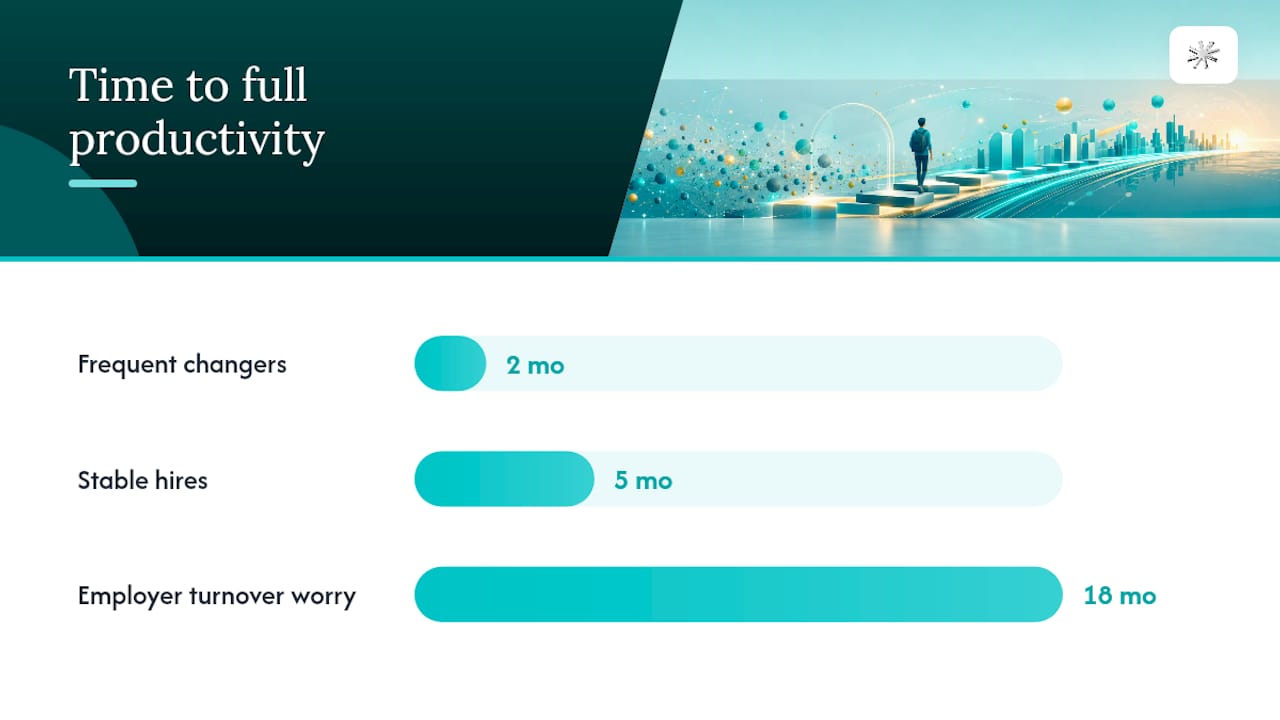
Cornell researchers describe this as a "mobility benefit," a set of adaptable social and learning skills that build with every transition. Rebecca Kehoe's work points to a specific place this pays off: collaborative, cross-functional roles where someone needs to build trust and read a room quickly.
That creates a real tension in hiring:
- What employers fear: turnover costs, retraining expense, another departure in eighteen months.
- What the research shows: faster ramp-up, stronger adaptability, and less initial performance drag than a "loyal" hire might show.
If you're applying for a role where speed-to-productivity actually matters, that mobility after pilot training isn't something to downplay. It's evidence.
How to Explain Job Hopping Without Apologizing for It
You don't need a long, defensive story. You need ninety seconds that sound rehearsed exactly zero times, even though they aren't.
SHRM's guidance on explaining short tenures converges on one idea: keep it concise, own the decision, and point forward. The clearest way to structure that is a Present, Past, Future script.
- Present. Open with what you're looking for right now and why this role fits it. One sentence, no hedging.
- Past. Briefly connect your last two or three moves with one honest thread, growth, layoffs, contract endings, whatever actually happened.
- Future. Close by naming what you want to build here and why this employer, specifically, supports that.
Three sample lines for common situations:
- Contract work: "Those two roles were fixed-term contracts, which is why they show as under a year."
- Layoffs: "Both companies had reductions unrelated to performance. I was one of several people affected each time."
- Growth moves: "I moved twice for roles with more scope, and I'm looking for the place I can build that scope over years, not months."
Your resume should carry the same discipline. Label contract and temporary roles explicitly instead of letting them look like abandoned permanent jobs. Group short, related roles under one header when they were genuinely connected. And lead every bullet with a measurable outcome, since results distract far more effectively than tenure dates do.
Pro Tip: Practice your Present-Past-Future answer out loud, timed. If it runs past ninety seconds, you're over-explaining, and over-explaining reads as guilt even when there's nothing to feel guilty about.
A career changer interview guide can help you adapt this script to your specific history, and a free tool for answering "tell me about yourself" works well as a rehearsal partner before the real interview.
When Job Hopping Helps vs. When It Hurts
Not every hiring manager reads a busy resume the same way, and the difference usually comes down to what the role actually needs.
Job hopping tends to help in:
- Fast-moving fields like tech, consulting, or startups, where adaptability and quick ramp-up are valued over tenure.
- Project-based or contract-heavy industries where short stints are the norm, not the exception.
- Early-career roles, where recruiters expect exploration and treat two or three short jobs as normal calibration.
Job hopping tends to hurt in:
- Leadership and management roles, where teams need to trust that a new boss will stick around.
- Highly regulated or relationship-driven fields, like healthcare or client-facing finance, where continuity builds trust with patients or accounts.
- Mid-career and senior roles, where the same pattern that looked like exploration at 25 looks like instability at 40.
Career stage changes the calculation more than most job seekers realize. A hiring manager reviewing a 26-year-old's resume and a 45-year-old's resume with the identical job history will draw different conclusions from it every time.
How NueCareer Helps You Reframe the Pattern
Explaining job hopping well starts with knowing what you actually want next, not just how to justify what you did last.
NueCareer's 7-Minute Career Quiz identifies your strengths and matches them to roles built around who you are, including paths you might not have considered. That clarity becomes the backbone of your Present-Past-Future script, since a confident "here's what I'm looking for now" line only works if you actually believe it.
From there, a few tools do the heavier lifting:
- The Reason for Leaving generator turns a messy work history into short, accountable explanations you can say out loud without flinching.
- Personalized roadmaps and 24/7 coaching chat help you rehearse the script until it sounds natural instead of memorized.
- Tailored job boards point you toward employers and roles where mobility reads as an asset instead of a liability.
The goal isn't to hide a pattern. It's to explain it with the same confidence Cornell's mobility-benefit research suggests you've earned.
How Long Should You Stay? Tenure Norms and Hiring Costs
There's no universal rule for "long enough," but patterns matter more than any single stay.
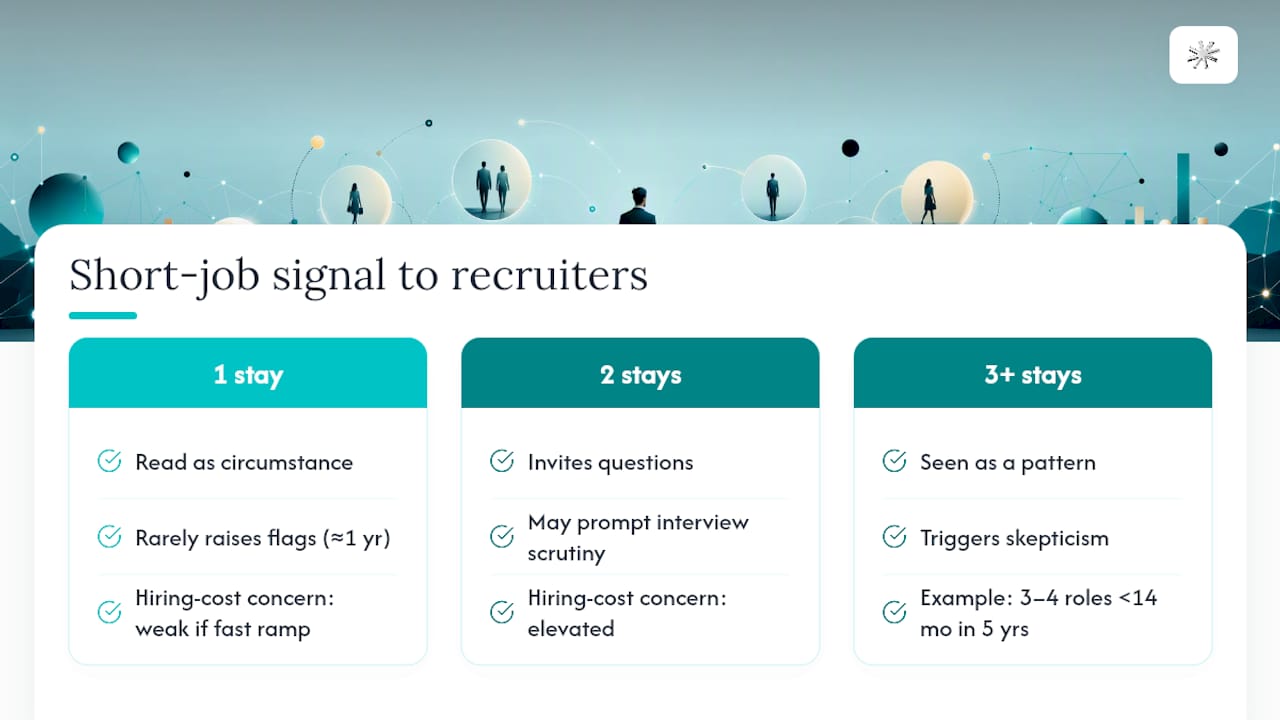
Recruiters generally read one short job as circumstance, not character. Two in a row invites a question. Three or more, especially without a clear thread connecting them, starts to look like a pattern rather than a coincidence. That's the real threshold most hiring managers apply, even when they never say it out loud.
The employer's math behind that caution comes down to replacement cost. Every open role represents weeks of lost output, recruiter or agency fees, and months of reduced productivity while a new hire climbs the learning curve. That's precisely why the Rutgers finding on faster ramp-up time matters so much: it directly answers the cost concern driving the stigma in the first place. If a candidate can prove they get to full speed in two months rather than five, the "hiring cost" argument against them gets a lot weaker.
For job seekers, the practical read is this: one year in a role rarely raises flags on its own, particularly early in a career. It's the accumulation, three or four roles under fourteen months each within a five-year window, that pushes hiring managers toward skepticism. Knowing where that threshold typically sits lets you decide, before you accept an offer, whether a short stay is worth the resume cost later.
How Job Hopping Stigma Has Changed Over the Decades
The stigma isn't new. What's new is how much less absolute it's become.
For most of the twentieth century, a single employer for an entire career was the expectation rather than the exception, and a resume with several jobs in a decade looked genuinely alarming to hiring managers. That norm started cracking with the corporate layoffs of the 1980s and 1990s, when loyalty stopped guaranteeing security in either direction.
The 2008 recession accelerated the shift further, forcing a generation of workers into short-term and contract roles simply because stable jobs weren't available. By the time Gen Z entered the workforce, job hopping had gone from taboo to strategy for a meaningful number of workers chasing faster pay growth than internal raises typically offer.
That doesn't mean the stigma vanished. It means it moved. Today's hiring managers worry less about the fact of movement and more about whether a candidate can explain it credibly, which is exactly the shift SHRM's interview guidance reflects.
Does Job Hopping Look Different Across Industries and Regions?
Stigma isn't distributed evenly, and pretending it is will lead you to over-explain in industries where nobody's asking.
In tech, startups, and consulting, frequent moves barely register as a red flag; they're closer to the default career shape. Project-based industries like construction, entertainment, and creative agencies build short-term engagements into how work gets structured in the first place, so tenure gaps read as normal, not risky.
Contrast that with healthcare, education, government, and traditional finance, where continuity carries real institutional weight. A hospital administrator or a public-school principal with five jobs in six years faces a harder conversation than a software engineer with the same pattern, because those fields tie stability to trust with patients, students, or regulators.
Regional hiring cultures shift the picture too. Employers in fast-growing metro job markets tend to see mobility as a sign of ambition, while more traditional regional economies often still reward the long-tenure model. None of this is a hard rule. It's context, and reading that context correctly matters more than memorizing a single national statistic.
What Job Hopping Stigma Costs You in Pay and Promotion
The stigma doesn't just cost interviews. It can quietly cap how far and how fast you rise once you're hired.
Candidates flagged as flight risks sometimes get passed over for leadership roles that require sustained relationship-building, even when their actual performance is strong. Managers making promotion decisions tend to invest development budget and mentorship in people they expect to stick around, which means a hopping pattern can slow advancement independent of skill or output.
Salary tells a more complicated story. External job changes frequently produce bigger pay jumps than internal raises do, which is a major reason frequent movers keep moving. But that short-term gain can carry a long-term cost if a hiring manager later reads the pattern as instability and prices in caution during an offer negotiation. The net effect depends heavily on how well a candidate can narrate the pattern as intentional rather than reactive, which is exactly what the Present-Past-Future structure is built to do.
How Employers Can Evaluate Job Hoppers More Fairly
Stigma often persists because it's easier to react to a pattern than to investigate it. Employers who want better hires benefit from doing the latter.
A USA Today analysis makes the case plainly: hiring managers should care less about the number of jobs on a resume and more about why each one ended, what the candidate delivered while there, and how professionally the exit was handled. That reframing shifts the interview from a tenure audit to an actual evaluation of fit.
Practical steps for assessing candidates fairly:
- Ask directly about reasons for leaving instead of assuming, and listen for whether the explanation is specific or vague.
- Weigh outcomes and measurable contributions per role over raw time-in-seat.
- Distinguish a genuine pattern of short, unrelated exits from a cluster of layoffs or contract endings tied to industry conditions.
- Check references for evidence of professional handoffs, not just performance.
Employers who skip this step lose strong candidates to a shortcut. The ones who do it well often end up hiring people who bring exactly the faster ramp-up speed the Rutgers research documents.
Why Networking Still Beats a Resume Full of Short Stays
A referral does something a resume alone can't: it hands the hiring manager a trusted opinion instead of a pattern to interpret cold.
When someone inside the company vouches for you, the conversation about tenure changes shape entirely. Instead of a recruiter guessing at your reasons for leaving four jobs in six years, a colleague who already worked with you can speak to your actual output and reliability. That context tends to neutralize the flight-risk assumption faster than any interview answer can.
Networking also gets you in front of hiring managers who screen for fit and results rather than running an automated tenure filter that quietly drops resumes with short stays before a human ever reads them. Warm introductions routinely skip that filter altogether.
If your work history is uneven, treat networking as damage control that happens before the interview instead of during it. A referral, a former manager's recommendation, or even a short conversation at an industry event can carry more weight than another rewritten resume bullet ever will.
Editorial Take: The Data Tells a More Useful Story Than the Fear Does
Most advice on job hopping stigma treats it as a single, unified problem. It isn't. The Purdue hiring-penalty numbers and the Rutgers mobility-benefit findings are both true at the same time, describing two different employer instincts that rarely get reconciled in the same conversation.
Where conventional advice falls short is in telling job seekers to minimize their history and hope nobody asks hard questions. That approach ignores the actual research, which shows adaptability from frequent moves is a genuine, measurable advantage in the right context. Hiding it wastes leverage you've already earned.
What matters most is matching your narrative to the specific concern in front of you. A hiring manager worried about flight risk needs the Future piece of your script emphasized. One worried about ramp-up time needs the Rutgers logic, stated plainly: you adapt fast, and you can prove it. Prioritize understanding which fear you're facing before you open your mouth in the interview.
— Shane
Try NueCareer: Tools to Make Explaining Job Changes Easier
There are other ways to prep for this conversation. You can write your own talking points, ask a friend to run a mock interview, or wing it and hope the hiring manager doesn't push. Most job seekers try all three before realizing none of them turn a messy work history into a confident, structured answer.

NueCareer's 7-Minute Career Quiz gets you there faster by identifying your real strengths and matching them to roles where your career pattern reads as an asset instead of a liability. Pair it with the free Reason for Leaving generator, which turns a complicated history into a clear, accountable line you can say in an interview without stumbling. Together, they give you the raw material for your Present-Past-Future script, plus job matches tailored to your actual strengths rather than a generic title search. Take the quiz now and walk into your next interview with an answer that sounds like a plan, not an excuse.
Sources
- Why Young Workers Are Job Hopping — The New York Times
- The pros and cons of job hopping | Purdue Daniels Insights
- Hopping vs. hugging: changing jobs builds hidden skill | Rutgers SMLR
- How to explain job hopping in an interview | SHRM
FAQ
Is Job Hopping Still a Red Flag in 2026?
It depends on context. Some employers still apply a real hiring penalty to frequent movers, but fast-moving industries and project-based fields increasingly treat mobility as normal rather than alarming.
Can Job Rejection From Job Hopping Stigma Affect Mental Health?
Repeated rejection during a job search is widely linked to increased stress and lower confidence, and candidates who feel unfairly judged for their work history often report this more acutely. Building a clear, rehearsed explanation for your history can reduce the anxiety that comes from feeling unprepared for the question.
What Are the Signs That Someone Is Considered a Job Hopper?
Recruiters typically look for a pattern of multiple short tenures in sequence, generally under a year or two each, rather than judging a single short stay on its own. One unrelated short role rarely triggers concern; three or four in a row usually does.
Why Are So Many Gen Z Employees Planning to Quit Their Current Jobs?
Younger workers frequently cite faster pay growth, better career fit, and stronger workplace culture as reasons for moving, since external moves often outpace internal raises. That trend is part of why NueCareer's career quiz focuses on matching people to roles aligned with what they actually value, not just the next available title.