
15 Cover Letter Opening Examples That Beat Generic Templates

Short, situational cover letter openings hiring managers read. 15 ready examples, formulas, and NueCareer's free tools to draft personalized openers fast.
A strong cover letter opening names the role in the first sentence, then delivers one specific hook — a metric, a referral, or an insight about the company — that earns the hiring manager's next few seconds. Skip the throat clearing. If your opener could be copied and pasted into any application at any company, it's not doing its job.
TL;DR:
- The opening line should include a specific, verifiable hook such as a metric, referral, or company insight to immediately grab the hiring manager’s attention.
- Lead with a clear mention of the role and a focused detail that demonstrates relevance, making it impossible for the reader to ignore your application.
- Use one of four proven formulas: quantify an achievement, mention a real referral, show understanding of a company challenge, or express targeted enthusiasm with a concrete reason.
- Keep the opening paragraph concise, ideally one to three sentences, with a strong bridge sentence that seamlessly connects the hook to the evidence in the next paragraph.
- Avoid generic or vague claims, double-ups, and overused phrases; instead, focus on specificity and relevance tailored to the job and company.
Table of Contents
- Why Your Cover Letter Opening Line Matters So Much
- Four Proven Cover Letter Opening Lines and When to Use Each
- Getting the Greeting Right Before You Even Start
- How to Structure Your Opening Paragraph
- 15 Cover Letter Opening Line Examples by Situation
- Cover Letter Opening Mistakes to Retire Immediately
- How NueCareer's Tools Help You Write Personalized Openings Faster
- How to Personalize Your Opening to the Job Posting
- Matching Your Tone to the Industry You're Applying To
- How Long Should a Cover Letter Opening Be?
- Adjusting Your Opening for Entry-Level, Mid-Career, and Senior Roles
- Working Job Description Keywords Into Your Opening
- What Actually Separates a Strong Opener From a Forgettable One
- Try NueCareer's Free Tools to Draft and Test Your Opening
- Sources
- FAQ
Why Your Cover Letter Opening Line Matters So Much
Hiring managers scan. They aren't reading your cover letter word by word the way you drafted it. The first sentence is doing all the work of deciding whether the second sentence gets read at all, and most readers decide within seconds whether to keep going.
That means your opening has three jobs, and it needs to do all three fast:
- What do you want? Name the role and, ideally, the company.
- Why should I keep reading? Give one detail that couldn't apply to any other candidate.
- How are you relevant? Connect that detail directly to the job, not just to your career in general.
Recruiters respond to signals they can verify in half a second: a number, a shared connection's name, a specific problem you've solved that mirrors what the job posting describes. Jobscan's guidance on cover letter openings points to the same pattern. Vague enthusiasm doesn't register as a signal. It registers as filler, and filler gets skimmed.
Four Proven Cover Letter Opening Lines and When to Use Each
You don't need to reinvent your hook every time you apply. Four formulas cover nearly every situation, and each one is built to answer the "why you" question a different way.
- The achievement opener. Lead with a quantified result. Best for anyone with at least a little track record: "I grew organic traffic 43% in eight months as a marketing coordinator at a 12-person startup, and I want to bring that same scrappiness to your growth team."
- The connection or referral opener. Name the person who pointed you here, if the referral is real and specific. Best when you actually have that connection: "Maria Chen on your engineering team suggested I reach out after we discussed your platform migration at a meetup last month."
- The insight or problem-fit opener. Show you understand a specific challenge the company faces. Best for cold applications or speculative outreach: "Your recent expansion into three new markets creates a logistics problem I've spent the last four years solving at a regional distributor."
- The targeted enthusiasm opener. Pair genuine interest with a concrete reason, not just adjectives. Best for career changers or entry-level candidates without a flashy metric yet: "After spending two years volunteering as a youth coding instructor, I'm applying for your Junior Developer role because teaching debugging to twelve-year-olds taught me more about clear thinking than any bootcamp did."
These four patterns are consistent across proven cover letter opener research because they all do the same underlying thing: replace a generic claim with proof.
Pro Tip: A referral opener only works if the name is real and the connection is verifiable. A vague or exaggerated name-drop can backfire fast if the hiring manager checks.
Getting the Greeting Right Before You Even Start
Your salutation sets the tone before the hiring manager reads a single word of your hook, so get it right.
- Use "Dear [Name]" whenever you can find the hiring manager's actual name. It signals you did your homework.
- Fall back to "Dear Hiring Manager" or "Dear [Department] Team" when a name genuinely isn't findable. Never guess and get it wrong.
- Check LinkedIn, the company's team page, or the job posting itself for a name before defaulting to a generic greeting.
- Match punctuation to formality: a comma after the name for most industries, a colon for more traditional or legal fields.
- Skip the extra blank line theatrics. One line for the greeting, then straight into your opening paragraph.
University career center guidance consistently backs a simple structure: identify a name if possible, keep formatting clean, and let the content of your opening paragraph do the real work.
How to Structure Your Opening Paragraph
Your first paragraph should run one to three sentences, and every sentence needs a job. Sentence one identifies who you are and what role you want. Sentence two (if you use it) delivers your hook. The final sentence bridges to the evidence you'll unpack in paragraph two.
That bridge sentence matters more than most applicants realize. It's the handoff, and skipping it makes your letter feel like two disconnected paragraphs instead of one argument.
- Name the role within your first two sentences, no later.
- Keep the paragraph short. Career guides recommend one to three sentences total for this section specifically.
- End with a transition like: "That experience is exactly why I think I can help your team hit similar numbers" or "Here's how I'd apply that same approach to your current hiring push."
- Avoid restating your resume. The opening paragraph previews your value. It doesn't summarize your whole career.
Think of the opening paragraph as a trailer, not the movie. It should make the hiring manager want the next scene.
15 Cover Letter Opening Line Examples by Situation
Different situations call for different hooks. Here's a sample cover letter opening for common scenarios, each annotated so you know exactly what to swap out.
Experienced hires:
- "I reduced customer churn by 18% in my first year managing renewals, and I'd like to bring that same retention focus to your Customer Success team." (Swap the metric and team name for your own.)
- "Managing a $2M annual budget across four departments taught me the value of forecasting mistakes before they happen." (Use a dollar figure specific to your role.)
Entry-level or no experience:
- "My senior capstone project analyzed supply chain delays for a local nonprofit, which is exactly the kind of problem-solving your Operations Analyst posting describes." (Academic projects count as real proof.)
- "I spent last summer building and running a small online shop from scratch, and the lessons about customer service translate directly to your support role." (Personal projects work when you connect the skill, not just the activity.)
Career change:
- "After eight years as a high school teacher, I'm moving into instructional design because I've already spent a career translating complex material into lessons people actually retain." (Name the transferable skill explicitly.)
Internal transfer:
- "In my two years on the Sales team here, I've watched the Marketing department's campaigns firsthand, and I'd like to bring that customer perspective to the Content Strategist opening." (Reference your current role by name.)
Cold outreach:
- "Your team's recent shift toward automated onboarding creates a training gap I've spent the last three years closing at similar-sized companies." (Research a real, current company initiative.)
Referral-based:
- "David Alvarez, your Head of Product, recommended I apply after we worked together on a cross-team project last spring." (Only use a name with permission.)
Relocation or remote:
- "I'm relocating to Austin this fall and have already spent the past year managing a fully distributed team, so your remote-first culture is a natural fit." (Address the location question directly instead of letting it become an unspoken concern.)
Cover Letter Opening Mistakes to Retire Immediately
Some openers show up in nearly every rejected pile. Career-writing guidance consistently flags these as retireable because they say nothing a hiring manager can act on.
- "I am writing to apply for..." Rewrite: state the role and one hook in the same sentence instead of announcing your intent.
- "I am excited about this opportunity." Rewrite: replace "excited" with the specific reason, tied to a company detail.
- "I have always been passionate about..." Rewrite: swap the passion claim for a result that demonstrates it.
- "My name is [Name] and I am applying for..." Rewrite: your name is already on the letter; lead with substance instead.
- "I believe I would be a great fit." Rewrite: show the fit with one concrete parallel between your experience and the job posting.
Before sending anything, run this two-minute check: read only your first sentence out loud. If it could apply to any job at any company, rewrite it.
How NueCareer's Tools Help You Write Personalized Openings Faster
Finding the right hook gets easier when you're not starting from a blank page. NueCareer's Free Cover Letter Generator builds tailored opening suggestions based on the job posting you paste in, so you're editing a draft instead of inventing one from scratch.
Before you can write a convincing achievement-based hook, though, you need to know which achievements are actually worth leading with. That's where The 7-Minute Career Quiz comes in. It surfaces your core strengths, including ones you might undersell on your own, and those strengths often make the sharpest opening lines.
- Generate a first-draft opener in minutes instead of staring at a blank document.
- Identify strengths you'd otherwise leave out of your hook entirely.
- Pull job-specific language straight from the posting into your draft.
How to Personalize Your Opening to the Job Posting
Read the job posting twice before you write a single word of your letter. The first read is for overall fit. The second read is for language: what specific phrases, priorities, or problems does the posting repeat?
If a posting mentions "cross-functional collaboration" three times, that phrase isn't filler. It's telling you what the hiring manager cares about most, and your opener should reflect it back using a real example, not the phrase itself repeated verbatim.
Look for these personalization anchors in any posting:
- A stated company goal or recent milestone (an expansion, a new product line, a funding round) you can reference directly.
- A named pain point, like "manage multiple stakeholders" or "reduce ticket backlog," that maps to something you've actually done.
- The seniority signal in the language itself. Postings for senior roles use words like "own" and "lead." Entry-level postings use "support" and "assist." Match your hook's confidence level accordingly.
Avoid the trap of personalizing only the company name while leaving the rest of the sentence generic. Swapping "Google" for "Amazon" in an otherwise identical opener isn't personalization, it's mail merge. Real personalization means the sentence itself would need to change if you were applying somewhere else. If you can't identify what's specific to this posting in your first sentence, it's not personalized yet.
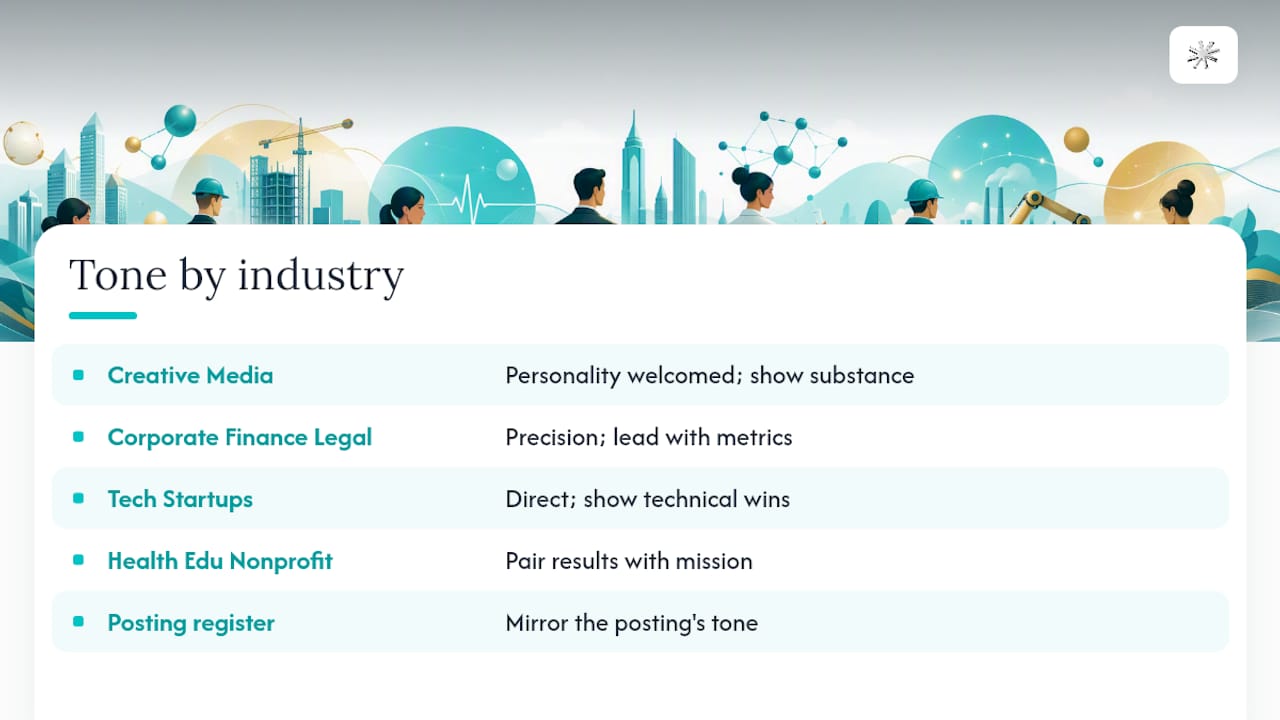
Matching Your Tone to the Industry You're Applying To
The same hook can land completely differently depending on the field, so calibrate your tone before you calibrate your content.
Creative and media industries tolerate, and often reward, more personality. A slightly conversational or even witty opener can work at a design agency or a media company in ways it wouldn't at a bank. That said, personality should never replace substance. A funny line with no real hook underneath still falls flat.
Corporate, finance, and legal fields reward precision and restraint. Skip the personality entirely and lead straight with a metric or a credential. These readers are evaluating judgment as much as skill, and an overly casual opener can read as a lack of professionalism.
Tech and startups sit in the middle. Directness matters more than formality. A short, confident opener that gets straight to a specific technical or product-related achievement tends to outperform anything that sounds like a form letter.
Healthcare, education, and nonprofit sectors respond well to openers that combine a concrete result with a clear sense of mission. Purely metric-driven openers can feel cold in these fields unless you pair the number with why it mattered to the people involved.
Whatever the industry, match the posting's own language register. A posting written in short, punchy sentences is telling you something about the culture. A posting full of formal, structured paragraphs is telling you something else.
How Long Should a Cover Letter Opening Be?
Your opening paragraph should run one to three sentences and be concise enough to maintain the reader's interest. Anything longer starts eating into the space you need for the proof paragraph that follows, and hiring managers are still deciding whether to keep reading during those first few lines.
Format matters as much as length. Keep your opening as a single, unbroken paragraph. Don't insert a line break or bullet point inside it. It should read as one clean thought, not a list disguised as prose.
A few format guardrails worth following:
- One idea per sentence. If your opening sentence needs a semicolon to hold together, split it into two shorter sentences instead.
- No headers or bold text inside the opening. Save formatting emphasis for skills sections or bullet-based achievement lists later in the letter.
- Avoid starting with "I." It's a minor stylistic point, but openers that lead with the role, the company, or a result read as more confident than ones that lead with the pronoun.
If your draft opening paragraph is pushing past four sentences, that's usually a sign you're trying to do the proof paragraph's job too early. Trim it back to the hook and the bridge, and let paragraph two carry the weight.
Adjusting Your Opening for Entry-Level, Mid-Career, and Senior Roles
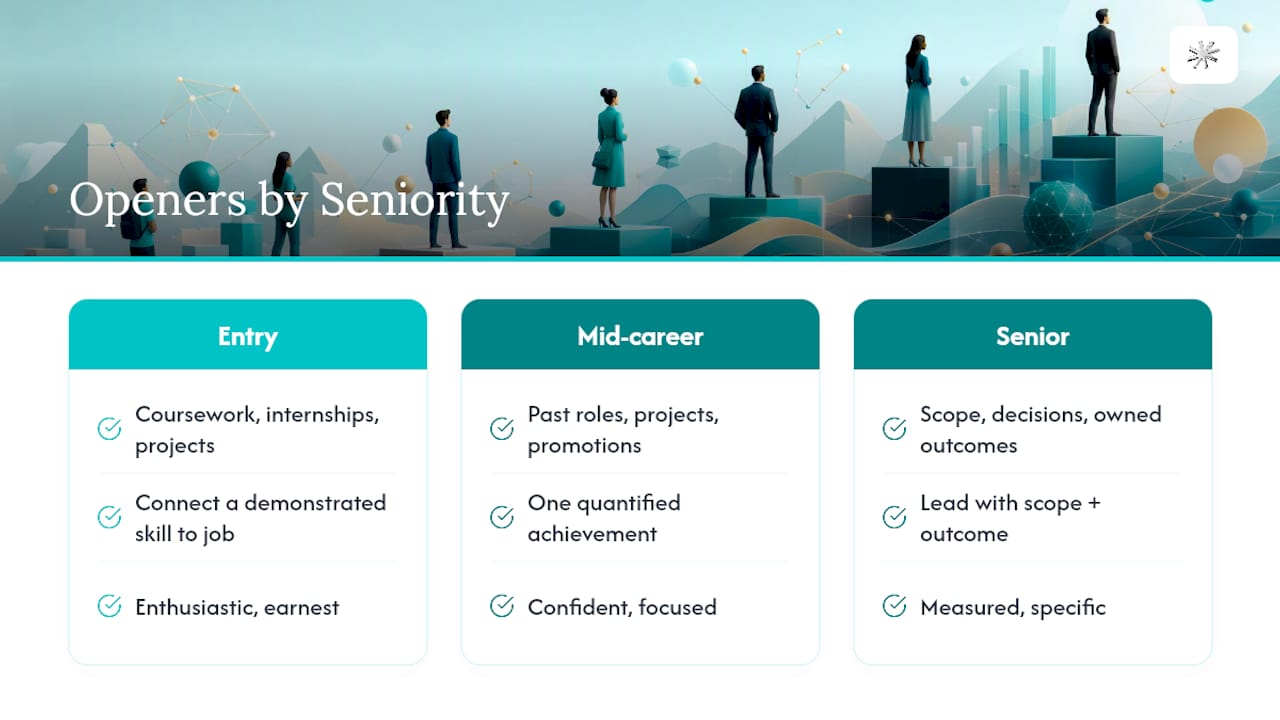
The seniority of the role should change what your hook leans on, even if the underlying formula stays the same.
Entry-level candidates often worry they have nothing to lead with. They usually do, it's just not sitting in a job title yet. Coursework, internships, volunteer leadership, and personal projects all work as hooks when you connect the skill demonstrated to the job's actual requirements, rather than just describing the activity.
Mid-career candidates have the easiest path here. A quantified achievement opener tends to work best, since there's usually a real number, project, or promotion to point to. The risk at this level is defaulting to a resume summary instead of a hook. Choose one specific result, not a list of three.
Senior candidates should lead with scope and outcome rather than task. A senior opener built around "I managed a team of six" undersells compared to one built around "I cut our department's turnover in half while managing a team of six." At this level, hiring managers are evaluating judgment and impact, not activity, so the opener should reflect decisions made and results owned.
Across every level, the tone should also shift slightly. Entry-level openers can carry more enthusiasm without it reading as naive. Senior openers should sound measured and specific, since over-enthusiasm at that level can actually undercut credibility rather than build it.
Working Job Description Keywords Into Your Opening
Job postings are full of language that applicant tracking systems, and human readers, are trained to look for. Your opening line is a natural place to work in a few of those terms, as long as they fit the sentence honestly.
Start by pulling three to five key terms directly from the posting: the job title itself, any named tools or methodologies, and the specific outcome the role is meant to drive. Then check whether any of those terms fit naturally into your hook without forcing it.
A posting for a "Senior Data Analyst" that mentions "SQL," "stakeholder reporting," and "reducing reporting turnaround" gives you real material: "I cut our stakeholder reporting turnaround by 30% using SQL-based dashboards I built from scratch, which is the exact problem your Senior Data Analyst posting describes."
That sentence works because the keywords aren't dropped in for scanning purposes. They're doing real descriptive work. Avoid stuffing keywords in a way that makes the sentence read like a list. If a term doesn't fit the sentence naturally, save it for your skills section or the body paragraphs instead. One well-placed keyword in an authentic sentence beats five crammed into an awkward one.
What Actually Separates a Strong Opener From a Forgettable One
Most cover letter advice treats openings like a creative writing exercise: find something clever, something memorable, something that stands out. That's the wrong frame, and it sends people chasing cleverness instead of relevance.
The openers that actually work aren't clever. They're specific. A number, a name, a real observation about the company beats a witty line every time, because specificity is what signals effort and fit, while cleverness just signals that you can write. Hiring managers aren't hiring writers in most roles. They're hiring problem solvers, and a hook built on a real result does more to prove that than any turn of phrase could.
Here's what conventional advice underweights: the bridge sentence at the end of your opening paragraph matters almost as much as the hook itself. A great hook followed by a paragraph that changes direction entirely feels disjointed, even if both pieces are individually strong. The reader should feel like they're following one argument, not reading two separate pitches stapled together.
If you take one thing from all of this, take the two-minute check. Read your first sentence alone, outside the context of the rest of your letter. If it could describe literally any candidate applying to literally any job, it's not ready yet.
— Shane
Try NueCareer's Free Tools to Draft and Test Your Opening
Writing a strong opener gets a lot easier once you know which strengths are actually worth leading with, and that's the piece most job seekers skip. NueCareer's 7-Minute Career Quiz identifies the strengths and career direction that make for a genuinely compelling hook, not just a generic one, before you even sit down to write.
From there, the Free Cover Letter Generator turns those insights into a tailored draft you can edit line by line, matched to the actual job posting instead of a one-size-fits-all template. Both tools are free to start. Take the quiz first, generate a draft opener from your results, then customize the hook with your own numbers and details before you send anything. If you want the full picture of where your strengths point career-wise, the quiz results connect to NueCareer's broader tool suite for resumes, interviews, and job matching too.
Sources
- How to start a cover letter: 14 opening lines that work — Workplacea
- How to Start a Cover Letter in 2026 · Jobscan
- Cover Letter Resources - University Career Center
- Resume
- How to write an effective cover letter (with samples) — MIT
FAQ
What's a good opening line for a cover letter?
A good opening line names the role and includes one specific, verifiable hook, like a metric, referral, or company-specific insight. Avoid generic statements like "I am writing to apply for" and lead instead with proof that couldn't apply to any other candidate.
Are cover letters outdated in 2026?
No. Most hiring managers still expect one, especially for competitive or mid-to-senior roles, and a strong opener remains one of the fastest ways to stand out from resume-only applicants. Cover letters have shifted toward shorter, more direct formats, but they haven't disappeared.
What five things should a cover letter include?
A complete cover letter typically includes a professional greeting, a strong opening paragraph that names the role and a hook, a body paragraph with quantified evidence, a closing paragraph with a call to action, and a professional sign-off. University career center guidance outlines this same core structure.
How do you start opening a cover letter?
Start with the correct greeting, ideally addressed to a named hiring manager, then move directly into a one-to-three-sentence opening paragraph. That paragraph should name the role, deliver a specific hook, and bridge to the evidence in your next paragraph, without wasting a sentence on introductions.