

Software development, data analytics, digital marketing, customer success, project management, and bookkeeping remain the most reliable remote friendly careers right now, spanning entry level and senior roles alike. Job postings favor candidates who can already prove remote competence, so your fastest move is to pick one category and either take The 7-Minute Career Quiz or start building one core skill this week. The Bureau of Labor Statistics still projects steady growth across most of these fields, which means the opportunity is real but only for people who approach it with a plan.
TL;DR:
- Remote roles in software development and data analytics favor candidates with proven experience, certifications, or portfolio work rather than just entry-level credentials.
- Most remote job listings now target experienced professionals, with only about 6% explicitly open to entry-level applicants, making practical proof of skills essential.
- Success in remote job searches relies heavily on niche job boards, early applications, and tailoring resumes to highlight remote-specific skills such as asynchronous collaboration and tool proficiency.
- Building real connections through online communities, LinkedIn activity, and virtual meetings is crucial for network growth without an office environment.
- Beware of scams that ask for payments or personal info early; verify company authenticity through official channels and look for clear remote workflow indicators in listings.
Table of Contents
- What Are the Best Remote-Friendly Career Categories?
- How Does Experience Level Affect Your Remote Job Options?
- How Do You Actually Find Remote Job Openings?
- Which Skills and Resume Changes Matter Most for Remote Roles?
- How Can You Spot a Remote Job Scam Before You Apply?
- What Other Skills Do Remote Workers Need Beyond Communication?
- What Are the Biggest Challenges of Working Remotely?
- What Legal and Tax Rules Apply to Remote Workers?
- What Career Growth Looks Like in Remote-Friendly Roles
- How Do You Build a Professional Network Without an Office?
- How Nuecareer Helps You Move From Exploring to Applying
- Shane's Take: Fit Beats Job Titles
- Sources
- FAQ
What Are the Best Remote-Friendly Career Categories?
Not every job translates well to a laptop and a Wi-Fi connection. The roles that do share a common trait: the output is a document, a line of code, a conversation, or a number, not a physical task tied to one location.
Software and product development leads the pack. Front-end developers, back-end engineers, and QA testers work asynchronously against shared codebases, using tools like GitHub and Jira to track progress without ever sitting in the same room.
Data and analytics roles follow closely. Data analysts, business intelligence specialists, and data scientists deliver dashboards and reports, work that depends on access to a database, not a desk.

Digital marketing and content roles, including SEO specialists, content writers, and social media managers, produce deliverables that live entirely online already.
Customer support and success teams increasingly work remote-first, using ticketing platforms and video calls to resolve issues from anywhere.
Project and product management roles coordinate teams through Slack, Asana, or Notion rather than hallway conversations.
Finance and bookkeeping round out the list. Accounts payable specialists, bookkeepers, and payroll administrators handle software-based ledgers that need no physical office.
- Software and product development (junior to senior roles both common)
- Data and analytics (BI analyst, data scientist, reporting specialist)
- Digital marketing and content (SEO, copywriting, social media)
- Customer support and success (support agent, success manager)
- Project and product management (coordinator to senior PM)
- Finance and bookkeeping (AP/AR, bookkeeper, payroll specialist)
Entry-level openings cluster in customer support, content, and bookkeeping. Engineering, data science, and product management skew toward candidates with two or more years of experience, according to role listings compiled by Indeed's remote jobs roundup.
How Does Experience Level Affect Your Remote Job Options?
The market has quietly shifted toward experienced hires, and pretending otherwise wastes your time. Remote job postings analyzed through Q1 2026 show that about 65% target experienced candidates, while only around 6% are explicitly labeled entry-level, according to Investopedia's analysis of remote jobs without a degree.
a majority of remote listings now target experienced professionals, while roughly 6% are open to entry-level applicants. The gap is real, but it is closable with the right proof points.
That does not mean the door is closed. It means you need something on paper that substitutes for years on a resume: a portfolio, a certification, a completed contract project.
Salary ranges vary widely by role and region. Bookkeepers and customer support agents often start in a moderate salary range, while experienced data analysts and product managers can earn significantly higher salaries, based on figures reported through FlexJobs and cited by Investopedia. The BLS Occupational Outlook Handbook remains the most reliable place to check projected growth and median pay for any specific occupation before you commit months of study to it.
Practical entry strategies that actually move the needle:
- Earn a focused certification (Google Analytics, HubSpot, CompTIA) rather than a broad degree
- Build two or three portfolio pieces that mirror real job tasks
- Take short contract or freelance gigs to generate a track record
- Find a mentor already working in your target category
How Do You Actually Find Remote Job Openings?
Generic job boards are crowded, and your application often disappears into a pile of hundreds. Niche remote job boards and a tighter search strategy change those odds.
- Start with specialized boards. Sites focused entirely on remote listings, like Remote, surface fewer but higher-quality postings than general search engines.
- Use LinkedIn's remote filter aggressively. Combine the "Remote" location filter with specific keywords tied to your target role, and save the search as a daily alert.
- Check company career pages directly. Many remote-first companies post openings there before they ever hit a job board.
- Set up alerts across three or four sources. A multi-channel search consistently outperforms mass-applying on one site, since it gets you in front of listings within hours of posting instead of days.
- Apply within 48 hours of a posting going live. Early applicants get more attention before a recruiter's inbox fills up.
- Tailor your top three resume bullets to remote-specific language each time, mentioning tools and independent ownership of deliverables.
Before you apply anywhere, look for these hiring signals that separate a real remote employer from a vague one: clear time zone expectations in the posting, mention of asynchronous workflows, and a written onboarding process you can ask about during the interview.
Pro Tip: Run every job description through a free tool like NueCareer's job description analyzer before you apply. It surfaces the exact keywords the employer is scanning for, which takes the guesswork out of tailoring your resume.
Which Skills and Resume Changes Matter Most for Remote Roles?
Employers hiring remotely are screening for one thing above all else: can this person work without being watched? That gets proven through specific language, not vague claims.
Prioritize these skills on your resume and in interviews:
- Written communication and async collaboration (Slack, email, Loom updates)
- Self-management and independent prioritization
- Proficiency with core tools: Zoom, Notion, Asana, Jira, Google Workspace
- Time zone awareness and scheduling flexibility
A resume line that says "Managed a team" says nothing. A line that says "Coordinated a five-person distributed team across three time zones using Asana and weekly async check-ins" says everything a remote hiring manager needs to hear.
Before and after examples worth stealing:
- Before: "Responsible for customer inquiries." After: "Resolved 40+ daily support tickets independently via Zendesk with a 95% satisfaction rating, no direct supervision required."
- Before: "Wrote marketing content." After: "Produced 12 SEO-optimized articles monthly while managing deadlines across four freelance clients in different time zones."
- Before: "Worked on data projects." After: "Built recurring dashboards in Tableau, delivered on a self-managed weekly schedule with zero missed deadlines."
A quick certification in your target tool, or a small portfolio project you can link directly in your resume, does more to prove remote readiness than another bullet point ever will. NueCareer's resume skills guide walks through exactly which phrases recruiters scan for first.
How Can You Spot a Remote Job Scam Before You Apply?
Scammers exploit the eagerness around remote work, and the patterns repeat often enough to be predictable. Any listing that asks you to pay for training materials, buy your own equipment upfront, or hand over banking details before an interview should be treated as a hard stop, per guidance from USU Extension's remote job scam checklist.
- Guaranteed high pay with no interview or skills check
- Requests for payment, gift cards, or personal financial details early in the process
- Vague job descriptions with no named manager or team
- Communication only through text or personal messaging apps, never a company email
Before accepting anything, verify the company's domain matches its official site, search for real employees on LinkedIn, and ask directly about onboarding steps and equipment policy. If you have already lost money, report it to the FTC and your state attorney general's office right away.
What Other Skills Do Remote Workers Need Beyond Communication?
Communication gets the spotlight, but it is not the only skill separating people who thrive remotely from people who burn out or get let go within a few months.
Time management sits right behind it. Nobody is checking whether you are at your desk at 9:00 AM, which means the responsibility for pacing your own day shifts entirely onto you. Workers who build a fixed daily structure, blocking focus time and meeting time separately, consistently outperform those who let their calendar dictate the day reactively.
Digital literacy matters more than most people expect going in. You do not need to code, but you do need to move comfortably between a shared drive, a project management board, a video call platform, and a messaging app, often within the same hour. Struggling with basic tool navigation slows a team down and gets noticed fast.
Collaboration tool proficiency deserves its own line on your resume, not just a mention. Knowing how to structure a Notion workspace, thread a Slack conversation properly, or leave a useful comment in Google Docs signals you can plug into a team without a training period.
Adaptability rounds it out. Remote teams change tools, processes, and sometimes managers more often than in-office teams do, simply because there is less friction to making a switch.
What Are the Biggest Challenges of Working Remotely?
Isolation is the challenge nobody warns you about loudly enough. Working alone for eight hours a day removes the small social exchanges that break up an office day, and that absence catches up with people after a few months, not a few days.
Work-life balance cuts the opposite direction from what people expect. Instead of leaving work at the office, work quietly follows you into every room of your home unless you build boundaries on purpose. Setting a hard stop time and communicating it to your team protects you more than any productivity app does.
Home office setup affects both your output and your health. A dedicated space, even a small one, with a proper chair and a second monitor if you can manage it, reduces physical strain and mental fatigue in ways that working from a couch cannot match over a full year.
The fix for isolation is rarely dramatic. Scheduling one or two recurring video calls a week with coworkers, joining an online community tied to your field, or working from a coffee shop occasionally all chip away at the problem without requiring you to go back to an office.
What Legal and Tax Rules Apply to Remote Workers?
Where you physically sit when you work determines a surprising amount of your legal and tax situation, more than most new remote workers realize.
State income tax rules vary based on your state of residence, and some states have reciprocity agreements while others do not. If you move states while keeping the same remote job, you are responsible for understanding how your new state taxes your income, and your employer's payroll department needs that update immediately, not months later.
Employment law also follows your location, not your employer's headquarters. Overtime rules, meal break requirements, and workers' compensation eligibility are generally governed by the state where you physically perform the work.
If you take on remote work as an independent contractor rather than an employee, the tax picture changes further. Contractors handle their own self-employment tax and estimated quarterly payments, unlike employees who have taxes withheld automatically. A tax professional familiar with remote and multi-state situations is worth the cost the first year you navigate this, since getting it wrong creates problems that follow you into the next filing season.
What Career Growth Looks Like in Remote-Friendly Roles
Remote does not mean static. Companies that hire remote-first still promote from within, and in some cases they promote faster, because performance gets measured by output rather than visibility in a hallway.
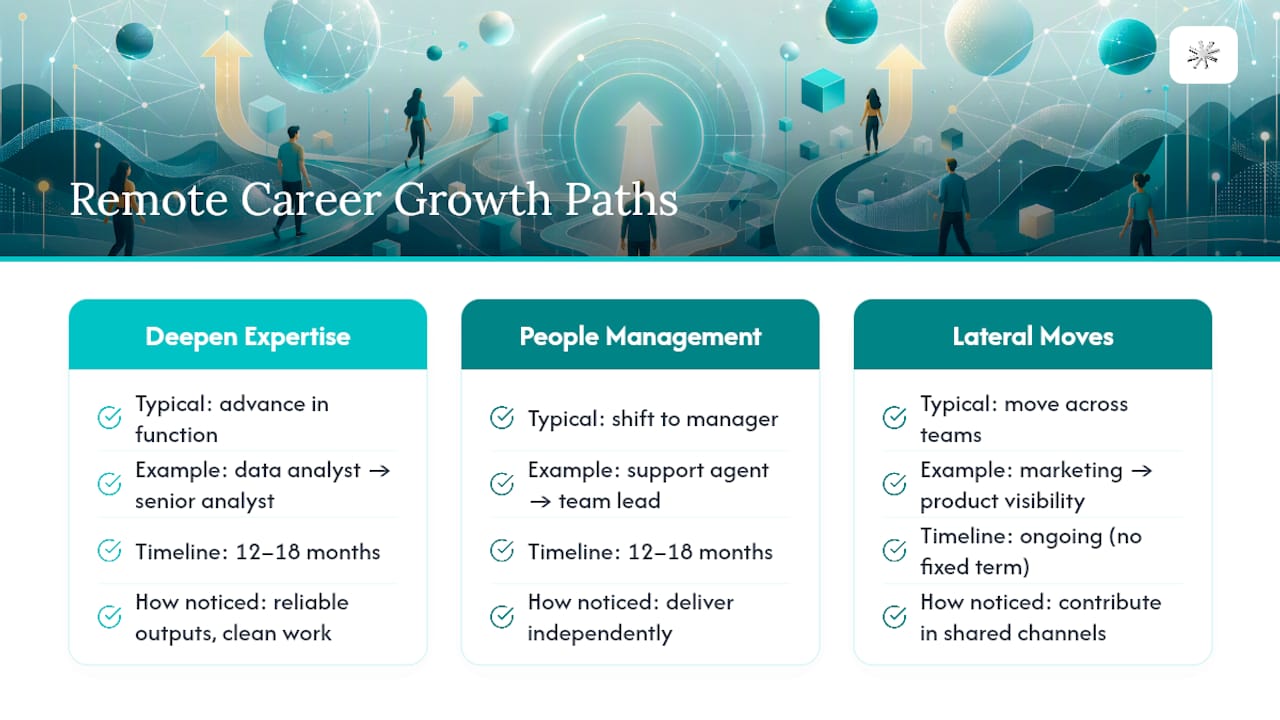
Growth in remote roles tends to follow two tracks: deepening expertise in your current function, or shifting into people management once you have proven you can deliver independently. A customer support agent who documents processes well often becomes a support team lead within 12 to 18 months. A data analyst who builds a reputation for clean, reliable dashboards moves into a senior analyst or BI lead role on a similar timeline.
Lateral moves happen more easily in remote-friendly companies too. Since teams already collaborate across departments through shared tools, an employee in marketing can build visibility with the product team simply by contributing well in shared channels, something far harder to do in a siloed office environment.
The clearest path to advancement is consistent, visible output paired with initiative that goes slightly beyond your job description. Volunteering to document a process, mentor a new hire over video calls, or lead a cross-functional project gets noticed in remote settings precisely because it stands out against the default of just doing your assigned tasks.
How Do You Build a Professional Network Without an Office?
Networking without hallway conversations or lunch meetings feels harder at first, but remote professionals who build real connections usually do it through a small number of consistent habits, not constant effort.
Join industry-specific online communities tied to your field, whether that is a Slack group for marketers or a forum for developers, and contribute occasionally rather than lurking. Comment thoughtfully on posts from people in roles you want, since that visibility compounds over months.
Keep your LinkedIn profile active with genuine updates about projects you have completed, not generic motivational posts. Recruiters and hiring managers browsing remote candidates check activity as a proxy for engagement.
Schedule occasional virtual coffee chats with people in your target industry. A short, specific message asking for 15 minutes of someone's time to hear about their role gets a far better response rate than a generic connection request.
Attend virtual conferences or webinars tied to your field when they are free or low-cost, and follow up with one or two people afterward instead of trying to connect with everyone in the chat.
How Nuecareer Helps You Move From Exploring to Applying
Choosing among software development, data analytics, marketing, and a dozen other remote paths gets easier with a structured starting point instead of open-ended research. The 7-Minute Career Quiz matches your actual strengths against real remote-friendly career paths, including options you may not have considered, and hands you a prioritized list of the skills worth building first.
From there, Nuecareer builds a personalized roadmap for your specific target role, gives you 24/7 coaching chat when you get stuck on a decision, and curates job boards so you are not sifting through irrelevant postings. The platform's resume and cover letter tools, including a free skills assessment and a cover letter generator, help you turn a vague sense of "I could do remote work" into an application that actually gets a response. Take the quiz now and see which remote career paths fit who you already are.
Shane's Take: Fit Beats Job Titles
After years watching people chase remote job titles instead of remote-ready skills, the pattern is consistent: fit and demonstrable competence get people hired faster than any resume keyword ever does. Stop hunting for the "right" title and start proving you can do the work independently. That shift alone changes your results.
— Shane
Sources
- 12 remote job scam red flags / job-search resource hub
- High-paying remote jobs you can get without a college degree — Investopedia
- U.S. Bureau of Labor Statistics — Occupational Outlook Handbook
FAQ
What Is the Best Career to Work Remotely?
There is no single best career, but software development, data analytics, and digital marketing consistently offer the most remote openings across experience levels, according to Indeed's remote jobs data. The better question is which of these fits your existing strengths, which The 7-Minute Career Quiz can help you answer directly.
How Can I Make $2,000 a Week Working From Home?
Reaching that income level typically requires an experienced-level remote role in tech, data, or specialized marketing, or a freelance/contracting setup with multiple clients. Entry-level remote positions rarely hit that figure immediately, since remote listings currently skew toward experienced hires.
What Is the Easiest Remote Job to Get Hired For?
Customer support, entry-level bookkeeping, and content writing roles tend to have the most accessible entry points, since they require fewer years of prior experience than engineering or product management. Building even a small portfolio in one of these areas significantly improves your odds.
Will Amazon Really Pay You to Work From Home?
Amazon does hire for legitimate remote positions in areas like customer service and virtual support, but any listing asking for payment, personal financial details, or purchase of equipment before an interview is a scam, not a real Amazon posting. Always verify openings directly on Amazon's official careers site rather than through a third-party link or unsolicited message.