
Send Thanks in 24 Hours: Interview Follow Up Email Templates

Send a thank-you within 24 hours, keep it under 200 words, and stop after two follow-ups. Ready templates, timing rules, and a quick generator to save you...
Send a thank-you email within 24 hours of your interview, and keep it under 200 words. Reference one specific moment from the conversation, restate your fit in a single line, and close without pressure. If the employer gave no decision date, wait five to seven business days before checking on your status, and cap your total follow-ups at two beyond that first thank-you.
TL;DR:
- Waiting five to seven business days after the decision date or interview is crucial before the first follow-up, to avoid seeming impatient.
- Keep follow-up emails concise, under 200 words for thank-you notes and 150 words for status checks, ensuring clarity and engagement.
- Personalize each message by referencing a specific moment from the interview, avoiding generic or copy-pasted messages to stand out.
- Limit follow-ups to two messages beyond the initial thank-you, as additional contacts often appear anxious or pushy and can harm your chances.
- Sending a thank-you email within 24 hours and a brief, polite follow-up ensures you stay visible without overstepping boundaries.
Table of Contents
- When to Send an Interview Follow-Up Email
- How to Write an Effective Follow-Up Email
- Follow-Up Email Templates for Every Stage
- What to Do If You Hear Nothing Back
- Personalizing Your Message Without Overdoing It
- Why Career Experts Still Recommend the Thank-You Email
- Phone and Video Interviews vs. In-Person: What Changes
- Common Mistakes That Undercut a Good Follow-Up
- Following Up on Promised Materials or Information
- A Quick Note From the Author
- Write Your Follow-Up in Minutes With NueCareer
- Sources
- FAQ
When to Send an Interview Follow-Up Email
The 24-hour window is not arbitrary. Career centers and hiring experts consistently point to same-day or next-morning delivery as the standard, because it lands while your conversation is still fresh in the interviewer's memory and shows you can move fast under pressure. If your interview happened at 4:00 PM, send that night is fine, but the next morning works just as well if you'd rather sleep on the wording — see tips in How to Write Chinese Emails for Professional Success.
After the thank-you, timing shifts to patience. Here's the rule set career coaches use most often:
- Thank-you email: within 24 hours, same day or next morning
- First status check: if the employer gave a decision date, wait until that date passes plus 2 to 3 business days; if no date was given, wait five to seven business days
- Second follow-up: about one week after the first status check
- Hard stop: no more than two follow-ups total after the thank-you
Why the ceiling? Repeated messages within a short window read as anxious rather than diligent, and hiring managers who are still deliberating internally have nothing new to tell you. A simple rule of thumb that career advisors repeat often: thank-you within a day, one status check when the timeline passes, one last nudge a week later, then stop. Two thoughtful messages keep you visible. A third usually works against you.
How to Write an Effective Follow-Up Email
Your subject line decides whether the email gets opened before it gets read. Use one of these patterns depending on the message type:
- Thank-you: "Thank You, [Name], for the [Job Title] Conversation"
- Status check: "Checking In: [Job Title] Application"
- Reply-in-thread: skip a new subject line entirely and reply directly to the original interview invite, since keeping the thread intact preserves context the hiring manager already has open
Once the subject line lands, the body should follow a tight three-part structure. Open with a specific thank-you that names something you actually discussed, not a generic "thanks for your time." Add one line reconnecting your background to what the role needs. Close with a low-pressure offer, something like making yourself available for anything else they need, rather than asking directly when you'll hear back.
Length matters more than most jobseekers assume. Keep a thank-you email under 200 words so it reads easily on a phone screen, and keep a status-check email under 150 words, since its only job is to remind, not to reargue your case. Before you hit send, read the message once out loud. Apologetic phrases like "sorry to bother you" or "I know you're busy" weaken the message and should come out entirely.
Pro Tip: Draft your thank-you email the moment you get back to your car or close your laptop, while the interviewer's exact words are still in your head. You can always polish the wording later, but you can't recreate that specific detail after two days pass.
Follow-Up Email Templates for Every Stage
Templates work best as a starting frame, not a script to copy word for word. Swap in the specific project, question, or detail that actually came up in your conversation.
- Thank-you email: "Hi [Name], thank you for taking the time to talk with me about the [Job Title] role today. I especially enjoyed our conversation about [specific topic]. It reinforced how well my background in [relevant skill] fits what your team needs right now. Please let me know if there's anything else I can provide as you move forward. Looking forward to hearing from you."
- Panel thank-you: send each interviewer a separate note referencing something unique to your exchange with them; if you only have one contact's email, ask that person to pass your thanks along to the rest of the team.
- First status check: "Hi [Name], I wanted to check in on the [Job Title] role I interviewed for on [date]. I remain very interested in the opportunity and happy to provide anything further that would help with your decision."
- Second follow-up: "Hi [Name], following up once more on the [Job Title] position. I understand hiring decisions take time, and I wanted to reaffirm my interest while the search is still open."
- Networking-close after a "no": "Thank you for letting me know. I enjoyed learning about [Company] and would welcome staying connected for future openings that fit my background."
What to Do If You Hear Nothing Back
Silence past your final follow-up is usually an answer in itself, even when it feels unsatisfying. Send the first status check once the stated timeline passes, or after about a week if no timeline was given at all.
- Send one status check when the promised timeline passes (plus 2 to 3 business days) or after roughly a week with no timeline
- Send one final, brief nudge about a week after that first check
- Keep both messages short, specific, and free of pressure language
- After the second follow-up goes unanswered, treat it as a close and redirect your energy elsewhere
Two polite check-ins are the professional norm. A third message rarely changes an outcome and can cost you goodwill for future openings at the same company.
Personalizing Your Message Without Overdoing It
Pick one specific moment from the interview and build your entire message around it. Maybe the interviewer mentioned a project launching next quarter, or asked a question that let you tell a story you were proud of. That single reference does more to make you memorable than any amount of general enthusiasm.
If you need to clarify something you answered poorly, do it in one brief sentence rather than re-explaining the whole exchange. Attach a work sample only when it's directly relevant, and name the file clearly so it's obvious what the hiring manager is opening.
What to leave out matters just as much. Guilt, urgency, or repeated messages that sound entitled to a faster answer all work against you. If you forgot to send a thank-you the same day, send a genuine one late rather than skipping it, and skip the over-apologizing when you do.
Pro Tip: If you're torn between two details to mention, pick the one only you would know to bring up, something specific to your conversation rather than something you could have learned from the job posting.
Why Career Experts Still Recommend the Thank-You Email
The 24-hour rule and the two-follow-up ceiling aren't guesswork. Career centers at institutions like Swarthmore continue to teach thank-you notes as a strategic move rather than an outdated courtesy, because they reinforce fit and show follow-through recruiters actually notice.
- Career coaches frame follow-ups as low-pressure signals of continued interest, not persuasion tactics
- Personalized notes to each panel interviewer outperform one identical message sent to everyone
- NueCareer's Interview Follow-Up Email Generator speeds up the drafting so you spend your time on the specific detail, not the boilerplate
- The 7-Minute Career Quiz helps you word your fit reminder around strengths you may not have realized to lead with
Phone and Video Interviews vs. In-Person: What Changes
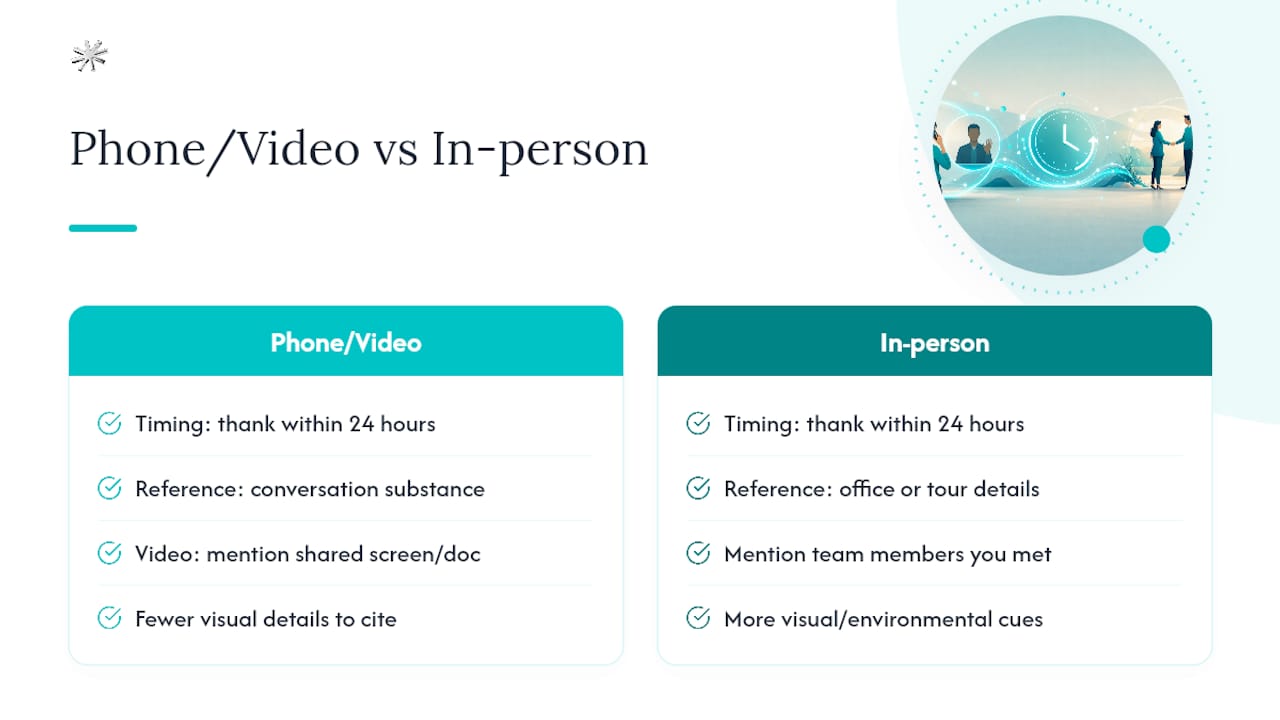
The timing rules stay identical no matter the format. A phone screen, a video call, and an in-person panel all get a thank-you within 24 hours. What shifts is what you have to reference.
After a phone or video interview, you often have fewer visual or environmental details to draw on, so lean on the substance of the conversation itself: a specific question they asked, a challenge they described, or a follow-up point you wish you'd expanded on. Video calls sometimes include a shared screen or document walkthrough, which gives you a concrete detail to mention that a phone call wouldn't offer.
In-person interviews usually hand you more material. You might reference the office environment, a team member you met in passing, or something the interviewer showed you during a tour. Use that. It signals you were present and paying attention beyond just answering questions.
One practical difference: in-person interviews often involve multiple people back to back, which means panel etiquette applies more often. Send separate, personalized notes to each interviewer rather than one group email, and if you only got contact information for the main point of contact, ask them to relay your thanks to the rest of the team. Phone and video interviews are more likely to be one-on-one, which simplifies your follow-up to a single note. Either way, the core formula doesn't change: specific detail, brief fit reminder, low-pressure close.
Common Mistakes That Undercut a Good Follow-Up
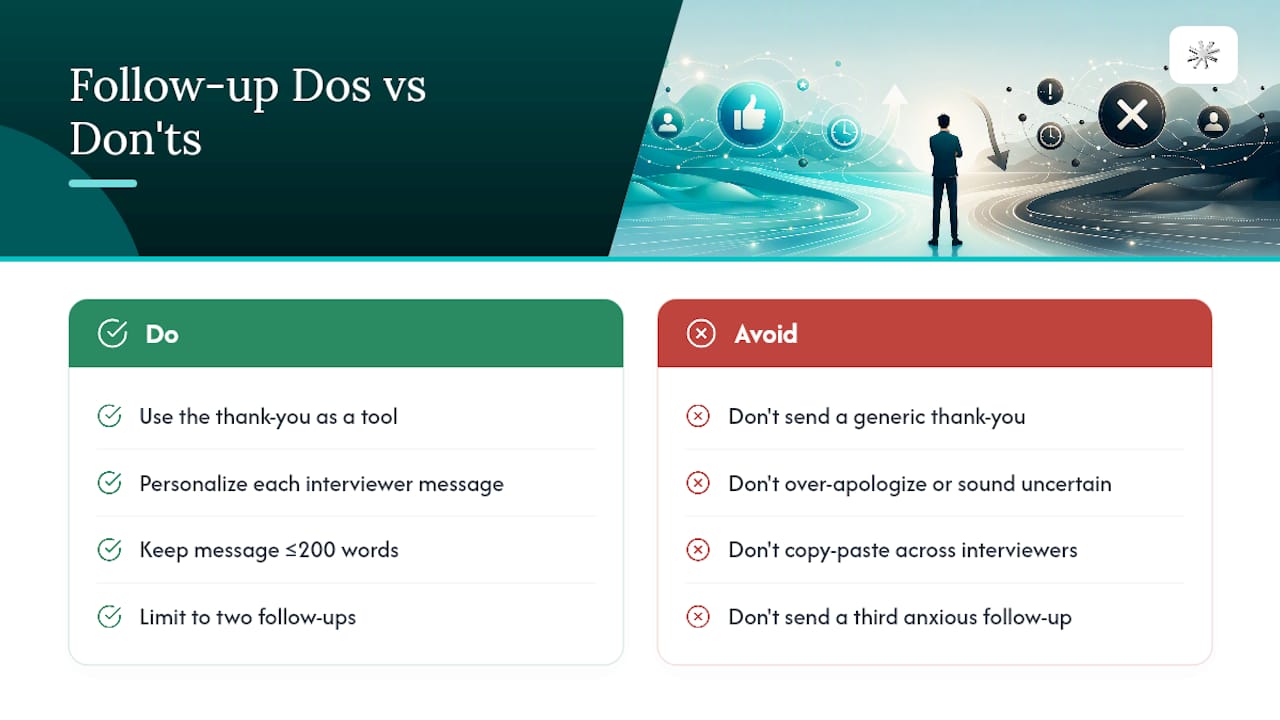
The most common mistake is treating the thank-you email as a formality instead of a tool. A generic "thank you for your time, I look forward to hearing from you" message gets forgotten within minutes because it says nothing the interviewer couldn't guess you'd write.
Over-apologizing is a close second. Phrases like "sorry to bother you again" or "I know you must be busy" don't read as polite, they read as uncertain, and they draw attention to the interruption instead of the value you're offering. Cut them entirely.
Sending identical messages to multiple interviewers after a panel is another frequent misstep. Recruiters compare notes more often than candidates expect, and a copy-pasted message across two or three people signals low effort rather than diligence.
Length is a quieter problem. A thank-you email that runs past 200 words buries your one important point under paragraphs the hiring manager will skim past on a phone screen. Trim ruthlessly. Every sentence should earn its place.
Finally, sending too many follow-ups is the mistake most likely to damage your candidacy outright. Two thoughtful messages beyond the thank-you is the practical ceiling. A third message, sent out of anxiety rather than new information, tends to read as pressure rather than persistence.
Following Up on Promised Materials or Information
If an interviewer said they'd send you something, a job description clarification, a salary range, or details on next steps, your follow-up email is the natural place to acknowledge it, not chase it down aggressively.
If you promised the interviewer something instead, a portfolio sample, a reference list, a writing sample, include it in your thank-you email rather than sending a separate follow-up later. Name the attached file clearly, keep it to one relevant item, and mention it briefly in the body rather than making it the focus of the message. A hiring manager juggling multiple candidates is more likely to open a single, well-labeled attachment than a message with several links competing for attention.
If the employer promised something and hasn't delivered it by the time you're ready to send your status check, a brief, polite reference works better than a pointed request. Something like acknowledging you're looking forward to the additional details they mentioned, folded into your existing status-check message, does the job without turning the follow-up into a demand.
A Quick Note From the Author
Follow-up emails are a small habit, not a persuasion campaign. The candidates who benefit most treat them as one brief, well-timed signal of interest, then let the process play out.
— Shane
Write Your Follow-Up in Minutes With NueCareer
NueCareer's Interview Follow-Up Email Generator turns the timing rules and templates above into a finished draft in a couple of minutes, so you spend your energy on the one specific detail that makes your note memorable instead of wrestling with subject lines and word counts.
If you're still not sure your resume and interview answers are pointing at the right roles in the first place, the 7-Minute Career Quiz is worth five minutes before your next application round. It matches your strengths to career paths you might not have considered, which makes the "fit reminder" line in your follow-up easier to write with real conviction instead of guesswork. Try the free generator on your next interview and see how much faster the draft comes together.
Sources
This guide draws on timing and wording standards published by university career centers, including Swarthmore, the University of Wyoming's Haub School career resources, and the University of Kentucky's Pigman Center, alongside hiring-manager perspective from Forbes Coaches Council.
- 12 follow-up email templates for every work situation
- How to Write a Second Follow-up Email After an Interview (Examples Included!)
- How to Write a Thank-You Email After an Interview in 2026 (With Examples) – Career Center | Swarthmore College
- When and How to Follow Up After an Interview (2026 Guide)
FAQ
How Do You Politely Ask About Interview Status?
Send a brief email that reaffirms your interest and asks whether there's an update, without demanding a specific answer. Something like "I wanted to check in on the [Job Title] role, I remain very interested and happy to provide anything further" does the job without pressuring the hiring manager.
How Long Should I Wait Before Following Up After an Interview?
If the employer gave a decision date, wait until it passes plus 2 to 3 business days. If no date was given, wait five to seven business days before your first status check.
What Are the Signs Your Interview Went Well?
Strong signs include the interviewer discussing next steps in detail, introducing you to other team members, or asking about your availability and timeline. None of these guarantee an offer, but they typically indicate genuine interest worth following up on politely.
What's the Biggest Red Flag to Hear in an Interview?
Vague or evasive answers about the role's day-to-day responsibilities, high turnover mentioned without explanation, or an interviewer who can't clearly describe what success looks like in the position are common warning signs. If you notice one, it's worth asking a direct follow-up question in the interview itself rather than waiting for your thank-you email to raise it.
How Many Follow-Up Emails Should I Send After an Interview?
Send one thank-you within 24 hours, then no more than two additional follow-ups: a status check and one final nudge about a week later. Beyond that, treat continued silence as your answer and redirect your search elsewhere.