
9 Steps to Move From Freelance to Full Time, Plus 7 Minute Career Quiz

A 9 step plan to move from freelance to full time. Turn projects into resume bullets, compare offers, and take a 7 minute career quiz to target the right...
Switching from freelance to full-time work makes sense when you want steady benefits, team ownership, and a built-in path for growth. It's worth staying freelance when autonomy or earning potential still outweighs those perks. Freelance experience is valid, widely represented work history, not a resume liability. This guide walks through the decision, the step-by-step plan, and a checklist for evaluating any offer you receive.
TL;DR:
- Moving to full-time work is ideal if you want predictable income, employer benefits, and clearer promotion paths, especially if freelancing no longer provides sufficient stability.
- Success depends on carefully assessing your skills, tailoring your resume to employer language, and applying selectively to roles that match your freelance experience.
- Evaluate offers holistically by analyzing total compensation, benefits, and contract clauses, not just the salary number, and confirm enrollment periods and legal conditions before accepting.
- Transition planning includes building a cash buffer, wrapping up client projects, and clarifying benefits to avoid gaps and support financial stability during the switch.
- Adjusting to structured employment requires reframing your mindset, establishing new routines, and proactively fostering team relationships to succeed in a more collaborative environment.
Table of Contents
- Why move: pros, cons, and decision checkpoints
- Step-by-step transition plan: define target role to accepted offer
- Convert freelance projects into resume bullets and interview stories
- How to evaluate offers: pay, benefits, and contract terms
- Timeline and money checklist for the handoff
- Managing the mindset shift from freelance autonomy to structured employment
- Navigating changes in work-life balance and daily routine
- Understanding benefits and legal implications of full-time work versus freelance
- Building professional relationships and team integration strategies
- Planning for career growth and development within a full-time role
- Reframing the move: an editorial take on freelance to full-time
- Try NueCareer: quick next steps
- Sources
- FAQ
Why move: pros, cons, and decision checkpoints
Full-time employment offers a few things freelancing rarely does: predictable income, structured mentorship, and a seat at the table when decisions get made. You also gain access to employer-sponsored benefits, which can be worth more than they first appear once you add up health coverage, retirement matching, and paid leave.
What you give up is real too. Freelancing typically means:
- Full control over your schedule and workload
- The freedom to work with a rotating mix of clients and projects
- No one else dictating how or where you do your work
A large majority of full-time civilian workers had access to employer medical and retirement benefits as of early 2025. Those figures matter because benefits are compensation you don't have to source, price, or manage yourself, which is a meaningful shift if you've spent years buying your own health plan.
Before you commit, run through a short set of decision checkpoints. Ask yourself whether you're chasing benefits you can't easily replicate alone, whether you want a clearer runway for promotions and skill-building, whether income unpredictability has become a genuine source of stress, or whether you'd resent a fixed schedule and less say over your projects. If the first three resonate more than the last, full-time is probably the right direction.
Pro Tip: If you're unsure, look for a contract-to-hire role or a part-time staff position first. It lets you test structured employment without fully closing the door on freelance work.
Step-by-step transition plan: define target role to accepted offer
Moving from freelance to full-time goes smoothly when you treat it like a project with milestones, not a vague hope that the right job will appear. Here's the sequence that keeps you organized.
- Define your target role and short list of companies. Narrow down to two or three job titles and five to ten companies that fit your skills and interests, rather than applying broadly and hoping something lands.
- Audit your freelance skills against the role. List what you actually did (client management, scoping, delivery, tools used) and map each skill to the requirements in real job postings.
- Build a master resume. CareerOneStop recommends keeping one long master resume that holds every project, metric, and STAR statement you've collected, so you're never starting from scratch when a new posting appears.
- Tailor a resume and cover letter for each application. Pull the relevant bullets from your master resume and reorder them to match the posting's language, a tactic CareerOneStop's resume strategies frame as matching your document to the job rather than the other way around.
- Reach out before you apply. A short message to someone at the company, even a former client or collaborator, often does more than a cold application.
- Prioritize applications by fit, not volume. Spend your energy on the roles where your freelance background maps cleanly onto the job description.
- Prepare for interviews on a set schedule. Block time each week to rehearse your STAR stories rather than cramming the night before.
- Balance freelance commitments while you interview. Keep existing clients informed of your availability so you're not scrambling to juggle a final deliverable against a second-round interview.
- Negotiate and accept deliberately. Compare the full offer (not just salary) against your current freelance income before saying yes.
A few smaller tasks round out the plan:
- Keep a running folder of client testimonials, metrics, and finished deliverables as you go, not after you need them.
- Set a realistic interview timeline: two to four weeks for a first conversation, often another two to six weeks before an offer.
- Give existing clients a clear handoff date once you accept, and resolve any open invoices before your start date.
- Confirm your new employer's benefits enrollment window so you're not left uncovered between freelance and full-time coverage.
Pro Tip: Treat your job search like a client project. Track every application, follow-up, and interview date in a simple spreadsheet so nothing falls through the cracks while you're also delivering freelance work.
This sequencing matters because rushing step four (tailoring) or skipping step two (the skills audit) is where most freelancers lose momentum. You end up sending generic applications that don't show hiring managers you've already done the job they're trying to fill, just under a different business card. If you want a longer walkthrough of this process, NueCareer's step-by-step career change guide covers the same sequence in more depth, and the career transition timeline gives a realistic week-by-week view of how long each stage tends to take.
Convert freelance projects into resume bullets and interview stories
Hiring managers don't automatically see freelance work as team experience. Your job is to translate it, and a master resume is the tool that makes translation fast instead of painful.
Group your freelance projects by outcome and function rather than by client name. A hiring manager scanning your resume cares less about which company you worked with and more about whether you managed budgets, led a redesign, or improved a process. CareerOneStop's master resume guidance recommends storing every project this way so you can pull the right grouping for each posting without rewriting from scratch.
Here's what that translation looks like in practice.
Freelance line: "Wrote blog content for small business clients."
Employer-focused STAR bullet: "Partnered with five small business clients to plan and write monthly content calendars, coordinating with each client's marketing lead to align messaging with campaign goals and increase average blog engagement."
The second version names the collaboration, the coordination, and the outcome, exactly what a hiring manager is scanning for when they wonder whether you can work inside a team.
The same logic applies in interviews. If you're asked about a time you handled conflicting priorities, don't just describe the freelance chaos. Frame it around coordination: "I was managing deliverables for three clients in the same week. I communicated clear timelines to each stakeholder, renegotiated one deadline transparently, and delivered all three on schedule." That answer signals planning and stakeholder management, not just solo hustle.
Before you start applying, gather these artifacts from past clients and projects:
- Specific metrics tied to your work (traffic, revenue, time saved, error rates reduced)
- Written testimonials or thank-you notes you can paraphrase into resume language
- Finished deliverables you can reference in a portfolio or interview
- Any instance where you coordinated with other contractors, vendors, or a client's internal team
Communication, critical thinking, and self-management are transferable skills that CareerOneStop's resume strategies specifically call out as worth highlighting explicitly, since a hiring manager won't infer them from a job title alone. For more on turning freelance work history into resume language that gets interviews, see NueCareer's resume tips for career changers.
How to evaluate offers: pay, benefits, and contract terms
A salary number alone tells you very little about whether a full-time offer actually beats your current freelance income. You need to look at the whole package.
Start with total compensation: base salary, any bonus structure, employer contributions to health insurance, retirement matching, paid time off, and any training or professional development budget. Then factor in costs the offer might change, like commuting or childcare, since those can quietly erode a salary bump.
Benefits access data gives you a useful reference point. Eighty-nine percent of full-time workers have access to medical benefits and 79% have access to retirement benefits, but access isn't the same as take-up. Ask what you'd actually pay before assuming the benefit is free money.
Before signing, check the contract or offer letter for:
- Noncompete or nonsolicitation clauses that could limit future freelance or consulting work
- IP assignment language, especially if you plan to keep any personal projects
- Moonlighting policies if you want to keep a small freelance client on the side
- Probation period length and what happens to benefits during it
- Reimbursement policies for equipment, software, or travel
Pro Tip: Ask HR directly when benefits enrollment begins and whether there's a waiting period. A 30 to 90 day gap in coverage is common and worth planning your cash buffer around.
If something feels unclear, ask. A reasonable employer expects questions about compensation structure, review timelines, and remote or hybrid flexibility before you sign.
Timeline and money checklist for the handoff
Give yourself a buffer, not just an acceptance date. A gap between your last freelance payment and your first full-time paycheck is normal, and planning for it keeps the transition from feeling like a financial scramble.
- Build a cash buffer covering one to two months of expenses before your start date, since payroll timing varies by employer.
- Keep detailed records of freelance income and expenses for your final tax year as a contractor, including any estimated quarterly payments you've already made.
- Send final invoices to clients before your last freelance day, and confirm expected 1099 forms will arrive by the following January.
- Notify clients with enough lead time to transition smoothly, offering a referral to another freelancer when possible to preserve the relationship.
- Confirm your new employer's benefits enrollment window so there's no coverage gap between freelance and employee insurance.
A simple three-month example: month one, finalize your target roles and master resume. Month two, apply, interview, and negotiate. Month three, give client notice, wrap outstanding projects, and start the new role with a cash buffer already in place. NueCareer's career change roadmap walks through a similar timeline in more detail if you want milestone-by-milestone guidance.
Managing the mindset shift from freelance autonomy to structured employment
The hardest part of this transition often isn't logistical, it's psychological. As a freelancer, you've been the one setting priorities, choosing clients, and deciding how your day unfolds. A full-time role hands some of that control to a manager, a team, and a calendar full of recurring meetings.
Reframe this rather than resist it. You're trading daily autonomy for structural support: mentorship, clearer feedback loops, and the chance to go deep on one problem instead of context-switching between five clients. Give yourself permission to feel the adjustment without treating it as evidence you made the wrong call.
It helps to set expectations early with your manager about how you like to work, while staying genuinely open to the team's existing rhythms. The freelancers who adjust fastest are the ones who treat the first 90 days as a two-way learning period rather than trying to recreate their old independence inside a new structure.
Navigating changes in work-life balance and daily routine
Freelancing often blurs the line between work and life in both directions: you might work odd hours, but you also answer client emails at 9 p.m. without a second thought. Full-time employment usually draws a firmer boundary, which can feel both freeing and restrictive.
Expect a real adjustment period for your daily routine. Fixed hours mean less flexibility for mid-day appointments or spontaneous breaks, but they also mean your evenings and weekends are more reliably your own, once you build the habit of logging off.
Build new routines deliberately instead of hoping they emerge on their own. Set a consistent wake time, a commute or transition ritual if you work remotely, and a clear end-of-day cutoff. Many former freelancers find the predictability, once they adjust to it, actually reduces the low-grade anxiety of never quite knowing when the workday ends.
Understanding benefits and legal implications of full-time work versus freelance
The legal and financial structure of your work changes substantially when you move from contractor to employee, and it's worth understanding the basics before you sign anything.
As an employee, your employer withholds income tax and pays half of your Social Security and Medicare taxes, something you previously covered entirely yourself as a freelancer. You also become eligible for benefits like employer-sponsored health insurance and retirement plans, protections under workplace safety and anti-discrimination laws, and potentially unemployment insurance if the role ends.

Freelancers, by contrast, operate as independent contractors: you set your own rates, manage your own tax payments, and generally aren't covered by the same workplace protections. Independent contractors made up 7.4% of total employment as of July 2023, a meaningful share of the workforce operating under this different set of rules.
Review your offer letter for how it classifies your role, confirm your start date for tax withholding purposes, and keep your final freelance-year records organized in case questions come up later.
Building professional relationships and team integration strategies
Freelancers build relationships with clients, but full-time roles ask you to build relationships with colleagues you'll see daily, which is a different skill. The transition goes faster when you treat the first few weeks as relationship-building time, not just task completion time.
Introduce yourself proactively rather than waiting to be looped in. Ask teammates about their role, their priorities, and how they like to collaborate. Small gestures, like asking a colleague to coffee or joining optional team events, go further than they seem to in building trust early.
Pay attention to how decisions get made and who the informal influencers are, separate from the org chart. Freelancers are used to being the sole decision-maker on their work; full-time employees need to learn when to advocate for an idea and when to defer to team consensus. Naming at least two or three team-focused interview stories in advance, ones that show you coordinating with others rather than working solo, helps hiring managers and then new colleagues see you as someone who integrates well.
Planning for career growth and development within a full-time role
One underrated benefit of full-time employment is a built-in structure for growth that freelancing rarely offers. Performance reviews, defined promotion paths, and access to internal training programs give you a clearer sense of where you stand and what's next.
Ask about growth expectations during the interview process itself, not after you've accepted. Questions like "What does success look like in the first year?" or "How have people in this role typically progressed?" signal genuine interest and give you information you can't get from the job posting.
Once you're in the role, treat your freelance background as an asset, not something to leave behind. The self-direction and client-facing skills you built as a freelancer often translate into strong ownership of projects and comfort presenting to stakeholders, qualities that stand out quickly in a team setting and can accelerate the growth path you're hoping for.
Reframing the move: an editorial take on freelance to full-time
Too many freelancers treat the move to full-time like an admission of failure, something to apologize for in a cover letter. That framing is backwards. Choosing structure, benefits, and team ownership is a deliberate tradeoff, not a retreat, and hiring managers respond better to candidates who present it that way.
The bigger mistake freelancers make isn't the decision to switch, it's the resume. Too many list client names and dates with no translation into the language a hiring manager actually scans for: outcomes, collaboration, and scope. A role-targeting tool like a short career quiz can help you figure out which roles actually fit your strengths before you spend weeks tailoring applications for the wrong job titles.
Use a data-driven approach to the search itself. Don't just apply broadly and hope; identify the right targets first, then build your materials around them.
— Shane
Try NueCareer: quick next steps
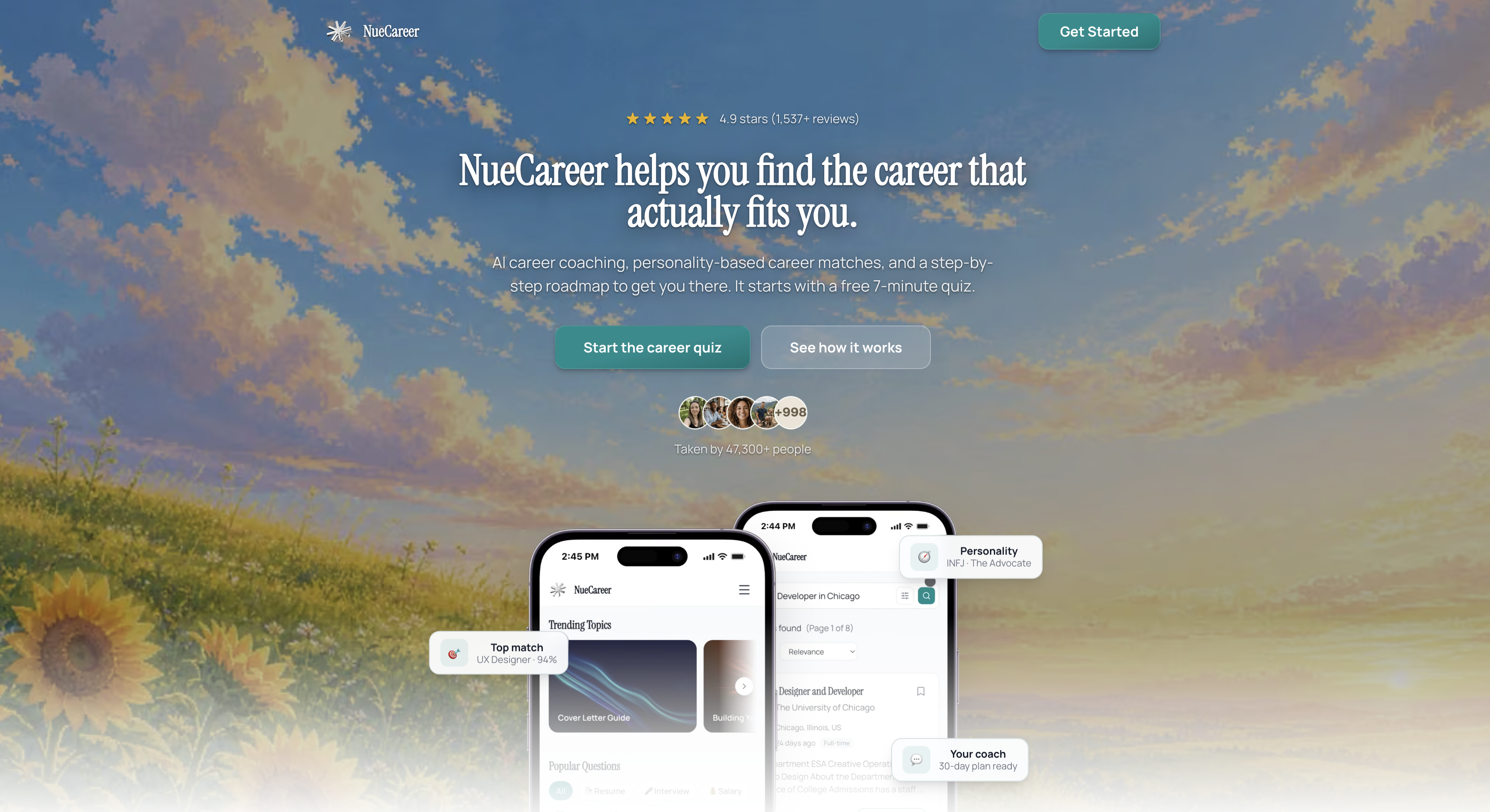
If you've read this far, you already know the plan: target the right roles, translate your freelance work into employer language, and prepare for interviews with intention. NueCareer's 7-Minute Career Quiz does the first part fast, matching your strengths to roles you might not have considered on your own, then hands you a personalized roadmap to work from.
From there, the platform's tools map directly onto the steps in this guide:
- Resume rewrites and a Cover Letter Generator for tailoring applications quickly
- Mock interview practice for rehearsing your STAR stories before the real thing
- 24/7 AI coaching chat for questions that come up between interviews
| Your need | Related tool |
|---|---|
| Figure out which roles fit your skills | Career quizzes |
| Build a tailored resume and cover letter | Resume and cover letter builders |
| Practice interview answers | Mock interview practice |
| Get ongoing guidance | Career coaching chat |
Start with the free quiz, then use the resume and mock interview tools to put the rest of this plan into action.
Sources
- Contingent and Alternative Employment Arrangements - July 2023
- Your master resume
- Top resume strategies
Always double-check your own offer letter and benefits enrollment dates directly with HR, since timing varies by employer.
FAQ
Can I freelance and work full-time at the same time?
Yes, many employees keep small freelance projects alongside a full-time job, though your offer letter may include moonlighting or noncompete clauses worth reviewing first. Check your contract for any restrictions before taking on outside client work.
How to make $1000 a week remotely?
There's no single guaranteed path, since remote income depends heavily on your skills, industry, and client base. A full-time remote role with a salary that divides out to that range, or a freelance practice with several steady clients, are both realistic routes worth evaluating against your own skills and the steps outlined above.
How much tax will I pay on freelance work?
Freelance tax obligations depend on your income level, deductions, and where you live, so there's no flat rate that applies to everyone. Keep detailed income and expense records and consider estimated quarterly payments, since you're responsible for both the employee and employer portions of Social Security and Medicare taxes as a contractor.
Can I make $1000 a month freelance writing?
It's possible for some freelance writers, depending on your rates, niche, and client volume, but income varies widely and isn't guaranteed by any standard formula. Building a portfolio and a few reliable clients is typically what separates consistent freelance income from sporadic project work.