
4 Axis Scorecard to Decide Between Salary and Passion

Use a 4 axis scorecard, the 7 Minute Career Quiz, and salary tools to compare offers, test a 15% pay gap, and choose the job that fits your life and goals.
Don't choose blindly. Use a simple scorecard that weighs your financial floor against passion and job quality, then let the numbers, not your anxiety, make the call. Start by testing whether an offer clears your real cost of living using a salary percentile check and an hourly-to-salary calculator. If you're still unsure which direction fits you, A career strengths assessment quiz can help narrow the field before you run the math.
TL;DR:
- Prioritize offers that meet your financial threshold by using salary percentile checks and hourly-to-salary conversions before considering passion or job quality.
- A combined score above 28 on a four-axis scorecard indicates a strong choice, while below 20 suggests continuing your search for better fit.
- If your passion-based role pays within 15% of the salary-first option's lifetime earnings, long-term benefits often favor pursuing passion.
- Building a financial buffer of three to six months and testing small-scale projects help reduce risks before major career moves.
- Hybrid careers, combining stable income with passion projects, often provide a balanced approach aligned with genuine market demand and personal fulfillment.
Table of Contents
- Pros and Cons of Choosing Salary Over Passion
- Pros and Cons of Choosing Passion Over a Paycheck
- The Passion & Paycheck Scorecard: A Repeatable Decision Framework
- How to Measure the Financial Gap and Find Your "Good Enough" Salary
- Planning Your Transition: Timeline, Buffer, and Risk Tests
- Combining Both: Hybrid Careers and Internal Alignment
- Why We Recommend a Scorecard, Not a Gut Call
- Let the Quiz Do the First Pass for You
- Sources
- FAQ
Pros and Cons of Choosing Salary Over Passion
A salary-first role gives you something passion often can't: predictability. You know what hits your account every two weeks, and that certainty compounds into savings, better credit terms, and fewer 2 a.m. money spirals. Employer benefits matter more than most people admit. Retirement matching, health coverage, and paid leave can add thousands of dollars in real value on top of the base number, which is why comparing two offers by salary alone is a mistake.
The trade-off is real, though. You risk waking up five years in, financially stable but quietly disengaged, watching the clock more than the work. Misalignment between what you do and what energizes you doesn't announce itself loudly. It shows up as low-grade fatigue that's easy to dismiss until it isn't.
Salary-first tends to be the smarter near-term move when:
- You're carrying high-interest debt or supporting dependents
- You have a specific savings goal with a hard deadline
- You need stability while you figure out what "passion" even means for you
- The passion-based option pays too little to cover essentials, full stop
Pros and Cons of Choosing Passion Over a Paycheck
Passion-driven work has a documented edge: people who experience their job as a calling report higher life satisfaction, stronger engagement, and more resilience when things go wrong. That resilience matters more than it sounds. When work feels meaningful, setbacks read as problems to solve rather than reasons to quit.
The risk isn't the passion itself. It's what happens when passion meets a market that doesn't reward it evenly. Income can swing wildly month to month, especially early on, and the pressure to monetize something you love can quietly kill the love part. Some passion-aligned fields also have slower pay ceilings, even after a decade of skill-building.
Passion-first tends to make sense when:
- Your financial obligations are low or you have real savings behind you
- There's demonstrable market demand for the skill, not just personal enthusiasm
- You're early career and can absorb a few years of experimentation
- You've already tested the work on a small scale and it held up
The Passion & Paycheck Scorecard: A Repeatable Decision Framework
Here's the tool that replaces the binary debate: a four-axis scorecard you can run on any offer in under ten minutes. Career researchers increasingly argue that a single passion-versus-pay axis is too crude to guide a real decision, since factors like autonomy and management quality predict satisfaction just as strongly as income does.
Score each option from 0 to 10 on these four axes:
- Financial floor — Does the pay cover essentials plus a buffer, after accounting for benefits? Score low if it doesn't clear your baseline regardless of anything else.
- Passion signal — How much genuine interest and engagement do you feel doing the actual daily tasks, not the idea of the job?
- Job quality — Rate hours, manager quality, and autonomy. Workplace conditions predict long-term well-being nearly as strongly as pay does.
- Upside — How much does this role grow your skills or market value over the next three years?
A combined score above 28 signals a strong yes. Below 20 means keep looking, regardless of how good any single axis looks.
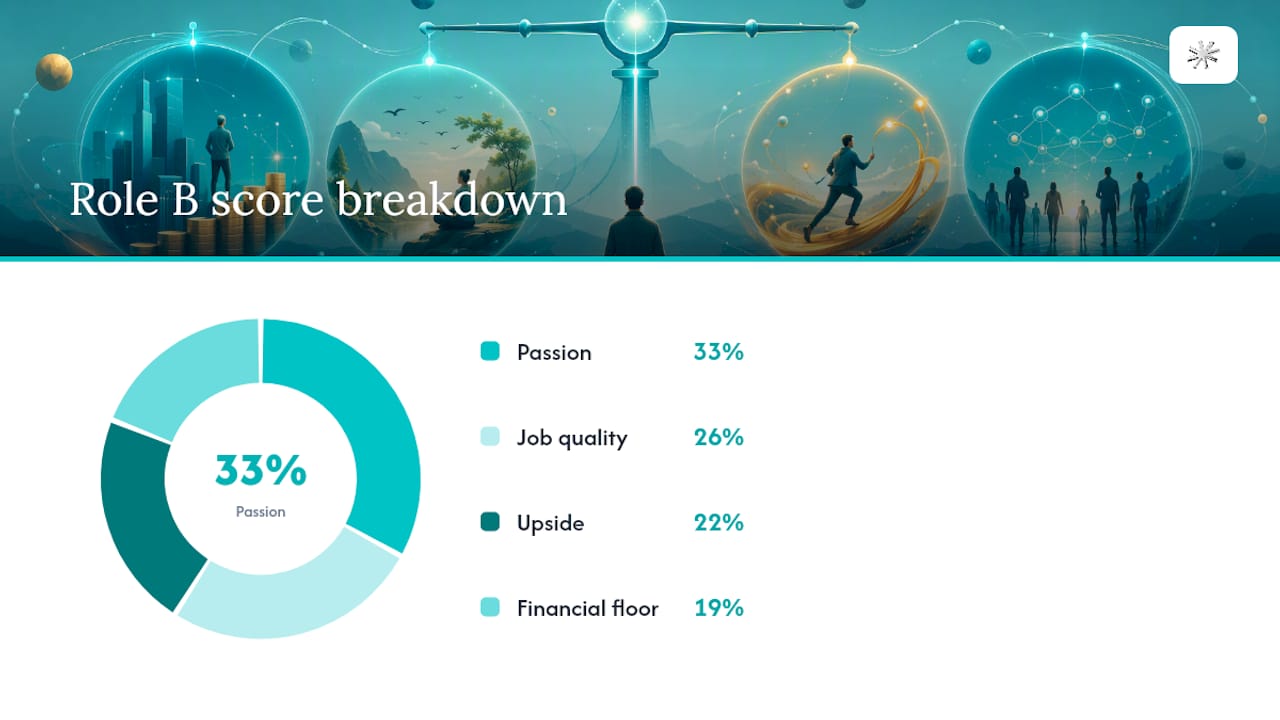
Worked example: Role A (corporate operations) scores 8 financial floor, 4 passion, 6 job quality, 5 upside: 23 total. Role B (small nonprofit) scores 5 financial floor, 9 passion, 7 job quality, 6 upside: 27 total. Role B wins on the scorecard even though it pays less, because the passion and job-quality gap outweighs the floor difference. Read our career satisfaction factors checklist to sharpen how you score the job-quality axis.
Pro Tip: Score the job before you know the salary. Anchoring on pay first skews every other axis toward a number you've already decided you want to justify.
How to Measure the Financial Gap and Find Your "Good Enough" Salary
Before you can weigh passion against pay, you need a real number, not a gut feeling. Run every hourly offer through a hourly-to-salary calculator, since a $28-an-hour freelance rate looks very different once you account for lost benefits and inconsistent hours. Then check where that number lands using a salary-percentile tool to see if you're being lowballed relative to your field.
A commonly cited reference point suggests that once household income reaches a certain moderate level, additional income buys diminishing returns on daily emotional well-being, though it doesn't cap overall life satisfaction. Treat that figure as a directional signal, not a hard ceiling.
A useful rule of thumb: if the passion-based option pays within about 15% of the salary-first option's lifetime earnings, interest and long-term performance effects often close that gap on their own. Beyond 15%, the math starts working against you unless upside is exceptional.
To measure your own gap:
- List every essential monthly cost, then add a 10% buffer
- Convert both offers to true net take-home, including benefits value
- Compare against your percentile check to see which offer is actually competitive
- Flag any gap over 15% as a decision that needs the full scorecard, not just gut instinct
Planning Your Transition: Timeline, Buffer, and Risk Tests
Nobody should quit a stable job on a Tuesday because a passion project felt exciting on Monday. Build a runway first, then test before you leap.
- Save a 3 to 6 month buffer covering essentials before making any irreversible move.
- Test small before going all in. Freelance nights and weekends, take on a part-time project, or ask for an internal shift toward passion-adjacent work.
- Run informational interviews with people already doing the work to pressure-test your assumptions about pay and lifestyle.
- Set a 90-day milestone. Track revenue consistency, actual demand for your skill, and your own stress level, not just enthusiasm.
- Define your stop signal in advance. If revenue hasn't stabilized and stress keeps climbing past your milestone, that's your pivot cue, not a failure.
Combining Both: Hybrid Careers and Internal Alignment
You don't always have to pick a side. A portfolio career, a part-time passion project alongside stable work, or an internal transfer toward more meaningful projects can deliver both income and engagement.
- Hybrid employment: full-time stability plus a side project scaled to real market demand
- Internal alignment: negotiating a shift toward higher-passion projects inside your current employer
- Portfolio work: multiple income streams, each smaller but collectively stable
The key is allocating time to whichever stream shows the strongest signal, not splitting hours evenly out of guilt. Combination paths are consistently recommended by career researchers as the realistic middle ground most people actually land on.
Pro Tip: Treat a side hustle as a research project first, income stream second. The data it generates about real demand is worth more than the early paychecks.
Why We Recommend a Scorecard, Not a Gut Call
We built our approach around the belief that "follow your passion" is incomplete advice, and the research on passion alone backs that up. Career assessment quizzes and salary tools exist because the scorecard above works better with real data behind each axis instead of a hunch. Readers who test small moves first, a freelance month, an internal transfer request, consistently make calmer, more informed decisions than those who leap on feeling alone.
— Shane
Let the Quiz Do the First Pass for You
Running the scorecard by hand works, but you can shortcut the passion-signal axis entirely with The 7-Minute Career Quiz. It matches your actual strengths and working style to career paths you may never have considered, including ones adjacent to your current field that quietly solve the passion problem without requiring a total reset.
Pair the quiz results with the free salary percentile check and hourly-to-salary calculator to fill in your financial-floor score, then use NueCareer's resume and cover letter tools once you know which direction the numbers point. Every free tool lives in one place at the NueCareer tools hub, so you're not juggling five different calculators from five different sites. If you're ready to see where you actually land, take The 7-Minute Career Quiz now and run your scorecard with real numbers instead of guesses.
Sources
- Passion vs. Paycheck (Hidden Brain)
- Follow Your Passion—or Take the Stable Job? Expert Weighs In (Investopedia)
- Workplace health and well-being (American Psychological Association)
- NBER working paper on earnings and education (example earnings-data methodology)
FAQ
Is Passion More Important Than Salary?
Neither wins outright. Research on people who treat work as a calling shows higher satisfaction and resilience, but job quality and pay both independently predict long-term well-being, which is why a multi-axis scorecard beats picking one over the other.
What Did Steve Jobs Say About Passion?
Steve Jobs famously argued that doing work you love is essential to sustaining the effort great work requires, since passion is often what keeps people going through the hard, unglamorous parts of a career.
Do We Need $75,000 a Year to Be Happy?
Not exactly. A commonly cited reference point suggests that once household income reaches a certain moderate level, additional income buys diminishing returns on daily emotional well-being, but it isn't a hard ceiling on overall life satisfaction, and your personal "good enough" number depends on your actual cost of living.
Is It Better to Follow Passion or Money?
It's better to follow a framework than either extreme. Weighing financial floor, passion signal, job quality, and growth upside together, rather than treating passion vs paycheck as a coin flip, consistently produces more durable decisions.
How Do I Know if a Passion-Based Career Pays Enough?
Compare the offer's true take-home, including benefits, against a salary percentile check for your field.