
Find Your Career Path Based on Personality in 2026

Discover how to find your career path based on personality in 2026. Use proven frameworks to align your strengths with fulfilling roles.
TL;DR:
- Matching your career to your personality involves aligning your core traits and values with roles where you can thrive.
- Using frameworks like the Big Five, Myers-Briggs, Holland Codes, and DISC helps identify suitable environments, not fixed job titles.
Matching your career to your personality is defined as aligning your core traits, values, and natural strengths with roles and work environments where you are most likely to thrive. People spend roughly 33% of their lives working, which means a poor fit does not just feel uncomfortable. It drains your energy every single day. The good news is that frameworks like the Big Five, Myers-Briggs Type Indicator, and Holland Codes give you a structured way to find a career path based on personality, not guesswork. This guide walks you through each model, how to interpret your results, and how to test your findings in the real world before committing.
What are the main personality assessment frameworks for career guidance?
Four major frameworks dominate career personality assessment today: the Big Five, Myers-Briggs, Holland Codes (RIASEC), and DISC. Each one approaches the question of career fit from a different angle, and understanding what each offers helps you use them together rather than relying on just one.
The Big Five (OCEAN)
The Big Five is the gold standard for predicting career fit across scientific research. It measures five traits: Openness, Conscientiousness, Extraversion, Agreeableness, and Neuroticism. High conscientiousness is the single strongest predictor of job performance, particularly in structured fields like medicine, law, and engineering. High openness, on the other hand, predicts success in creative and rapidly evolving fields like UX design and entrepreneurship.
Myers-Briggs Type Indicator (MBTI)
The MBTI categorizes people into 16 personality types based on four dimensions: Introversion/Extraversion, Sensing/Intuition, Thinking/Feeling, and Judging/Perceiving. While its scientific reliability is debated, it remains widely used in corporate settings and career counseling because it gives people an accessible vocabulary for describing how they prefer to work and make decisions.
Holland Codes (RIASEC)
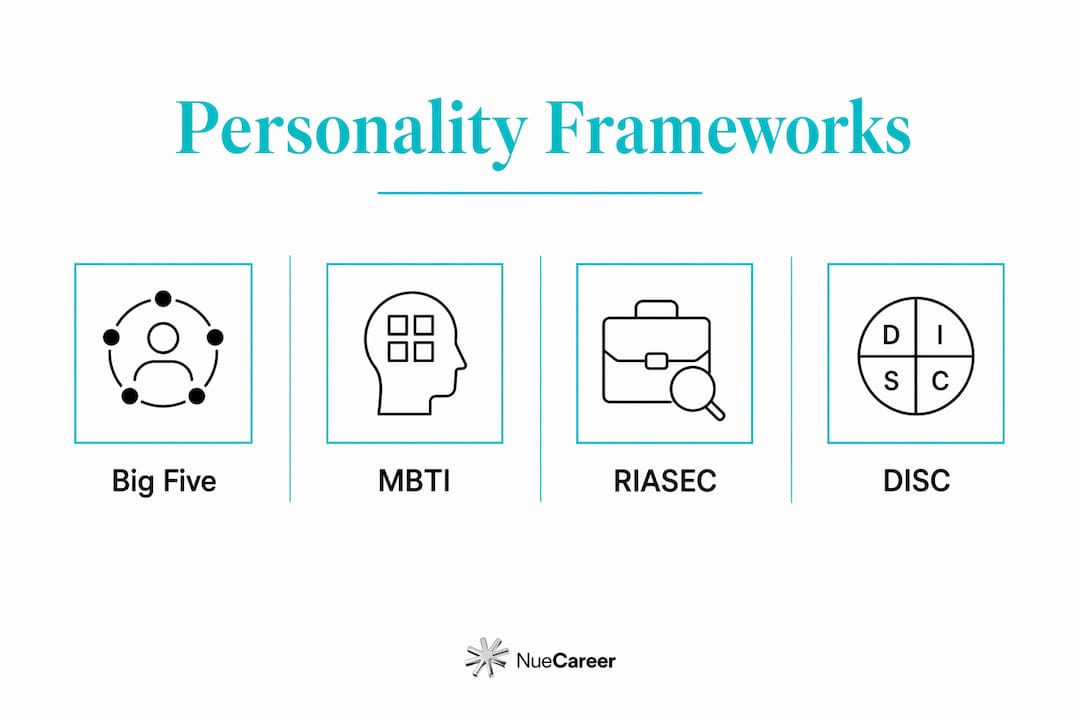
The RIASEC model, developed by psychologist John Holland, groups careers and people into six types: Realistic, Investigative, Artistic, Social, Enterprising, and Conventional. Career counselors at institutions like the U.S. Department of Labor's O*NET use this model to match job seekers to roles where their interests and work style naturally align.
DISC
DISC focuses on four behavioral styles: Dominance, Influence, Steadiness, and Conscientiousness. It is most commonly used in workplace settings to improve team communication and identify leadership styles rather than for initial career selection.
Here is a quick comparison of what each framework offers:
| Framework | Best used for | Career application |
|---|---|---|
| Big Five | Predicting job performance | Matching traits to structured or creative roles |
| Myers-Briggs | Understanding work style preferences | Team fit and communication style |
| Holland Codes | Matching interests to job categories | Broad career field exploration |
| DISC | Workplace behavior | Leadership and team dynamics |
Pro Tip: Take at least two different assessments before drawing conclusions. The Big Five and Holland Codes together give you both a trait profile and an interest map, which is a far stronger foundation than either alone.
How to interpret personality test results to identify suitable careers
Personality test results are more valuable as filters than as exact job prescriptions. The goal is not to find one perfect career title. The goal is to identify which work environments energize you and which ones drain you.
Start by looking at your results through these four lenses:
- Work environment fit: Do your results suggest you prefer autonomy or structure? High conscientiousness points toward structured environments like finance or project management. High openness points toward flexible, idea-driven settings.
- Social intensity: Extraversion predicts preference for social and leadership roles like sales, teaching, and management. Introversion predicts stronger fit for roles requiring deep focus, such as research, writing, or software development.
- Collaboration style: High agreeableness correlates with success in caregiving, counseling, and team-based roles. Lower agreeableness often suits competitive or independent roles like law or entrepreneurship.
- Emotional sustainability: High neuroticism (low emotional stability) in high-pressure roles like emergency medicine or financial trading is a known burnout risk. Recognizing this early helps you build in the right support structures or choose lower-stress environments.
The most overlooked question in career guidance based on personality is this: what drains you versus what energizes you? Two people can both score high in conscientiousness, but one thrives in a hospital and the other burns out within a year. The difference is usually found in the secondary traits and in the specific tasks the role requires day to day.
Career coach Octavia Goredema makes this point clearly: when career fits personality, work feels like an asset rather than a daily challenge. That shift is what makes personality-driven career choices sustainable over the long term.

Pro Tip: After reviewing your results, write down three work situations where you felt fully engaged and three where you felt depleted. Map those experiences to your trait scores. The patterns you find will tell you more than any single test result.
How to use personality assessments alongside real-world tests to find your path
Personality assessments give you a starting hypothesis. Real-world testing is how you confirm or revise it. Modern career guidance, including the approach used by 80,000 Hours, treats career exploration like a scientific experiment with hypotheses and incremental tests.
Here is a practical step-by-step process:
Rank your top career options. After completing a Big Five or RIASEC assessment, list 5–7 career paths that align with your results. Use resources like the Nuecareer career personality types guide to understand how your traits map to specific fields.
Define your key uncertainties. For each option, write down what you do not yet know. Do you know what the day-to-day work actually feels like? Do you know whether the culture of that industry suits your working style? Naming uncertainties prevents you from making decisions based on incomplete information.
Run cheap tests first. The ladder of low-cost exploration looks like this: read books and articles written by people in the field, then listen to podcasts or watch interviews, then reach out to professionals for informational conversations, then take on a short freelance project or volunteer role. Each step gives you real data without a major commitment.
Move to deeper tests only when warranted. Internships, part-time roles, and formal training are expensive in time and money. Reserve them for options that have already passed your cheaper tests. Successful career pivoting involves incrementally deeper exploration to reduce risk and increase fit.
Update your rankings continuously. Your preferences will shift as you learn more. Career decision-making works best when you frame it around 3–7 key factors rather than a simple pros and cons list. Narrow framing, where you treat a decision as binary, is one of the most common and costly mistakes career changers make.
Reassess your personality profile periodically. Traits can shift. Higher income and career success often correlate with increased openness and extraversion over time. A profile you took at 25 may not fully reflect who you are at 35.
What are the most common career personality assessment mistakes?
The biggest mistake people make with personality assessments is treating them as a prescription rather than a starting point. Here are the most common errors and how to avoid them:
- Expecting one perfect job title. No test can deliver that. Assessments identify environments and patterns, not specific roles. A person with high social and investigative scores might thrive as a therapist, a UX researcher, or a science journalist. The test narrows the field; you do the rest.
- Ignoring how personality evolves. Personality traits can evolve with career success and life experience. Taking one test at a single point in time and treating it as permanent is a significant error.
- Skipping values and motivations. A career that fits your personality but conflicts with your values will still feel wrong. Career tests are far more effective when integrated with exploration of your interests, motivations, and values alongside your trait scores.
- Forcing a mismatch. Choosing a career because it pays well or because others expect it, despite a clear personality mismatch, is a direct path to burnout. Mismatched roles lead to stress even for highly capable workers.
- Over-analyzing without acting. Paralysis from too much self-assessment is real. At some point, you need to move from reading about careers to actually testing them.
"Overemphasis on personality test results without real-world validation can cause missteps in career choices." — SeeMyPersonality Career Test Research
The healthiest approach treats personality data as one input among several. Use it to filter and prioritize, then let real-world experience do the confirming.
Key takeaways
Personality-driven career choices work best when assessment results are treated as filters for work environments, not final answers, and then validated through real-world exploration.
| Point | Details |
|---|---|
| Use multiple frameworks | Combine Big Five and Holland Codes for both trait and interest data before deciding. |
| Filter, do not prescribe | Assessments identify energizing environments, not single perfect job titles. |
| Test incrementally | Move from reading to networking to short projects before committing to a full pivot. |
| Revisit your profile | Personality traits shift over time; reassess every few years to stay aligned. |
| Integrate values | Pair test results with your motivations and values to avoid a mismatch that leads to burnout. |
Why I think most people use personality tests backwards
Here is what I have observed after years of watching people navigate career transitions: most people take a personality test hoping it will hand them certainty. They want the test to make the decision for them. That is the wrong expectation, and it sets them up for disappointment.
The tests that matter most, the Big Five in particular, are genuinely good at one thing: telling you what kind of environment you are likely to thrive in. They are not good at telling you which specific job title to pursue. When you understand that distinction, the whole process becomes less anxious and more useful.
What I have found actually works is using your personality profile as a compass, not a map. It points you in a direction. Then you go explore that direction through conversations, short projects, and honest reflection. You will learn more from one informational interview with someone doing the job you are considering than from ten hours of additional self-assessment.
The other thing I would push back on is the idea that your personality is fixed. I have seen people who tested as strong introverts build thriving careers in client-facing roles because the work itself gave them enough meaning to sustain the social energy it required. Personality is a tendency, not a ceiling. Use the data, respect it, and then go test it against reality. That combination is what actually leads to a career that fits.
You can also use tools like Nuecareer's career path evaluation guide to structure that real-world testing process so it feels less overwhelming and more like a clear plan.
— Shane
Start finding your career fit with Nuecareer
If you are ready to move from self-reflection to real direction, Nuecareer gives you the tools to do it in one place.
The 7-minute Nuecareer quiz identifies your strengths and matches you to career paths built around who you are, including options you may never have considered. From there, you can use the free job application skills tool to translate your personality strengths into concrete skills that belong on your resume. Nuecareer also includes a free cover letter generator tailored to your target roles, plus 24/7 coaching chat and personalized roadmaps. Everything you need to go from assessment to application is already there.
FAQ
What is the best personality test for career guidance?
The Big Five is the most research-backed framework for predicting career fit, with high conscientiousness being the strongest predictor of job performance. For career interest matching, the Holland Codes (RIASEC) model is widely used by career counselors and tools like O*NET.
Can personality tests tell me exactly what career to choose?
No. Personality assessments provide probabilistic guidance, not definitive answers. They are most useful as filters that help you identify work environments where you are likely to thrive, not as tools that deliver a single correct job title.
How do I find a career path based on personality if my results feel too broad?
Narrow your results by combining trait scores with a values inventory and real-world exploration. Use the ladder of cheap tests: read, network, and take on short projects in your top fields before making a larger commitment.
Do personality traits change over time?
Yes. Research shows that personality traits can evolve with career success and life experience, with higher income and achievement often correlating with increased openness and extraversion. Reassessing your profile every few years keeps your career planning aligned with who you are now.
What is the difference between Myers-Briggs and the Big Five?
Myers-Briggs categorizes people into 16 fixed types based on behavioral preferences, while the Big Five measures five continuous trait dimensions with stronger scientific support for predicting job performance. Career counselors often recommend the Big Five for accuracy and Myers-Briggs for understanding communication and team dynamics.