
Why Feeling Stuck at Work: Causes and Real Fixes

Discover why feeling stuck at work happens and explore effective fixes. Break free from stagnation and reignite your career today!
TL;DR:
- Feeling stuck at work signifies a state of stagnation involving reduced growth, motivation, or satisfaction despite remaining in the same role. High performers are just as vulnerable to stagnation caused by organizational failures, unclear expectations, and relational issues as less engaged employees. Overcoming this requires identifying the root cause, actively fostering engagement, and making deliberate changes or considering a career transition if necessary.
Feeling stuck at work is defined as a state of stagnation where professionals experience a loss of growth, motivation, or satisfaction despite remaining in their roles. This condition, formally described in organizational psychology as career plateau, affects millions of working adults and carries real costs for both individuals and employers. The causes run deeper than pay or a bad manager. They span economic constraints, psychological dynamics, and organizational failures that compound over time. Understanding why this happens is the first step toward doing something about it.
Why feeling stuck at work happens to high performers too
Career stagnation does not only affect disengaged or low-performing employees. It frequently hits high performers who have outgrown their current environment without realizing it.

The economic picture plays a significant role. Gallup's 2026 worker data shows that 69% of workers who feel restless but stay cite pay and benefits as the primary constraint, while 51% say they cannot find comparable roles elsewhere. That data tells us that many professionals are not choosing to stay out of satisfaction. They are staying because leaving feels financially risky.
Organizational failures compound the problem. Unclear role expectations, weak recognition practices, and limited development opportunities all create the conditions for stagnation. When you do not know where you stand or where you are headed, motivation naturally fades.
The psychological dimension is equally important. A CEPR 2026 study found that poor workplace relationships, long hours, and heavy workload rank as top dislikes among workers, often surpassing pay concerns. That finding challenges the common assumption that a raise will fix everything. The real drivers of dissatisfaction are relational and structural, not just financial.
- Economic constraints: Pay gaps, limited comparable roles, and schedule dependency trap workers in place
- Organizational gaps: Unclear expectations, poor recognition, and no visible development path
- Relational friction: Difficult colleagues, unsupportive managers, and weak team culture
- Psychological mismatch: Skills and ambitions that have grown beyond the current role's demands
How does feeling stuck affect engagement and productivity?
Employee engagement is defined as the degree of emotional and cognitive investment a worker brings to their role. Low engagement is both a symptom and a cause of workplace stagnation. The two feed each other in a cycle that is hard to break without deliberate intervention.
Gallup's 2026 engagement research puts the stakes in sharp relief: highly engaged teams achieve 23% higher profitability, 18% higher productivity, and 51% less turnover compared to disengaged teams. Those numbers represent a significant organizational cost when stagnation spreads across a workforce.
"Less than half of employees strongly agree they know what is expected of them at work." — Gallup, 2026
That single finding explains a great deal. Clarity about expectations is one of the most basic conditions for engagement. Without it, even motivated professionals begin to drift. They show up, complete tasks, and collect a paycheck, but the sense of purpose that drives real performance disappears.
| Engagement Level | Profitability Impact | Turnover Impact |
|---|---|---|
| Highly engaged teams | +23% higher profitability | 51% less turnover |
| Disengaged teams | Below-average output | Higher voluntary exits |
| Stuck but present | Declining over time | Risk of quiet quitting |
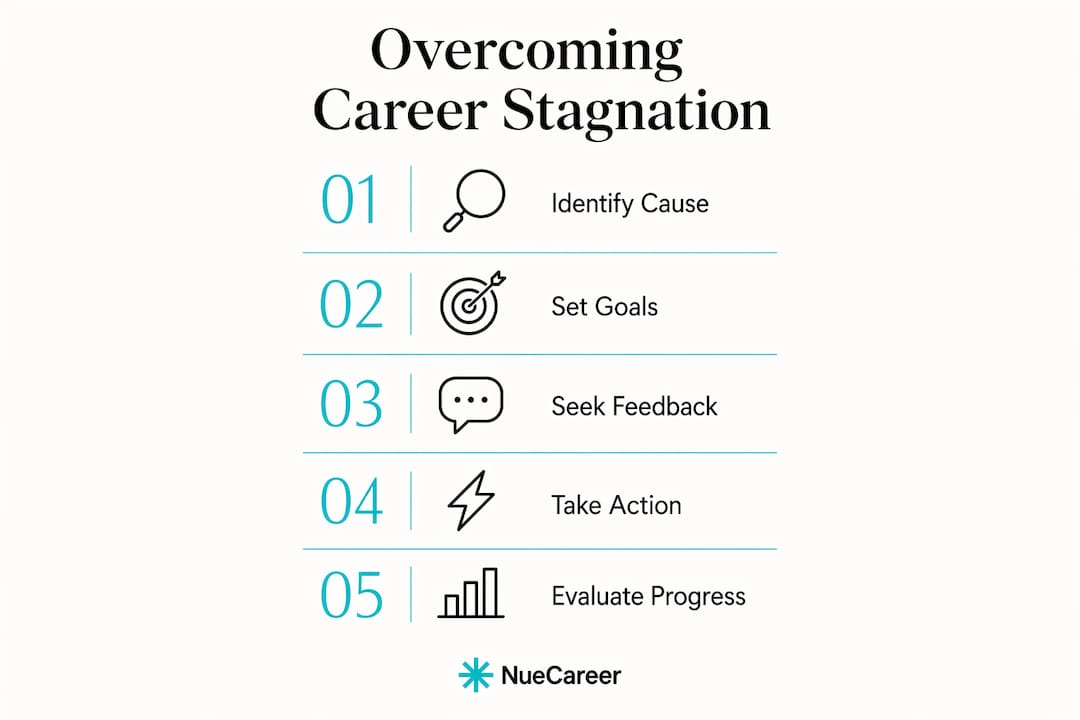
Detachment builds gradually. A professional who once cared deeply about their work starts to disengage when clarity, connection, and recognition are consistently absent. Feeling stuck is often the visible sign of a deeper engagement problem that has been developing for months.
What psychological dynamics drive workplace stagnation?
Career plateau is the technical term for the point at which upward mobility or skill growth slows significantly. It is not the same as burnout. Burnout comes from too much demand. Career plateau often comes from too little challenge.
Fast Company's 2026 reporting on Art Markman's research describes this shift precisely: when work becomes too routine, employees move from exhaustion to boredom. Boredom is a different kind of stuck. It signals under-stimulation, not overload. Addressing it requires actively seeking novelty and new learning, not rest.
A 2026 Frontiers study on early-career nurses found that career plateau ties strongly to two related concepts: psychological contract and job embeddedness. The psychological contract refers to the unwritten expectations an employee holds about what their employer owes them in exchange for their effort. When those expectations go unmet, trust erodes and stagnation deepens. Job embeddedness explains why people stay anyway. Ties to colleagues, community, and benefits create a kind of gravity that keeps professionals in roles even when they are deeply dissatisfied.
Feeling stuck can also signal growth, according to The Conversation's 2026 analysis. When your internal development outpaces the opportunities your current role offers, the mismatch creates friction. That friction feels like stagnation, but it is actually a signal worth paying attention to.
Pro Tip: Ask yourself three diagnostic questions: Have I learned anything new in the past 90 days? Do I solve different problems each week, or the same ones? Am I using my strongest skills regularly? If the answer to all three is no, boredom-driven stagnation is likely the culprit.
What practical strategies help you regain motivation at work?
Overcoming workplace stagnation requires action at multiple levels: individual, relational, and organizational. No single fix works for everyone, but the following steps address the most common root causes.
Get clear on your role expectations. Request a direct conversation with your manager about what success looks like in your position. Gallup's engagement strategy research identifies clarity as the single most powerful lever for reversing detachment. If your organization does not offer that clarity proactively, ask for it.
Pursue deliberate skill development. Platforms like Coursera, LinkedIn Learning, and edX offer structured learning paths that can reintroduce novelty and challenge into your professional life. The goal is not just adding credentials. It is restoring the feeling of forward movement.
Invest in workplace relationships. The CEPR 2026 data shows that workers value social relationships and autonomy more than pay alone. Strengthening connections with colleagues, finding a mentor, or joining a cross-functional project can shift your daily experience significantly.
Try job crafting. Job crafting means reshaping how you think about and approach your current tasks. A 2026 experimental study on cognitive crafting found that reinterpreting your role's purpose and impact increases engagement even when you cannot change the tasks themselves. This is especially useful when formal changes are not immediately available.
Build a career roadmap. Stagnation often persists because there is no visible path forward. Mapping out where you want to be in one, three, and five years creates direction. Direction restores motivation.
Pro Tip: Start with one small change this week. Sign up for a single course, schedule a conversation with your manager, or reach out to one colleague you have not spoken to in months. Small, purposeful actions build momentum faster than waiting for the perfect plan.
When should you consider changing jobs if you feel stuck?
Not every case of workplace stagnation can be resolved from within. Sometimes the role, the organization, or the industry is genuinely the wrong fit, and no amount of job crafting will change that.
The decision to leave is rarely simple. Economic ties, schedule flexibility, and benefits keep many professionals in place even when dissatisfaction is high. That is not irrational. It is a realistic assessment of risk. The key question is whether a job change will actually resolve the stagnation or whether the same patterns will follow you to a new employer.
Career plateau and job embeddedness research from Frontiers 2026 warns that quitting without addressing underlying growth pathways rarely solves the problem. If the stagnation comes from your own unmet development needs, a new job title will not fix it. You need a plan for growth, not just a change of scenery.
Consider leaving when you identify these conditions:
- Your values are in direct conflict with your organization's culture or leadership
- You have exhausted internal options for development, recognition, and advancement
- A personal jolt, such as a health event, a major life change, or a values clarification moment, has shifted your priorities
- The role has no realistic path to the work you actually want to do
If you are weighing a transition, a structured career change guide can help you assess your options clearly before making a move. For professionals over 40 considering broader life pivots, real-world examples of meaningful career changes offer useful perspective on what transitions actually look like in practice.
Key takeaways
Feeling stuck at work is a solvable problem when you correctly identify whether the cause is economic, organizational, psychological, or a mismatch between your growth and your current role's demands.
| Point | Details |
|---|---|
| Stagnation has multiple causes | Economic constraints, poor culture, and career plateau each require different responses. |
| Engagement drives real outcomes | Highly engaged teams show 23% higher profitability and 51% less turnover, per Gallup 2026. |
| Boredom differs from burnout | Under-stimulation requires novelty and learning, not rest or reduced workload. |
| Job crafting works without a promotion | Cognitive reframing of your current role increases engagement even without formal task changes. |
| Quitting alone rarely fixes stagnation | Leaving without a growth plan often recreates the same conditions in a new environment. |
The uncomfortable truth about feeling stuck
I have spent years reading career research and talking to professionals at every stage of their working lives. The pattern I see most often is this: people assume feeling stuck is a sign that something is wrong with them. They blame their attitude, their ambition, or their choices. That framing is almost always wrong.
Stagnation is usually a structural signal, not a personal failure. It tells you that your internal development has moved ahead of what your current environment can support. That is actually a good thing to know. The problem is that most people sit with that feeling for months or years without acting on it because they do not have a clear framework for diagnosing what is actually happening.
The research on job embeddedness explains why so many smart, capable people stay in roles that no longer serve them. The ties are real. The risks are real. But staying without a plan for growth is the one choice that guarantees the stagnation continues. Small, deliberate moves, whether that means a new skill, a direct conversation, or a structured reassessment of your career direction, consistently outperform waiting for the right moment. The right moment does not arrive. You create it.
— Shane
Ready to move past stuck? Nuecareer can help
If you recognize yourself in this article, you are not alone, and you do not have to figure out the next step without support.
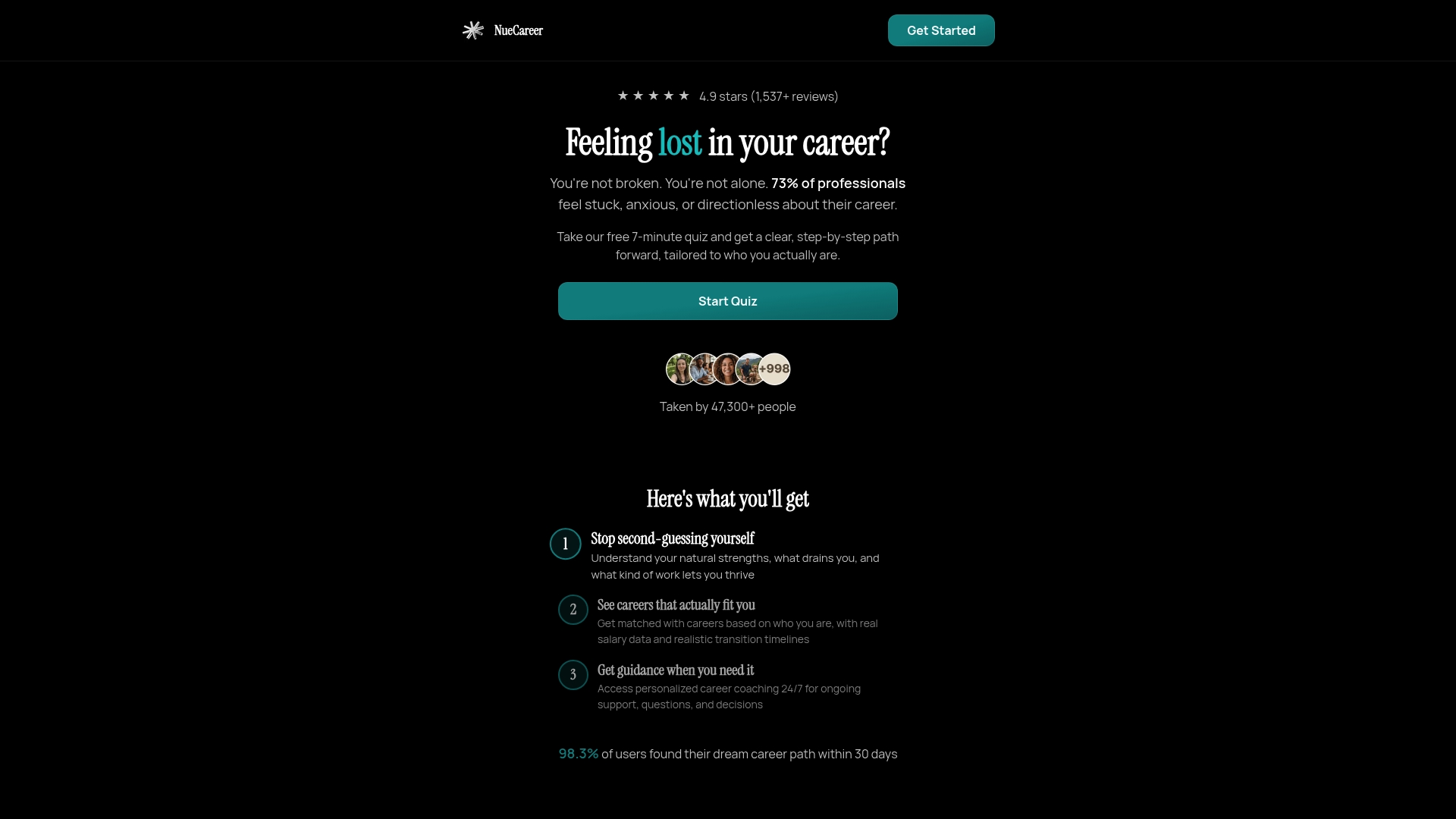
Nuecareer is built specifically for working adults who feel lost or stagnant in their careers. The 7-Minute Career Quiz identifies your strengths and matches you to career paths you may never have considered, including roles that align with who you actually are today. From there, Nuecareer gives you personalized roadmaps, a 24/7 coaching chat, job boards, and a full suite of resume and cover letter tools to help you apply with confidence. You can also explore the full range of free career tools to assess your skills and plan your next move.
FAQ
What does feeling stuck at work actually mean?
Feeling stuck at work means experiencing stagnation in growth, motivation, or satisfaction while remaining in your role. Organizational psychologists refer to this as career plateau, which can result from economic constraints, unclear expectations, or a mismatch between your skills and your current responsibilities.
Why do employees feel unfulfilled even in well-paying jobs?
Pay alone does not determine fulfillment. The CEPR 2026 study found that poor workplace relationships, heavy workload, and lack of autonomy rank as top sources of dissatisfaction, often outweighing compensation concerns.
What are the signs of burnout vs. career stagnation?
Burnout results from excessive demand and shows up as exhaustion and overwhelm. Career stagnation results from under-stimulation and shows up as boredom, disengagement, and a sense that nothing is changing. Both require different interventions.
Can job crafting really help when you feel stuck?
Yes. A 2026 experimental study found that cognitive crafting, which involves reinterpreting your role's purpose and impact, increases engagement even without formal changes to your tasks or responsibilities.
How do you know when it is time to change careers?
Consider a career change when your values conflict with your organization's culture, internal development options are exhausted, or a significant personal event has shifted your priorities. Leaving without a growth plan, however, often recreates the same stagnation in a new role.