
Why Career Change Feels Scary (and What to Do About It)

Discover why career change feels scary and learn how to overcome that fear. Transform uncertainty into confidence with proven insights!
TL;DR:
- The brain perceives career change as a survival threat due to identity fusion and ancient threat responses. Fears of financial loss, social judgment, and skill loss intensify this anxiety, which can be managed by small experiments and clear planning. Overcoming these fears is a matter of building perceived control and reframing the transition as an informed, growth-oriented step.
Career change feels scary because your brain interprets professional uncertainty as a survival threat, not a growth opportunity. The same ancient threat-detection system that once protected humans from predators now fires when you consider leaving a familiar role. This is not weakness or indecision. It is neuroscience. Understanding why the fear of career change is so intense is the first step toward moving through it with clarity. The psychological forces at work, including identity fusion, loss aversion, and status quo bias, are predictable and manageable once you can name them.
Why career change feels scary: the psychology behind the fear
Career-change anxiety is a real neurological response in which the brain treats a growth decision like a survival threat. Your amygdala, the brain's alarm center, cannot reliably distinguish between a physical danger and a major life decision. Both trigger the same cascade of stress hormones, the same racing thoughts, and the same impulse to retreat to safety.
What makes this especially powerful is the concept of career identity fusion. After years in one profession, your job title, your expertise, and your daily routines become woven into how you define yourself. People with roughly eight or more years in a single role often experience what psychologists call identity foreclosure, a state where the professional self and the personal self become nearly indistinguishable. When you contemplate leaving, the brain does not register "I am changing jobs." It registers "I am losing myself." That is why the emotional impact of a job switch can feel disproportionate to the practical reality.
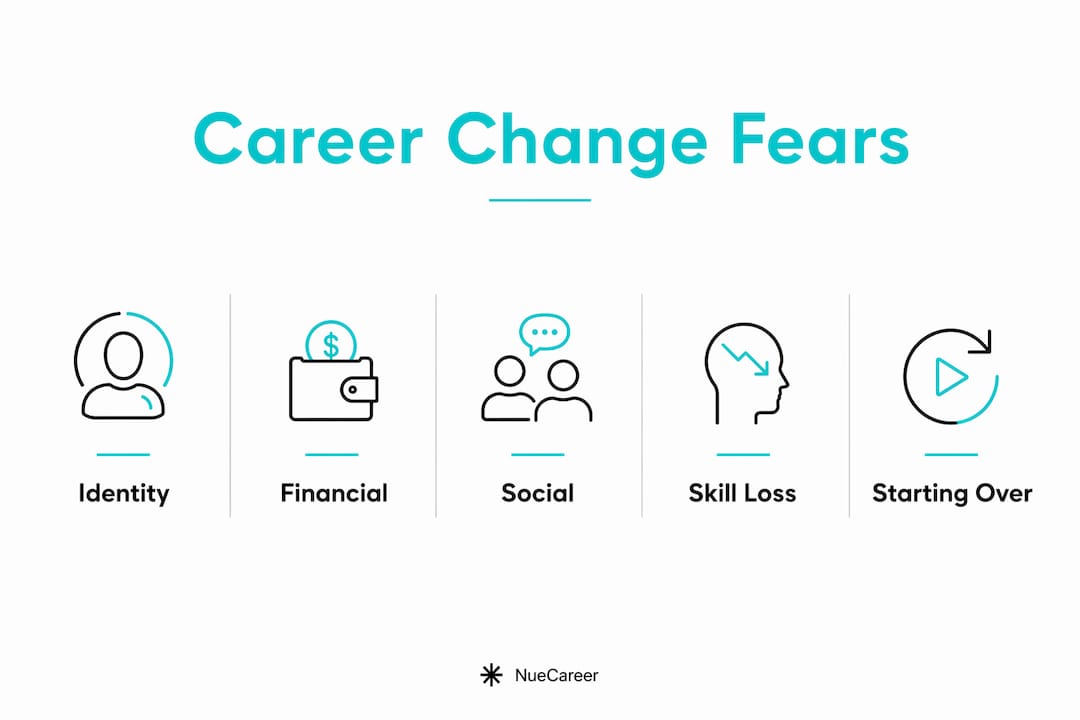
Three core fears sit at the center of most career transition anxiety: losing financial stability, losing your professional identity, and losing social approval. These fears interact and amplify each other. The more tightly your identity is fused with your current role, the more threatening every other fear becomes.
What psychological factors make career change feel threatening?
Several cognitive mechanisms work together to make staying feel safer than leaving, even when the evidence points the other way.
- Identity foreclosure. When your sense of self is built around a professional role, any threat to that role feels personal. A teacher who has spent a decade in the classroom does not just fear losing a paycheck. She fears losing the version of herself that students depend on.
- Loss aversion. Behavioral science shows that losses feel roughly twice as intense as equivalent gains. Leaving a familiar role means surrendering certainty, routine, and social proof. The potential upside of a new career rarely feels as vivid as the concrete losses in front of you.
- Status quo bias. The brain has a built-in preference for the familiar, even when better options exist. This bias explains why you can intellectually know a career change is right for you while still feeling paralyzed. The status quo bias is not irrational. It is a predictable cognitive shortcut that once helped humans conserve energy and avoid unnecessary risk.
- Catastrophizing and negativity bias. Cognitive biases like catastrophizing and ambiguity aversion inflate the perceived risk of change, generating distorted worst-case scenarios that feel more real than they are. Your brain presents "I might fail" as "I will definitely fail."
Anxiety also manifests physically during career transitions. Insomnia, difficulty concentrating, and a persistent sense of dread are common. These symptoms are not signs that you are making the wrong decision. They are signs that your nervous system is working exactly as designed.
Pro Tip: Name the bias when you feel it. When you catch yourself thinking "everything will fall apart," label it: "That is catastrophizing." Naming the cognitive distortion reduces its emotional grip and restores rational thinking.
How do fears about skills and starting over amplify the anxiety?
The fear of becoming a beginner again is one of the most underestimated challenges of changing careers. High achievers in particular build a significant portion of their self-worth around competence. They are the expert in the room. They know the answers. A career pivot strips that away, at least temporarily.
Career change involves a period as a beginner that challenges competence-based self-identity, and this causes real distress, especially for people who have spent years being very good at what they do. The discomfort is not just about performance. It is about the loss of mastery as a source of identity and confidence.
Here is what most people miss: the skills you have built are not tied to your current job title. They are tied to you.
- List your skills, not your tasks. A project manager who moves into UX research does not start from zero. She brings stakeholder communication, timeline management, and systems thinking. These are transferable. Separating skills from tasks reveals strengths that cross industry lines and open unexpected doors.
- Expect a learning curve and plan for it. Temporary incompetence is a stage, not a destination. Framing the beginner phase as a structured investment rather than a failure reduces its emotional weight considerably.
- Reframe "starting over" as "starting informed." You are not a 22-year-old entering the workforce. You bring professional maturity, self-awareness, and a network. That context accelerates learning in ways a true beginner cannot replicate.
Pro Tip: Try Nuecareer's free skills assessment to map your transferable strengths before you make any decisions. Seeing your skills laid out clearly reduces the feeling that you have nothing to offer in a new field.
Why do social and financial fears intensify the fear of career change?
Even when someone has resolved their internal identity questions, external pressures can reignite the fear. Social and financial fears operate on a different layer, one that is harder to reason with because it involves other people's opinions and real money.
- Fear of judgment. Telling your family, your mentor, or your professional network that you are leaving a stable career can feel like announcing a failure before it happens. The fear of disappointing people who invested in your current path is a genuine emotional barrier, not just insecurity.
- Fear of perceived betrayal. Some career changers, particularly those in medicine, law, or academia, feel they are abandoning a calling or wasting years of training. This guilt compounds the anxiety and makes the decision feel heavier than it needs to be. Resources like switching careers without starting over reframe this as continuation rather than abandonment.
- Financial risk. Pay cuts during retraining periods, the cost of new certifications, and the loss of seniority-based compensation are real concerns. These are not irrational fears. They are practical risks that deserve honest planning.
- The interaction effect. When financial stress and social judgment combine with identity threat, the result is a fear response that feels overwhelming. Each layer reinforces the others. Addressing them separately, rather than as one undifferentiated mass of dread, makes each one more manageable.
Understanding career identity alignment can help you separate who you are from what others expect you to be, which is often the first crack in this particular wall of fear.
What practical strategies actually help you manage the fear?
Managing the fear of career change is not about eliminating it. It is about building enough structure and self-awareness that the fear no longer controls your decisions. The strategies that work are grounded in behavioral science and supported by research on perceived control during transitions.
- Recognize anxiety as information, not instruction. Fear signals that something matters to you. It does not mean you should stop. Reframing anxiety as evidence of personal significance rather than danger changes your relationship with it.
- Build identity flexibility. Practice separating your self-worth from your current job title. Ask yourself: "Who am I when I am not at work?" The more dimensions your identity has, the less threatening any single change becomes.
- Use small experiments. Before committing fully, test the new direction. Take a course, do a freelance project, or shadow someone in the target role. Small experiments reduce the all-or-nothing pressure and generate real data to replace imagined worst-case scenarios.
- Restore perceived control. Research shows that greater perceived career control reduces negative mental health outcomes during transitions. Create a clear timeline, identify specific milestones, and build a support network of mentors or peers who have made similar moves.
- Balance emotional awareness with rational planning. Acknowledge the fear without letting it run the analysis. Write down the actual risks, the actual resources you have, and the actual evidence for and against the change. Cognitive clarity and emotional honesty work together, not against each other.
"The goal is not to feel fearless. The goal is to feel informed enough that the fear no longer has the final vote."
For a structured approach to the practical side, Nuecareer's guide on how to switch careers walks through eight concrete steps that address both the emotional and logistical dimensions of a career pivot.
Key takeaways
Career change feels scary primarily because the brain treats identity loss and uncertainty as survival threats, not because the change itself is objectively dangerous.
| Point | Details |
|---|---|
| Identity threat drives fear | Career change feels like losing yourself, not just a job, especially after years in one role. |
| Loss aversion amplifies risk perception | Losses feel twice as intense as gains, making the familiar feel safer than it actually is. |
| Competence fears are temporary | The beginner phase is a stage, not a verdict. Transferable skills reduce how long it lasts. |
| Social and financial fears compound anxiety | Addressing each fear layer separately makes the overall challenge far more manageable. |
| Perceived control is the key stabilizer | Clear timelines, mentors, and small experiments restore a sense of agency and reduce stress. |
Fear is not a stop sign. It is a signal.
I have talked with hundreds of people who were stuck at the edge of a career change, not because the new path was wrong for them, but because the fear felt like proof that it was. That is the cruelest trick the brain plays. The intensity of the fear gets misread as a warning when it is actually a measure of how much the change matters.
Here is what I have come to believe after years of watching people navigate this: the people who make successful career pivots are not the ones who felt no fear. They are the ones who stopped waiting for the fear to disappear before they acted. They built structure around the uncertainty. They found one person who had made a similar move. They took one small step that gave them real information instead of imagined catastrophe.
The fear of career change is not a character flaw. It is a predictable response to a genuine identity transition. Honoring that fear, understanding where it comes from, and then choosing to move anyway is not recklessness. It is courage in its most practical form. A career pivot is not a loss of who you were. It is a redirection toward who you are becoming. That distinction changes everything.
— Shane
Start your career change with clarity, not guesswork
If the fear of not knowing where to start is holding you back, you do not have to figure it out alone. Nuecareer is built specifically for working adults who feel stuck or lost in their careers.

The free career skills assessment takes minutes and maps your transferable strengths to career paths you may never have considered. From there, Nuecareer gives you personalized roadmaps, 24/7 coaching chat, and a full suite of resume and cover letter tools so you can start applying with real confidence. You do not need to have everything figured out before you take the first step. You just need a starting point. Nuecareer is that starting point.
FAQ
Why does career change feel so emotionally overwhelming?
Career change triggers the brain's threat-detection system, which treats identity loss and uncertainty as danger. The emotional intensity is a neurological response, not a sign that the change is wrong.
What are the most common career change fears?
The three most common fears are losing financial stability, losing your professional identity, and losing social approval from peers, family, and mentors. These fears often interact and amplify each other.
How long does career change anxiety typically last?
Anxiety tends to peak during the decision phase and the early transition period, then decreases as competence and familiarity build in the new role. Restoring perceived control through clear planning accelerates this process.
Is it normal to feel like a failure when changing careers?
Feeling like a failure during a career change is common, particularly for high achievers who tie self-worth to competence. It is a temporary emotional response to the beginner phase, not an accurate assessment of your value or potential.
Does having a mentor actually reduce career change fear?
Yes. Research on career transitions and perceived control shows that mentor support measurably reduces stress and negative mental health outcomes by restoring a sense of agency during uncertain periods.